

The uncomfortable truth about yoga on-demand monetization: filming classes is the easy part. Almost every studio that started recording during the shutdowns now has a Google Drive or Vimeo folder full of decent content generating roughly nothing. The video exists. The revenue doesn't.
The gap isn't quality. It's packaging. A single flat "unlimited access" price slapped on a pile of unsorted videos is basically the same as running your entire in-studio schedule as one class called "Yoga, sometime, maybe." Nobody knows what they're buying, so they either don't buy — or they buy once, watch two videos, and cancel by month two.
This post is about the operational layer underneath VOD: how you tier access, how you bundle content into things people actually finish, and where you place the retention hooks that keep the monthly charge alive. I'm skipping the "why online yoga is booming" angle because you already know that. Let's talk mechanics.
Why flat "unlimited access" quietly bleeds money
The default VOD setup: one price, one library, everything unlocked. Studios choose it because it's simple to sell and simple to run. And it fails for a specific, predictable reason.
When everything is available, nothing feels particularly valuable — and there's no natural reason to stay subscribed once the novelty wears off. A student pays $19/month, binges a handful of classes in week one, then the app sits unopened. Month two, month three — they're still being charged, they feel vaguely guilty about not using it, and the moment their card gets declined or they notice the charge, they cancel and don't come back.
That last part is the real damage. Flat-access churn doesn't happen gradually. It clusters right after a failed payment or an account review, because the subscriber was already mentally checked out weeks before. You're not losing engaged customers. You're losing people who quietly quit long ago and just hadn't done the paperwork yet.
The pattern shows up clearly in the numbers. A studio running around 180 online subscribers on flat pricing might see 60–70% of cancellations come from people with fewer than three logins in the prior 30 days. Those aren't churn problems. They're packaging problems wearing a churn costume.
Tiered access: giving people a reason to trade up
Tiering isn't about squeezing more from each customer. It's about matching price to how someone actually uses the content — so the casual dabbler and the committed home practitioner aren't stuck on the same plan resenting it.
Eliminate class scheduling chaos.
Yoglyly helps you book, confirm & manage every class seamlessly.
- Centralized class scheduling
- Member notifications
- Instructor and resource management
No credit card required
| Tier | Rough Price | What's Included | Who It's For |
|---|---|---|---|
| Library | $12–15/mo | Full on-demand catalog, no live access | Home practitioners, budget-conscious, ex-members who moved away |
| Hybrid | $29–39/mo | On-demand + 2–4 live-stream classes weekly | Current-ish members who want flexibility |
| All-Access | $89–120/mo | On-demand + unlimited live-stream + in-studio | Your core in-person members who also travel |
The thing most studios miss: the Library tier isn't your money-maker, it's your reactivation net. When a loyal in-studio member moves cities or has a baby, they don't want to cancel entirely — they want a cheaper way to stay connected. Without a low tier, that person churns to $0. With one, they drop to $12–15 and stay in your ecosystem for months or years, often climbing back up when life settles.
The Hybrid tier is where the real recurring revenue tends to live, because it bridges digital and physical without forcing an all-or-nothing choice. It also creates a natural upsell path: someone on Library who joins a live class a couple of times gets a logical nudge toward Hybrid.
When tiering makes sense — and when it doesn't
Tiering is worth the operational effort once you're past roughly 100 paying online users, or once you have a genuinely deep catalog — say 60+ classes across levels and styles. Below that threshold, three tiers just fragment a small audience and make each option look thin.
If your library is 15 videos of the same vinyasa flow, don't tier. Bundle it into something finishable first, then revisit pricing once you have depth.
Bundled series: the thing that actually gets watched
Most on-demand libraries go to die the same way: organized like a video dump — "Class 1, Class 2, Class 34" — no beginning, no end. Humans don't finish open-ended libraries. They finish programs.
A bundled series is a set of classes with a promise and a finish line. "30 Days to Comfortable Backbends." "Beginner Foundations: 12 classes over 4 weeks." "Post-Run Recovery Series." The content might already exist in your library — you're just sequencing it, naming it, and giving it a completion arc.
This connects directly to how you'd approach in-person programming. If you've read our programization playbook for series, workshops and cohorts, the logic is identical — you're just running it on video instead of in a room.
-
Completion drives retention. Someone on day 14 of a 30-day series has a concrete reason to keep their subscription active this month. An open library doesn't.
-
Series create natural re-entry points. When one ends, you prompt the next. That's a renewal moment you can actually design around.
-
They're sellable as standalone products. A $49 one-time "8-Week Prenatal Series" reaches people who'll never commit to a subscription — and some convert later.
-
They give you real marketing angles. "New series drops Monday" is an actual email worth opening. "We have videos" is not.
The mistake that comes up repeatedly: studios film beautiful individual classes and never sequence them. Ten scattered hip-opener videos are worth a fraction of the same ten arranged as "Open Hips in 3 Weeks" with a clear day-by-day path.
The retention hooks that keep the charge alive
Retention in VOD is won in the first 30 days and defended at every renewal after that. The core problem is that a subscription is invisible — no physical touchpoint reminds someone why they're paying. So you have to engineer the reminders yourself.
-
New subscriber signs up
-
Routed to "Start Here" series matched to stated goal
-
Day 1
Single class surfaced — not the full catalog
-
Day 3
Check-in message — "How did that first class feel?"
-
Day 7
Progress summary — "You've done 3 of 12 — you're on track"
-
Day 14
Tease what's coming next month
-
Day 25 (pre-renewal)
Highlight untried class + upcoming new series
Below is a simple visual of that onboarding workflow.
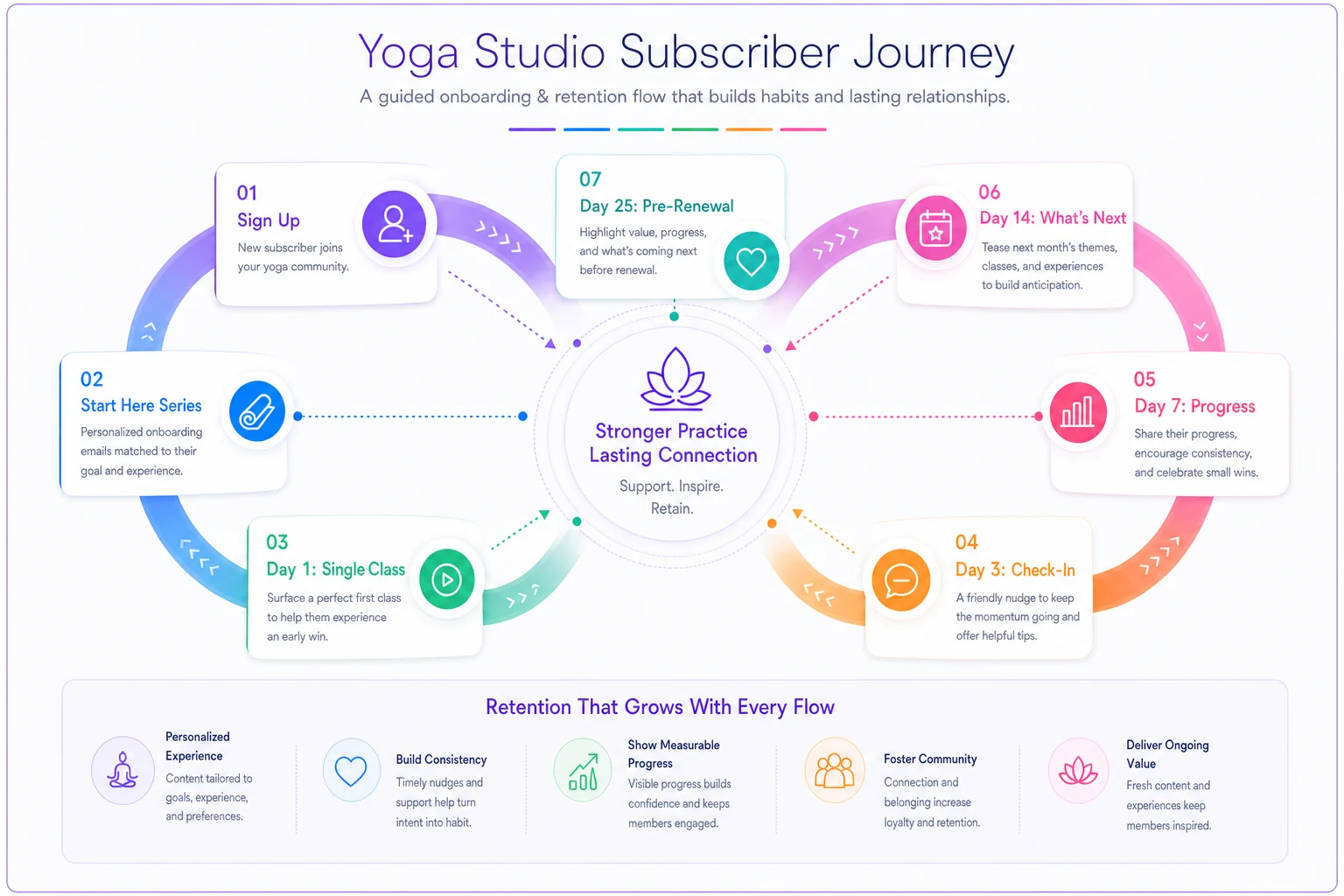
That drip of small, relevant touchpoints does the work an in-studio front desk does naturally. It keeps the relationship warm between sessions.
The four hooks that matter most:
-
A guided onboarding path so the first week has direction, not decision fatigue.
-
Progress visibility — streaks, completion bars, "classes this month." People stay subscribed to things they feel like they're winning at.
-
A rolling reason to return — a new class or series dropping on a predictable schedule (say, every Monday) so there's always a "next."
-
A pre-renewal touch timed 4–6 days before the charge, surfacing value so the renewal feels earned, not accidental.
None of these are discounts. Discounting to retain teaches subscribers to cancel and wait for the save-offer. The hooks above build actual engagement — and that's the only churn defense that compounds over time.
Who should NOT lean hard on VOD retention hooks
If your online audience is basically your in-studio members using video as a "can't make it today" backup, don't overbuild digital retention machinery. Their retention lives in the physical space. Layering aggressive VOD onboarding on top mostly just annoys people who already love you. Keep it simple: give them the library as a perk, and focus your energy on new digital-only subscribers who have no physical tie to the studio.
A measurement framework you can actually run
"Number of subscribers" is a vanity metric that hides the real story. Here are the numbers that tell you whether your yoga on-demand monetization is actually healthy, and what each one warns you about.
-
Activation rate — % of new subscribers who complete 3+ classes in their first 14 days. Below roughly 40% means your onboarding is broken, not your content.
-
30-day early churn — % who cancel within the first month. This is your packaging report card.
-
Series completion rate — % who finish a series they start. Low completion predicts next-month churn better than almost any other signal.
-
Monthly active ratio — % of subscribers who watched at least once in the last 30 days. Your silent churn early-warning.
-
Tier migration — movement between Library / Hybrid / All-Access. Upward movement means your upsell path is working; downward is retention working (still better than a full cancel).
-
Revenue per subscriber — total VOD revenue ÷ active subscribers. Rising means healthy tiering. Flat while subscribers grow means you're adding low-value users without converting them up.
Pull these into the same weekly review you use for the rest of the business. If you don't have one yet, our studio operations dashboard with KPIs and a weekly playbook walks through how to set that cadence so VOD numbers sit alongside class attendance instead of living in a separate spreadsheet nobody opens.
Worked revenue scenario: flat vs. tiered + series
Two versions of the same studio, same catalog, same audience size — different packaging.
Version A — Flat access
-
180 subscribers × $19/month = ~$3,420/month
-
30-day churn around 12%, most within the first three logins
-
No standalone product sales
-
Annual VOD revenue
roughly $34k–$38k after churn drag
Version B — Tiered + bundled series
-
90 on Library ($14) = ~$1,260
-
70 on Hybrid ($34) = ~$2,380
-
20 on All-Access ($99) = ~$1,980
-
Monthly subscription base
~$5,620
-
Plus standalone series sales
2 series/quarter, ~25 buyers each at $45 = roughly $2,250/quarter, averaged to about $750/month
-
30-day churn drops to around 7% because onboarding and series give early reasons to stay
-
Annual VOD revenue
comfortably in the $70k–$78k range
Same content. Same number of people. Roughly double the revenue — and a portion of it (standalone series) reaches buyers who'd never have subscribed at all.
The exact figures will differ for your studio. The point is that packaging is the lever, not filming more videos. A Version A studio's instinct would be "we need more content to grow." Version B shows they mostly needed to reorganize what they already had.
A short real scenario
A two-location studio with around 140 flat-rate subscribers at $18 was watching online revenue flatline while their video count kept climbing. More content, same money. Classic sign that the problem is packaging, not production.
They didn't film anything new for two months. Instead they introduced three tiers, carved four bundled series out of the existing catalog, and added a simple day-1/day-7/day-25 email sequence for new signups. The first thing they noticed wasn't revenue — it was that early cancellations quieted down. Then Library-tier reactivations started trickling in from members who'd moved away and rejoined at the cheaper price point. Within a couple of quarters, online revenue had climbed noticeably, and standalone series sales became a small but reliable line item they hadn't had before.
No new studio, no new instructors, no new footage. Same library, organized like a product.
Where the operational work actually lives
None of this is hard conceptually. The friction is operational: tagging content into tiers, sequencing series, timing renewal touches, tracking six metrics without drowning in spreadsheets. Doing it by hand across a growing catalog is where good intentions die — you tier once, never revisit, and the onboarding emails get sent manually until someone forgets.
This is the part worth handling inside your platform rather than relying on memory. When your booking, membership, and content systems share the same data, the pre-renewal nudge and the "you've finished a series, here's the next one" prompt can fire based on real behavior — not because you remembered to hit send. The goal isn't automation for its own sake. It's making the retention hooks actually happen every time, instead of only when you're on top of it.
The takeaway
Your on-demand library isn't underperforming because the videos aren't good enough. It's underperforming because it's priced like a commodity and organized like a junk drawer. Tier it so different practitioners can buy at the right level. Bundle it into series people can actually finish. Place the retention hooks where drop-off happens — the first 30 days and every renewal after. Measure the six things that tell you whether it's working.
Do that, and the footage you already own stops being a sunk cost and starts being a revenue line you can plan around.
Your on-demand library isn't underperforming because the videos aren't good enough. It's underperforming because it's priced like a commodity and organized like a junk drawer. Tier it so different practitioners can buy at the right level. Bundle it into series people can actually finish. Place the retention hooks where drop-off happens — the first 30 days and every renewal after. Measure the six things that tell you whether it's working.
Ready to elevate your studio operations?
Join 1,500+ yoga studios using Yoglyly to save time, reduce scheduling conflicts, and enhance member experiences.