


Most yoga studios treat their schedule like a bulletin board — post whatever's available and hope students show up. Drop-in classes here, a random workshop there, maybe a teacher training when enough people finally ask. The result is monthly revenue that swings all over the place, and a studio owner who can't plan anything with real confidence.
Why Your Studio's Revenue Feels Impossible to Predict
The problem usually isn't attracting students. It's that there's no real system behind how offerings get packaged, priced, and launched. So you end up with teachers pitching workshop ideas at random, series that quietly cannibalize drop-in attendance, and capacity confusion that leaves you either overbooked or staring at an embarrassingly sparse room.
Studios that build repeatable program structures stop experiencing those brutal slow months. They stop guessing whether a workshop will fill. They start knowing which formats work, when to launch them, and what to actually charge.
Why Studios Default to Reactive Programming
Drop-in classes are the obvious starting point because they're simple. Student walks in, pays, takes class. But as the studio grows, that model starts creating compounding headaches.
Eliminate class scheduling chaos.
Yoglyly helps you book, confirm & manage every class seamlessly.
- Centralized class scheduling
- Member notifications
- Instructor and resource management
No credit card required
Teachers pitch ideas constantly. "Can I run an arm balance workshop?" "What about a meditation series?" Without a framework, decisions get made based on whoever asked most recently or which teacher you're trying to keep happy. The schedule turns into a confusing mess of overlapping offerings competing for the same students.
The administrative burden gets real around 150 regular students. You're juggling multiple payment types, tracking who enrolled in what, managing series waitlists while drop-ins show up confused about why Tuesday's class is blocked. Your front desk spends half their shift explaining the difference between unlimited memberships, class packs, and series enrollment — none of which should require a full explanation every single time.
What actually breaks studios is cash flow unpredictability. March brings strong revenue from a successful workshop series and teacher training deposits. April drops hard when nothing special runs. You can't plan expenses, can't commit to marketing spend, and definitely can't confidently hire the additional teacher you need.
The Framework: Series vs Workshops vs Drop-In Mix
Successful programization starts with understanding what each format actually does inside your revenue structure. They're not interchangeable — each one has distinct operational requirements and profit margins that most studios never bother to calculate.
Drop-in classes are your baseline revenue and new student acquisition engine. In a healthy studio, they should make up somewhere around 55–65% of total revenue. The operational load is minimal — standardized pricing, simple scheduling, predictable teacher costs. Margins tend to run tighter though, usually in the 25–35% range after teacher pay, utilities, and overhead. Drop-ins keep the studio busy and cash flowing. They're not where you grow profit.
Series programming creates commitment and community while solving the attendance prediction problem that haunts drop-in-only models. A 6-week beginner series at $120 gives you guaranteed revenue upfront and lets you forecast attendance accurately. The operational advantage is significant: you know exactly who's coming for six weeks, which makes teacher scheduling cleaner and eliminates the constant no-show anxiety.
Workshops are your profit centers — when done right. A weekend workshop with 20 students at $75 each grosses $1,500 with solid margins after teacher pay and minimal overhead. But they're operationally intensive. Dedicated marketing, specific scheduling considerations, careful timing so they don't eat into regular class attendance. Get those pieces wrong and a workshop underperforms badly.
| Format | Revenue Target | Monthly Occurrences | Operational Complexity | Profit Margin |
|---|---|---|---|---|
| Drop-in Classes | $12,000–14,000 | Daily | Low | 25–35% |
| Series Programs | $4,500–6,500 | 2–3 series running | Medium | 40–50% |
| Workshops | $3,000–4,500 | 2–3 workshops | High | 55–65% |
| Privates/Other | $1,500–2,000 | As scheduled | Low | 70–80% |
Studios that get this mix right stop experiencing those crushing slow months. Baseline drop-in revenue, committed series students, and strategically timed workshops that lift profit without overwhelming operations.
Launch Cadence That Prevents Cannibalization
The most common programization mistake is launching everything at once. January arrives and suddenly you're promoting a beginner series, a philosophy workshop, and a 30-day challenge simultaneously. Students feel overwhelmed. Marketing gets muddled. Every offering underperforms because none of them gets enough attention.
A studio owner in a mid-sized city made exactly this mistake — excited about January momentum, she launched three campaigns at once and ended up splitting her audience across all three. None of them filled properly. She scaled back hard in February and rebuilt from one offering at a time.
A working cadence might look like this: January: Launch 6-week beginner series and 4-week core strengthening series February: Weekend workshop on inversions March: Start registration for April beginner series April: Launch spring series programs (2–3 different levels) May: Mother's Day workshop and special classes June: Summer intensives (3-week formats) July: Light programming — maintain drop-ins August: Prep fall launches September: Major series launches (biggest enrollment period for most studios) October: Halloween workshops and themed classes November: Gratitude practices and workshops December: Light programming, gift certificate push
Notice the breathing room between major launches. Each offering gets dedicated marketing attention and operational focus. You're never competing against yourself for student attention or stretching admin capacity too thin.
The operational key is always selling the next thing while delivering the current thing. When students finish a 6-week series, they should already know what's coming next. Email sequences that convert can automate a lot of that cross-promotion, but the programming calendar itself needs to create natural progression paths first.
Pricing Anchors and Psychological Price Points
Most studios price reactively — $18 for drop-in because the studio down the street charges $20, $120 for a series because it "feels right." That approach leaves money on the table and creates confusion when students can't follow the logic.
Effective programization uses deliberate pricing architecture. Your drop-in rate isn't just a price — it's an anchor that makes everything else feel reasonable or overpriced. If drop-ins are $22, a $140 six-week series might sound expensive at first glance. But frame it as "$140 for six weeks of progressive learning in a consistent cohort" versus "$132 for six random drop-in classes," and the series looks like the better deal despite the higher per-class cost.
Workshop pricing should roughly follow a 3.5x rule: charge at least 3.5 times your drop-in rate. A studio with $20 drop-ins should be pricing workshops at $70 minimum. Workshops demand more preparation, deliver specialized knowledge, and have space limitations that regular classes don't.
The psychological checkpoints worth knowing:
-
Under $100
Impulse purchase for many students
-
$100–150
Considered purchase, needs value justification
-
$150–250
Significant investment, benefits from payment plans
-
$250+
Major commitment, requires established trust
A studio doing around 200 drop-ins weekly at $20 each might test raising that to $24 while introducing a $99 unlimited monthly membership. Suddenly the membership looks like an obvious value, driving more predictable revenue. Meanwhile, the higher drop-in rate improves margins on casual attendees who won't commit to memberships regardless.
Capacity Rules That Maximize Profit Per Square Foot
Your studio has fixed capacity, but most operators treat it like it's unlimited. They'll try to squeeze 30 people into a workshop room that fits 25 comfortably, or run a 4-person series in a space that could profitably handle 12.
Real programization requires capacity discipline. A 1,000 square foot studio typically handles around 20–25 students for regular practice, closer to 18 for workshops where people need more movement space, and 28–30 for gentle or restorative classes. These numbers come from what actually makes a class feel good versus what makes students feel like they're navigating an obstacle course.
The math gets interesting when you layer different program types. That same space on Tuesday at 6 PM could run:
-
A drop-in vinyasa
22 students x $20 = $440
-
A series class (week 3 of 6)
14 students x $0 = $0 (already paid upfront)
-
A specialized workshop
16 students x $65 = $1,040
But contribution margin per square foot per hour is what actually matters. The workshop looks best on paper, but if it requires 3 hours of setup and breakdown versus 30 minutes for a regular class, and you're paying a specialist 50% versus 35%, that margin advantage shrinks considerably.
Never run series below 40% capacity — If the room fits 20, don't run a series with fewer than 8 enrolled. The energy suffers, students feel awkward, and word spreads.
Cap series at 70% capacity — Leave room for makeups and maintain quality. An overpacked series where students can't move properly generates complaints and dropouts.
Workshops need 60% enrollment to run — Higher bar than series because they're one-shot. Cancel and reschedule rather than running a weak workshop that damages your reputation.
Reserve prime slots for proven programs — That Tuesday 6 PM spot goes to whatever format has consistently produced the highest margin, not whatever teacher asked most recently.
The Operational Readiness Checklist
Before launching any programized offering, you need systems in place to handle the administrative complexity. Too many studios launch ambitious series programs and then drown in chaos when students start asking about makeups, refunds, and transfers.
Registration and payment processing
-
Can you handle series pre-payment and track who's paid?
-
Do you have clear refund and transfer policies?
-
Can your system prevent drop-ins from taking series spots?
-
Have you set up automated payment reminders?
Communication workflows
-
Are welcome emails automated for series participants?
-
Do you have templates for workshop reminders?
-
Can you quickly communicate with just series students?
-
Is there a clear absence and makeup notification process?
Scheduling mechanics
-
Can students see which classes are drop-in versus series?
-
Does your schedule clearly show capacity status?
-
Can teachers access roster information easily?
-
Have you blocked studio time for setup and breakdown?
Teacher preparation
-
Do teachers have curriculum outlines for series?
-
Are substitute protocols clear for series classes?
-
Have you set expectations for homework and practice outside class?
-
Is teacher compensation structured for series versus drop-ins?
Financial tracking
-
Can you separate series revenue from drop-in revenue?
-
Do you track attendance rates for series students?
-
Can you calculate true profit margins by program type?
-
Have you set aside funds for refunds and cancellations?
Studios that check these boxes before launching run into far less friction and significantly fewer complaints about confusion or miscommunication.
Sample Timeline: Launching Your First Workshop
Here's what a successful workshop launch actually looks like across eight weeks. Assume a weekend workshop for around 16 students at $75 each.
-
Weeks 8–7 before workshop
Confirm teacher and topic based on student requests and honest gap analysis. If you've been tracking what students ask about, you probably already know whether "Hip Opening Intensive" or "Meditation Fundamentals" will sell. Lock in the teacher contract — somewhere in the 40–50% of gross revenue range for specialized workshops is typical.
-
Weeks 6–5 before
Create marketing materials and open registration. You need benefit-focused copy that explains why someone should spend their Saturday afternoon and $75 with you rather than taking four regular classes. Set up early-bird pricing to create real urgency, not manufactured urgency.
-
Weeks 4–3 before
Deploy targeted marketing. Email your list, but segment it. Students who've taken the teacher's classes before get one message, beginners get something different. Post in the studio and reach out to complementary businesses. The massage therapist next door? Their clients would probably love a restorative workshop.
-
Week 2 before
Assess enrollment and make a go/no-go decision. Ten enrolled with 16-person capacity is solid. Fewer than 8? Seriously consider rescheduling rather than running something that feels underfilled. Shift to regular pricing and create honest urgency around remaining spots.
-
Week 1 before
Finalize logistics and send preparation emails. Confirm any assistant teachers, prep materials and props, and send participants what to bring and what to expect. This email should build anticipation while setting clear expectations.
-
Workshop weekend
Arrive two hours early. Test any audio or visual equipment, arrange props, prepare sign-in sheets. Capture photos and testimonials during breaks — you'll need them for marketing the next one.
-
Week 1 after
Send a follow-up sequence. Thank participants, share photos, and offer a discount on the next workshop or a series that builds on what they just learned. Document actual attendance versus registration and write down what you'd do differently.
This timeline works because it balances marketing momentum with operational preparation. No last-minute scrambling, and no promoting so early that people forget by the time it actually matters.
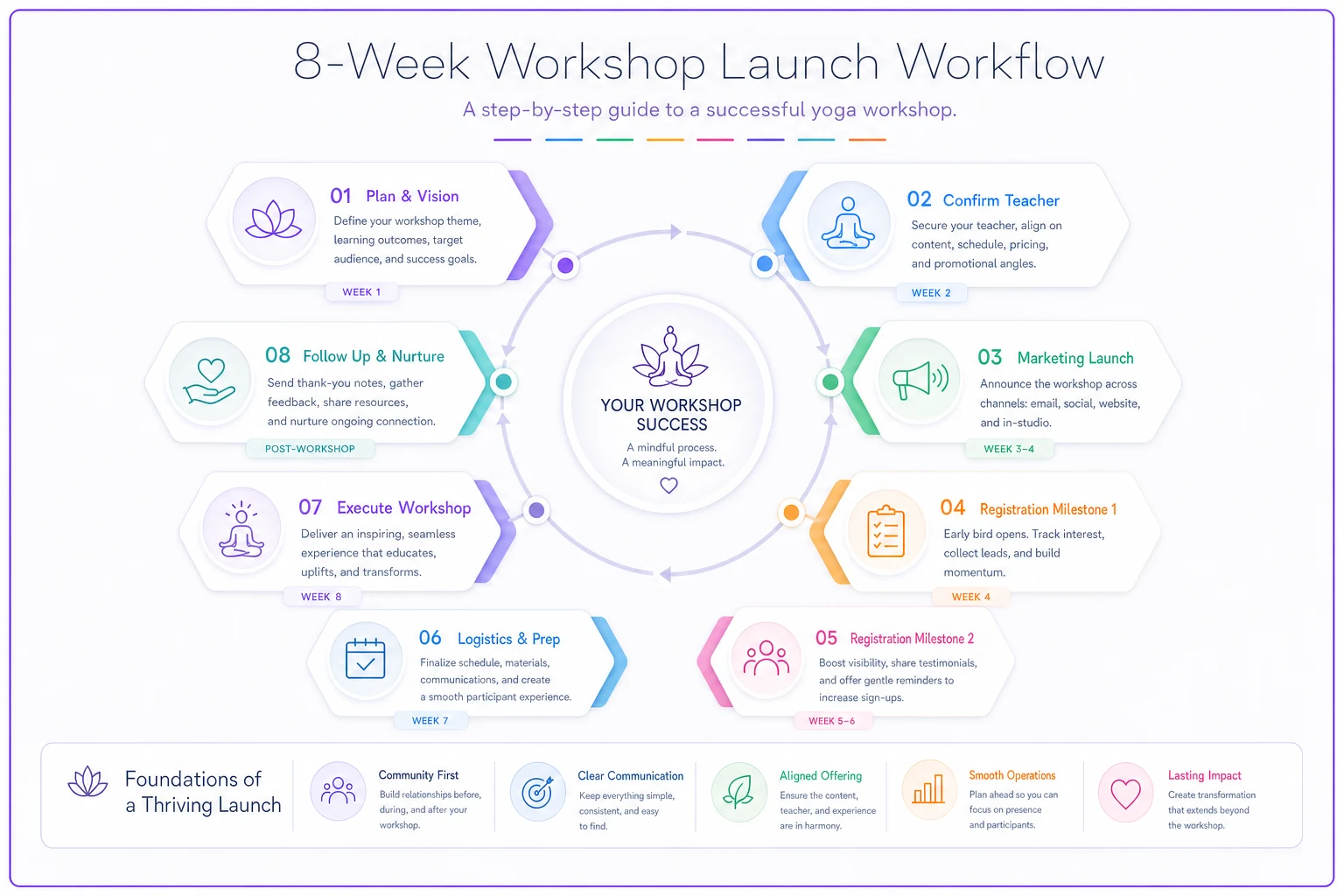
Visual overview of the 8-week workflow to share with your team during planning.
Building Enrollment Funnels for Predictable Series Revenue
Studios doing well with programization understand that series enrollment isn't about convincing people at the last minute. It's about building natural progression paths that feel obvious to students who are already engaged.
Start with drop-in students who've attended 6–8 classes in the past month. They're already committed but haven't found their groove. These students are solid series candidates — they want consistency but need structure to maintain momentum. Rather than blasting generic "join our beginner series" emails, send targeted messages: "You've been putting in consistent work — here's a structured path to take it further."
The funnel generally flows like this:
Discovery phase: New student takes a drop-in, gets added to your system, receives a welcome sequence that mentions upcoming series as one natural option — not a hard sell.
Engagement phase: After 3–4 classes, students showing up consistently get different messaging. "Ready for something more structured? Our 6-week fundamentals series starts next month." Position series as a natural next step, not remediation.
Conversion phase: About 10 days before launch, engaged drop-in students get direct invitations with specific benefits. "Based on when you've been coming in, this Tuesday/Thursday series would fit your schedule and help you build progressively." Include real testimonials — specific, not "this was amazing!"
Commitment phase: Once enrolled, focus shifts to retention. Pre-series email with what to expect, mid-series check-in, end-of-series graduation with clear next steps. A solid chunk of series graduates — ideally more than half — should naturally flow into another series or an unlimited membership.
The operational trap most studios fall into is treating series marketing as separate from regular operations. Your front desk should know, based on attendance patterns, which students are ready for a series. Teachers should mention upcoming programs to regulars. The whole system needs to support natural progression, not rely on desperate last-minute emails trying to fill spots two days before launch.
Who Should Avoid Structured Programization
Not every studio should jump into this right away. If you're running fewer than 15 classes weekly or seeing fewer than 100 unique students a month, focus on building consistent drop-in attendance first. The overhead of managing multiple program types will drain energy you need for basic growth.
Studios in highly transient areas — college towns during summer, tourist-heavy locations with seasonal swings — often struggle with series commitment. When a large portion of your students rotate out within weeks, series programming creates more frustration than revenue. Short workshop intensives and drop-in optimization tend to work better in those markets.
If your teacher roster is unstable or you're regularly covering classes with substitutes, don't launch a series yet. Students pay premium prices for consistency. When the teacher changes multiple times during a 6-week series, trust erodes fast and refund requests follow.
Studios renting space hourly or sharing locations also need to be careful. Series require guaranteed access to consistent time slots. If you can't lock in the same Tuesday/Thursday slot for 6 weeks, students will get frustrated and enrollment will suffer.
The biggest red flag: if you're not yet profitable on drop-in classes alone, don't add programmatic complexity. Series and workshops should enhance a business that's already working, not rescue one that isn't. Fix basic unit economics first.
Technology and Systems That Enable Scale
Once you hit around 200 regular students running multiple programs simultaneously, manual tracking stops working. You're buried in spreadsheets, losing track of who's enrolled in what, and spending hours on administrative work that should be handled automatically.
Modern operational software handles the complexity of yoga class programization without requiring a massive investment. The features that actually matter:
Integrated registration that understands the difference between drop-ins, series, and workshops. Students see real-time availability, can register for entire series at once, and receive appropriate confirmations based on what they purchased.
Intelligent capacity management that prevents overselling workshops or having drop-in students accidentally take series spots. The system automatically waitlists when programs fill and alerts you when cancellations open spots worth promoting.
Automated communication workflows that remove the constant mental load of remembering to send things. Series students get weekly prep emails, workshop participants receive logistics details, and everyone gets appropriate follow-up without manual intervention.
Financial reporting by program type that shows you which formats actually make money. Total revenue isn't enough — you need margins by teacher, time slot, and program format. That data drives better decisions about what to launch and when.
AI-assisted platforms can now surface patterns in enrollment timing and flag when pricing adjustments might make sense based on demand signals. Instead of guessing whether April or May works better for your spring series, the system pulls from past behavior and gives you something to actually act on. Studios using proper programization software typically report meaningful reductions in time spent on administrative tasks and fewer enrollment errors — and that freed capacity goes toward improving the student experience, not untangling spreadsheets.
From Revenue Chaos to Predictable Growth
Yoga class programization isn't about building complicated offerings that confuse students and overwhelm your operations. It's about creating systematic approaches to packaging, pricing, and delivering classes in ways that make revenue more predictable while actually serving students better.
Studios that get this right stop having crushing slow months. They have a reasonable sense of what their fall series will generate, what a November workshop will bring in, and that baseline drop-in revenue won't fall off a cliff month-to-month. That kind of visibility changes how you run the whole business — marketing decisions get cleaner, hiring becomes less stressful, and you stop making reactive choices based on whatever panic the current week is producing.
Programization also creates operational clarity that makes everything else easier. Marketing sharpens when you're promoting specific programs with defined benefits. Teacher relationships improve when everyone understands the schedule and compensation structure. Student satisfaction goes up when there are clear progression paths instead of endless drop-in repetition with no obvious next step.
Start small — pick one series format that serves an obvious need in your community. Test it, refine it, document what works. Once it's running smoothly, layer in workshops. Build your operational muscles gradually rather than launching everything at once and drowning in complexity.
The path from reactive scheduling to systematic programization typically takes somewhere between 6 and 9 months to fully implement. Studios that commit to the transition report not just better financial results, but less stress and more time to focus on what they actually built the studio for — teaching yoga and building a real community.
Ready to elevate your studio operations?
Join 1,500+ yoga studios using Yoglyly to save time, reduce scheduling conflicts, and enhance member experiences.