


Most yoga studio owners schedule classes the same way: look at last month's schedule, copy it forward, hope for the best. Then Tuesday's 6pm vinyasa gets 3 students while Thursday's noon class overflows with 22 people crammed into a space built for 15.
The problem isn't that attendance patterns don't exist—they absolutely do. Studios just don't have a systematic way to spot them. You end up with instructors teaching to empty rooms, students getting turned away from packed classes, and no real sense of whether adding that Saturday morning class actually makes financial sense.
Why Studios Default to Schedule Guesswork
Attendance forecasting feels complicated because the data sits everywhere. Sign-ups in your booking software, no-shows scribbled on paper, walk-ins counted manually, weather affecting turnout—it all becomes noise that drowns out actual patterns.
Studio owners tell me they've tried tracking attendance. They export reports, build spreadsheets, create elaborate color-coded systems. Then life happens—a teacher calls in sick, the computer crashes, someone forgets to update the sheet for three weeks—and the whole thing collapses.
The bigger issue? Most forecasting methods you'll find online assume you have consistent historical data going back months or years. Meanwhile, you opened nine months ago, changed your schedule twice, and half your data lives in the previous owner's head because you bought the studio last quarter.
Method 1: Rolling Historical Averages (The Foundation)
This method works when you have at least 8 weeks of attendance data for recurring classes. Not perfect, but it catches the basic patterns that drive most of your scheduling decisions.
Eliminate class scheduling chaos.
Yoglyly helps you book, confirm & manage every class seamlessly.
- Centralized class scheduling
- Member notifications
- Instructor and resource management
No credit card required
Step-by-step process:
-
Pull attendance numbers for each class slot over the past 8 weeks
-
Remove obvious outliers (holidays, weather events, instructor substitutions)
-
Calculate the average for each time slot
-
Set your baseline forecast at 90% of that average
Here's what this looks like for a Tuesday 6pm flow class:
Week 1: 12 students Week 2: 14 students Week 3: 8 students (substitute teacher—remove) Week 4: 13 students Week 5: 15 students Week 6: 11 students Week 7: 14 students Week 8: 12 students
Average (excluding week 3): 12.7 students Baseline forecast: 11 students
The 90% adjustment matters. Studios consistently overestimate attendance because they remember packed classes more vividly than empty ones. Setting your forecast slightly below the mathematical average keeps you from overstaffing and overspending.
Making Historical Averages Actually Useful
-
Under 5 students forecasted
Consider canceling or combining with another class
-
5–8 students
Run with single instructor
-
9–12 students
Standard setup
-
13+ students
Add assistant or consider splitting into two sessions
Thresholds turn data into decisions. Instead of staring at a spreadsheet wondering what 11 students means for your Tuesday class, you know exactly how to staff and prepare.
Method 2: Exponential Smoothing (When Trends Matter)
Historical averages assume every week matters equally. But your studio three months ago isn't the same as your studio today. Maybe you launched a beginner's program that's building momentum. Maybe summer started and half your regulars disappeared to the beach.
Exponential smoothing weighs recent weeks more heavily than older ones. It catches trends that simple averages miss.
The calculation process:
Start with your most recent actual attendance. Then blend it with your previous forecast using a smoothing factor—typically 0.3 for yoga studios.
New forecast = (Smoothing factor × Last actual) + ((1 - Smoothing factor) × Last forecast)
Sounds complicated. Here's what it actually looks like:
Last week's forecast: 10 students Last week's actual: 13 students Smoothing factor: 0.3 This week's forecast = (0.3 × 13) + (0.7 × 10) = 3.9 + 7 = 11 students Each week, you update the forecast based on what actually happened. Classes growing? The forecast gradually adjusts upward. Attendance dropping? It follows.
Picking Your Smoothing Factor
| Smoothing Factor | Behavior | Best For |
|---|---|---|
| 0.1–0.2 | Very stable, ignores temporary blips | Established classes with consistent membership |
| 0.3–0.4 | Balanced responsiveness | Most studios |
| 0.5+ | Highly reactive, follows every change | New classes still finding their footing |
A studio launching new programs might use 0.4 to catch growth quickly. A studio with stable membership might use 0.2 to avoid overreacting to random fluctuations.
Method 3: Event-Adjusted Rules (Reality-Based Forecasting)
Historical data won't tell you that next Tuesday is the day after Labor Day. Or that there's a massive festival downtown that weekend. Or that your star instructor just announced they're leaving.
Common adjustment factors:
Holiday weeks:
-
Week of major holiday
-40% attendance
-
Week after major holiday
+15% attendance
-
Long weekend
-20% Friday/Monday classes
Weather patterns:
-
First sunny weekend after winter
+25% attendance
-
Heavy rain forecast
-30% for morning classes, -15% for evening
-
Heatwave (over 95°F)
-20% for heated classes, +10% for gentle/yin
Instructor changes:
-
Substitute teacher
-25% attendance
-
Guest teacher promotion
+35% attendance
-
Popular instructor's last class
+50% attendance
You build these adjustment rules by tracking what actually happens during these events. After a few months, you'll have enough data to develop your own factors—ones based on your actual students, not generic advice from someone who's never been in your studio.
Example calculation for a Thursday evening class:
-
Historical average
14 students
-
First nice day after two weeks of rain
+20%
-
Adjusted forecast
14 × 1.20 = 17 students
-
Action
Ensure second instructor available, prep extra mats
The Adjustment Hierarchy
When multiple events overlap, don't just stack percentages. Use this hierarchy:
-
Major holidays override everything (-40% regardless)
-
Weather events apply after holidays
-
Instructor changes apply last
-
Cap total adjustment at ±50% to avoid absurd forecasts
Cap total adjustment at ±50% to avoid absurd forecasts
Turning Forecasts into Scheduling Decisions
Numbers mean nothing without action thresholds. A forecast of 8 students tells you nothing until you know that 8 students means one instructor, standard mat spacing, and no need for the room partition.
Staffing thresholds based on forecast:
-
1–6 students
Single instructor, consider combining classes
-
7–12 students
Single instructor, standard setup
-
13–16 students
Add assistant for adjustments
-
17–20 students
Two instructors or cap registration
-
21+ forecast
Open second room or add another time slot
Space configuration thresholds:
-
Under 8 students
Cozy setup in smaller room
-
8–14 students
Standard room configuration
-
15+ students
Open partition to expand space
-
20+ students
Implement pre-registration requirements
Most studios miss this part: these thresholds should trigger automatic actions, not discussions. When your forecast hits 15 students, you don't debate whether to open the partition. You just do it.
Sample Calculation Walkthrough
Let's run through a complete forecast for a Monday 9am gentle yoga class.
Historical data (past 6 weeks):
Week 1: 8 students Week 2: 9 students Week 3: 7 students Week 4: 10 students Week 5: 8 students Week 6: 9 students
Step 1: Calculate baseline
Average: 8.5 students 90% adjustment: 7.7 students (round to 8)
Step 2: Apply smoothing (if you have a previous forecast)
Previous forecast: 7 students Last actual: 9 students Smoothed forecast: (0.3 × 9) + (0.7 × 7) = 7.6 students (round to 8)
Step 3: Check for events
Next Monday is a federal holiday Adjustment: -40% Final forecast: 8 × 0.6 = 5 students
Step 4: Apply action thresholds
5 students = Consider canceling or combining with the 10:30am class
Decision: Email registered students about combining classes, offer makeup credits for those who can't attend the later slot.
Common Forecasting Mistakes Studios Make
Ignoring no-show patterns. A class with 15 registrations and 5 no-shows isn't a 15-person class. It's a 10-person class with an overbooking problem. Track actual attendance, not registrations.
Over-adjusting for single events. One packed class doesn't mean you've turned a corner. One empty class doesn't mean the time slot is dead. Look for patterns across at least 4 occurrences before making schedule changes.
Forecasting new classes like established ones. New classes need 8–12 weeks to stabilize. Until then, use higher smoothing factors and expect significant week-to-week variance.
Not accounting for capacity constraints. If your 6pm class hits capacity every week, your forecast shouldn't be the average attendance—it should flag that you need another evening slot.
When Each Method Works Best
Most studios end up using a combination. Historical averages for stable morning classes, smoothing for growing evening programs, event adjustments layered on top of both.
| Method | Best Situation |
|---|---|
| Historical averages | Classes running 3+ months, stable patterns, just starting with data |
| Exponential smoothing | Growing or declining classes, seasonal shifts, programs under 6 months old |
| Event adjustments | Predictable seasonal patterns, holiday-sensitive attendance, instructor changes |
Most studios end up using a combination. Historical averages for stable morning classes, smoothing for growing evening programs, event adjustments layered on top of both.
Making Forecasting Actually Happen
The biggest challenge isn't choosing a method—it's maintaining the system when things get busy. Studios start strong then abandon forecasting the first time someone forgets to record attendance or the spreadsheet breaks.
Dedicate 15 minutes every Monday morning to updating forecasts for the week. Not Sunday night when you're exhausted. Not Tuesday when you're already behind. Monday morning, before the chaos starts.
Track only what you'll actually use. You don't need seventeen metrics. You need attendance per class, maybe broken down by member vs. drop-in. Everything else is procrastination disguised as analysis.
Set up automatic data capture where possible. If your booking software exports attendance, use it. If instructors can tap a counter, get one. The less manual entry required, the more likely the system sticks.
Review and adjust thresholds monthly. Your action thresholds from January won't work in July. Build a monthly review into your routine.
Dedicate 15 minutes every Monday morning to updating forecasts for the week.
Review and adjust thresholds monthly. Your action thresholds from January won't work in July. Build a monthly review into your routine.
Building Your Forecasting System
Start simple. Pick one method, implement it for your five most popular classes, run it for a month. Don't try to forecast every class on day one—you'll overwhelm yourself and quit by week two.
-
Weeks 1–2 Gather historical data
-
Weeks 3–4 Calculate baselines and set thresholds
-
Weeks 5–8 Run forecasts, track accuracy
-
Week 9 Adjust method based on results
The studios that succeed with forecasting aren't the ones with perfect data or complex models. They're the ones that pick a simple method and actually use it every single week.
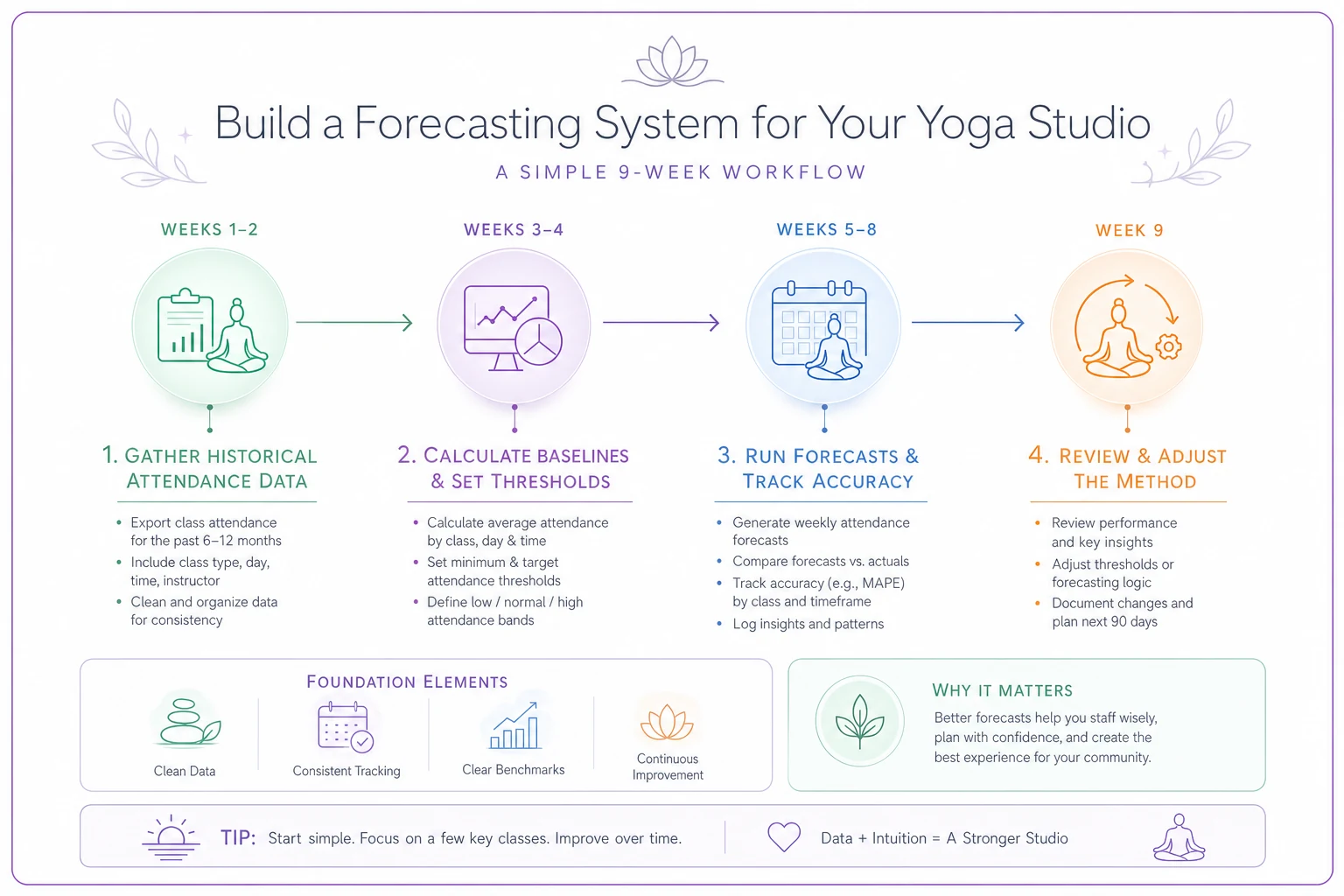
A simple visual of the 9-week workflow.
A basic forecast you actually use beats a perfect system that sits in a drawer. Your Tuesday 6pm class doesn't need a sophisticated prediction model. It needs you to notice it averages 11 students so you can staff accordingly and stop being surprised every week.
The patterns are already there in your attendance data. These methods just help you see them clearly enough to make better decisions about scheduling, staffing, and space. Start with historical averages this week. Add smoothing when you're comfortable. Layer in event adjustments as you learn your studio's unique patterns. Your students get more consistent experiences, your instructors stop teaching to empty rooms, and you stop guessing whether that new Sunday morning class makes financial sense.
Ready to elevate your studio operations?
Join 1,500+ yoga studios using Yoglyly to save time, reduce scheduling conflicts, and enhance member experiences.