

Most yoga studios chase corporate partnerships backward. They land a one-time wellness workshop, deliver a great experience, then watch the company disappear. Meanwhile, that same corporation is spending $18,000 a year on mediocre wellness vendors who showed up with professional contracts and predictable pricing.
The difference isn't teaching quality. It's operational infrastructure.
Corporate clients don't buy yoga classes. They buy workplace wellness programs with clear deliverables, standard billing cycles, and proper liability coverage. The studios consistently winning these contracts aren't necessarily better teachers—they just speak the language of procurement departments.
Why Studios Struggle to Convert Corporate Interest Into Contracts
Corporate wellness budgets exist in nearly every mid-size company. HR departments actively search for stress reduction programs. Yet most studios fumble these opportunities at the proposal stage.
The disconnect happens because studio owners approach B2B sales like they're selling memberships to individuals. A procurement manager evaluating wellness vendors doesn't care about your class variety or instructor certifications. They need to know:
-
How you'll handle their accounting department's 45-day payment terms
-
Whether your liability insurance covers on-site workplace injuries
-
What happens when only 3 people show up to the scheduled session
-
How you'll invoice them quarterly instead of monthly
-
Whether you can provide utilization reports for their wellness committee
Studios typically respond to these questions with improvised answers or worse—silence. The opportunity dies before the first class ever happens.
The gap becomes obvious when you compare what studios offer versus what companies actually buy. Studios pitch "weekly yoga sessions." Companies purchase "employee wellness programs with measurable engagement metrics." Same product, completely different packaging.
The Per-Employee vs Per-Session Pricing Trap
Pricing kills more corporate partnerships than any other factor. Studios default to their consumer pricing model—charging per class or per participant—which creates immediate friction with corporate buyers.
Eliminate class scheduling chaos.
Yoglyly helps you book, confirm & manage every class seamlessly.
- Centralized class scheduling
- Member notifications
- Instructor and resource management
No credit card required
Per-session pricing creates budgeting nightmares for companies. If 8 employees attend one week and 23 the next, their monthly invoice becomes unpredictable. Finance departments hate variable costs for recurring services. They want fixed line items they can forecast quarterly.
The smarter approach: per-employee pricing based on company size, not attendance.
| Company Size | Monthly Rate | What's Included | Invoice Terms |
|---|---|---|---|
| 10-25 employees | $450 flat | 4 weekly sessions | Quarterly |
| 26-50 employees | $750 flat | 4 weekly sessions | Quarterly |
| 51-100 employees | $1,200 flat | 4 weekly sessions + monthly workshop | Quarterly |
| 100+ employees | $1,800 flat | 8 weekly sessions (2 time slots) | Quarterly |
This removes attendance anxiety for both parties. The company knows their exact quarterly expense. You know your guaranteed revenue. Low attendance weeks don't trigger awkward conversations about value.
Some studios resist flat-rate pricing, worried they'll lose money if attendance drops. But corporate wellness programs typically see somewhere between 15-30% participation regardless of pricing model. A 40-person company might average 8-12 attendees per session. Price with that variance already built in.
There's also a psychological angle here. When companies pay per employee, they feel like they're providing a benefit to everyone, even non-participants. When they pay per attendee, low turnout feels like waste. That framing matters more than you'd think.
Building a Proposal That Procurement Departments Actually Read
Corporate proposals fail when they read like yoga studio brochures. Procurement teams evaluate dozens of vendor proposals monthly. They scan for specific information in predictable places.
A functional B2B proposal follows corporate documentation standards, not creative marketing formats. Skip the flowing descriptions of yoga's benefits. Focus on operational clarity.
Start with program structure, not philosophy. Companies need to understand exactly what they're buying before they care why they should buy it. Lead with:
Program delivery specifications:
-
Two 45-minute sessions weekly (Tuesday/Thursday, 12
00-12:45 PM)
-
On-site delivery in designated wellness room
-
All equipment provided by vendor
-
Minimum 5 participants to run session, maximum 25
-
Make-up sessions for company holidays included
Instructor qualifications and coverage:
-
Primary instructor assigned for program consistency
-
Backup instructor identified for absence coverage
-
All instructors carry individual liability insurance
-
Background checks completed for all staff
-
Current CPR/First Aid certification maintained
Reporting and communication:
-
Monthly attendance reports provided
-
Quarterly engagement surveys administered
-
Designated account manager for scheduling changes
-
24-hour response time for administrative requests
Notice what's missing? No mention of chakras, mindfulness journeys, or stress reduction philosophy. Those conversations happen after the contract gets signed.
The pricing section needs similar precision. Corporate buyers expect detailed breakdowns, not bundled mystery prices:
-
Base program fee
$750/month
-
Equipment rental (if needed)
$50/month
-
Setup/breakdown time
Included
-
Liability insurance
Included
-
Administrative fee
Waived for annual contracts
-
Total monthly investment
$750
-
Quarterly billing
$2,250
Payment terms matter more than price for many companies. Standard corporate payment cycles run 30-45 days from invoice receipt. Fighting this means losing deals. Build the delay into your cash flow planning instead.
Contract Terms That Protect Studios Without Scaring Clients
Most studios either use no contract (dangerous) or copy a generic template from the internet (equally dangerous). Corporate contracts need specific provisions that consumer agreements ignore.
90-day termination notice for both parties. This gives you a full quarter to find replacement revenue while giving them flexibility to adjust wellness programs. Avoid making it shorter—corporate decisions move slowly and you need planning time.
Automatic renewal with rate protection. Include annual auto-renewal with a maximum 5% rate increase. This prevents constant renegotiation while protecting you from inflation. Companies appreciate predictability.
Force majeure provisions that actually work. Standard force majeure clauses don't cover realistic workplace scenarios. Add specific language for:
-
Office relocations or renovations
-
Workforce reductions affecting program viability
-
Extended remote work periods
-
Wellness room unavailability
Attendance minimums without penalties. Instead of charging cancellation fees for low attendance, include language like: "Sessions with fewer than 3 participants may be cancelled with 2 hours notice. Cancelled sessions will be rescheduled within the current billing period when possible."
Liability allocation also needs attention. Your insurance covers injuries during class, but what about someone slipping in the hallway walking to your session? Include:
"Studio liability begins when participants enter the designated wellness space and ends when they exit. Company maintains responsibility for common areas and pathways to wellness facilities."
Don't hide behind legal language when plain English works better. Corporate legal teams appreciate clarity. They'll modify anything too aggressive anyway, so start reasonable.
Liability Insurance and Compliance Documentation
Insurance questions kill studio momentum in corporate sales. Most studios carry general liability insurance for their physical location. Corporate clients need something different.
You need a Certificate of Insurance (COI) listing the company as "additional insured" for on-site services. This typically costs $25-50 per certificate from your insurance provider. Get familiar with requesting these—you'll need new ones for every corporate client.
Standard coverage requirements for corporate wellness programs:
-
General liability
$2 million per occurrence
-
Professional liability
$1 million per occurrence
-
Sexual abuse liability
$1 million per occurrence
-
Hired/non-owned auto
$1 million (if driving to locations)
That sexual abuse liability line makes studio owners uncomfortable, but it's standard in corporate contracts. Every vendor working with employees needs it. Don't argue—just confirm your policy includes it.
Beyond insurance, companies increasingly request:
-
W-9 forms for vendor setup
-
Background check confirmations for instructors
-
Safety protocol documentation
-
Emergency response procedures
-
Data privacy agreements (if collecting employee information)
Create a standard compliance packet with all these documents. Update it quarterly. When a company asks for documentation, send the complete packet immediately. Speed signals professionalism.
Staffing Templates for Predictable Program Delivery
Corporate programs fall apart when they depend on a single instructor's availability. The company doesn't care that your best teacher had a family emergency. They care that their employees showed up to an empty wellness room.
Build redundancy into your staffing model from day one. Assign a primary instructor and a designated backup for every corporate account. Pay the backup a small monthly retainer—somewhere around $50-100—to keep those time slots available. It's cheap insurance against cancellation disasters.
The compensation structure for corporate programs differs from studio classes. Instead of per-class payments, monthly contracts work better for corporate instructors:
Corporate instruction package:
-
8 sessions monthly
$600 base
-
Travel time included
-
Equipment transport included
-
Backup coverage coordination
instructor's responsibility
-
Sick day coverage
arranged by instructor, paid from base rate
This shifts reliability responsibility to the instructor while guaranteeing their income. They're motivated to stay consistent because they're paid monthly, not per session.
For larger programs, teaching teams work better than solo instructors. Two instructors alternating weeks prevents burnout and ensures coverage. Companies often prefer this model anyway—it feels more like a "program" and less dependent on one person.
Document everything in a simple staffing template:
-
Account
TechCorp Downtown
-
Primary instructor
Sarah (Tuesday/Thursday)
-
Backup instructor
Marcus (on-call)
-
Sessions
8 monthly
-
Rate
$75/session to instructor
-
Travel reimbursement
None (downtown location)
-
Equipment responsibility
Studio provides
-
Backup activation
2-hour notice required
Paying a small monthly retainer to backup instructors reduces cancellations and keeps schedules reliable.
The compensation structure for corporate programs differs from studio classes. Instead of per-class payments, monthly contracts work better for corporate instructors:
Invoicing Cadences That Match Corporate Accounting Cycles
Studios lose corporate clients through invoice friction more than poor service quality. Your standard payment processing doesn't align with corporate accounting workflows.
Companies don't pay through Mindbody or Square. They need formal invoices with purchase order numbers, proper tax identification, and specific formatting their accounting software can process. Miss these requirements and your invoice sits in limbo for months.
Quarterly invoicing works best for most corporate partnerships. Invoice on the first day of each quarter for the upcoming three months of service. This aligns with corporate budget cycles and reduces administrative back-and-forth.
Your invoice needs:
-
Your EIN or tax ID prominently displayed
-
Their purchase order number (if provided)
-
Service period clearly stated ("Q1 2024
January-March")
-
Detailed service description matching the contract language
-
Payment terms ("Net 45" is standard)
-
ACH transfer information or check mailing address
Skip credit card processing for corporate clients. The 3% fees add up fast on a $2,250 quarterly invoice. Push for ACH transfers or physical checks. Yes, checks still exist in corporate America.
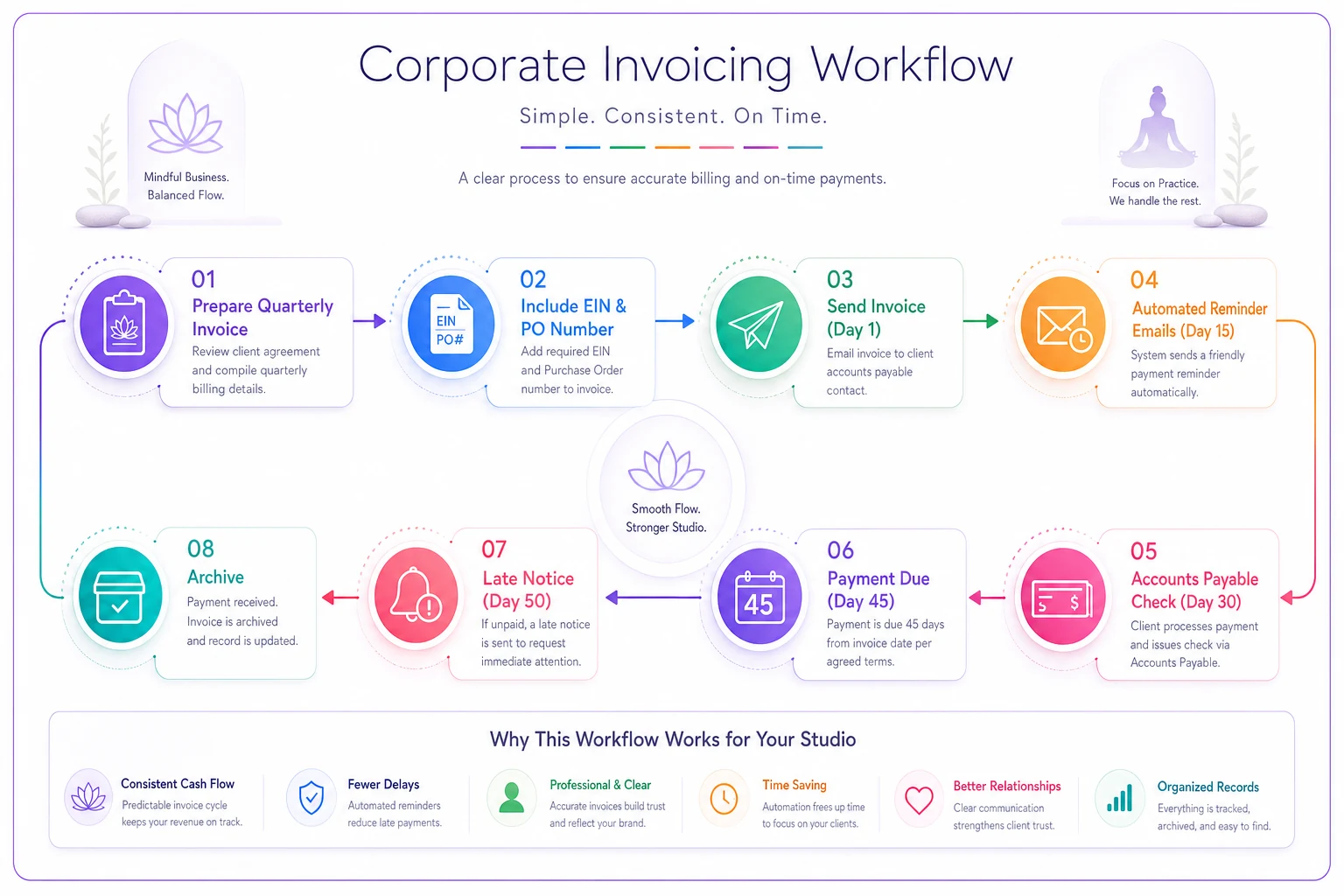
Set up a recurring follow-up schedule for invoices. Companies lose them constantly:
-
Day 1
Send invoice
-
Day 15
Friendly reminder email
-
Day 30
Check payment status with accounts payable
-
Day 45
Payment due
-
Day 50
Late payment notification
Most payments arrive somewhere between days 35-45. Don't panic before then.
Visual workflow of the invoicing cadence:
Most payments arrive somewhere between days 35-45. Don't panic before then.
Converting Trial Workshops Into Annual Contracts
Single workshops rarely convert directly to ongoing programs. The evaluation committee who approved a one-time stress reduction workshop isn't the same group that approves recurring wellness programs. But workshops create the internal advocates you need for larger contracts.
Structure your trial workshop to generate employee demand, not just deliver value. End with anonymous feedback cards asking: "Would you attend weekly if offered?" Compile these responses into a simple report for HR.
When 80% of participants say they'd attend weekly sessions, HR has the ammunition they need to propose an ongoing program. You've shifted from selling to supporting their internal pitch.
The post-workshop follow-up sequence matters more than the workshop itself:
-
Day 1 after workshop
Send thank you email with attendance numbers
-
Day 3
Share employee feedback summary (keep it positive but honest)
-
Week 2
Send a formal proposal for quarterly program
-
Week 3
Follow up with pricing for different service levels
-
Week 4
Offer to present to wellness committee if needed
Price your trial workshops strategically. Charge enough to seem valuable ($500-750) but include a credit toward the first quarter of an ongoing program. This removes the cost objection from moving forward.
Tracking What Actually Matters in B2B Partnerships
Studios track the wrong metrics for corporate programs. Class attendance and student satisfaction matter less than contract renewal rates and payment timeliness.
Your operational dashboard for corporate programs should focus on business health, not class metrics:
Revenue stability indicators:
-
Contracts up for renewal next quarter
-
Average contract length
-
Quarterly revenue per account
-
Payment days outstanding
Program health metrics:
-
Instructor consistency rate (same teacher %)
-
Cancellation rate by studio
-
Average attendance as % of company size
-
Quarterly business reviews completed
Growth opportunities:
-
Workshops delivered without contracts following
-
Referral requests from current clients
-
Expansion opportunities within current accounts
-
Employee requests for additional time slots
Track contract renewal rates religiously. A corporate client worth $2,250 quarterly who renews for 3 years generates $27,000 in revenue. That's worth more than 50 drop-in students.
When renewal discussions approach, prepare a simple quarterly business review:
-
Sessions delivered vs contracted
-
Average attendance trends
-
Employee feedback highlights
-
Suggested program adjustments
-
Renewal terms (with any rate changes)
Companies appreciate vendors who proactively manage relationships. Don't wait for them to evaluate you—demonstrate value consistently.
The Reality of Scaling Corporate Partnerships
Corporate partnerships transform studio economics when executed properly. Five corporate accounts at $750 monthly adds $3,750 in predictable revenue—roughly equivalent to 40 unlimited memberships but with far less facility wear.
Finding interested companies isn't really the problem. Wellness budgets exist everywhere. The challenge is being operationally ready to serve corporate clients in the way they actually expect.
Studios that make this work share some common traits:
-
Dedicated corporate service standards separate from consumer operations
-
Instructors trained in workplace-appropriate programming
-
Administrative capacity to handle corporate requirements
-
Cash flow reserves to absorb payment delays
-
Systematic approaches to documentation and compliance
The path from first workshop to recurring revenue typically takes 3-6 months. Companies move slowly. Committees meet monthly. Budgets get approved quarterly. Your sales cycle needs to match their buying cycle.
Most studios quit before reaching profitability in corporate partnerships. They land one difficult client, deal with payment delays and administrative friction, then retreat to consumer-focused operations. But corporate partnerships, once established, provide a stability that consumer memberships never can.
Making Corporate Partnerships Sustainable
The hardest part about corporate partnerships isn't landing them—it's maintaining them without overwhelming your core studio operations. The administrative burden catches a lot of studios off guard, usually around the third corporate client.
This is where operational software becomes genuinely useful. Managing corporate contracts, tracking multiple invoice cycles, coordinating instructor schedules across locations, and keeping compliance documentation current in spreadsheets gets messy fast. AI-powered platforms can take over the repetitive parts—invoice generation on corporate schedules, instructor assignment and backup coordination, automated COI requests when policies renew, quarterly business review report prep. That frees you to focus on program quality and relationship building instead of chasing paperwork.
But even with good systems in place, corporate partnerships should supplement studio revenue, not replace it. The studios thriving long-term maintain balanced revenue streams. Corporate contracts provide stability. Consumer memberships provide growth. Together they create businesses that can actually weather market changes.
The opportunity in corporate wellness is real and still growing. Companies increasingly prioritize employee wellbeing, and remote work created new stress patterns that workplace wellness programs are well-positioned to address.
Success comes down to speaking their language, meeting their operational requirements, and delivering consistent value within their systems. Do that, and one-off workshops start turning into recurring revenue streams that stabilize your studio for years.
Ready to elevate your studio operations?
Join 1,500+ yoga studios using Yoglyly to save time, reduce scheduling conflicts, and enhance member experiences.