



Most studio owners get stuck between two bad choices: pay teachers enough to keep them happy and risk losing money on slower classes, or keep compensation low and watch good instructors walk out. The real problem isn't choosing between these options—it's that most studios never actually run the numbers to figure out what structure works for their situation.
The gap between what teachers expect and what studios can afford keeps widening because neither side usually understands the full financial picture. Teachers see packed classes and assume the studio is printing money. Owners see rent, insurance, software costs, and wonder how they'll cover next month. Both perspectives make sense, yet most compensation conversations happen without anyone pulling out a calculator.
Why traditional flat-rate models break down
Paying teachers a flat $75 per class sounds simple until a 6am Monday class with four students is costing you money while the Saturday morning class with 22 students barely covers overhead. That inconsistency destroys margins, especially when you're trying to hold a full schedule together.
Studios on flat rates tend to see the same pattern: popular teachers push for higher rates because their classes fill up, while newer teachers need guaranteed income even while building a following. You end up overpaying for quiet time slots and underpaying for packed ones. Teachers also have zero incentive to promote classes or retain students since their pay doesn't move either way.
One studio in Denver figured out their flat-rate system was losing them $340 monthly on early morning classes while evenings generated decent margins. The owner kept morning slots open thinking they served members, but the losses eventually meant cutting marketing and equipment budgets. They ended up reducing the schedule anyway when cash flow got tight.
The math explains why flat rates rarely survive long-term:
Flat Rate Reality Check
-
Teacher pay
$75/class
-
Minimum students to break even
8 (at $20 drop-in rate)
-
Average 6am attendance
4 students
-
Revenue
$80
-
Loss per class
-$45 (after just teacher pay)
-
Monthly loss on morning slots
~$900
The math explains why flat rates rarely survive long-term:
Revenue share models that protect margins
Revenue sharing seems like the obvious fix—teachers earn more when classes perform, studios never lose on slow ones. A basic 50/50 split is clean: a class bringing in $400 means the teacher gets $200. Simple math, aligned incentives.
Eliminate class scheduling chaos.
Yoglyly helps you book, confirm & manage every class seamlessly.
- Centralized class scheduling
- Member notifications
- Instructor and resource management
No credit card required
But pure revenue share creates its own headaches. Teachers won't commit to building new time slots since empty classes mean zero income. They migrate toward established busy slots rather than helping grow the schedule. New instructors can't afford to stick around while developing a following.
The sweet spot is usually a hybrid—base guarantee plus performance bonus. Here's how the math typically plays out:
| Model Component | Calculation | Example (15 students) |
|---|---|---|
| Base guarantee | $40 per class | $40 |
| Revenue share | 30% after first 5 students | (10 × $20) × 0.30 = $60 |
| Total teacher pay | Base + share | $100 |
| Studio revenue | 15 × $20 | $300 |
| Studio keeps | Revenue - teacher pay | $200 |
| Studio margin | 66.7% |
Teachers never walk away empty-handed, but they're motivated to fill classes. The studio holds healthy margins on moderately attended sessions while sharing upside when things get packed.
Tax implications nobody talks about
Whether teachers are employees or contractors changes your real costs significantly. Most studios default to contractor status thinking it's simpler, but the math surprises a lot of owners who haven't worked through the full picture.
Say you want the teacher to net $3,500 monthly:
As an employee:
-
Gross salary needed
~$4,200 (accounting for their tax withholding)
-
Employer payroll taxes (7.65%)
$321
-
Workers comp (varies, using 2%)
$84
-
Unemployment insurance
~$50
-
Total monthly cost
~$4,655
As a contractor:
-
1099 payment
$3,500
-
No additional taxes
-
But
Higher audit risk, less schedule control, and they'll often demand higher rates to cover self-employment tax
The employee model runs roughly $1,155 more per month, but you get schedule control, training requirements, and exclusive teaching agreements. Contractors can teach anywhere, set their own methods, and leave with zero notice.
California studios deal with additional complexity from AB5 legislation, which essentially forces employee classification for regular teachers. New York follows similar rules. Studios in these states running contractor arrangements risk penalties plus back taxes.
Building compensation models for different class types
Fundamentals/Beginner Classes — Base: $50, Revenue share: 20% after 8 students
These build your pipeline but rarely pack out. A lower base protects margins while the achievable threshold gives teachers a reason to retain beginners.
Standard Classes — Base: $40, Revenue share: 35% after 5 students
Your bread and butter. This structure rewards teachers for maintaining strong regular attendance.
Specialty Workshops — Base: $0, Revenue share: 50% of everything
Higher risk, higher reward. Teachers promoting specialty offerings should share equally in success or failure.
Private Sessions — Teacher keeps 60–70% depending on whether they sourced the client
Studios often undervalue the space and scheduling infrastructure they provide. Even 30% of private session revenue adds up across a month.
The membership problem everyone ignores
This is where compensation math gets genuinely messy: unlimited membership models. A student paying $120 monthly might attend 16 classes. That's $7.50 per class in revenue, but you're paying the teacher based on headcount, not actual revenue per student.
Studios handle this a few different ways, each with tradeoffs:
-
Option 1
Count membership visits at drop-in value
Teacher gets credit as if each member paid $20. Simple, but expensive—you can end up paying out more than you collected. -
Option 2
Weighted attendance calculation
Members count as 0.5 or 0.75 of a drop-in. More sustainable, but teachers feel shortchanged when classes fill with members. -
Option 3
Separate base rates
Higher base pay for classes that typically draw members, lower revenue share. Requires careful tracking and regular adjustment.
The calculation gets complicated fast. A typical Saturday morning class:
-
8 members (from $120/month unlimited passes)
-
7 drop-ins at $25 each
-
Total headcount
15
-
Actual revenue
$175 from drop-ins + allocated membership revenue
If members attend an average of 12 classes monthly, each visit represents $10 in revenue. The class actually generates: $175 + ($10 × 8) = $255.
Paying the teacher based on 15 students at full drop-in rate would mean crediting $375 in revenue—47% more than you actually brought in.
Guarantee structures that actually protect both sides
Guarantees stop teachers from walking when classes start slow, but structure them wrong and you're bleeding cash on underperforming slots indefinitely. The key is making guarantees conditional and time-limited.
Sliding guarantee model:
-
Month 1–2
$60 guarantee
-
Month 3–4
$50 guarantee if average attendance >6
-
Month 5–6
$40 guarantee if average attendance >8
-
Month 7+
Performance-based only if average attendance <10
This gives new classes enough time to build while protecting the studio from permanently subsidizing empty rooms. Teachers understand expectations from day one.
A studio in Austin implemented sliding guarantees and saw new class success rates climb from around 40% to 65%. Teachers stayed long enough to build a following, but the studio wasn't locked into paying guarantees on classes that never caught on.
The termination clause matters too. If attendance stays below 6 students average after three months, either party can cancel with two weeks' notice. This removes the awkward conversation about cutting unsuccessful classes—the metrics just make the decision obvious.
Full-time versus casual staffing economics
Full-time teachers on salary sounds great until you run the actual numbers. A full-timer at $45,000 annually costs roughly $56,000 after benefits and taxes. They need to generate at least $93,000 in revenue annually for you to maintain a 40% margin.
Breaking that down:
-
$93,000 ÷ 12 months = $7,750 monthly revenue needed
-
At $20 average revenue per student per class
-
Need roughly 387 student visits monthly from their classes
-
Teaching 20 classes monthly = 19–20 students per class average
Those are aggressive targets. Most full-time teachers end up carrying some poorly attended classes that drag down their averages. And salary removes the performance incentive entirely—why push to fill classes when pay stays constant?
Casual staffing typically works better financially. Pay is tied directly to performance. There's natural self-selection—busy teachers want more hours, struggling ones phase out. Schedule flexibility based on demand, no benefits costs, and teachers often bring more energy since they're not burned out from 20+ weekly classes.
The downside is less consistency, more scheduling complexity, and higher turnover. Some studios split the difference with "lead teacher" positions—guaranteed weekly hours at hybrid compensation, without full employment costs.
Modeling your actual margin impact
Theoretical models mean nothing without your specific numbers. Here's a framework for calculating real margin impact:
-
Calculate true class revenue. Don't use list prices. Track actual average revenue per student including membership allocations, package pricing, intro offers, and comps and trades.
-
Identify full costs. Teacher pay is just one piece. Rent allocation (divide monthly rent by total class hours), utilities per hour, software and booking costs per class, insurance allocation, and cleaning and supplies all factor in. Most studios find their real per-class cost runs $30–50 before teacher pay even enters the picture.
-
Set minimum viable attendance. With real costs identified, calculate break-even attendance for each compensation model. Example with $40 base cost and $18 average revenue per student: flat $75 rate needs 6 students to break even, 50/50 revenue share breaks even at 5 students, and $40 base plus 30% share breaks even at 4 students.
-
Run scenarios. Model a slow month at roughly 70% of normal attendance, an average month, and a busy month around 130% of normal. Calculate margins for each compensation model across all three. The best model stays positive even in slow months while sharing upside during busy periods.
Run scenarios. Model a slow month at roughly 70% of normal attendance, an average month, and a busy month around 130% of normal. Calculate margins for each compensation model across all three. The best model stays positive even in slow months while sharing upside during busy periods.
Creating transparent win-win agreements
Teachers often accept lower pay when they understand the actual economic picture. Transparency builds trust and cuts turnover—share enough financial reality that teachers get why certain models make sense.
Smart studios put together simple one-page compensation summaries showing how pay is calculated, studio costs per class without going too granular, attendance targets for bonuses, and growth incentives.
Something like: "When your regular classes average 15+ students for two consecutive months, your base rate increases $10 permanently." That motivates teachers to retain students rather than constantly chasing new ones.
Some studios share actual P&L data with senior teachers, which creates a real partnership mentality. One studio in Portland opened their books and discovered teachers had wildly overestimated profit margins. After seeing the real numbers, the teaching team actually proposed a more sustainable compensation model themselves.
Automation tools that simplify complex calculations
Tracking all these calculations manually turns into a nightmare fast. Different rates for different teachers, class types, and attendance levels—often calculated retroactively when attendance reports finally come in. Studios running these models without proper systems burn hours every month just on payroll math.
AI-powered operational platforms now handle multi-tier compensation models automatically. The software tracks attendance, applies your specific compensation rules, and generates payment reports. Teachers can see their earnings in real-time, which improves transparency and cuts down on pay disputes.
Here's a simple workflow for automating compensation calculations:
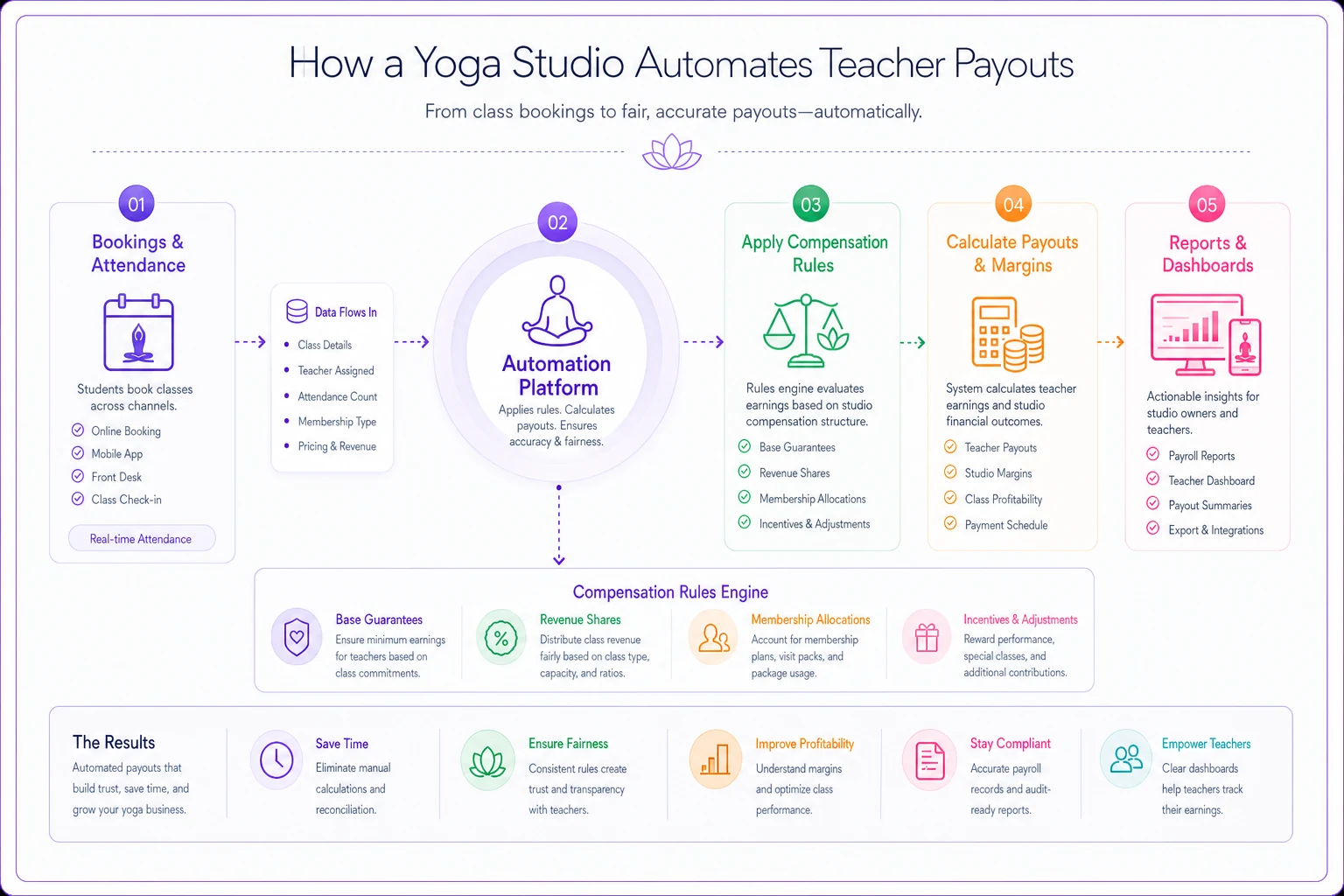
Automating compensation calculations frees up real time for actually growing the business. Instead of spending Sunday nights wrestling with spreadsheets, owners can focus on marketing, student retention, and program development. These platforms also let you model different scenarios before committing—test how switching from flat rate to revenue share would affect margins using your actual historical attendance data. That removes a lot of the guesswork from compensation decisions.
Making compensation changes without losing teachers
Changing compensation structures feels risky. Teachers have bills, and any reduction looks like a pay cut. But sticking with unsustainable models eventually forces worse choices: closing locations, cutting classes, or shutting down entirely.
How you transition matters more than which model you land on. Start by applying new structures to new hires only. Existing teachers keep current arrangements for 6–12 months while watching how the new model plays out. Often, teachers doing well under the new structure earn more, which makes switching appealing.
For across-the-board changes, offer minimum guarantees during transition.
"For the next three months, you'll receive whichever is higher—your old compensation or the new model calculation." That removes fear while letting teachers actually experience the new system.
One studio moved from flat rate to hybrid by letting teachers opt in voluntarily with a sweetener—the first three to switch got permanently higher base rates. Within two months, the entire team had switched after watching early adopters earn more.
Beyond money: retention factors that matter
Compensation conversations often skip the non-monetary stuff that keeps good teachers around. Schedule flexibility, professional development, and feeling connected to the studio community matter almost as much as pay for a lot of instructors.
Studios that hold onto teachers long-term tend to offer consistent schedules with the same time slots each week, first choice on new class openings, paid training opportunities, free membership for personal practice, and real input on studio decisions.
These cost less than constantly recruiting and onboarding new teachers. The lifetime value of a solid instructor who stays three years versus one who leaves after six months is significant—usually $15,000–30,000 in reduced recruiting costs alone, plus the students who follow their favorite teachers out the door.
Building sustainable compensation models means balancing financial reality with human needs. The spreadsheets show what you can afford, but the best models feel fair to both sides because they're built on honest math and realistic expectations—not wishful thinking.
Teachers want to earn decent income doing work they care about. Studios need margins that allow growth and stability. When both sides understand the numbers and operate from the same financial reality, finding the right balance is actually possible. The models here are starting points. Your specific market, clientele, and vision ultimately determine what sticks.
Start by running your actual numbers. Calculate real costs, model different scenarios, and have honest conversations with your teaching team. The sustainable answer probably isn't the cheapest or the most generous—it's the one that aligns incentives and shares both risks and rewards in a way that makes sense for everyone involved.
Ready to elevate your studio operations?
Join 1,500+ yoga studios using Yoglyly to save time, reduce scheduling conflicts, and enhance member experiences.