

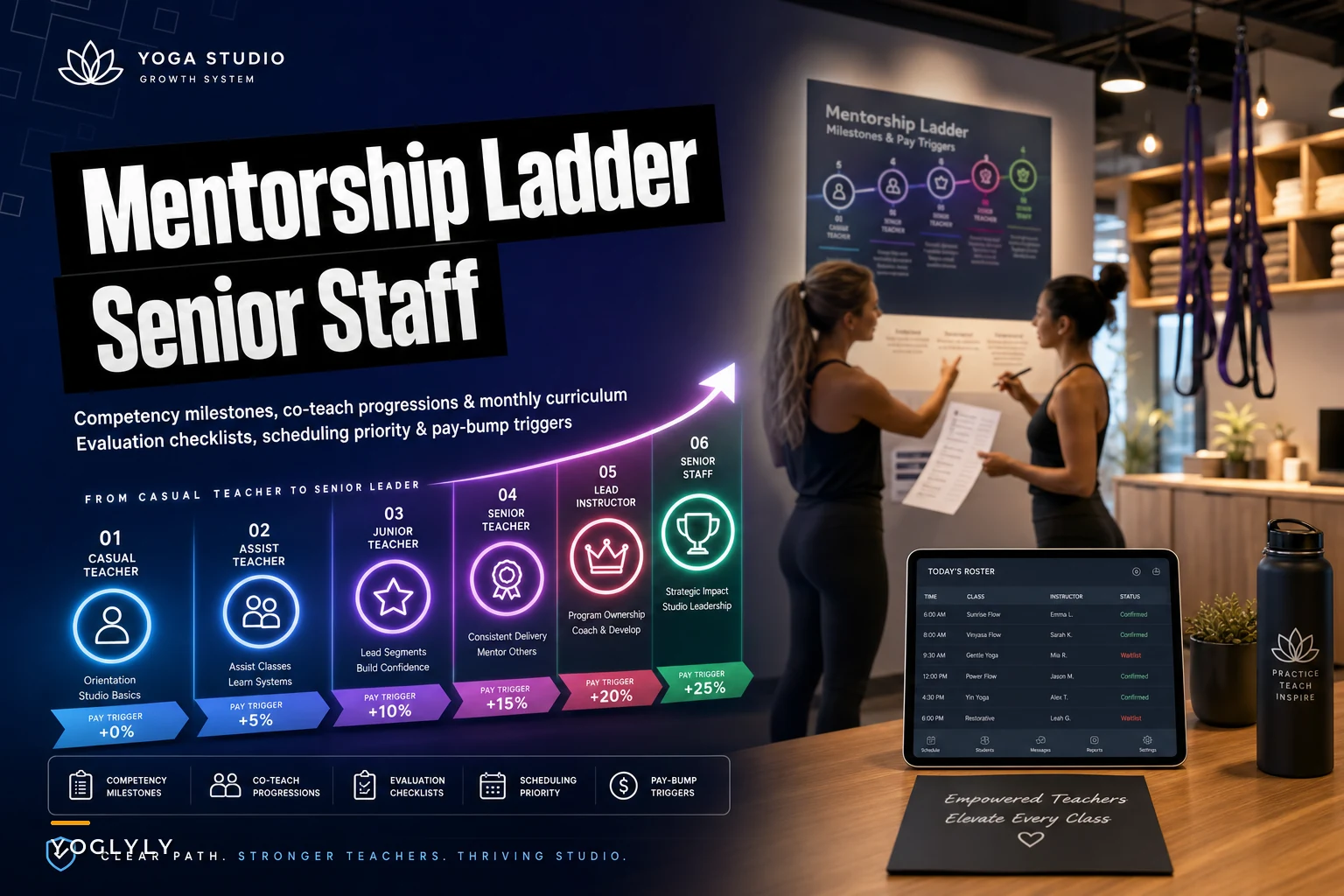

Most studios promote instructors the same way they lose them: by vibe. Someone covers a few classes, students seem to like them, and one day they get bumped up to the prime Tuesday 6pm slot. No checklist, no benchmark, nobody wrote down what "ready" actually meant. Three months later the retention on that class quietly sags, and now there's an awkward conversation nobody wants to have.
The fix isn't more feedback. It's a yoga teacher mentorship ladder — an actual sequence of competency milestones, co-teaching steps, and pay changes that trigger on evidence, not opinion. This piece walks through how to build one that's specific enough to be fair and loose enough to survive a real studio schedule.
Why "promotion by vibe" quietly costs you
A newer teacher subs a handful of classes. Attendance holds fine — but partly because those were already established time slots with loyal regulars who'd show up for almost anyone. The owner reads that as "this person can carry a class." So they hand over a permanent slot. Now the teacher is building a room from a colder start, and the skills that actually matter — sequencing a full arc, holding a room of 25, adjusting on the fly when three injuries walk in — were never tested. They were assumed.
The consequence isn't a blowup. It's a slow drift. Class average slips from around 18 down to 12 over a quarter. Nobody complains loudly; they just book a different time. By the time you notice, you've trained your regulars to route around your newest teacher, and undoing that is much harder than never letting it happen.
The deeper issue is that "good teacher" is a bundle of maybe eight distinct skills, and most casual teachers are strong at three of them. Without a ladder, you can't see which three. You just get a general impression, and general impressions are terrible at predicting whether someone can hold a Friday night slot solo.
The ladder: four rungs, defined by what someone can actually do
Skip the fuzzy titles. Define each rung by observable competency, not by how long someone's been around. Here's a structure that works well as a starting frame — adjust the specifics to your style and class mix.
Eliminate class scheduling chaos.
Yoglyly helps you book, confirm & manage every class seamlessly.
- Centralized class scheduling
- Member notifications
- Instructor and resource management
No credit card required
| Rung | Role | Core competency to prove | Typical time on rung |
|---|---|---|---|
| 1. Apprentice | Assists, subs pre-built sequences | Cueing clarity, hands-on adjustments, room setup/turnover | 2–4 months |
| 2. Sub | Covers classes solo from a template | Holds a room of 15+, manages mixed levels, timing | 3–6 months |
| 3. Resident | Owns a recurring off-peak slot | Builds attendance from a cold start, retains a cohort | 4–8 months |
| 4. Senior | Owns peak slots, mentors apprentices | Trains others, sustains 20+ avg, covers emergencies | ongoing |
The point of the table isn't the exact months. It's that each rung has a thing you can watch someone do. "Manages mixed levels" isn't a feeling — it's whether the teacher gave the pregnant student and the ex-athlete different options in the same pose without stopping the class. Either they did or they didn't.
One mistake to avoid: don't let people skip rungs because they came in with an impressive certification or a big Instagram following. A 500-hour cert tells you about their training hours. It tells you almost nothing about whether they can rescue a class where the playlist won't load and half the room is new. The ladder tests that second thing.
Co-teaching progressions: the part most studios skip
The gap between "assists sometimes" and "runs a class alone" is where teachers actually get made — and it's the part almost nobody structures. People just get thrown in.
-
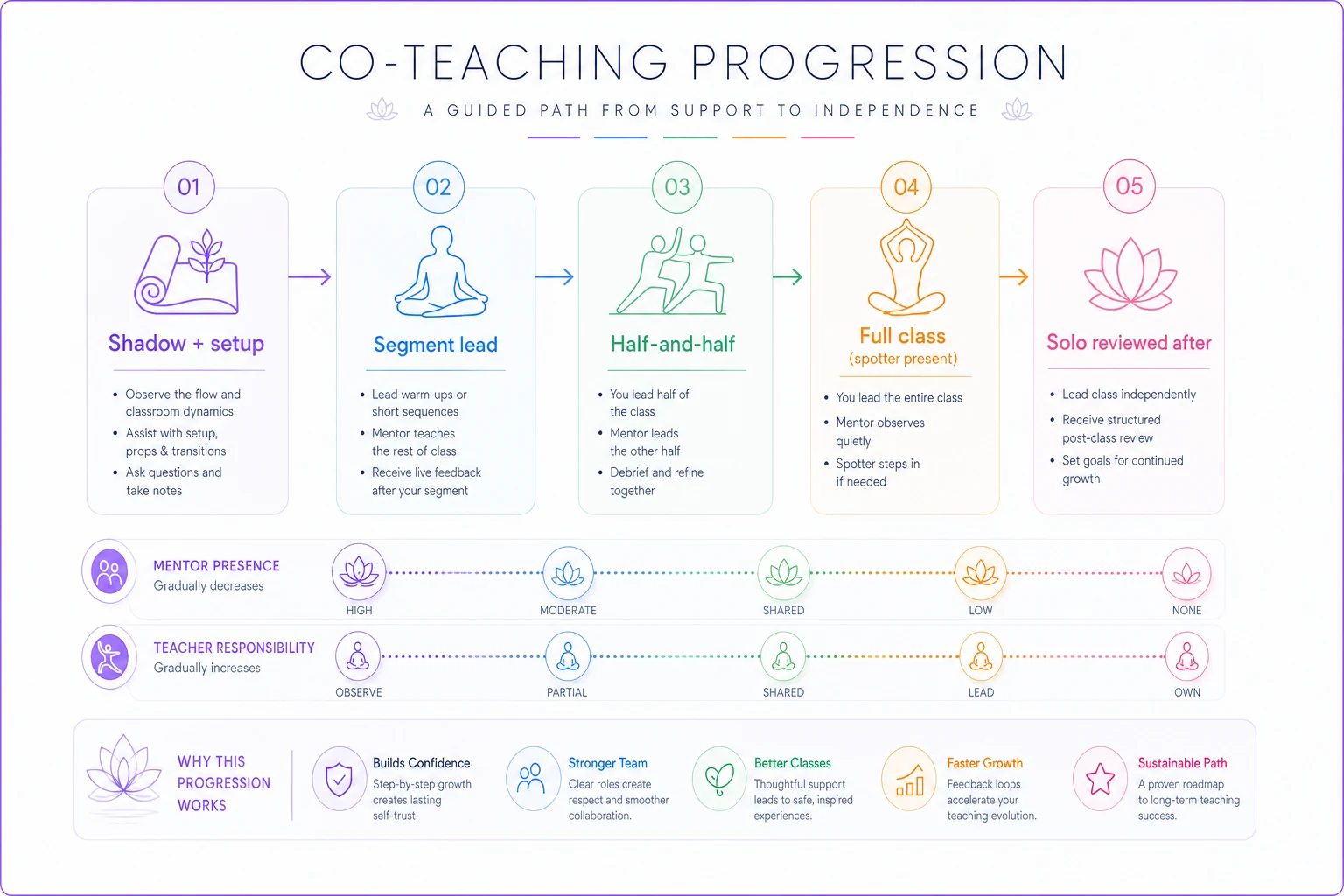
Shadow + setup. New teacher runs arrival, props, and turnover only. Watches the full class. Debriefs after on one thing they'd have done differently.
-
Segment lead. They cue the warm-up or the cooldown — 8 to 10 minutes — while the senior teacher holds the rest. Small stakes, real reps.
-
Half-and-half. They lead the first half of the arc, senior takes the peak and close. This is where sequencing logic gets tested, because they have to hand off a warmed-up room, not a cold one.
-
Full class, spotter present. They run the whole thing. Senior sits in the back, only steps in for safety. Silent otherwise.
-
Solo, reviewed after. They teach alone; senior reviews attendance and a student check-in a week later.
Below is a workflow visualization of the co-teaching progression.
What makes this work is that the senior teacher isn't just supervising — they're getting paid to develop someone, which means it has to show up in comp. Otherwise your best teachers quietly stop mentoring because it's unpaid emotional labor on top of a full teaching load. If you haven't sorted out how development ties into pay, that's the foundation to lay first — this connects directly to building predictable instructor capacity through a workforce lifecycle rather than reacting every time someone gives notice.
Monthly curriculum: keep it light or it dies
The fastest way to kill a mentorship program is to make it a course. Teachers have day jobs. A four-hour Sunday workshop every month sounds great in a planning doc and gets skipped by March.
-
One skill focus per month — say, "adjustments for tight hips" or "cueing without demonstrating."
-
One observed class where the mentor watches specifically for that skill and nothing else. Narrow observation is far more useful than general feedback.
-
One 20-minute debrief, ideally same day while it's fresh.
-
One micro-assignment — try the new cue in three classes, report back on what happened.
Keep observation focused on a single skill to make feedback actionable.
That's it. Maybe 90 minutes of structured time a month per teacher. The theme changes; the format doesn't. Predictable, low-friction, and it compounds. A teacher who's worked through nine monthly themes is genuinely different from one who's just been winging it for nine months.
The observation piece is where studios usually go wrong. They watch the whole class and give a grab-bag of notes — "great energy, maybe slow down the transitions, the playlist was nice." That's noise. Watch for one thing. The teacher can actually act on one thing.
Evaluation checklists: how you decide someone moved up
This is what makes the whole thing fair instead of political. When a teacher asks "why did she get promoted and I didn't," you want to point at a checklist, not shrug.
-
- [ ] Held a class of 15+ solo without the mentor stepping in, twice
-
- [ ] Sequenced a full class from scratch (not a template) that a senior reviewed as safe and coherent
-
- [ ] Gave level-appropriate options for a mixed room in an observed class
-
- [ ] Managed at least one disruption (late arrivals, an injury, tech failure) without derailing the class
-
- [ ] Positive student check-in feedback from a slot they covered
-
- [ ] Ran turnover and setup cleanly across a full month of classes
These are things a mentor saw happen, not survey scores or self-assessment. Self-assessment is useful for reflection and useless for promotion decisions — the teachers who most overestimate themselves are exactly the ones you shouldn't fast-track.
The other thing checklists fix: they stop the recency bias problem where whoever taught a great class last week feels most ready. Written milestones spread across weeks force you to look at consistency, which is the whole point of a senior teacher.
Pay-bump triggers tied to scheduling priority
Here's the mechanism that makes teachers actually chase the ladder instead of treating it as a nice-to-have: tie rung advancement to two things that matter to them — pay and schedule priority.
The pay side you can structure a few ways (per-class bumps, base rates, revenue share on classes they build), and the specifics really depend on your margins — worth working through the math the way you would in any fair teacher pay model that doesn't burn margins before you commit to numbers you can't sustain.
The scheduling trigger is the underrated lever. Prime slots — the 6pm weeknights, the Saturday 9am — are the scarcest, most valuable thing you control. Instead of assigning them by tenure or favoritism, make them a reward for reaching Resident and Senior. Advancing the ladder earns the right to request peak slots. This does two things at once: it motivates people to actually clear milestones, and it protects your best time slots from being handed to under-tested teachers.
A rough example of how the triggers might stack:
| Rung reached | Pay change | Scheduling priority |
|---|---|---|
| Sub | +$8–12/class over apprentice | Can pick up any open sub slot |
| Resident | +$15–20/class, small retention bonus on their cohort | First pick of off-peak recurring slots |
| Senior | Base bump + mentor stipend | Priority on peak slots, input on schedule |
The numbers are illustrative — the structure is the point. What you're building is a system where every teacher can see the exact behavior that earns the next rung, and the studio never has to make an awkward subjective call about who deserves the good slot.
A real scenario
A two-room studio, roughly 30 classes a week, had six teachers and the usual problem: two carried all the good slots, the other four were interchangeable subs with no path forward. Turnover among the four was constant — they'd teach for five or six months, get no sense of progression, and leave for a studio that gave them a regular slot.
They built a four-rung ladder over a weekend and rolled it out with the checklists. Nothing fancy. Within about two quarters, two of the four subs had cleared the Resident milestones and taken over off-peak slots that used to sit half-empty because a senior teacher was reluctantly covering them. Those off-peak classes went from averaging around 7 to around 11 as the new residents built their own following. Sub turnover slowed noticeably — people stayed because they could see the next rung. And the two senior teachers, finally paid a stipend to mentor, stopped resenting the development work.
Nothing about that required new software or a big budget. It required writing down what "ready" means and attaching real consequences to it.
When this makes sense — and when it doesn't
Do this if you have four or more teachers, at least a few casual subs, and you're feeling the pain of not knowing who's ready for more. That's the sweet spot.
Skip it (for now) if you're a solo teacher or you've got two instructors and no bench. A ladder for two people is bureaucracy. Just talk to each other. The ladder earns its keep when you have enough people that informal management stops scaling.
Don't force it if your senior teachers refuse to mentor even when paid. A mentorship ladder needs mentors. If your top people genuinely don't want to develop others, you need a different structure — maybe external teacher training partnerships — not a ladder that assumes internal coaching that won't happen.
Where to start this week
You don't need the whole system live to get value. Do this much:
-
Write down the four rungs and one clear competency for each.
-
Pick your two strongest teachers as mentors and figure out how you'll pay them for it.
-
Build the single most important checklist — the Sub → Resident jump, since that's usually where the real gap sits.
-
Attach one concrete reward to reaching Resident
better slot access, a pay bump, or both.
The studios that keep good teachers aren't the ones paying the most. They're the ones where a talented sub can look at a wall and see exactly what "next" looks like, what it pays, and what class they'll get to teach when they get there. Make that path visible and specific, and your casual teachers stop being a revolving door — they start becoming the senior staff you're not scrambling to replace every six months.
The studios that keep good teachers aren't the ones paying the most. They're the ones where a talented sub can look at a wall and see exactly what "next" looks like, what it pays, and what class they'll get to teach when they get there. Make that path visible and specific, and your casual teachers stop being a revolving door — they start becoming the senior staff you're not scrambling to replace every six months.
Ready to elevate your studio operations?
Join 1,500+ yoga studios using Yoglyly to save time, reduce scheduling conflicts, and enhance member experiences.