


Most yoga studio owners think instructor workforce strategy means posting job ads when someone quits. But after watching studios struggle with capacity planning across different markets, the real problem runs much deeper. It's the difference between constantly scrambling to fill tomorrow's 6am class and actually knowing your instructor pipeline three months out.
Studios that survive past year three don't just hire instructors – they build instructor ecosystems. They understand that workforce strategy connects directly to class consistency, member retention, and ultimately whether you're running a real business or just renting space to contractors who might leave next month.
The instructor lifecycle breaks in predictable places
A typical mid-size studio with 8-12 instructors loses roughly 40% of their teaching staff annually. Not because instructors hate teaching – but because studios treat workforce management like a series of one-off decisions instead of an interconnected system.
The breakdown usually starts small. An instructor mentions they're cutting back hours. You scramble to cover their classes. Another instructor picks up the slack, gets burned out, then starts cutting hours too. Before you know it, you're teaching 15 classes a week yourself just to keep the schedule intact while desperately interviewing anyone with a 200-hour certification.
What makes this particularly frustrating is that studios often see the warning signs months in advance but lack the operational framework to act on them. That instructor gradually reducing availability? They've probably been signaling burnout for three months. The new hire who keeps arriving late? Already halfway out the door.
The real insight is that instructor capacity isn't about headcount – it's about understanding the full lifecycle from recruitment through development to eventual transition. Studios that build predictable capacity treat each phase as part of an integrated system, not isolated HR tasks.
Hiring cadence: why random recruitment creates perpetual instability
Studios typically hire in two scenarios: panic mode when someone quits unexpectedly, or overflow mode when existing instructors complain about teaching too many classes. Both approaches guarantee operational chaos.
Eliminate class scheduling chaos.
Yoglyly helps you book, confirm & manage every class seamlessly.
- Centralized class scheduling
- Member notifications
- Instructor and resource management
No credit card required
A structured hiring cadence means running recruitment cycles on a schedule, not based on immediate need. This sounds counterintuitive – why hire when you don't need someone? Because by the time you need them, it's already too late.
Consider a studio running 45 classes weekly. With 10 instructors averaging 4-5 classes each, you have decent coverage. Then two instructors want summer off, one gets injured, another picks up a corporate teaching gig. Suddenly you're down 30% capacity with no pipeline.
Studios that maintain stable schedules run quarterly recruitment cycles regardless of current needs. They maintain a bench of 2-3 trained substitutes who aren't on regular schedule but can step in immediately. They track instructor availability patterns and can predict capacity gaps 8-12 weeks out.
The quarterly recruitment framework
Q1 (January-March): Focus on building your substitute bench. New Year energy brings motivated newly-certified instructors looking for experience. Run open auditions in February, even if you don't need anyone immediately.
Q2 (April-June): Assess summer capacity. Survey existing instructors about summer plans by April 15th. If you're losing more than 20% of weekly classes to vacation, start recruiting for summer coverage by May 1st.
Q3 (July-September): Recruit for fall expansion. This is when experienced instructors from other studios start looking as their contracts renew. Best hiring season for senior instructors.
Q4 (October-December): Evaluate and plan. Use the slower holiday season to audit instructor performance, plan Q1 needs, and identify development opportunities for your existing team.
The math is straightforward: maintaining a 15-20% capacity buffer costs less than constantly recruiting, training, and losing members due to cancelled classes.
Onboarding programs that actually stick
Most studios confuse orientation with onboarding. Orientation is showing someone where the cleaning supplies are kept. Onboarding is systematically preparing an instructor to deliver consistent experiences that align with your studio's standards.
The typical studio approach: here's the schedule, here's how to use the booking system, teach your first class Thursday. Then they wonder why every instructor teaches completely differently and members complain about inconsistency.
Real onboarding takes 30 days minimum and follows a structured progression:
Week 1-2: Foundation
-
Shadow 5 different classes from 5 different instructors
-
Document observations about studio culture, pacing, music levels
-
Practice teach one class to staff only, receive structured feedback
-
Complete studio philosophy training (not just read a manual)
Week 3-4: Integration
-
Co-teach 3 classes with senior instructor
-
Teach 2 solo classes with mentor observing
-
Receive feedback on alignment with studio standards
-
Begin building relationships with regular students
Week 5-6: Establishment
-
Take over 2-3 regular time slots
-
Receive weekly check-ins from studio manager
-
Complete first student feedback survey
-
Adjust based on early patterns
Week 7-8: Optimization
-
Review attendance patterns for their classes
-
Identify what's working and what needs adjustment
-
Develop their unique style within studio parameters
-
Plan their ideal long-term schedule
This might seem excessive for someone teaching three classes a week. But consider the alternative: an instructor who wasn't properly onboarded loses 30% of students from their classes over three months. At $18 per drop-in, losing just 5 students per class costs $270 weekly. The onboarding investment pays for itself in retained revenue within the first month.
Scheduling fairness without the drama
Nothing destroys instructor morale faster than perceived scheduling inequity. Sarah gets all the prime evening slots while Mike is stuck with 6am classes nobody wants. Jennifer teaches 12 classes while David struggles to get his minimum 4. The resentment builds until someone quits dramatically, usually right before a holiday weekend.
Fair scheduling connects directly to compensation models, but even with transparent pay, the schedule itself becomes a battlefield without clear rules.
The scheduling governance framework
Start with scheduling tiers based on experience and performance, not favoritism:
Tier 1 - Senior Instructors (18+ months, consistent 85%+ capacity)
-
First choice of schedule changes
-
Guaranteed minimum 6 classes weekly if desired
-
Protected time slots (can only be moved with 30 days notice)
Tier 2 - Established Instructors (6-18 months, 70%+ capacity)
-
Second choice of new time slots
-
Minimum 4 classes weekly guaranteed
-
14-day schedule protection
Tier 3 - New Instructors (Under 6 months)
-
Fill remaining slots after Tier 1 and 2
-
Minimum 2 classes guaranteed during probation
-
Flexible scheduling to find their best fit
Most studios create tiers but never explain the progression criteria. Instructors need to know exactly how to move up: maintain 80% capacity for 6 months, average 4.5+ star reviews, complete advanced training. Make advancement objective, not subjective.
The rotation policy prevents stagnation. Every quarter, open 20% of prime slots for rotation. Senior instructors can keep their slots, but they have to actively choose them. This prevents the "Sarah has taught Tuesday 7pm for five years" problem that makes everyone else feel stuck.
For substitutions, implement a points system. Each instructor earns one point for covering another's class. Points determine priority for vacation requests and schedule preferences. Suddenly everyone wants to substitute.
Track substitution points on the same dashboard you use for monthly capacity so priorities are transparent during schedule freezes.
Scheduling fairness connects directly to long-term retention and reduces passive resentment that leads to sudden departures.
Pay governance that scales
The compensation conversation usually happens in isolation – what to pay per class. But pay governance in a yoga studio involves multiple interconnected decisions that compound over time.
Base pay structures need built-in progression that rewards both longevity and performance. A flat $35 per class sounds simple until you realize your best instructor makes the same as someone who just started. But pure performance pay ($20 base + $2 per student) creates cutthroat competition for popular time slots.
The sustainable model combines base, performance, and responsibility:
Base Rate Progression
-
Months 0-6
$30/class
-
Months 7-12
$35/class
-
Months 13-24
$40/class
-
Year 2+
$45/class
Performance Bonuses
-
80%+ average capacity
$5/class bonus
-
4.7+ star reviews
$3/class bonus
-
Perfect monthly attendance
$50 monthly bonus
Additional Responsibilities
-
Mentoring new instructors
$100/month per mentee
-
Workshop development
30% revenue share
-
Social media content
$15/post
This structure costs roughly 15-20% more than flat-rate pay but reduces turnover significantly. The math works out: recruiting and training a new instructor costs $800-1,200. Paying an existing instructor an extra $200 monthly to stay is just good business.
Multi-location studios need even more complex governance to handle travel time, location preferences, and market-rate variations between neighborhoods.
Monthly capacity rituals that prevent surprises
Most studios check instructor availability when building next week's schedule. By then, it's too late to adjust strategically. Monthly capacity planning creates visibility into future constraints before they become crises.
The monthly capacity ritual happens on the 15th of each month, planning for the month starting in 45 days. In mid-January, you're planning March. This gives you roughly 6 weeks to adjust if someone's reducing hours or wants time off.
The monthly capacity scorecard
| Metric | Target | January Actual | Status |
|---|---|---|---|
| Total weekly classes offered | 45 | 43 | Yellow |
| Instructor utilization rate | 75% | 68% | Red |
| Substitute bench depth | 3 | 2 | Yellow |
| Classes per instructor (avg) | 4.5 | 3.8 | Yellow |
| 30-day availability confirmed | 100% | 85% | Red |
| Instructor satisfaction score | 4.2+ | 4.1 | Yellow |
The scorecard reveals patterns before they become problems. When utilization drops below 70%, instructors aren't getting enough hours. When it exceeds 85%, they're heading toward burnout. The sweet spot sits between 72-78%.
During the monthly ritual, each instructor submits their actual availability for the period 45-75 days out – not their desired schedule, their real availability. Can they teach mornings? Weekends? How many classes maximum? Any planned vacations?
This data feeds into capacity modeling. If you need 45 weekly classes covered and have 380 instructor-hours available monthly (10 instructors × 38 hours average), you're in decent shape. But if three instructors want to reduce hours and you drop to 310 available hours, suddenly your buffer disappears and any illness or emergency becomes a genuine crisis.
The ritual also includes one-on-one check-ins with any instructor showing warning signs: declining class attendance, frequent substitution requests, reduced availability. These conversations happen before someone quits, not after.
Here's a simple visual of the monthly capacity planning workflow.
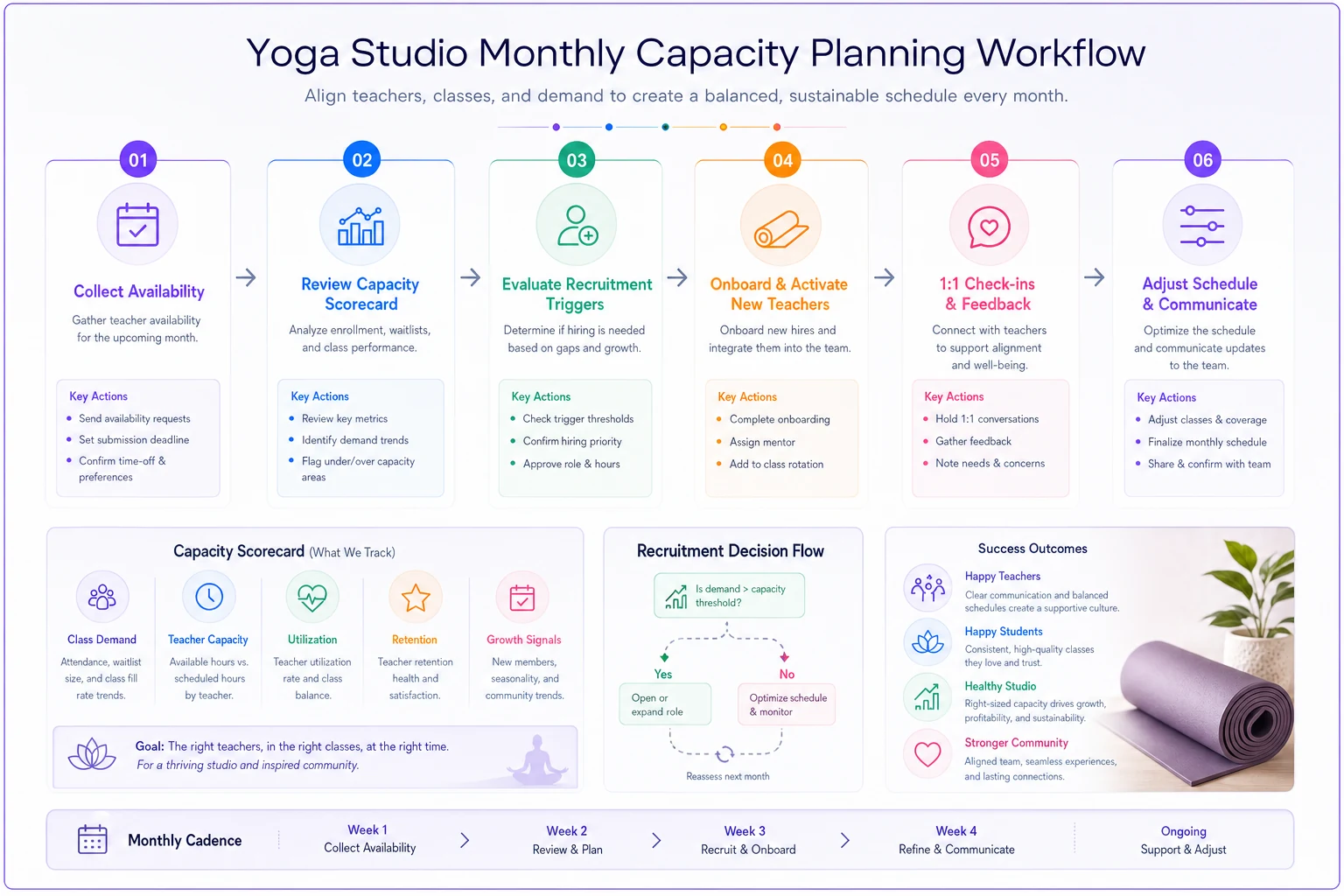
Use this workflow to standardize the 15th-of-month ritual so it's repeatable across managers and locations.
Development pathways beyond "senior teacher"
The traditional yoga studio career path is embarrassingly linear: new teacher → experienced teacher → maybe workshop leader. Then instructors hit a ceiling and either accept the limitation or leave to open their own studio.
Studios with stable workforces create multiple development pathways that don't all lead to teaching more classes:
The Teaching Excellence Path
-
Advanced certification support ($500 annual education budget)
-
Signature class development (instructor "owns" a unique class format)
-
Workshop and retreat leadership opportunities
-
Visiting instructor exchanges with partner studios
The Operations Path
-
Shift lead responsibilities (opening/closing, inventory)
-
Schedule coordination assistant
-
New instructor mentor
-
Social media contributor
The Business Development Path
-
Corporate wellness program instructor
-
Teacher training assistant
-
Private lesson specialist
-
Community partnership coordinator
Each path includes clear milestones, additional compensation, and – critically – doesn't require teaching more regular classes. A great instructor teaching 6 classes weekly might not want 10 classes, but they'd love to earn extra income leading monthly workshops or managing the studio Instagram.
Development conversations happen quarterly, aligned with performance reviews. But instructors choose their path, not you choosing for them. Someone might excel at teaching but hate social media. Forcing them into content creation destroys morale. Let them focus on teaching excellence while someone else who actually enjoys Instagram handles social content.
Software infrastructure for workforce predictability
Managing all these moving pieces – recruitment cycles, onboarding stages, capacity planning, development pathways – in spreadsheets and paper calendars guarantees dropped balls. At some point the administrative overhead becomes its own problem.
AI-powered operational platforms now handle the repetitive coordination that burns out studio managers. Availability collection, schedule optimization, substitute matching – these workflows can run automatically while you focus on instructor relationships and studio growth.
Automated availability tracking: Instead of chasing instructors for next month's availability, the system sends reminders and collects responses automatically. You see a dashboard of confirmed availability, not a spreadsheet of maybes.
Performance analytics: Class attendance, student reviews, and substitution patterns get tracked automatically. You spot trends before they become problems.
Capacity forecasting: Based on historical patterns, the system flags when you'll likely need additional coverage. If summer typically brings 30% reduced availability, you get a prompt in April to start recruiting.
Development pathway tracking: Each instructor's certifications, workshop experience, and growth goals stay organized in one place. Quarterly reviews include actual data, not vague impressions.
This isn't about replacing human judgment with algorithms. It's about freeing studio managers from administrative chaos so they can focus on what actually matters: building solid instructor relationships and delivering consistent member experiences.
Making it real: a complete workforce lifecycle
Here's what this looks like in practice for a studio with 8 instructors running 40 classes weekly:
January: Run Q1 recruitment even though fully staffed. Interview 5 candidates, select 2 for substitute bench. Begin onboarding immediately.
February: Monthly capacity ritual shows two instructors want to reduce hours in April. Activate one substitute for April schedule. Post recruitment for Q2 hiring.
March: Complete Q1 performance reviews. One instructor expresses interest in workshop development. Create their first workshop for May. Another wants social media responsibilities. Add to their role with additional compensation.
April: New instructor from January is ready for regular classes. Senior instructor reduces from 8 to 5 classes as planned. No schedule disruption.
May: Q2 recruitment brings in one new instructor to start June onboarding. Monthly ritual shows strong summer availability – no major gaps expected.
June: Mid-year review of pay structure. Adjust base rates 3% for inflation. Two instructors hit milestone bonuses. Total labor cost increase: $340 monthly. Turnover: zero.
Notice what's missing from this whole timeline: panic. No desperate Sunday night texts begging someone to cover Monday morning. No sudden resignation leaving you scrambling. No simmering resentment about unfair scheduling.
The compound effect of systematic workforce management
Studios using this structured approach report significantly less instructor turnover. But the real impact shows up in secondary metrics: member retention increases when classes maintain consistent instructors, and revenue per class rises when experienced instructors have development pathways beyond just teaching more.
The upfront investment feels heavy. Building onboarding programs, creating development pathways, implementing monthly rituals – it's easier to just post on Instagram when you need someone. But that reactive approach guarantees you'll stay stuck in the same chaos indefinitely.
Start with one component. If schedule drama is killing morale, implement the fairness framework first. If you're constantly surprised by instructor departures, begin monthly capacity rituals. If new instructors keep failing, build proper onboarding.
Workforce strategy for yoga studios isn't about having perfect instructors. It's about creating systems that turn good instructors into great ones while preventing the operational chaos that makes everyone – instructors, staff, and members – miserable. The studios thriving five years from now won't necessarily be the ones with the best teachers. They'll be the ones with the best systems for developing, retaining, and managing those teachers.
Once you see workforce management as an integrated system rather than a collection of isolated HR tasks, the path to predictable capacity becomes clear. The only question is whether you build these systems proactively or keep reacting to each crisis as it appears.
Ready to elevate your studio operations?
Join 1,500+ yoga studios using Yoglyly to save time, reduce scheduling conflicts, and enhance member experiences.