


Running one yoga studio is hard enough. Managing multi location yoga studio scheduling across two, three, or more locations? That's when simple problems turn into operational nightmares.
The breaking point usually hits around month three of the second location. Suddenly you're dealing with instructors who want to teach at both studios but can't commit to fixed schedules. Students show up at the wrong location because your website shows combined schedules. Revenue gets messy because you're not sure if a membership bought at Studio A should work at Studio B. And that instructor who's been with you since day one? They're upset because newer teachers are getting prime slots at the flagship while they're stuck with 6am classes at the new spot.
What starts as expansion excitement quickly becomes fragmentation. Different locations develop their own cultures, their own scheduling quirks, their own unofficial policies. Before long, you're essentially running separate businesses that happen to share a name.
Why scheduling breaks first (and takes everything else with it)
Multi location yoga studio scheduling fails for predictable reasons. Not because studio owners are incompetent, but because the complexity multiplies faster than anyone expects.
Think about a single location. You've got maybe 15-20 instructors, around 40-50 classes per week, one schedule to manage. Double that to two locations and the complexity doesn't just double—it quadruples. Now you're coordinating instructor availability across locations, managing travel time between studios, dealing with substitutes who might not know both spaces, and trying to maintain consistent quality while your attention splits.
The real killer is information silos. Studio A's manager makes scheduling decisions without knowing Studio B just lost two instructors. An instructor commits to a workshop at one location not realizing they're already scheduled at the other. A popular class gets added at both locations simultaneously, cannibalizing attendance instead of growing it.
One studio owner in Denver ran into this exact scenario. Three locations, all within a 15-minute drive of each other. Seemed perfect for instructor rotation. Within six months, instructors were showing up at wrong locations, double-bookings piled up because different managers used different scheduling tools, and students started abandoning memberships because their favorite teachers kept getting shuffled around without notice.
And the chaos cascaded from there. Payroll became a mess because instructors were paid different rates at different locations. Marketing couldn't promote classes effectively because schedules kept shifting. Customer service spent half their time explaining why certain instructors weren't where students expected them.
Building rotation policies that actually work
Instructor rotation sounds great in theory. Fresh energy at each location, cross-pollination of teaching styles, instructors don't get bored. Without clear policies though, rotation just becomes chaos with extra steps.
Eliminate class scheduling chaos.
Yoglyly helps you book, confirm & manage every class seamlessly.
- Centralized class scheduling
- Member notifications
- Instructor and resource management
No credit card required
Studios that make rotation work treat it like airline scheduling—systematic, predictable, with clear rules everyone understands upfront. Not random assignments based on whoever's available.
Start with rotation cycles. Four-week cycles work better than weekly changes. Instructors stay at one location long enough for students to find them, but rotate frequently enough to prevent staleness.
Here's a basic rotation framework that actually functions:
-
Each instructor has a "home" studio (60-70% of classes)
-
Rotating assignments at secondary locations (30-40% of classes)
-
Minimum two-week blocks at any location
-
Maximum 2 locations per week for any instructor
The piece most studios miss: transition weeks. When an instructor rotates, overlap their last week at Location A with their first week at Location B. They teach reduced schedules at both, giving students time to adjust without their instructor just disappearing.
One studio group in Austin implemented what they called "instructor lanes"—each teacher specialized in certain class types and rotated only within those lanes. Power vinyasa instructors rotated between locations but always taught power vinyasa. Gentle yoga instructors had their own rotation pattern. Consistency stayed intact even with the movement.
Travel compensation matters too. If instructors are driving between studios, build in travel time and mileage reimbursement. Nothing kills rotation enthusiasm faster than teachers quietly losing money on the commute.
Standardize a clear mileage and time-reimbursement policy so travel never becomes a hidden cost for rotating instructors.
What really makes or breaks rotation is communication lead time. Every rotation needs a three-week announcement window. Week one: internal notification to staff. Week two: email to affected students. Week three: in-class announcements. No surprises.
Shared waitlists without the chaos
The waitlist problem compounds fast across locations. A student signs up for the waitlist at Studio A, a spot opens at Studio B, but they can't get there in time. Or worse—they're on waitlists at both locations for similar classes, get into both, can only attend one, and now you've got empty spots that could've gone to someone else.
Most multi-location studios handle waitlists wrong. They either keep them completely separate (missing fill opportunities) or fully combine them (creating logistics headaches). The workable solution sits in the middle: intelligent waitlist sharing with clear parameters.
Here's a waitlist mechanics framework that reduces no-shows while maximizing fill rates:
-
Same-day waitlists remain location-specific
-
Next-day waitlists can cross-promote with opt-in
-
Students specify location preferences when joining
-
2-hour minimum notice for cross-location offers
-
Automatic removal from parallel waitlists upon confirmation
The real game-changer is the "flex list"—students who explicitly say they'll take openings at any location given enough notice. These become your fill-rate heroes. When a spot opens, the system first offers to the location-specific waitlist, then the flex list, then a broader audience.
A three-studio chain in Phoenix built their entire waitlist system around proximity zones. Students could set their "willing to travel" radius—some only took spots at their home studio, others would drive up to 10 miles for their favorite instructor. The system automatically factored travel time and only offered spots students could realistically make.
Managing cross-location waitlists manually or through spreadsheets is basically impossible at any real scale. This is where proper operational software earns its keep—AI-assisted platforms can handle the matching logic automatically, surfacing the right offer to the right student without someone manually cross-referencing multiple lists.
Revenue allocation that doesn't cause resentment
Money splits kill multi-location operations faster than almost anything else. Studio A generates more revenue but Studio B has higher costs. An instructor teaches at both locations but brings their following mostly to one. A workshop sells out at the flagship but barely fills at the satellite. How do you split it fairly?
Studios that survive multi-location expansion create clear, transparent allocation rules before problems arise. Not after the first blowup about unfair splits.
Start with membership revenue. Three models work:
Model 1: Home Studio Attribution
-
Member "belongs" to their sign-up location
-
Revenue stays with home studio regardless of where they practice
-
Simple, but can create imbalances over time
Model 2: Usage-Based Split
-
Revenue splits based on actual attendance
-
If a member attends 70% at Studio A and 30% at Studio B, revenue splits accordingly
-
Fair, but requires meticulous tracking
Model 3: Hybrid Pool
-
70% stays with home studio
-
30% goes into a shared pool, distributed by total studio attendance
-
Balances stability with fairness
Package and class pack revenue gets trickier. Some studios track every single class use, splitting revenue per attendance. Others assign the full revenue to the purchase location. Neither is perfect. The approach that creates the least friction: tiered allocation based on package type. Unlimited memberships use Model 2 (usage-based), class packs use Model 1 (home studio), drop-ins credit the attending location entirely.
| Event Type | Revenue Split Method | Rationale |
|---|---|---|
| Regular workshops | Host location keeps 80%, instructor gets standard rate | Location bears marketing and space costs |
| Traveling workshops | 60% host, 20% organizing location, 20% instructor | Organizing location handles logistics |
| Joint events | Equal split minus direct costs | Shared risk and reward |
| Online hybrid | Based on student location, not viewing location | Prevents attribution gaming |
One critical detail: establish "transfer pricing" for instructor sharing. If Studio A's instructor teaches at Studio B, Studio B pays Studio A a transfer fee—usually somewhere in the 20-30% range above instructor cost. This prevents hoarding of popular instructors and compensates for training investment.
Templates that prevent location drift
Even with the best intentions, locations drift apart operationally. Different managers make different calls. Local preferences emerge. Before long, your studios feel like competing franchises rather than a unified brand.
Documentation and templates prevent this, but only if they're actually usable. Not 50-page manuals nobody reads. Real, practical templates people actually reference.
Essential Templates for Multi-Location Operations:
-
Class Transition Checklist — Same 5-point check at every location, posted in every studio space, updated quarterly based on real issues that come up
-
Instructor Onboarding Packet — Location-specific maps and parking, studio-specific equipment locations, key contacts for each site, emergency procedures by location
-
Schedule Change Request Form — Standardized across locations, requires impact assessment, must list affected instructors and students, includes a communication plan
-
Incident Report Template — Identical across all locations, feeds into a central database, triggers the same escalation process regardless of which location it happens at
-
Revenue Reconciliation Sheet — Weekly close process, cross-location membership tracking, instructor float documentation, package usage allocation
The templates themselves matter less than the standardization. Every location needs to handle basic operations identically, even if local personality gets layered on top.
A four-studio group in Seattle learned this the hard way. Each location had developed its own new student process. The flagship did a full tour, the downtown location just handed out schedules, the suburban studios had different waiver processes. Students who visited multiple locations got confused, instructors couldn't sub smoothly, and the brand felt inconsistent.
They fixed it with what they called "core standards"—non-negotiable processes that work identically everywhere—while allowing "local additions" that could vary by site. Every location runs the same 5-minute new student orientation, but some add neighborhood-specific info on top. Same foundation, local personality. That distinction matters more than most owners realize until they've already dealt with the drift.
The standardization checklist you actually need
Most multi-location standardization checklists are either too vague ("ensure consistent customer experience") or way too detailed. You need the middle ground—specific enough to prevent real problems, flexible enough to actually follow.
Scheduling Standards:
-
[ ] Class names identical across locations
-
[ ] Level descriptions match exactly
-
[ ] Pricing tiers align (no location-based pricing)
-
[ ] Time slots follow same pattern (classes start on the hour or half-hour)
-
[ ] Minimum 2-week notice for permanent schedule changes
-
[ ] Sub process identical at all locations
Instructor Standards:
-
[ ] Same pay scale structure (rates can vary by location cost)
-
[ ] Identical certification requirements
-
[ ] Shared instructor database with availability
-
[ ] Same performance review process
-
[ ] Cross-location training required before floating
Student Experience Standards:
-
[ ] Check-in process takes same steps
-
[ ] New student flow identical for the first 10 minutes
-
[ ] Membership benefits work identically
-
[ ] Waitlist rules consistent
-
[ ] Same cancellation policies
Operational Standards:
-
[ ] Opening and closing checklists match
-
[ ] Cleaning supplies stocked the same way
-
[ ] Emergency procedures posted identically
-
[ ] Temperature and music guidelines shared
-
[ ] Equipment maintenance schedule aligned
Communication Standards:
-
[ ] Email templates for common situations
-
[ ] Social media voice guidelines
-
[ ] Schedule change announcement timing
-
[ ] Instructor bio format
-
[ ] Class description templates
Standardize the skeleton, not the personality. Every location should handle a late cancellation the same way, but the front desk conversation can reflect local culture.
Technology solutions for multi-location coordination
Manual coordination across locations starts breaking down around 100 classes per week total. That's when spreadsheet schedules fall apart, paper waitlists fail, and verbal instructor availability becomes impossible to track.
Studios succeeding with multi-location operations use integrated platforms that connect scheduling, communication, revenue tracking, and instructor management. Not separate systems duct-taped together—actual unified operations.
Here's what effective multi-location software actually makes possible, roughly in order of impact:
-
Real-time schedule visibility — Managers at any location can see instructor assignments everywhere. No more double-booking because Studio A didn't know Studio B already claimed that instructor's Saturday morning.
-
Automated waitlist management — Handles cross-location offers based on student preferences and travel radius. The system knows Student A will drive 5 miles for vinyasa but only attends yin at her home studio.
-
Unified instructor portals — Teachers manage availability across all locations from one place. They block out dates, set location preferences, and see their full schedule without juggling multiple logins.
-
Centralized revenue reporting — Answers multi-location questions that individual reports can't: revenue by source location, instructor float patterns, cross-location student behavior, and schedule efficiency by site.
-
Automated rotation scheduling — Instructor rotation schedules generate based on rules you set. Revenue allocations calculate without spreadsheet gymnastics. Waitlist notifications go out without someone manually checking multiple lists.
A quick workflow showing how scheduling, waitlists, rotation, and revenue systems connect across locations.
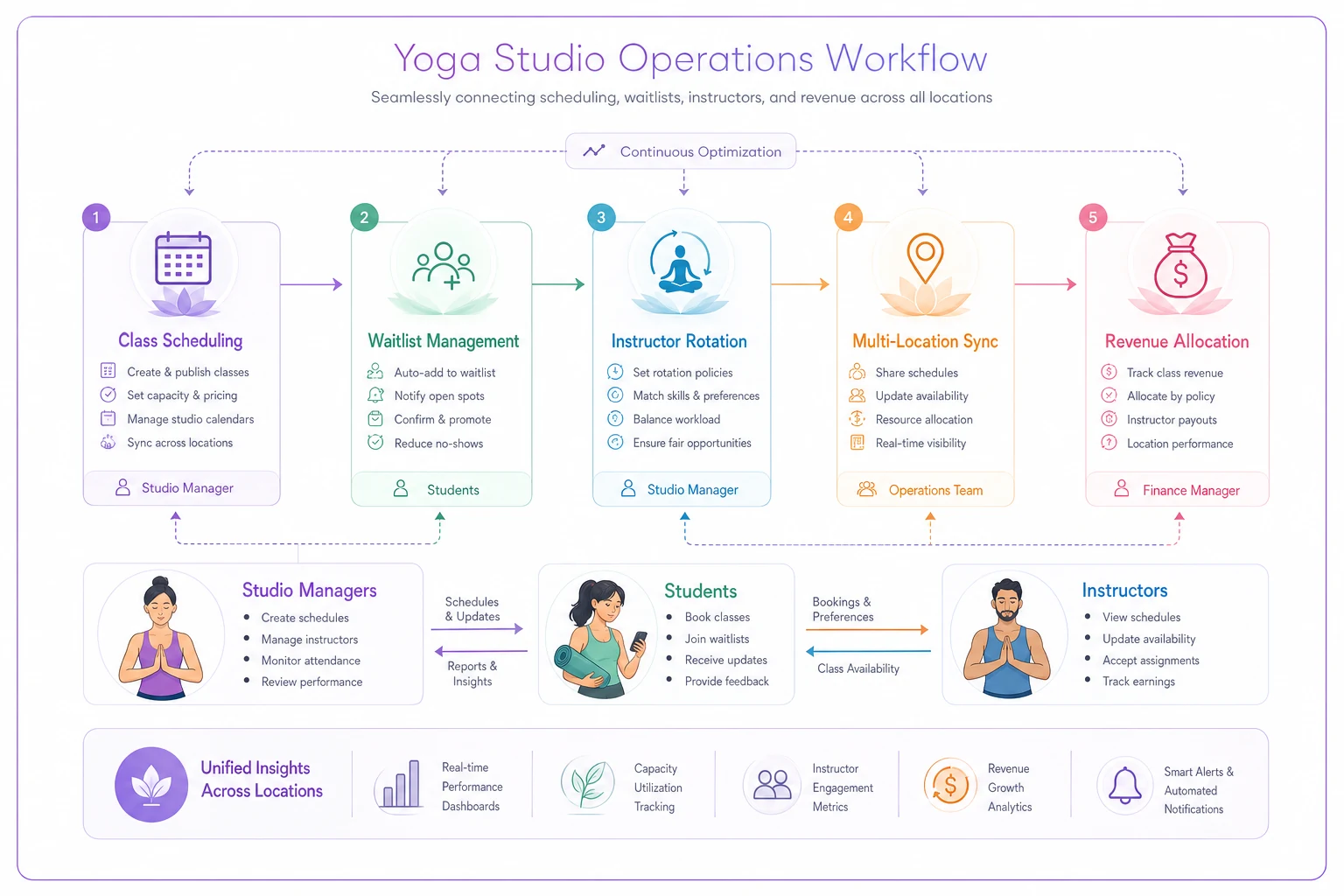
One studio group cut their scheduling coordination time from around 15 hours per week to under 2 hours after implementing proper multi-location software. The platform handled the complexity so managers could focus on quality and culture instead.
The automation matters most in the coordination layer—the repetitive back-and-forth between locations that burns management time without adding much value. Getting that off someone's plate changes what's actually possible operationally.
Making the transition without losing your mind
The worst time to implement multi-location systems is after you've already opened the second location and everything's on fire. The second worst time is never doing it and hoping things magically improve.
Start with scheduling and revenue—those break first and hurt most. Get instructor rotation policies in place before anyone expects them. Build revenue allocation rules while everyone's still excited about expansion, not after the first quarterly reconciliation fight.
Phase your rollout:
-
Month 1
Document current state at all locations. What's actually happening, not what should happen.
-
Month 2
Build core policies—rotation, revenue, waitlists. Get buy-in from location managers and senior instructors.
-
Month 3
Implement templates and checklists. Train everyone on standardized processes.
-
Month 4
Launch technology platform if needed. Migrate historical data, train staff, run parallel systems for two weeks.
-
Month 5
Full transition. Monitor, adjust, document issues.
-
Month 6
Optimization based on real usage. Refine policies, adjust automation rules.
The transition always takes longer than expected. Studios consistently underestimate the change management side—instructors comfortable with current chaos, managers protective of their location's unique approach, students confused by new policies.
Communication becomes everything during this period. Over-communicate changes. Explain why, not just what. Show how standardization actually helps instructors (predictable schedules, fair rotation) and students (consistent experience, better availability).
The reality of multi-location operations
Multi location yoga studio scheduling isn't just scheduling. It's the canary in the coal mine for broader operational health. When scheduling breaks, everything downstream breaks too.
But when you build proper systems—clear rotation policies, intelligent waitlists, fair revenue allocation, solid templates, real standardization—multiple locations become a strength instead of a liability. Instructors get variety without chaos. Students get access without confusion. The business gets scale without fragmentation.
The studios thriving with multiple locations didn't get there through heroic management effort. They got there through systematic operations that prevent problems rather than constantly fighting fires.
Your flagship location took years to get right. Your second, third, and fourth locations don't need to repeat that whole journey from scratch. Build the operational foundation correctly, and expansion becomes actual growth—not just multiplication of problems. The difference between multi-location success and failure usually isn't instructor quality or neighborhood appeal. It's whether you build operations that scale or let each location become its own operational island.
Ready to elevate your studio operations?
Join 1,500+ yoga studios using Yoglyly to save time, reduce scheduling conflicts, and enhance member experiences.