


Most studio owners don't have a revenue problem. They have a coordination problem that looks like a revenue problem.
The marketing person runs a promo. Capacity fills unevenly — your 6pm Vinyasa is packed and your 11am slow flow sits at four people. The ops lead scrambles to add a class, which the instructor finds out about the night before. Meanwhile the owner is staring at a spreadsheet trying to figure out why a "successful" campaign didn't move monthly revenue the way it should have.
Everybody did their job. The system still failed. That gap is what studio revenue operations — RevOps — is supposed to close. Not more dashboards. Not another promo calendar. A connected way of running the business where the people spending money to acquire students, the people building the class schedule and packages, and the people running the floor are all working off the same numbers and the same rules. This post lays out a studio-specific RevOps blueprint: one source of metrics, launch playbooks that behave like SLAs, a 30/60/90 revenue runbook that ties spend to capacity, and clear handoff agreements between growth, product, and ops.
Why revenue falls through the cracks between teams
In a single-location studio with one owner wearing every hat, RevOps happens in that owner's head. They know the schedule, they know the margins, they know which teacher pulls a crowd. The coordination is invisible because it's all one brain.
The cracks show up the moment responsibility splits. You hire a front-desk lead who also handles scheduling. You bring on someone part-time to run ads and email. You open a second location with its own manager. Suddenly three different people are making decisions that affect the same revenue, and none of them can see the whole board.
The pattern that keeps coming up: each function optimizes for its own metric, and those metrics quietly fight each other.
-
Growth is measured on leads and trial signups. So they push volume into whatever class is easiest to sell, regardless of whether that slot has room.
-
Product (your class mix, packages, memberships, workshops) is measured on offering variety or "filling the calendar." So they add a 9pm restorative class nobody asked for.
-
Ops is measured on smooth execution — classes start on time, teachers get paid, the floor runs. So they resist last-minute changes, even good ones.
None of these are wrong. They're just unaligned. And when nobody owns the seams between them, revenue leaks out of those seams.
What breaks as you scale
The failure points shift as the studio grows, and the fix is different at each stage.
Eliminate class scheduling chaos.
Yoglyly helps you book, confirm & manage every class seamlessly.
- Centralized class scheduling
- Member notifications
- Instructor and resource management
No credit card required
One location, 2–4 staff. The main failure is memory and handoff. Decisions live in text threads and nobody writes down why a promo was run or what it was supposed to achieve. When it underperforms, there's no record to learn from. You repeat the same mistake next quarter.
One location, busy, 6–10 staff. Now the failure is conflicting incentives. Your marketing contractor is driving signups into a schedule they can't actually see the capacity of. You end up either overselling popular slots — bad first-timer experience, waitlist chaos — or burning spend driving people to classes that were already half-empty and would've filled anyway.
Two to five locations. This is where it gets ugly. Each site has slightly different pricing, a slightly different schedule logic, a slightly different idea of what "full" means. Growth runs a network-wide campaign and the results are impossible to read because every location measures attendance and revenue a little differently. You can't tell if the campaign worked or if Location B just happened to have a strong month.
The bigger you get, the more the lack of a shared operating system costs you. Small studios survive on coordination-by-proximity. That stops working, usually faster than owners expect.
The foundation: single-source metrics
You cannot run RevOps across functions if growth, product, and ops are each looking at different numbers. This is the non-negotiable first step, and most studios skip it because it feels like plumbing instead of progress.
Single-source metrics means one agreed definition for every number that drives a decision, pulled from one place, visible to everyone who needs it.
| Metric | Common inconsistency | The single definition to lock |
|---|---|---|
| Class capacity | Mat count vs. "comfortable" count vs. fire-code max | Bookable capacity per class type, per room |
| Utilization | Booked seats vs. attended seats | Attended ÷ bookable capacity |
| Active member | Anyone with an account vs. attended in last 30 days | Attended ≥1 class in trailing 30 days |
| New student | First booking vs. first attended class | First attended class |
| Revenue per class | Gross vs. net of instructor pay | Net contribution after direct class cost |
The last column is the whole game. Once "utilization" means the same thing to your ads person and your schedule builder, they can actually have a useful conversation. Before that, they're essentially arguing past each other.
One definition that causes more downstream pain than any other: active member. Studios that count anyone with an account wildly overstate their base, which inflates every per-member calculation and makes retention look fine when it isn't. Fix that one first.
Tying metrics to margin matters too — not just fill rate. A packed class taught by your highest-paid senior instructor on a low-price intro pass can lose money. If you haven't already, the logic in a revenue-governance framework that protects margins rather than just prices pairs directly with single-source metrics — the definitions only matter if they roll up to contribution, not vanity attendance.
SLA-style launch playbooks
Borrow a concept from software teams: the SLA — a service-level agreement. In RevOps terms, a launch playbook that behaves like an SLA means every time you launch something (a new class series, a promo, a membership tier, a workshop), there's a written agreement about who does what, by when, and what "success" means — before it goes live.
This sounds bureaucratic for a yoga studio. It isn't. It's the difference between a launch that teaches you something and a launch that just happens.
A studio launch playbook should pin down five things:
-
The capacity target. How many seats are we trying to fill, in which specific classes? Not "boost attendance." Fill the Tue/Thu 12pm slow flow from 6 average to 15 average over four weeks.
-
The spend ceiling. Growth gets a defined budget tied to that capacity. Once the target slots are full, spend stops or reallocates — no burning money driving people toward classes that are already booked.
-
The product readiness checklist. Is the class actually built in the booking system with correct pricing, correct capacity, correct instructor assigned? More launches die here than anywhere.
-
The ops handoff. Who's told, and when? The instructor, the front desk, the cleaning/turnover schedule. A filling midday class changes staffing needs.
-
The success definition and review date. What number do we check, and on what day do we decide it worked, failed, or needs adjusting?
The thing most studios miss: the launch playbook isn't really about the launch. It's about creating a record so you can tell the difference between a bad idea and a good idea executed badly. Without it, every underwhelming result gets blamed on "the market" or "the season," and you learn nothing.
A simple launch readiness checklist
-
[ ] Capacity target defined (specific slots, specific numbers)
-
[ ] Budget ceiling set and tied to those slots
-
[ ] Offering correctly built in booking system (price, cap, instructor)
-
[ ] Instructor confirmed and briefed
-
[ ] Front desk briefed on what's being promoted and why
-
[ ] Turnover/cleaning impact checked for new time slots
-
[ ] Email/SMS and ad creative reviewed against the actual offer
-
[ ] Success metric and review date written down
-
[ ] One person named as the launch owner
That last item matters more than it looks. Launches with no single named owner drift. Everyone assumes someone else is watching the number.
The 30/60/90 revenue runbook
This is the core mechanism for tying marketing spend to class capacity over time. A runbook is a staged plan that defines what you expect to see and what you do about it at each checkpoint.
The core principle: spend should chase open capacity, not total volume. Driving 40 new trials into a studio that only has 25 genuinely open seats across the week doesn't create revenue — it creates waitlists, frustrated first-timers, and strained instructors. The money would've been better spent elsewhere or saved.
This capacity-first logic deserves its own deep read — the model in capacity-aware growth that prioritizes channels by class capacity is the acquisition engine that feeds this runbook. The runbook is how you phase it over 90 days.
Days 0–30: fill the obvious gaps. Start by mapping true open capacity per slot. Point spend only at the classes with real room and reasonable demand — usually your midday and early-evening off-peak slots. Measure attended utilization, not bookings. The mistake here is celebrating signups. A signup that no-shows is a cost, not a win.
Days 31–60: reallocate based on what actually filled. By now you know which slots responded to spend and which didn't. Pull budget off the classes that won't fill no matter what — some slots are just dead, accept it — and concentrate on the ones showing momentum. This is also when product should weigh in: maybe that stubborn 9am needs a different format, not more marketing. Spend can't fix a class nobody wants at that hour.
Days 61–90: lock in the repeatable pattern. The goal by day 90 isn't a big one-time attendance spike. It's a known relationship — roughly this much spend into these slots produces roughly this much sustained utilization and this much net revenue. Once you have that, you can forecast. You can plan. You stop running random promos and start running a predictable engine.
| Checkpoint | Spend focus | What you're reading | Typical decision |
|---|---|---|---|
| Day 30 | Off-peak slots with room | Attended utilization by slot | Cut dead slots from the plan |
| Day 60 | Winners from day 30 | Cost per retained student | Shift budget, flag product issues |
| Day 90 | Proven slots only | Net revenue per spend dollar | Set the repeatable baseline |
The checkpoints aren't magic — the value is in having a fixed moment where someone is required to make a call rather than letting mediocre campaigns drift on autopilot.
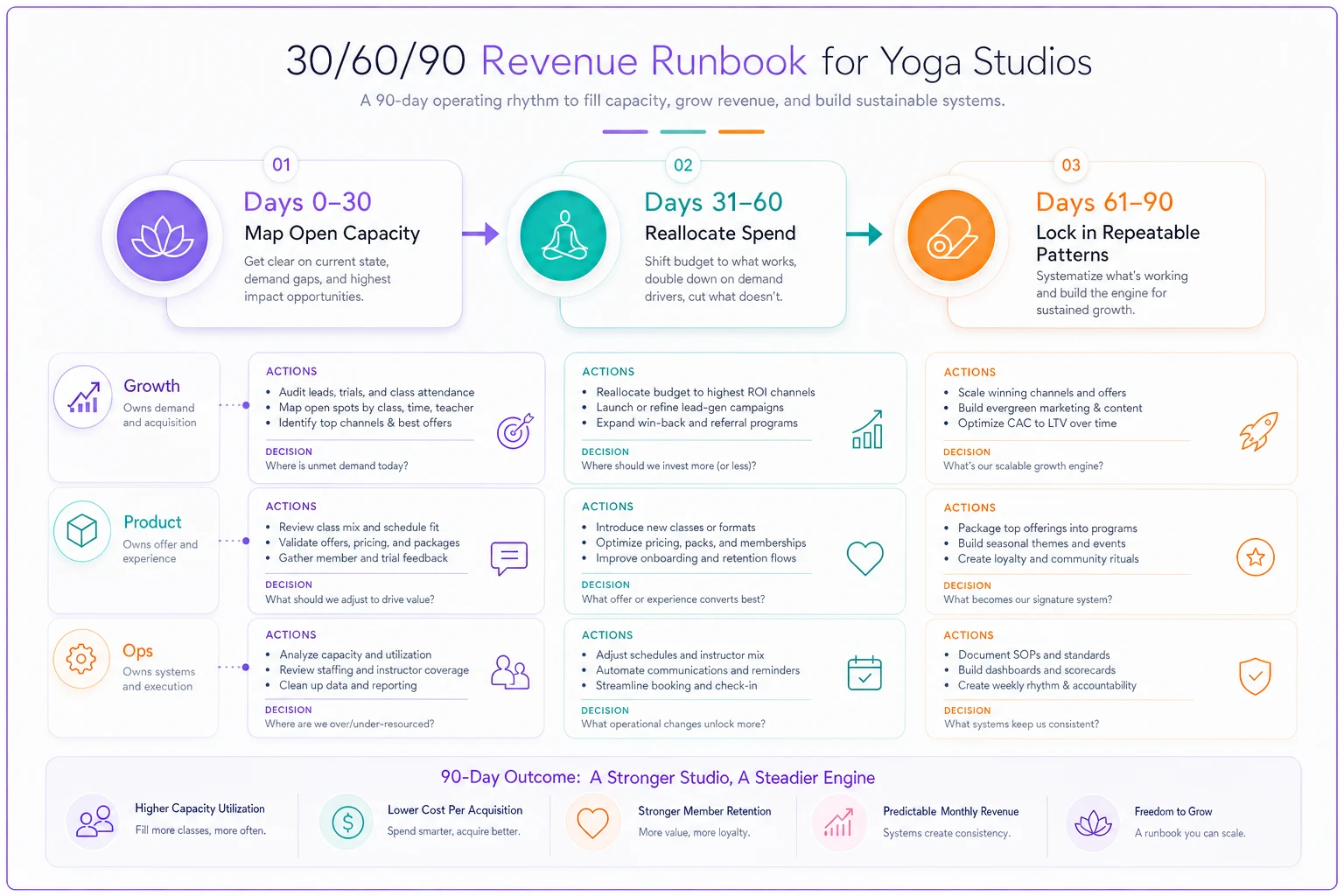
A simple visual of the runbook phases and who makes each call.
SLAs for handoffs between growth, product, and ops
Everything above falls apart at the handoffs if nobody's agreed on them. This is the least glamorous part of RevOps and the part that actually determines whether it works.
A handoff SLA is a small, explicit agreement about what one function owes another and by when. Three handoffs cause almost all the friction:
Growth → Ops. When growth drives a surge into specific classes, ops needs lead time to staff and prep. The SLA might be: growth gives ops 72 hours' notice before any campaign that targets a specific slot. Simple. Prevents the "why is my 12pm suddenly at 20 people and I found out this morning" disaster.
Product → Growth. When product builds or changes an offering, growth needs accurate details to sell it correctly. The SLA: any new or changed offering is fully built and verified in the booking system before growth is told to promote it. This kills the classic failure where ads drive people to a class that isn't bookable yet, or is priced wrong.
Ops → Product + Growth. Ops sits closest to reality — they see no-shows, waitlist pressure, instructor strain. The SLA: ops reports capacity and utilization reality on a fixed weekly cadence, so product and growth are planning off truth, not guesses.
Handoff SLAs aren't about blame. They're about lead time and accurate information. Almost every revenue leak between functions traces back to someone acting on stale or wrong information, or getting no warning before a change hit them.
A real scenario
A two-location studio, roughly 480 active members between the sites, kept running promos that "worked" on paper but never moved monthly revenue much. Signups spiked during each campaign, then attendance flattened back within a few weeks.
When they mapped actual open capacity, the problem was obvious. Spend had been pouring into evening classes that were already running near-full — those students would have come anyway, so the campaigns were essentially paying to fill seats that didn't need filling. Meanwhile midday and early-afternoon slots sat at 30–40% utilization, barely touched by marketing.
They rebuilt around a 30/60/90 runbook. Spend got redirected to the genuinely open midday slots. Growth started giving floor managers a few days' notice before pushing a slot. Product tweaked two stubborn morning classes instead of marketing harder at them — one got reformatted, one got cut.
By the end of the quarter, overall utilization climbed from the low 60s to the mid-70s percent range. More importantly, the gains held after spend normalized, because they were filling real gaps instead of subsidizing full classes. The number that told the story wasn't signups — it was sustained net revenue per dollar of spend, which roughly doubled once the money stopped chasing already-full rooms. Revenue moved in a way that individual promos never managed.
When this makes sense — and when it doesn't
When RevOps helps depends on scale, variability, and how obviously money is being wasted.
When RevOps is worth building:
-
You have more than one person making decisions that affect revenue
-
Your schedule, pricing, or packages vary across locations
-
You're spending real money on acquisition and can't cleanly tell what it's producing
-
Promos "work" but monthly revenue stays flat
When it's premature:
-
You're a solo owner running one location. The coordination lives in your head and formalizing it is overhead you don't need yet. Keep a light launch checklist and move on.
-
You're pre-product-market-fit. If you don't yet know which classes reliably fill, you're not optimizing handoffs — you're still discovering your offering. Fix that first.
Who should not do this: anyone treating RevOps as "buy a dashboard tool." The dashboard is the easy part. If growth, product, and ops haven't agreed on definitions and handoffs, a prettier chart just gives three people a new thing to disagree about.
Where software fits — quietly
None of this requires fancy technology. It requires agreement and discipline. That said, the parts that break hardest at scale are the mechanical ones: keeping capacity and utilization numbers consistent across locations, making sure the slot a campaign targets reflects real open seats, notifying ops when a surge is coming, and keeping a record of what each launch was supposed to achieve.
That's where an operational platform with some automation earns its place — not to run the strategy, but to hold the single source of truth, surface real-time capacity numbers everyone's supposed to work from, and handle routine handoff notifications so they don't depend on someone remembering to send a text. The judgment stays with your people. The software just keeps everyone honest about the same numbers.
The real point
Studio revenue operations isn't a department you hire or a tool you install. It's the practice of making three functions — growth, product, ops — work off shared definitions, agreed handoffs, and spend that follows real capacity instead of raw volume.
The studios that struggle aren't lazy or underfunded. They're running three decent functions that quietly pull against each other, with no one owning the seams. Close those seams — one source of metrics, launch playbooks with teeth, a runbook that phases spend into actual open capacity, and SLAs so handoffs don't depend on luck — and the revenue that's been leaking out of the gaps starts showing up where you can see it. That's the whole job.
Ready to elevate your studio operations?
Join 1,500+ yoga studios using Yoglyly to save time, reduce scheduling conflicts, and enhance member experiences.