



Most studio growth plans get the sequencing backwards. They pick a marketing budget, chase leads, then try to squeeze new students into whatever schedule already exists. The problem is that a studio isn't an app or an e-commerce store — you can't just "add more inventory" when demand spikes. Your inventory is a physical room with a fixed number of mats, a specific class time, and one instructor who can only teach so many people well.
That constraint changes everything about how you should think about a studio CAC LTV model. Acquisition cost only matters relative to the value of the spot you're filling — and that value depends heavily on whether the seat was going to sit empty anyway, or whether you're paying to shuffle a student from your own 6pm flow into your own 7pm flow.
This piece walks through a growth model that treats capacity as the anchor. Not budget. Not lead volume. Capacity. Once you tie your CAC caps and channel choices to actual open seats, the whole thing gets a lot easier to run — and a lot harder to accidentally blow up.
The core mistake: acquiring students you have no room for
There's a pattern that shows up constantly in studios that "did marketing and it didn't work."
They run a promo, get a wave of intro-offer signups, and their popular evening classes — already at 80–90% capacity — get pushed to waitlists. New students show up, can't get into the class they actually wanted, take a mediocre midday slot instead, and churn out after the intro period ends. The studio paid to acquire people and then delivered them the worst version of the product.
Meanwhile the classes that genuinely needed bodies — the Tuesday 2pm, the early Friday — stayed empty because the marketing didn't point anyone there. So the owner spent real money, filled nothing that needed filling, cannibalized the classes that were already healthy, and walked away convinced that "ads don't work for us."
The acquisition wasn't the problem. The absence of a capacity map was. You can't set a sensible CAC cap or choose a channel if you don't know, class by class, where your open seats actually are and what each of those seats is worth.
Step one: build a capacity-and-margin map before you touch CAC
Before any LTV math, you need a simple grid of your weekly schedule with three numbers per class:
Eliminate class scheduling chaos.
Yoglyly helps you book, confirm & manage every class seamlessly.
- Centralized class scheduling
- Member notifications
- Instructor and resource management
No credit card required
-
Capacity — realistic max, not the fire-code max. If 24 mats fit but it feels cramped at 20, your number is 20.
-
Average paid attendance — over the last 8–12 weeks.
-
Contribution per filled seat — revenue from that seat minus the variable cost of filling it (mostly marginal instructor and space cost, which is often close to zero once the class is already running).
That third number is the one people skip, and it's the most important. A class that runs whether or not one more person shows up has a very high contribution on the next seat. Filling seat 15 in a class that already has 14 people costs you almost nothing extra — so the value of acquiring a student into that slot is enormous.
A typical example looks something like this:
| Class slot | Capacity | Avg attendance | Open seats | Marginal seat value |
|---|---|---|---|---|
| Mon 6pm Flow | 20 | 18 | 2 | Very high (class already runs) |
| Tue 2pm Gentle | 16 | 5 | 11 | High volume, but must justify running the class |
| Wed 7pm Power | 22 | 21 | 1 | Very high but almost no room |
| Sat 9am Flow | 24 | 22 | 2 | Very high, prime slot |
| Fri 12pm Slow | 16 | 4 | 12 | Low — class near cancellation threshold |
Look at that grid and the marketing priorities practically write themselves. The Wednesday 7pm has one open seat — spending to acquire for it is almost pointless. The Tuesday 2pm has eleven open seats and the class is already paid for, so every student you route there is nearly pure contribution. Your growth spend should be pulling students toward the open, viable seats, not the ones already nearly full.
Step two: turn LTV into something class-specific
The generic LTV formula — average revenue per member times average lifespan — is fine for a boardroom slide and useless for channel decisions. What you actually need is LTV segmented by how a student enters.
Entry point predicts retention more than almost anything else. A student who comes in through a friend referral and lands in a class with real social density — people who know each other, a consistent instructor — retains far longer than someone who grabbed a cheap drop-in through a discount aggregator at an off-peak time.
So your LTV inputs should look roughly like this:
-
Referral entrants longest lifespan, often 9–14 months, highest rebooking rate.
-
Local organic / walk-in solid, usually 6–10 months.
-
Paid social intro offer wide range — anywhere from 2 to 8 months, heavily dependent on whether they land in a good class.
-
Discount marketplace / deal sites shortest, frequently under 3 months, and often price-anchored low from the start.
Once you have even rough lifespan and monthly contribution numbers per channel, LTV stops being one blurry average and becomes something you can actually make decisions with.
Step three: set CAC caps per channel using payback, not gut feel
The clean way to cap acquisition cost is to work backward from a payback period you can stomach given your cash situation. Studios live and die on cash timing, not annual profit — which is why aligning acquisition spend with a real cash calendar matters. If your months are already unpredictable, fix that first; there's a full walkthrough in the monthly financial calendar approach for yoga studios that pairs naturally with this model.
The logic itself is straightforward:
CAC cap = monthly contribution per member × acceptable payback months
If a referral-sourced member contributes around $90/month and you're comfortable recovering acquisition cost in 3 months, your CAC cap for that path is roughly $270. For a marketplace-sourced member contributing $40/month who tends to churn fast, a 3-month payback caps you at around $120 — and honestly you probably want a shorter payback on low-LTV channels, because the risk of them leaving before you break even is real.
-
Pull monthly contribution per member for each entry channel.
-
Decide your maximum acceptable payback window (2–3 months is common when cash is tight; 4–6 only if you have real runway and strong retention data).
-
Multiply to get a per-channel CAC cap.
-
Discount low-retention channels further — if fewer than half survive to payback, cut the cap proportionally.
-
Compare each channel's actual CAC to its cap monthly and cut or scale accordingly.
The mistake is using one blanket CAC target across every channel. That's how studios keep pouring money into a cheap-looking marketplace that produces students who never pay full price, while starving a referral engine that costs a bit more per head but keeps members around for a year.
Step four: prioritize channels by where the open seats are
Now you combine the two halves. You have a capacity map (where the open, viable seats are) and per-channel CAC caps (what each acquisition path is worth). Channel prioritization becomes a matching problem:
-
Off-peak open seats (that Tuesday 2pm) → cheaper, broad-reach channels are fine, because the marginal seat value is high and you just need volume. Local organic, email to lapsed members, community partnerships.
-
Near-capacity prime slots → stop acquiring for these. Protect them, waitlist smartly, and use them as the destination you route loyal or referred students toward.
-
New or fragile classes near cancellation threshold → targeted, higher-intent channels only. Referral and reactivation, not cold discount traffic, because these classes need students who'll actually stick and build the social density that keeps the class alive.
This is also why random, calendar-blind promos do so much damage — they blast the same offer regardless of which classes actually need bodies. A structured approach that ties promotions to capacity gaps solves most of it, and there's a detailed version in the 12-month marketing calendar built around filling capacity.
The monthly growth dashboard that keeps this honest
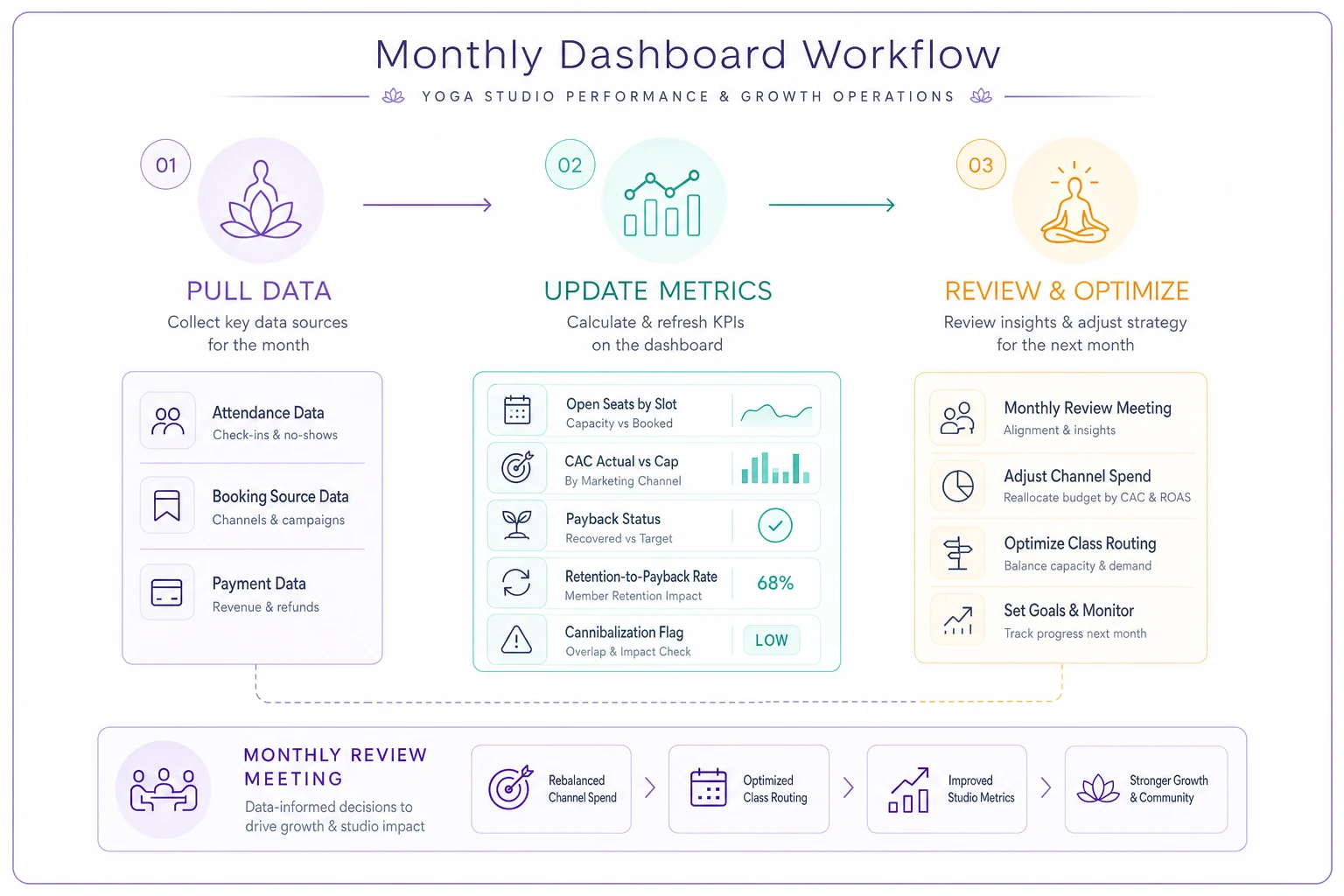
None of this survives contact with a busy studio unless it lives on one simple dashboard you actually look at each month. The version that tends to stick is short:
-
Open seats by slot (updated from the last 8 weeks of attendance)
-
CAC actual vs cap, per channel
-
Payback status — how many months to recover on each channel's current cohort
-
Retention-to-payback rate — % of last quarter's new students who survived long enough to break even
-
Cannibalization flag — new students who just shifted from another of your classes rather than adding net attendance
That last metric is the one almost nobody tracks, and it quietly wrecks growth math. If a big share of your "new" bookings are existing members hopping slots, you're paying acquisition cost for zero net revenue.
Keeping this in front of you monthly is where AI-assisted operational platforms genuinely earn their place — pulling attendance, booking source, and payment data together so the dashboard updates itself instead of you rebuilding a spreadsheet every month. The point isn't automation for its own sake; it's that a capacity-aware model only works if the numbers stay current, and manual maintenance is exactly where these models fall apart.
Here's a simple workflow for how the dashboard should update each month.
The point isn't automation for its own sake; it's that a capacity-aware model only works if the numbers stay current, and manual maintenance is exactly where these models fall apart.
A real scenario
A two-room studio with around 330 active members was spending roughly $2,400/month split between a discount marketplace and paid social, with a single blanket CAC target around $60. Growth looked flat, evenings were jammed, and middays sat half empty.
They rebuilt around capacity. They pulled almost all marketplace spend — those students were churning inside two months and were price-anchored at the low intro rate. They redirected budget toward referral incentives and a lapsed-member reactivation push, and pointed both specifically at underused midday and early-morning classes.
Over the next two quarters, blended CAC actually rose slightly, to somewhere around $70 — but payback shortened because the new students stayed. Midday attendance climbed enough that two previously at-risk classes stabilized. Net new paying members grew instead of just churning through the intro funnel. Nothing dramatic month to month, but the trajectory flipped from flat to steadily up, and the owner finally stopped feeling like marketing spend was money set on fire.
When this model makes sense — and when it doesn't
When it makes sense:
-
You have a mix of full and empty classes (almost every studio does).
-
Evenings and weekends are strong but weekday middays lag.
-
You've been running promos without knowing which classes they actually filled.
When it's a bad fit:
-
You're brand new with almost no attendance history — you don't have enough data to segment LTV by channel yet. Grow first, model second.
-
Your entire schedule is genuinely full. Then the answer isn't acquisition at all; it's adding capacity, raising prices, or protecting margin.
Who should not do this: anyone treating it as a one-time setup. A capacity map from six months ago is a liability — your open seats shift as classes fill and fade. If you can't commit to refreshing it monthly, a simpler flat CAC rule will hurt you less than a stale sophisticated one.
Bringing it together
Growth feels unpredictable for studios largely because acquisition, scheduling, retention, and cash tend to be managed as separate problems. This model forces them into one loop: capacity tells you which seats are worth filling, LTV tells you what each type of student is worth, CAC caps and payback tell you how much you can spend to fill them, and the dashboard tells you whether last month's decisions actually worked.
Start with the capacity map — it's an afternoon of work and it immediately changes how you read every marketing dollar. Everything else in the model hangs off knowing exactly where your empty seats are and what they're truly worth.
Start with the capacity map — it's an afternoon of work and it immediately changes how you read every marketing dollar. Everything else in the model hangs off knowing exactly where your empty seats are and what they're truly worth.
Ready to elevate your studio operations?
Join 1,500+ yoga studios using Yoglyly to save time, reduce scheduling conflicts, and enhance member experiences.