


You know that sinking feeling when you close out the month and realize your intro offer brought in 40 new students but your revenue per student dropped 22%? That's not a pricing problem — it's a revenue governance problem that compounds every time you launch another promotion without checking how it affects your existing revenue streams.
Most studio owners measure promotional performance by counting signups. New student special brought in 35 people? Success! Except those 35 people included 12 who would have bought full-price drop-ins, 8 who downgraded from monthly unlimited passes, and 4 who jumped between different promotional offers to avoid paying regular rates. Your "successful" promotion just cost you $1,800 in margin that month.
The real damage happens when these patterns repeat month after month without anyone catching them. Student numbers go up, cash flow gets tighter, you add more promotions to boost revenue, margins erode further. It's a slow spiral that eventually forces you to cut instructor hours or delay equipment upgrades.
Why margin protection beats price optimization
Price optimization is about finding the sweet spot where demand meets willingness to pay. Margin protection looks at the entire ecosystem — how different revenue streams interact, cannibalize each other, and affect your bottom line over time. That's a much harder problem.
Think about your studio's typical promotion mix. You probably run:
-
New student intro offers
-
Return student win-back deals
-
Seasonal promotions
-
Corporate discounts
-
Student/senior rates
-
Package deals and bundles
Each one seems reasonable in isolation. The problem shows up when they start overlapping in ways nobody planned for.
One studio I worked with pulled their numbers and found that 31% of "new" students taking intro offers had actually attended before under different email addresses. Another studio discovered that their Black Friday unlimited pass sale killed their workshop revenue for the following three months — regular students stopped buying workshop add-ons because they'd already committed cash to the pass.
These aren't edge cases. They're predictable patterns that emerge when promotions run without governance rules. The studios consistently making money have figured out that managing promotion interactions matters more than tweaking individual price points.
Building your promotion decision tree
A promotion decision tree creates clear pathways for when each offer applies and when it doesn't. This prevents overlap, reduces gaming, and protects margins while still leaving room for genuine growth opportunities.
Eliminate class scheduling chaos.
Yoglyly helps you book, confirm & manage every class seamlessly.
- Centralized class scheduling
- Member notifications
- Instructor and resource management
No credit card required
Start with eligibility gates. Your new student offer needs strict criteria:
-
No previous purchases under any email/phone combination
-
No attendance in past 18 months (check sign-in records)
-
Cannot combine with other offers
-
One-time use per person/household
Next, add capacity triggers. Promotions should activate based on actual availability:
| Class Fill Rate | Promotion Status | Action |
|---|---|---|
| Under 40% | Active | Full promotional pricing available |
| 40-60% | Selective | Limit to off-peak times only |
| 60-75% | Restricted | New student offers only |
| Above 75% | Suspended | No promotional pricing |
Then create sunset rules that automatically expire promotions:
-
Time-based
Intro offers expire 30 days from first purchase
-
Usage-based
After 10 classes, convert to regular pricing
-
Revenue-based
Once promo cap is hit (say, 50 intro passes sold), pause until next month
These rules work together. A potential student tries to buy an intro offer, the system checks: Have they purchased before? Is the class below 75% capacity? Has the monthly promo cap been reached? Only if all conditions pass does the offer apply.
Pro-tip: Check sign-in records and phone numbers to catch repeat attendees using different emails.
Here's a visual of how that decision tree flows.
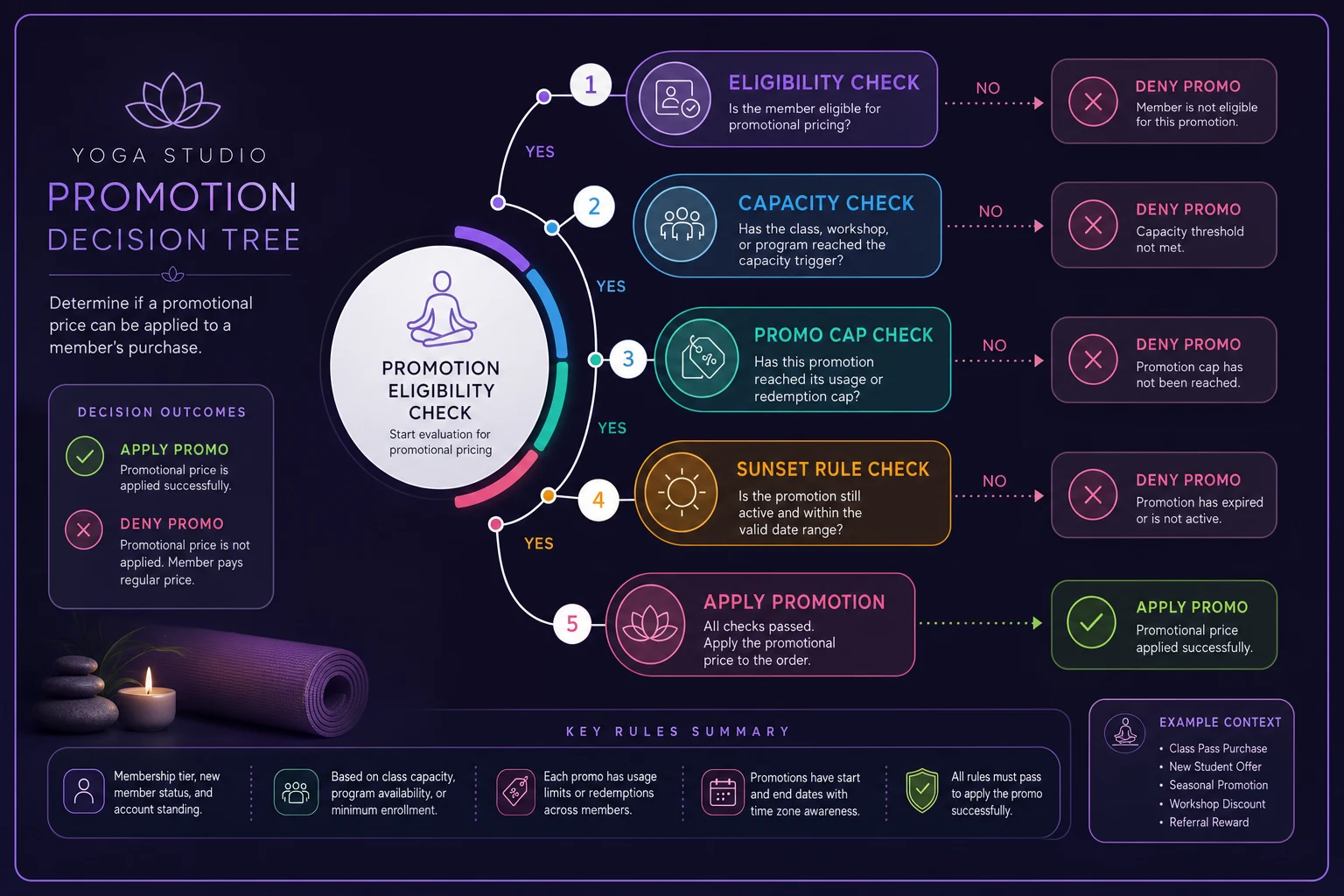
Only if all eligibility, capacity, and cap checks pass does the system apply the promotional pricing.
Cannibalization patterns that destroy profitability
Promotion cannibalization happens in predictable ways most studios miss until the damage is done.
The Downgrade Cascade Regular unlimited members see a "bring a friend for 50% off" promotion and realize they can save money by both signing up as "new" friends. They cancel their memberships, wait two weeks, then re-register under the promotion. You just lost $180/month in recurring revenue to save a $45 acquisition cost.
The Perpetual Trialist Students hop between promotional offers — intro month, then a workshop package, then a holiday special, then a "we miss you" win-back. They attend regularly for 6 months but never pay full price because your offers overlap without blackout periods.
The Bundle Erosion You offer a "5 classes for $50" package to attract new students. Existing drop-in customers who normally pay $22/class switch to packages, dropping their per-class revenue by over 50%. Meanwhile, unlimited members start questioning why they pay $140/month when packages offer better per-class value.
Peak-Time Arbitrage Promotional students flood your profitable 6pm classes while morning classes stay empty. You're discounting high-demand periods where spots would sell at full price, while the low-demand periods that actually need promotion go unfilled.
Margin KPIs that actually matter
Standard studio metrics like total revenue and student count hide margin erosion. You need KPIs that expose the real health of your revenue streams.
Revenue Per Available Spot (RevPAS) Calculate: (Total class revenue) / (Total available spots) This shows whether you're filling classes profitably or just filling them. A packed class at promotional rates might generate less RevPAS than a moderately full class at regular pricing.
Promotion Dependency Ratio Calculate: (Promotional revenue) / (Total revenue) If this exceeds 25%, you're likely in a margin death spiral. Healthy studios keep promotional revenue under 15% of total.
Customer Lifetime Value by Acquisition Channel Track how different promotions affect long-term value. That aggressive Groupon deal might bring bodies through the door, but if those students never convert to full price, you're buying problems, not customers.
Effective Hourly Rate per Instructor Calculate: (Class revenue - instructor cost) / (instructor hours) This reveals which class types and times actually generate margin after labor costs. You might find your "successful" donation classes actually cost you money to run.
Conversion Lag Time Measure: Days from first promotional purchase to first full-price purchase The longer this lag, the more likely students are gaming your system rather than genuinely converting.
Worked example: Implementing revenue governance at a 2-location studio
Here's how revenue governance played out at a real studio — two locations, 18 instructors, around 850 active students.
The Starting Situation:
-
Monthly revenue
$42,000 across both locations
-
45% of revenue from promotional offers
-
Margins declining despite 10% student growth
-
Instructor hours being cut to manage costs
Phase 1: Audit and Baseline (Month 1) We pulled 90 days of transaction data and found:
-
68 students had used intro offers multiple times under different emails
-
Unlimited member retention was sitting at 61% (well below the 80% target)
-
Premium evening classes were 78% promotional students
-
Saturday morning classes averaged 4 students despite 20 available spots
Phase 2: Build the Decision Framework (Month 2) Created rules that connected promotions to capacity and margin outcomes:
-
Intro offers only valid for classes under 65% full
-
Blackout periods for all promotions during 5-7pm weekdays
-
Maximum 30 promotional passes per location per month
-
Automatic conversion triggers after 8 classes or 25 days
Phase 3: System Implementation (Month 3) The key was making these rules automatic rather than manual. Their booking system already tracked capacity — we just needed to connect it to promotional eligibility.
When someone tried to book with a promotional pass:
-
System checked current class capacity
-
Verified no previous purchases
-
Confirmed monthly promo cap not exceeded
-
Applied appropriate pricing
Phase 4: Reporting Triggers (Month 4) Set up automatic alerts when:
-
Promotion dependency exceeded 20% for any week
-
Any single class had more than 50% promotional attendance
-
Conversion lag exceeded 35 days for any cohort
-
RevPAS dropped below $12 for any regular time slot
Results After 6 Months:
-
Revenue increased to $49,500/month (18% growth)
-
Promotional revenue dropped to 19% of total
-
Unlimited member retention hit 77%
-
Added back 22 instructor hours per week
-
Margins improved from 24% to 41%
The biggest win wasn't the revenue increase — it was the predictability. The studio could finally plan their financial calendar with confidence that promotions wouldn't randomly crater their margins.
Technology that enforces governance (not just tracks it)
Spreadsheets and manual checking don't scale. Once you pass roughly 400 active students, human oversight starts failing and margin leakage accelerates. You need systems that automatically enforce rules, not just report violations after the fact.
Most booking platforms handle capacity-based pricing, but they don't connect to promotional rules. That gap is where students exploit loopholes faster than staff can close them.
AI-powered operational software can connect your booking system, payment processor, and CRM to enforce governance rules in real-time. Instead of manually verifying if someone qualifies for a promotion, the system validates eligibility, applies the correct pricing, and triggers conversion workflows automatically.
The automation also handles the complex scenarios that break manual processes entirely. Student trying to stack a referral discount with an intro offer? Blocked. Unlimited member attempting to downgrade to packages during a promotion? Flagged for review. Corporate client employees using both corporate and seasonal discounts simultaneously? The rules engine prevents it without anyone having to catch it manually.
Beyond enforcement, these platforms can surface patterns that are genuinely hard to spot otherwise — like the fact that students who take Tuesday 6pm classes convert at much higher rates than those in Thursday 6pm, which suggests different promotional strategies might work better for each group. Or that your "win-back" campaigns are actually encouraging strategic churn by training students to lapse and wait for an offer.
This isn't about replacing judgment — it's about enforcing the rules you've already decided on while surfacing better information for future decisions.
Revenue governance as competitive advantage
Studios with strong revenue governance consistently outperform competitors, not because they charge more or spend less, but because they protect the margins they already have.
Think about two studios on the same block.
Studio A runs constant promotions to keep classes full. Impressive student numbers, packed classes. But barely breaking even because 40% of attendees pay promotional rates, the conversion rate sits at 12%, and unlimited members keep churning to chase better deals elsewhere.
Studio B runs fewer but smarter promotions. Moderate class sizes, higher RevPAS. Promotions fill empty morning slots without cannibalizing prime time. Conversion rate hits 31% because promotional students can't game the system. Unlimited members stay because the value proposition stays clear.
After 18 months, Studio A is still scrambling to make rent. Studio B is opening a second location.
The difference isn't marketing spend or instructor quality or location. It's that Studio B treats revenue governance as core operations, not an afterthought.
Warning signs your governance is failing
Most studios don't realize their revenue governance is broken until they're in crisis. Watch for these earlier indicators.
Financial Signals:
-
Promotion dependency creeping above 20%
-
Declining RevPAS despite stable attendance
-
Growing gap between gross revenue and net margin
-
Increasing reliance on retail or workshops to subsidize classes
Operational Signals:
-
Staff spending excessive time on payment exceptions
-
Manual overrides becoming routine rather than rare
-
Promotional students dominating premium time slots
-
Regular members complaining about overcrowding from promotional attendees
Strategic Signals:
-
Afraid to raise prices because of promotional pressure
-
Adding more promotions to boost declining revenue
-
Considering cutting instructor pay or hours
-
Postponing necessary equipment or facility investments
Three or more of these signals showing up at once means governance needs immediate attention.
Implementation roadmap for margin protection
Don't try to fix everything at once. This works best in phases.
Month 1: Audit Current State
-
Pull 90 days of transaction data. Map every promotion, discount, and special offer. Calculate your true promotion dependency ratio and RevPAS by time slot. Identify your top three margin leaks.
Month 2: Create Basic Rules
-
Start simple
-
One intro offer per person, period
-
Capacity triggers for promotional pricing
-
Blackout times for peak classes
-
Monthly caps on promotional passes
Month 3: Connect Systems
Your booking system needs to talk to your payment system and CRM. If they don't integrate naturally, you'll need middleware or some manual processes initially. Focus on preventing double-dipping and enforcing capacity rules.
Month 4: Add Conversion Triggers
-
Build workflows that move promotional students toward full pricing automatically:
-
Email series starting around day 20 of the intro offer
-
Booking restrictions after the promo period ends
-
Clear next-step offerings at appropriate price points
Month 5: Implement Reporting
-
Create dashboards showing
-
Daily promotion dependency
-
Weekly RevPAS trends
-
Conversion funnel metrics
-
Margin by class type and time
Month 6: Optimize and Iterate
Use data from months 1-5 to refine the rules. Adjust capacity triggers based on actual patterns. Modify conversion sequences based on what's working. Add new governance rules for edge cases you've discovered.
The compound effect of margin discipline
Small margin improvements compound dramatically over time. A studio that improves margins from 25% to 35% doesn't just make more profit — they create breathing room for investments that accelerate growth.
With that extra margin, you can pay instructors better, which reduces turnover. You can upgrade equipment before it fails. You can build cash reserves for slow seasons, invest in marketing that actually works, and test new class formats without risking stability.
More importantly, margin discipline changes how you make decisions. Instead of chasing revenue with aggressive promotions, you can be selective about growth opportunities. Instead of reacting to competition with price cuts, you focus on value creation.
Studios with strong revenue governance sleep better. They know their numbers, trust their systems, and aren't guessing whether next month's rent is covered.
The path from promotional chaos to margin discipline isn't complicated, but it does require committing to systematic governance over random tactics. Every studio that's made this transition will tell you the same thing: they wish they'd started sooner.
Your next promotion will either strengthen or weaken your studio's financial foundation. Which outcome you get depends entirely on whether you have the governance framework in place to protect your margins while you grow.
Ready to elevate your studio operations?
Join 1,500+ yoga studios using Yoglyly to save time, reduce scheduling conflicts, and enhance member experiences.