



Most studios don't get into trouble because they have too few revenue streams. They get into trouble because they added five of them in eighteen months without checking whether the business could actually carry them. The schedule gets lumpy, the front desk stops knowing which promo applies to whom, and your best teacher is suddenly running a workshop series, a corporate gig, and a teacher training — none of which are at full margin.
The real question in a studio product portfolio strategy isn't "what else can we sell?" It's "what can we add right now without quietly damaging the thing that already works?" That's a sequencing problem, not a creativity problem. And it's the part almost nobody plans for.
This is a decision framework — not a list of product ideas. A way to decide what to launch, what to delay, and what to kill — using three filters: operational readiness, capacity impact, and go-to-market sequencing.
Why portfolios dilute instead of grow
A studio with a solid drop-in and membership base decides to "diversify." Workshops first, then a retreat, then on-demand video, then corporate, then a 200-hour training. Each one made sense on its own. But nobody looked at them as a system.
The dilution happens in three places, and they compound:
-
Attention dilution. The owner's time splits across launches, so nothing gets a proper runway. The retreat half-fills because it got two weeks of promotion instead of eight.
-
Capacity dilution. New offerings quietly steal your best time slots, your most experienced teachers, and your front-desk bandwidth from the core classes that actually pay the rent.
-
Positioning dilution. When a studio sells everything, students stop knowing what it's for. A membership base that signed up for "great vinyasa three times a week" gets confused when half the schedule is now specialty workshops and teacher training intensives.
Revenue can go up for a couple of quarters while the business gets weaker — because core membership slowly erodes underneath the new-revenue excitement. By the time the churn shows up in the numbers, you've already rebuilt the whole schedule around products that don't retain.
A portfolio isn't a collection. It's a hierarchy. Something has to be the core, and everything else has to earn its place around it without taking from it.
The three gates every new offering has to pass
Before anything gets a launch date, run it through three gates in order. If it fails an early gate, it doesn't matter how good it looks on the later ones.
Eliminate class scheduling chaos.
Yoglyly helps you book, confirm & manage every class seamlessly.
- Centralized class scheduling
- Member notifications
- Instructor and resource management
No credit card required
Gate 1 — Operational readiness
Can you actually run this well, repeatedly, without the owner personally holding it together?
Readiness is where most studios are honest for about thirty seconds and then launch anyway. The test is simple: could you run this offering twice with the same quality if you were on vacation for the second one? If the answer is no, you have a one-time event, not a product.
Readiness questions worth answering before launch:
-
Is there a teacher who can own this and a backup who can cover it?
-
Does the front desk know the pricing, the refund rule, and who it's for — without asking you?
-
Can it be booked, paid for, and confirmed through your existing system, or does it need a spreadsheet and a group text?
-
If 40 people buy it, does anything break?
That last one matters more than it looks. A workshop that's charming at 12 people can become a logistics mess at 40. Readiness has to hold at the successful version of the launch, not the quiet one.
Gate 2 — Capacity impact
Every new product consumes capacity somewhere — a room, a time slot, a teacher's hours, or your own attention. An honest portfolio plan accounts for what the new thing takes, not just what it adds.
The trap is treating capacity as free because the room is "empty anyway." It rarely is. The 11am slot you want for a specialty series is also the slot you'd use to grow a midday regular class. The experienced teacher you'd assign to a premium workshop is the same one your Saturday regulars come for.
> Net contribution = new revenue − revenue displaced from existing offerings − added coordination load
If a new series pulls your strongest teacher off two sold-out classes, you're not adding a revenue stream. You're swapping one for another at a worse margin and calling it growth.
Gate 3 — Go-to-market sequencing
Even a ready, capacity-safe product can fail if you launch it at the wrong time, next to the wrong thing, to the wrong people. Sequencing is about order and spacing.
Two sequencing rules that quietly save studios from themselves:
-
Never launch two retention-dependent products in the same quarter. A membership and an on-demand library both depend on re-engagement energy. Launch them together and they compete for the same follow-up attention — and both under-perform.
-
Anchor new products to existing audiences before cold acquisition. The cheapest first customers for any new offering are the students you already have. If your current base won't buy it, a Meta campaign won't fix that. It'll just pay to discover the product was weak.
Sequencing is about order and spacing.
ROI thresholds by product type
Not every offering should be held to the same standard. A drop-in class and a teacher training have completely different cost structures, time horizons, and strategic jobs. Applying one ROI bar across all of them is how studios end up killing good long-game products and protecting bad short-term ones.
Here's a rough way to think about thresholds by product type:
| Product type | Primary job | Reasonable margin target | Payback window | Capacity risk |
|---|---|---|---|---|
| Core memberships / class pass | Retention & base revenue | 55–70% | Immediate | N/A — this is the core |
| Workshops / specialty series | Margin + reactivation | 60–75% | Within the series | Medium (prime slots) |
| On-demand / VOD | Recurring, low marginal cost | 70%+ at scale | 3–6 months | Low |
| Teacher training | High-margin, high-effort | 50–65% | Across the cohort | High (senior teacher time) |
| Corporate / B2B | Predictable contracts | 40–60% | 1–2 contract cycles | Medium (off-peak dependent) |
| Retail | Supports experience | 30–45% | Rolling | Low |
A few things worth noticing in that table. On-demand looks like the dream — high margin, low capacity risk — but it has a slow payback and only works if you've solved packaging and retention. If you're going that route, think carefully about tiering and retention hooks before you film a single class, the way turning your VOD into recurring revenue lays out. A pile of videos nobody re-watches is a cost, not a product.
Teacher training is the opposite shape: high-margin but with real capacity risk, because it eats your most senior teacher's time and your best weekend slots. It can be excellent — it can also hollow out the core if you launch it before the core is stable.
The point of thresholds-by-type is to stop comparing apples to retreats. Judge each product against the job it's supposed to do.
What breaks at scale
The front desk becomes the failure point. Every new product adds pricing rules, eligibility rules, and exceptions. At three products, staff can memorize it. At seven, they can't — and the result is wrong discounts, double-booked rooms, and refund disputes that nobody planned for.
Reporting goes blurry. With a tangled portfolio, total revenue looks healthy while per-product margin quietly rots. You can't tell that the teacher training is subsidizing a corporate contract that's actually losing money on travel time. The numbers aggregate the problem away.
Scheduling starts fighting itself. Specialty series, regular classes, private bookings, and events all want the same prime windows. Without clear sequencing rules, the schedule becomes a negotiation every single week — and the person doing that negotiation is usually you.
This is the stage where a real studio product portfolio strategy stops being a planning document and becomes an operational necessity. You need a single place where every product's pricing, eligibility, capacity claim, and margin lives — so the front desk isn't guessing and you're not re-explaining the same rules for the fifth time. Platforms that centralize bookings, payments, and offering rules in one source of truth are doing exactly this job: keeping the portfolio legible as it grows so that adding a product doesn't add chaos. The automation matters less than the consolidation — when the rules live in one system, staff stop making expensive judgment calls on the fly.
A sequencing process you can actually run
Here's a repeatable way to decide what launches next, and when.
Here's a simple workflow diagram:
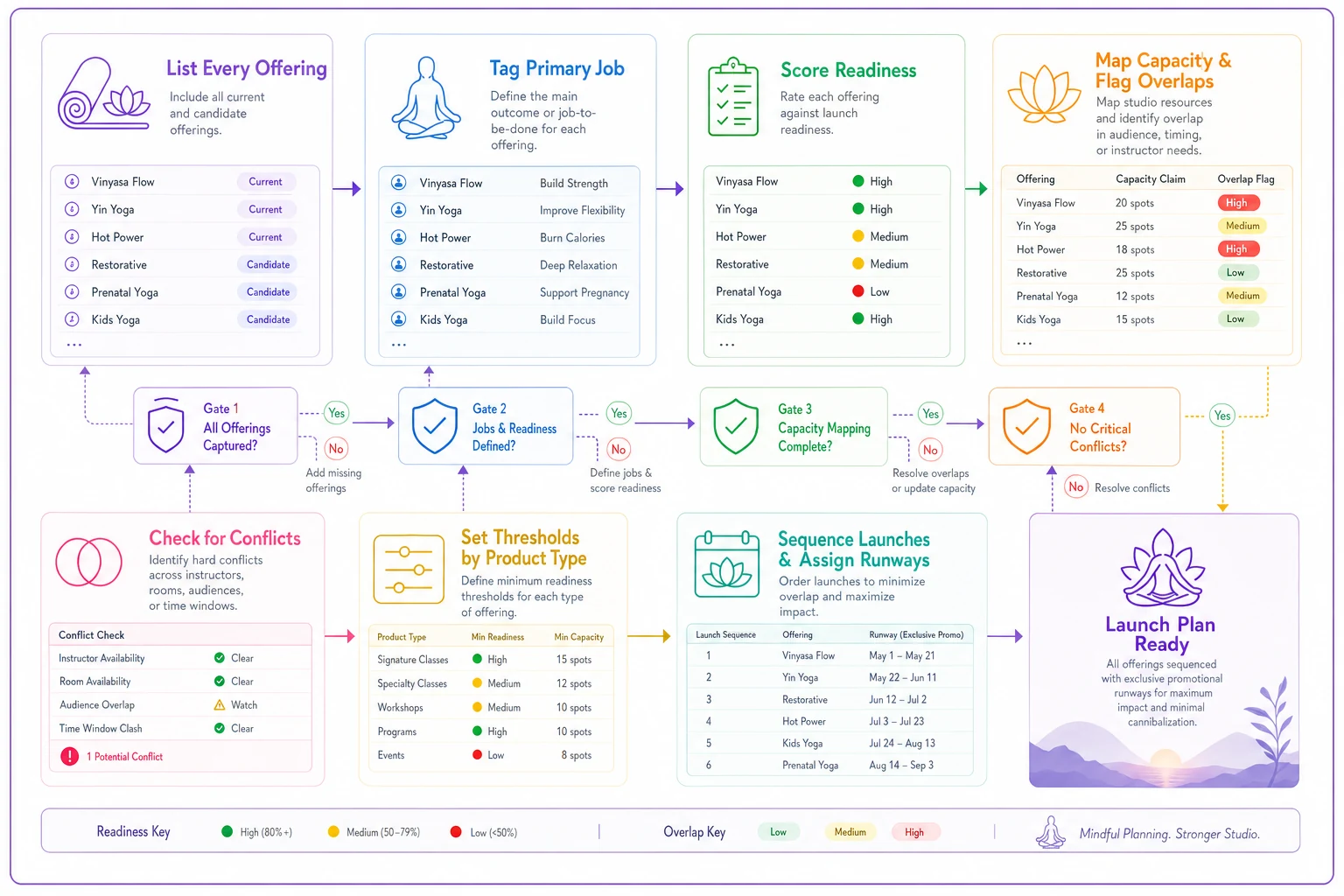
Then follow these steps:
-
List every current and candidate offering. Include the dead ones and the "someday" ideas. You're mapping the whole board.
-
Tag each with its primary job. Retention, margin, reactivation, acquisition, or brand. If two products share the exact same job, one of them is probably redundant.
-
Score readiness honestly. Red / yellow / green on the Gate 1 questions. Anything red doesn't get a launch slot — it gets a readiness plan instead.
-
Map capacity claims. For each candidate, write down which slots, which teachers, and whose attention it needs. Flag overlaps.
-
Check for conflicts. Two retention products in one quarter? Two offerings fighting for the same senior teacher? Space them out.
-
Set the threshold by type. Pull the right margin and payback bar from the table above, not a universal one.
-
Sequence, then commit to a runway. Pick an order. Give each launch an exclusive promotional window so nothing competes with itself.
Give each launch an exclusive promotional window so nothing competes with itself.
The discipline is in step 7. Most dilution comes from skipping the runway — launching things on top of each other because the calendar felt open. A product with no clear air to breathe will underperform a worse product that got a clean runway.
When adding a product makes sense — and when it doesn't
When it makes sense:
-
Your core is stable and retaining, not just filling.
-
You've found a clear job the product does that nothing else covers.
-
You have a teacher and a backup for it.
-
Your existing audience shows real demand, not polite interest.
When it's a bad idea:
-
Your membership retention is soft. New products won't fix a leaky core; they'll distract you from it.
-
The only teacher who can run it is already your constraint elsewhere.
-
You're adding it because a competitor did. That's reaction, not strategy.
Who should probably not expand yet:
A studio still fighting basic consistency — inconsistent class revenue, a schedule that changes every month, a front desk improvising prices — is not ready to add variety. Variety multiplies whatever system you already have. If the system is shaky, adding products multiplies the shakiness. Fixing core consistency first, the way a programization playbook for series, workshops and cohorts lays out, usually earns more than any new offering would.
A real scenario
A mid-sized studio — one location, around 330–360 active members — wanted to grow beyond memberships. Over about a year they'd added a workshop series, a small on-demand library, and a corporate wellness contract. Revenue was up maybe 15% year over year, so on paper it was working.
When they actually separated the numbers, the picture changed. The corporate contract looked like real money until travel time and a mid-week teacher reassignment were factored in — it was running close to break-even and pulling their best vinyasa teacher out of two popular evening classes. Those evening classes had softened, and member churn had ticked up a few points. The on-demand library, launched the same quarter as the corporate push, never got a proper promotion window and sat mostly unused.
The fix wasn't adding anything. It was sequencing what they already had. They paused new corporate outreach, moved the senior teacher back to the evening core, renegotiated the existing contract to off-peak-only delivery, and gave the on-demand library its own clean three-week relaunch. Within a couple of quarters the evening classes recovered, churn settled back down, and the on-demand library started producing a modest but steady recurring line. Total revenue barely moved at first — but margin and retention both improved, and the portfolio finally made sense.
That's the whole point. Growth that weakens the core isn't growth. It's borrowing from tomorrow's retention to make this quarter's top line look good.
The takeaway
A portfolio that scales revenue without dilution comes from restraint more than ambition. The studios that pull it off aren't the ones with the most offerings — they're the ones who know exactly what their core is, protect its capacity, and let each new product earn its slot by passing readiness, surviving the capacity math, and getting a clean runway.
Add products in order. Hold each to the standard its type deserves. And whenever a new idea feels exciting, ask the uncomfortable question first: what does this take from what already works? If you can't answer that, you're not ready to launch it yet.
Ready to elevate your studio operations?
Join 1,500+ yoga studios using Yoglyly to save time, reduce scheduling conflicts, and enhance member experiences.