


Most studio owners don't get burned by one bad software decision. They get buried under six or seven okay-ish ones stacked over a few years, each signed for a different reason, none of them talking to each other, all of them charging monthly. That accumulation has a name most people never use: vendor debt. It's the ongoing cost — money, time, and switching friction — of tools you've outgrown but can't easily leave.
The reason yoga studio tech procurement matters more than it looks is that the mistakes don't show up on day one. They show up on year two, when you try to add a second location, or move your on-demand library, or export your member list and realize you don't actually own it in any usable form. By then the tool has hooks in your bookings, your payment history, your automated emails, and your class schedule. Leaving feels like moving houses during a flood.
This isn't a "pick the best software" article. It's about building a procurement process that keeps you free — one where every tool you add can also be removed without setting the whole operation on fire.
Why studios accumulate vendor debt faster than most small businesses
A studio's software footprint grows in a very predictable, very messy pattern. You start with a booking platform because you need people to reserve spots. Then payments get bolted on, usually through whatever the booking tool partners with. Then you want to email students, so a marketing tool joins. Then you launch on-demand, so a VOD platform appears. Somewhere in there you add a waiver tool, a review tool, maybe a separate payroll or teacher-pay system.
-
The booking tool becomes the de facto CRM because that's where member data lives, even though it's a mediocre CRM
-
Payment history sits inside a processor you can't easily migrate without re-collecting card info from every member
-
Your automated reminders and sequences are built inside one platform, so switching means rebuilding months of logic
-
Your VOD content is uploaded to a host that owns the player, the URLs, and sometimes the analytics
None of these individually feel like a trap. Together they form one. The more integrated your stack becomes, the higher the exit cost — and vendors know this. Renewal pricing tends to climb precisely because they've calculated how painful leaving would be.
What actually breaks as you grow
At one location with 200-ish active members, a clunky stack is annoying but survivable. You paper over the gaps with manual work — someone exports a spreadsheet on Fridays, someone re-enters no-shows by hand. The duct tape holds. Scale changes the math completely. Add a second studio and suddenly the tools that don't sync become active liabilities. A waitlist that lives in one system, memberships that don't recognize cross-location visits, revenue reports that require you to manually stitch two dashboards together every month. If you've dealt with the syncing headache before, you already know how fast this compounds — the governance playbook for when bookings, payments, and CRM don't sync goes deep on that specific failure mode.
Eliminate class scheduling chaos.
Yoglyly helps you book, confirm & manage every class seamlessly.
- Centralized class scheduling
- Member notifications
- Instructor and resource management
No credit card required
-
Data fragmentation — the same member exists in three tools with three slightly different records
-
Reporting blindness — you can't see true LTV or retention because the numbers live in separate silos
-
Renewal leverage loss — you're too embedded to negotiate, so prices ratchet up unchallenged
-
Integration fragility — an update to one tool silently breaks a connection to another, and you find out when a member complains
-
Exit paralysis — even when you know a tool is wrong, migrating feels riskier than staying
That last one is where vendor debt really costs you. Staying with the wrong tool because leaving is scary is still a decision — just an expensive, invisible one.
The category-by-category RFP checklist
Before you sign anything, run the tool through a category-specific evaluation. The mistake most owners make is using the same generic questions for every tool. A payment processor and a VOD host fail in completely different ways, so they need different scrutiny.
Booking / Scheduling
-
Can you export the full class schedule, roster history, and member visit logs in a usable format (CSV/API), not a locked PDF?
-
Does it support multi-location natively, or is that a bolt-on that breaks at scale?
-
Who owns the waitlist logic and cancellation data?
-
What happens to recurring bookings if you leave mid-term?
Payments
-
Is the payment processor swappable, or are you locked to their in-house processor?
-
Can card-on-file tokens be migrated to another processor (this is huge — most can't without re-collecting)?
-
What's the full fee schedule including chargebacks, refunds, and international cards?
-
Do you retain the transaction history in exportable form?
CRM / Member Data
-
Do you own the member records outright, including custom fields and tags?
-
Can you export communication history and consent/opt-in status?
-
Are automation sequences exportable or documented, or do they vanish when you leave?
VOD / On-Demand
-
Do you own the raw video files, or only streaming access?
-
Can you migrate the library without re-uploading everything manually?
-
Who owns the viewing analytics and the member-content relationship?
-
What happens to purchased/subscribed access if you switch hosts?
Run every prospective tool through the relevant block. If a vendor can't answer these clearly, that vagueness is the answer.
A minimum SLA matrix worth demanding
Service-level agreements sound like enterprise stuff, but studios lose real money to downtime and slow support. When your booking system goes down at 5:45pm on a Saturday, a "we'll get to it Monday" support tier costs you a full weekend of no-shows and confused members.
| Category | Uptime minimum | Support response | Data export guarantee | Notes |
|---|---|---|---|---|
| Booking | 99.5%+ | Under 4 hrs, incl. weekends | Full export on demand | Peak hours are evenings/weekends — off-hours support matters |
| Payments | 99.9%+ | Under 2 hrs | Transaction history export | Downtime here directly loses revenue |
| CRM | 99%+ | Next business day | Full member + comms export | Less time-sensitive but data ownership is critical |
| VOD | 99.5%+ | Under 8 hrs | File-level export access | Buffering/downtime frustrates paying subscribers fast |
The point isn't to memorize these percentages. It's to make the vendor commit in writing to something, because "trust us, we're reliable" has no teeth when you're losing bookings. A vendor who refuses any SLA language is telling you exactly where you'll rank when things break.
Contract red-lines: the clauses that create lock-in
Most studio owners skim the contract and sign. The clauses that matter most are the ones designed to make leaving expensive. Here are the red-lines to catch and push back on:
-
Auto-renewal with long notice windows. A 90-day cancellation notice on an annual contract means you have a narrow window to leave, and if you miss it, you're locked another year. Push for 30 days or shorter.
-
Data-hostage exit terms. Any clause where your data export requires a fee, a support ticket, or "reasonable effort on our part." Your data should be exportable, free, anytime.
-
Price-increase blank checks. Contracts that let them raise renewal prices with vague notice. Ask for a cap — increases limited to a defined percentage per renewal cycle.
-
Payment-processor lock-in. Terms that force you to use their processor and prevent you from taking your tokenized card data. This is the single most common trap in studio software.
-
Content ownership ambiguity. For VOD especially — make sure the contract states clearly that you own your recordings.
When a vendor won't move on any of these, that rigidity tells you how the relationship will feel in year three. The good ones understand these are reasonable asks.
Integration testing SOPs (before you commit, and after)
Here's a step most studios skip entirely: actually testing whether the tools connect before you're depending on them for real revenue. The demo always looks smooth. Real data behaves differently.
-
Create test records end-to-end. Book a fake class, run a real payment for a small amount, confirm it appears correctly in the CRM and the reports. Watch where it doesn't show up.
-
Test the failure paths. Cancel the booking. Issue a refund. Does the CRM update? Does the member's status change everywhere it should?
-
Test the sync timing. How long until a payment shows in reporting? Real-time, hourly, daily? Lag here causes reconciliation headaches later.
-
Test a partial export. Pull your data out during the trial. If exporting is painful now, it'll be worse when you actually need to leave.
-
Document what breaks. Keep a short log of every gap. That log becomes your ongoing integration health check.
Here's a quick visual of that testing flow.
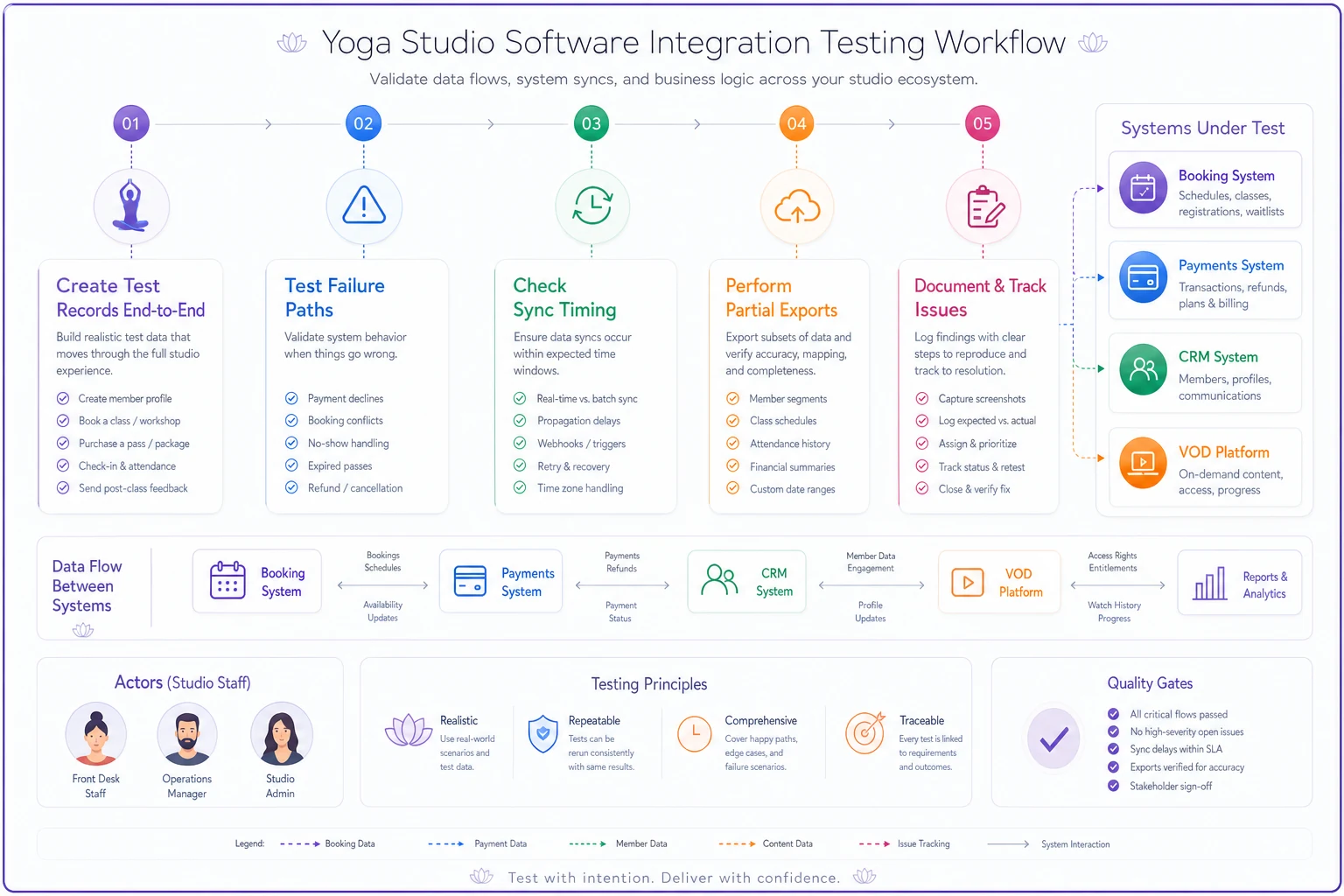
When possible, use a staging account to run tests without affecting live bookings and payments.
The reason this matters long-term: integrations break silently. A vendor pushes an update, a field mapping changes, and suddenly no-shows stop syncing. You find out when a member complains, or worse, when you're trying to reconcile a month of data. Having a defined SOP — even a monthly 20-minute check — catches these before they turn into a real mess. The framework for keeping everything reconciled is covered well in this piece on building a studio single source of truth with a data-ownership matrix and sync cadence, which pairs naturally with testing SOPs.
Vendor-exit rules: plan the divorce before the marriage
This is the section almost nobody does, and it's the one that saves you the most. Before you sign, write down your exit plan. Not because you're planning to leave — because knowing how you'd leave keeps you from getting trapped.
-
What would trigger us leaving? Price crossing a threshold, repeated downtime, a missing feature blocking growth. Define it now, unemotionally.
-
What do we need to take with us? Member list, payment tokens, visit history, automation logic, video files. List it explicitly.
-
How long would migration realistically take? If the honest answer is "we have no idea," that's the lock-in showing.
-
Who owns the migration? Internal person or a hired consultant. Knowing this removes the "it's too hard" excuse that keeps you paying for the wrong tool.
Keep this as a one-page document per major tool. Update it when contracts renew. The mere act of maintaining it changes how you negotiate — you're no longer a captive customer.
A real scenario
A studio running two locations had accumulated the classic stack: one booking platform doubling as CRM, its bundled payment processor, a separate email tool, and a VOD host for their growing on-demand library. Roughly 380 active members across both sites, on-demand adding maybe $2k–$3k monthly.
The problem surfaced when they tried to switch booking platforms to something with real multi-location support. They discovered the card-on-file tokens couldn't migrate — every member would have to re-enter payment details. On-demand was worse: the host owned the player and URLs, so moving meant re-uploading close to 200 videos and losing all viewing history. Their "simple" switch was quoted at several months of work.
They didn't switch. They stayed, and their renewal went up around 12% that year with no added value — because the vendor knew they were stuck. The fix wasn't a heroic migration. It was procurement discipline going forward. On the next VOD renewal, they required file-level export rights and content ownership in writing before signing. On payments, they moved to a processor that supported token portability. It took about a year of renewal cycles to unwind, but they went from fully locked-in to genuinely able to leave any single tool without collapsing the rest. The renewal ratchet stopped because they finally had leverage.
When tighter procurement isn't worth it
There's a point where this discipline becomes over-engineering. A brand-new single-location studio with 60 members doesn't need contract red-line negotiations and SLA matrices — they need to fill classes. Spending three weeks evaluating VOD hosts when you have no on-demand content is procrastination dressed up as diligence.
The rules scale with your exposure. If a tool touches your revenue, your member data, or your ability to move — apply the full checklist. If it's a low-stakes tool you could rip out in an afternoon, don't overthink it. The whole point of avoiding vendor debt is freedom to focus on the studio, not building a procurement bureaucracy that eats the time you were trying to save.
The system view
Vendor debt isn't a software problem — it's an ownership problem. Every tool decision is really a decision about who controls your members, your money, and your content. When you procure without exit rules, you're slowly handing that control away one signature at a time, and the bill arrives years later as inflated renewals and migrations you can't afford.
The studios that stay flexible aren't the ones with the fanciest tools. They're the ones who treated procurement as an ongoing discipline: category-specific evaluation before signing, SLAs in writing, red-lines they won't cross, integration tests that catch silent failures, and an exit plan for every major tool. That combination is what keeps your options open as you grow from one room to several — and keeps the tools working for you instead of quietly owning you.
Vendor debt isn't a software problem — it's an ownership problem. Every tool decision is really a decision about who controls your members, your money, and your content. When you procure without exit rules, you're slowly handing that control away one signature at a time, and the bill arrives years later as inflated renewals and migrations you can't afford.
The studios that stay flexible aren't the ones with the fanciest tools. They're the ones who treated procurement as an ongoing discipline: category-specific evaluation before signing, SLAs in writing, red-lines they won't cross, integration tests that catch silent failures, and an exit plan for every major tool. That combination is what keeps your options open as you grow from one room to several — and keeps the tools working for you instead of quietly owning you.
Ready to elevate your studio operations?
Join 1,500+ yoga studios using Yoglyly to save time, reduce scheduling conflicts, and enhance member experiences.