


Most studios don't have a data problem. They have an ownership problem.
The bookings platform thinks it knows a student's status. The payment processor disagrees. The email tool has a third version. And when a member emails saying "I was charged but the app says my class pass expired," you spend twenty minutes clicking through four dashboards trying to figure out which one is telling the truth.
That's not a technology gap. That's a governance gap. Nobody ever decided, on purpose, which system gets to be the authority for each piece of information. So all of them act like the authority, and none of them agree.
This post is about building a single source of truth (SSOT) for your studio — specifically the data-ownership matrix that decides who owns what, and the sync-cadence rules that keep everything aligned. If you've already read the broader governance playbook for when bookings, payments and CRM don't sync, think of this as the architectural layer underneath it — the actual blueprint your yoga studio data architecture should follow.
Why "everything syncs to everything" quietly destroys your data
The default state for most studios is a spiderweb. Bookings talks to payments. Payments talks to the CRM. The CRM pushes back into bookings. The VOD platform grabs member status from somewhere. Zapier holds three of these connections together with duct tape.
The failure mode nobody warns you about: when every system can write to every field, conflicts become invisible.
A typical example looks like this. A student updates their email in your booking app. That change syncs to your CRM. But two days earlier, someone imported a corrected email list into the CRM, and that system is set to overwrite on the next sync. Now the two systems ping-pong the email back and forth, and depending on which sync runs last, the student either gets your newsletter or doesn't. You'll never see it happen. You'll just notice, months later, that open rates are weirdly low and some members swear they never hear from you.
-
The same member existing as three slightly different records
-
Payment status that lags behind reality by hours or days
-
Class credits that don't match what the member actually paid for
-
Reactivation emails sent to people who already came back
The fix isn't more integrations. It's fewer authorities.
The data-ownership matrix
An ownership matrix is a boring spreadsheet that solves an enormous amount of chaos. For each category of data, you pick exactly one system that owns it — the one allowed to make changes that everyone else must accept. Every other system reads that data but never overwrites it.
Eliminate class scheduling chaos.
Yoglyly helps you book, confirm & manage every class seamlessly.
- Centralized class scheduling
- Member notifications
- Instructor and resource management
No credit card required
Here's a starting point most studios can adapt:
| Data type | Owner (source of truth) | Systems that read it | Never allowed to overwrite |
|---|---|---|---|
| Class schedule & capacity | Booking platform | CRM, website, VOD | Payments, CRM |
| Booking / attendance status | Booking platform | CRM, payments, dashboard | VOD, email tool |
| Payment & charge status | Payment processor | Booking platform, CRM | Booking platform, CRM |
| Membership / pass balance | Booking platform (synced from payments) | CRM, VOD access | Email tool, VOD |
| Contact info (email, phone) | CRM | Booking, payments, VOD | Booking imports |
| Marketing consent / opt-out | CRM | Email/SMS tool | Everything else |
| VOD access entitlement | Payment/membership status → VOD | — | VOD manual edits |
| Lifecycle stage (new/active/lapsed) | CRM (derived from booking + payment) | Dashboard, email tool | Manual edits |
The single most important row is payment status. This should almost always be owned by your payment processor, not your booking tool. The reason is straightforward: the processor is the only system that actually knows whether money moved. Everything else is guessing based on what it was told. When a card fails on a recurring membership, the processor knows first. If your booking platform "owns" payment status, it'll happily keep letting someone book classes for a week while a failed charge sits unresolved.
The second most important row is marketing consent. This one isn't just about tidiness — it's a compliance issue. If a member opts out and that opt-out lives in your email tool but your booking platform re-imports them as "subscribed," you've got a real problem. Consent should have exactly one owner, full stop.
One mistake worth flagging: don't let people be an exception to the matrix. The most common source of dirty data isn't a bad integration — it's a front-desk staffer manually editing a phone number in the "wrong" system because it was the tab they had open.
The matrix only works if the humans around it respect it too.
The matrix only works if the humans around it respect it too.
Event-driven vs batch sync: pick the right pattern per flow
Once you know who owns what, the next decision is how the news travels. There are two patterns, and the biggest architectural mistake studios make is using one when they need the other.
Event-driven sync means a change fires immediately. Someone books a 6pm class → the CRM knows within seconds → the confirmation SMS goes out. It's triggered by an event, not a clock.
Batch sync means changes pile up and get processed on a schedule — every 15 minutes, every hour, overnight. Nothing happens the instant it happens; it happens at the next scheduled run.
| Flow | Recommended pattern | Why |
|---|---|---|
| New booking → confirmation | Event-driven | A late confirmation feels broken to the student |
| Failed payment → access hold | Event-driven | Every hour of delay is a free class you didn't sell |
| Cancellation → waitlist promotion | Event-driven | Speed directly affects whether the spot gets filled |
| Attendance → lifecycle stage update | Batch (hourly/daily) | No one's harmed by a few hours' delay |
| Nightly revenue → dashboard | Batch (overnight) | You only look at it once a day anyway |
| Bulk contact cleanup → CRM | Batch (scheduled, reviewed) | You want a human checkpoint here |
The pattern most studios get wrong is waitlist promotion. They run it on a batch schedule — say, every 30 minutes — and then wonder why waitlisted members complain. Someone cancels a spot in a popular 6am class, and the person next in line doesn't find out until 6:12am, which is useless. That flow needs to be event-driven. The cost of latency is a genuinely lost booking.
On the flip side, plenty of studios burn money and create noise by making everything real-time. If your lifecycle-stage logic recalculates on every single event, you'll get members bouncing between stages all day and trigger reactivation emails to people mid-visit. Some data should settle before you act on it.
Sync cadence guidelines
Cadence is just "how often does batch data refresh, and how fast should event data land." A workable default for a small-to-mid studio:
-
Bookings & cancellations real-time (event-driven), target under ~30 seconds end to end
-
Payment status changes real-time for failures and refunds; batch reconcile nightly
-
Membership/pass balances update on the triggering event, verify in the nightly batch
-
Contact info changes near-real-time one direction (from the CRM owner), never bidirectional
-
Lifecycle stage recalculate hourly during the day, full recalc overnight
-
Dashboard & reporting overnight batch is fine for most studios
A rule of thumb worth holding onto: the faster a stale value costs you money or annoys a member, the more it belongs in the event-driven bucket. Everything else can wait for a batch.
One under-appreciated cadence decision is how often you run reconciliation — which is different from how often you sync. You can sync in real time all day and still drift, because real-time syncs fail silently. That's what the next section covers.
Reconciliation checks: catching the drift real-time sync hides
Event-driven syncs fail quietly. A webhook times out, a rate limit gets hit, an API has a bad five minutes — and the change never lands. No error shows up on your screen. The two systems just disagree now, and they'll stay disagreeing until something forces a comparison.
Reconciliation is that forced comparison. It's a scheduled job — or a manual check if you're small — that pulls the same data from two systems and looks for mismatches.
A practical nightly reconciliation set for a studio:
-
Payments vs. bookings. Every successful charge should map to a corresponding membership or pass. Every active pass should trace back to a real payment. Flag orphans on either side.
-
Membership balance vs. attendance. Passes decremented should equal classes attended. A member showing 8 credits used but only 5 classes attended means a sync fired twice.
-
Contact records across systems. Count total contacts in the CRM vs. the booking platform. A gap larger than your normal daily signups means records aren't propagating.
-
VOD entitlement vs. membership status. Everyone with VOD access should have an active, paid membership. Catch the people who cancelled but still have the login working.
-
Opt-outs. Anyone marked opted-out in the CRM should be excluded everywhere. Zero tolerance on this one.
The number that matters isn't zero mismatches — you'll always have a handful of in-flight records. What matters is the trend. If reconciliation normally surfaces 3–5 mismatches a night and suddenly you see 40, an integration broke sometime in the last 24 hours, and you caught it before a member did.
This is exactly the kind of signal that belongs on your operations dashboard — not the raw mismatch list, just a daily "reconciliation health" indicator so you know at a glance whether your data architecture is holding together.
The escalation playbook: what to do when checks fail
Finding a mismatch is only useful if there's a decided response. Otherwise every discrepancy becomes a five-person Slack thread. An escalation playbook assigns each type of failure a severity and an owner, ahead of time.
A simple three-tier structure works for most studios:
Tier 1 — Auto-resolve (no human needed). The owner of record wins. If payment status and booking status disagree, the payment processor value gets written to the booking platform, logged, and done. Most contact-info and balance drifts fall here. The rule was already decided by your ownership matrix, so the system just applies it.
Tier 2 — Flag and fix same-day (front desk / manager). A member has VOD access but no active membership. A pass balance doesn't reconcile to attendance. These need a human to look, but they're not emergencies. One person owns the daily flag queue and clears it before close.
Tier 3 — Stop and escalate (owner / whoever holds the integrations). Payments and bookings are broadly out of sync. Reconciliation mismatches jumped 10x overnight. An opt-out isn't propagating. These mean the system is broken, not one record, and pushing more data through it just multiplies the damage. The response is to pause the affected sync — not hand-fix a hundred records downstream of a broken pipe.
The mistake studios make is either treating every discrepancy as Tier 3 — panicking over a single mismatched phone number — or treating a Tier 3 like a Tier 2, hand-correcting records one by one while the broken integration keeps generating new ones behind them. Severity tiers keep the response proportional.
A real scenario
A two-location studio, roughly 330 active members plus a growing on-demand library, kept getting the same complaint: members charged for the month whose VOD access had quietly stopped working. Support was eating maybe 4–6 of these a week, each one a 15-minute dig through three dashboards.
The root cause wasn't a bad tool. It was ownership. VOD access was being set manually whenever someone remembered to, based on nobody's authoritative record. There was no agreement that entitlement should flow from payment status, and no reconciliation to catch when it drifted.
They did three things. First, they wrote the ownership matrix and made payment status the source of truth for VOD entitlement. Second, they moved the entitlement update to event-driven — a successful renewal grants access immediately, a cancellation revokes it. Third, they added a nightly reconciliation comparing VOD access to active memberships.
Within about six weeks the "charged but locked out" tickets basically disappeared — down to the occasional one-off instead of a weekly stack. Nightly reconciliation surfaces a handful of edge cases they clear in a few minutes before opening. Nothing about the number of tools changed. They just decided, on purpose, who owned what.
When this level of structure actually makes sense
Not every studio needs a formal matrix and nightly reconciliation jobs.
Worth building when:
-
You run more than one or two tools that share member data
-
You've hit the "which system is right?" question more than a couple times
-
You sell memberships or passes that gate access to something — classes, VOD, anything
-
You have staff manually editing records across systems
Probably overkill when:
-
You're a single instructor with one booking tool and payments built in
-
Almost no data flows between separate systems
-
You can eyeball your entire member list without scrolling
If a specific integration is flat-out broken, fix that first. The matrix is preventive architecture — it keeps a healthy setup healthy. It won't repair a pipe that's already burst.
Where good software quietly helps
You can run this on spreadsheets and scheduled scripts, and plenty of studios do at first. Where an integrated operational platform earns its keep is in collapsing the number of authorities in the first place. When bookings, payments, membership balances and VOD access live inside one system rather than four stitched-together ones, most of your ownership matrix becomes a single default — and whole categories of drift simply can't happen because there's no second system to disagree with.
The parts that stay valuable regardless of tooling are the decisions: who owns what, what fires instantly versus overnight, what reconciliation runs, and who responds when it fails. Software can enforce those decisions and automate the boring checks. It can't make the decisions for you. That part is operational, not technical.
Bringing it together
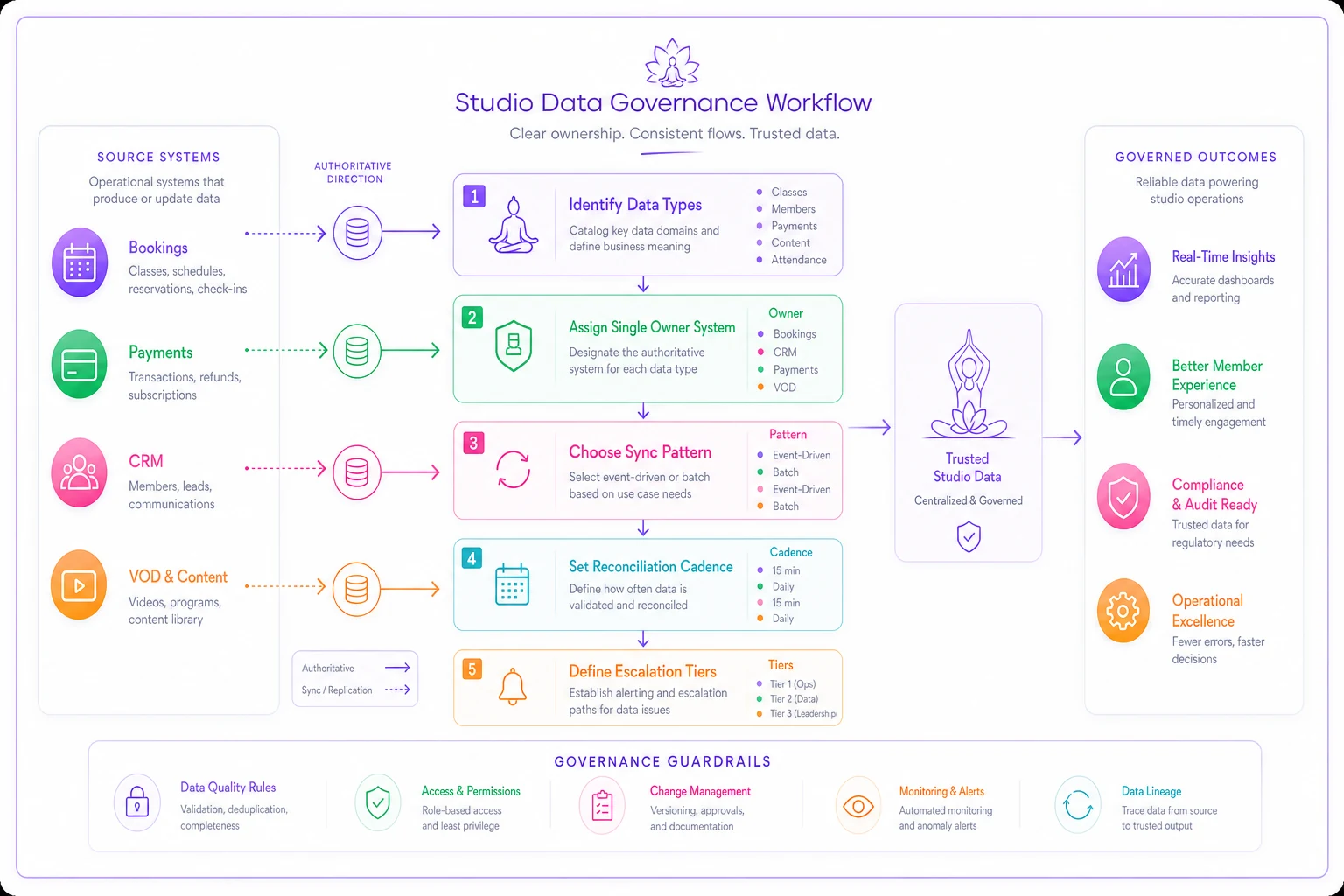
A single source of truth isn't a product you buy — it's a set of choices you commit to. Pick one owner per data type. Match sync patterns to how much latency actually costs you. Reconcile on a schedule because real-time syncs lie by omission. Decide your escalation tiers before something breaks, so a mismatch triggers a known response instead of a scramble.
Below is a simple workflow for deciding owners and sync patterns.
The studios that stay sane as they add locations, memberships and on-demand content aren't the ones with the fanciest tools. They're the ones who sat down early and answered a deceptively simple question for every piece of data: when two systems disagree, which one wins? Get that answer written down, and most of the chaos in your yoga studio data architecture stops being a mystery and starts being a rule.
A single source of truth isn't a product you buy — it's a set of choices you commit to. Pick one owner per data type. Match sync patterns to how much latency actually costs you. Reconcile on a schedule because real-time syncs lie by omission. Decide your escalation tiers before something breaks, so a mismatch triggers a known response instead of a scramble.
The studios that stay sane as they add locations, memberships and on-demand content aren't the ones with the fanciest tools. They're the ones who sat down early and answered a deceptively simple question for every piece of data: when two systems disagree, which one wins? Get that answer written down, and most of the chaos in your yoga studio data architecture stops being a mystery and starts being a rule.
Ready to elevate your studio operations?
Join 1,500+ yoga studios using Yoglyly to save time, reduce scheduling conflicts, and enhance member experiences.