



Open your schedule right now and read your class names like you've never done yoga before. "Vinyasa Flow." "Gentle Yoga." "Yoga 2." "Slow Burn." Now try to answer one simple question about any of them: what will I actually walk out with?
You can't. And neither can the person deciding whether to spend $22 and ninety minutes of their evening at your studio. That gap — between what you know the class delivers and what the name and description communicate — is quietly costing you bookings every single week. Not because the class is bad. Because nobody can tell what it's for.
This is fixable, and it's one of the cheapest conversion levers available. You don't need a new website. You need better words in the two places students actually read: the class name and the first two lines of the description.
The real problem with "Vinyasa Flow (All Levels)"
Insider language is invisible to the person it's supposed to attract. You know the difference between Yin and Restorative. You know what "Level 2" implies about arm balances. A prospective student sees a wall of Sanskrit and vague adjectives and defaults to the safest option available: closing the tab.
Studios tend to have a handful of classes that fill reliably and a long tail that sits at 30–40% capacity. When you look closely at the underperformers, the class itself is almost never the problem. The 6pm "Flow" that's half-empty is often the same physical experience as the 6pm "Flow" at a studio across town that's packed. One of them told the student what they'd get. The other didn't.
-
Style-first naming. "Hatha," "Ashtanga," "Vinyasa" lead the title. Works for the 5% who already know. Invisible to everyone else.
-
Vague benefit adjectives. "Gentle," "Powerful," "Grounding." These feel like something but promise nothing specific.
-
Level codes with no translation. "Level 2/3" tells an existing yogi plenty and tells a new mover nothing except "probably not for me."
-
No outcome anywhere. Nowhere in the name or first line does it say what changes for you — less back pain, better sleep, more mobility, a way to reset after work.
The mistake underneath all of these is naming the class from the teacher's perspective (what I'm going to teach) rather than the student's (what I'm going to get).
Outcome-first naming: the actual template
An outcome-first name leads with the result or the situation the student is in, then layers in style and intensity so experienced students still get the context they need. Structure it like this:
Eliminate class scheduling chaos.
Yoglyly helps you book, confirm & manage every class seamlessly.
- Centralized class scheduling
- Member notifications
- Instructor and resource management
No credit card required
[Outcome or situation] + [format/style] + [intensity or level cue]
That order matters. The outcome goes first because it's the word doing the deciding. Style and level ride along for the people who care about that.
| Old name | Outcome-first name | What changed |
|---|---|---|
| Vinyasa Flow (All Levels) | Post-Work Reset Flow — Moderate | Leads with the when and the why |
| Gentle Yoga | Stiff Backs & Tight Hips — Slow Stretch | Names the exact body complaint |
| Yoga 2/3 | Build Strength Flow — Intermediate | Turns a level code into a benefit |
| Yin Yoga | Deep Stretch & Wind-Down — Beginner Friendly | Signals relaxation and accessibility |
| Power Hour | Sweat & Strength — Fast Pace, Level 2 | Sets the physical expectation upfront |
| Morning Flow | 6AM Wake-Up Flow — Energize Before Work | Ties the class to the student's day |
None of these hide the style or level — they just stop leading with it. "Deep Stretch & Wind-Down — Beginner Friendly" still tells a Yin veteran exactly what it is. It just also works on someone who's never heard the word Yin.
A few naming rules that keep this from going sideways:
-
Pick one dominant outcome per class. A class that promises stress relief and strength and flexibility promises nothing. Pick the one you'd defend.
-
Use the language your students use, not the language you use. They say "tight hips" and "bad back," not "hip openers" and "spinal mobility."
-
Keep intensity honest. If you oversell "gentle" as "restorative deep-relaxation" and someone leaves sore, that's a refund and a bad review.
-
Don't abandon your regulars. Keep the style word in the name so people searching for "Yin" or "Ashtanga" still find it.
Don't abandon your regulars. Keep the style word in the name so people searching for "Yin" or "Ashtanga" still find it.
Writing the description: the first two lines do 90% of the work
Almost nobody reads the full class description. They read the name and maybe the first line or two visible before the "read more" cutoff. The entire job of the description is front-loaded.
Use a three-part structure and put the payload at the top:
Line 1 — The outcome + who it's for. State the result and name the person.
Line 2 — What actually happens in the room. Set expectations on pace, props, difficulty.
Line 3+ — Logistics and reassurance. What to bring, whether beginners are welcome, how they'll be supported.
Here's a before and after.
> A dynamic vinyasa class linking breath and movement through a series of flowing sequences. All levels welcome.
That could describe forty different classes and reassures nobody.
> Unclench after a long day at a desk — this moderate flow targets tight shoulders, neck, and lower back that build up from sitting. Expect steady movement, a few strength holds, and a long stretch at the end to wind down. New to flow? You'll be fine — modifications given for everything, mats and props provided.
The second version does three things the first doesn't: it names a specific pain (desk tension), sets honest expectations (moderate, some strength), and removes the beginner's biggest fear (looking lost). That's the whole game.
A short checklist for descriptions that convert:
-
[ ] The outcome appears before the "read more" cut
-
[ ] You name a specific person or situation ("desk workers," "new parents," "runners with tight hips")
-
[ ] Pace and intensity are stated plainly
-
[ ] The beginner's fear is addressed if the class welcomes beginners
-
[ ] No unexplained Sanskrit in the first two lines
-
[ ] One clear outcome, not a menu of five
A short checklist for descriptions that convert:
A micro-A/B test plan you can actually run
You don't need a fancy testing tool or thousands of visitors. Studios don't have that kind of traffic anyway. What you have is enough class slots and weekly bookings to run simple sequential tests and read the direction of the results.
The trap most owners fall into is changing everything at once — new name, new description, new time — and then having no idea what moved the needle. Change one variable at a time.
The process:
-
Pick your worst-performing recurring class that isn't underfilled for an obvious reason (bad time slot, brand-new to the schedule). You want a class where the only likely problem is how it's presented.
-
Establish a baseline. Pull the last 4–6 weeks of that class
average bookings, page views if you have them, and view-to-booking rate. Write it down. This is your control.
-
Test the name first, description second. The name has more reach because it shows up on the schedule grid where everyone browses. Run the new name for 3–4 weeks with the old description untouched.
-
Measure, then swap the description. Keep the winning name, change only the description. Run another 3–4 weeks.
-
Keep what wins, kill what doesn't. If a change does nothing after a fair run, revert and move to the next class.
The metrics worth tracking (in rough priority order):
| Metric | What it tells you | How to get it |
|---|---|---|
| Bookings per session | The bottom line — did more people sign up | Your booking system |
| View-to-booking rate | Whether the copy converts browsers | Page views ÷ bookings |
| No-show rate | Whether the name overpromised | Booked vs attended |
| First-timer share | Whether new language pulls newcomers | Booking system tags |
That no-show line is the one people forget. If a slicker name fills the room but the description oversold the vibe, you'll see no-shows climb. A name that fills seats and keeps the no-show rate flat is a real win. A name that fills seats while no-shows spike means your copy is writing checks the class can't cash.
Give each test a fair run. Three to four weeks smooths out the noise from a rainy Tuesday or a holiday week. Judging a change off a single session is how you convince yourself of things that aren't true.
Here's a short visual of the testing flow.
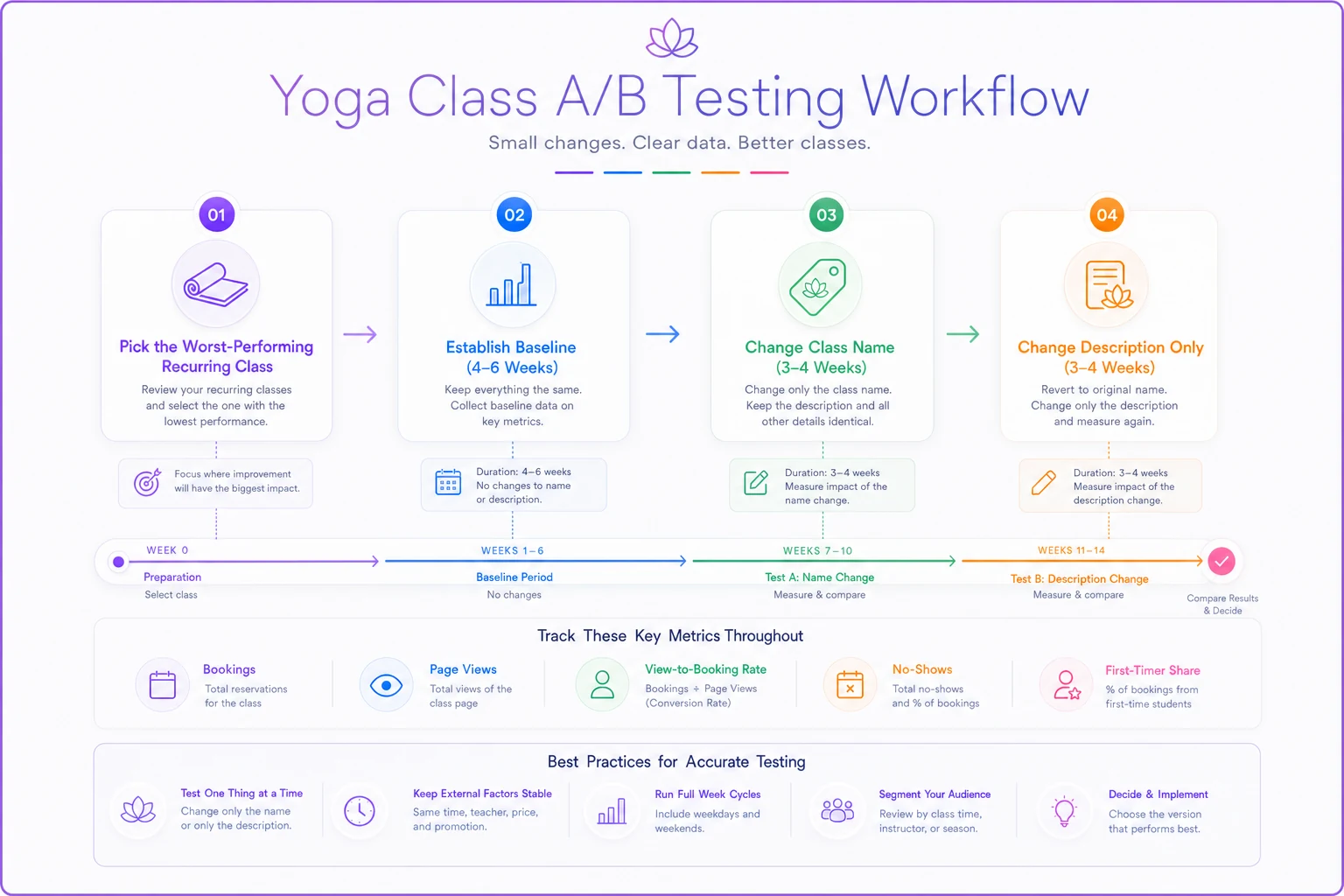
Run the steps in order and keep the changes isolated so you know which variable moved the needle.
A real scenario
A small two-room studio — somewhere around 240 to 280 bookings across their weekly schedule — had a mid-morning "Gentle Flow" running at about 35% full while their evening classes packed out. The time slot wasn't the issue; a different class at the same hour did fine.
They renamed it "Tight Hips & Lower Back — Slow Stretch (Beginner Friendly)" and rewrote the first line to speak directly to desk workers and older students easing back into movement. Everything else stayed the same — same teacher, same time, same room.
Over the following month, that class climbed from the mid-30s in fill rate to somewhere around 55–60%. Not dramatic, not overnight. A couple of the new bookings were regulars who'd shifted over from another class. But the meaningful shift was that first-timers started choosing it, because for the first time the name told them it was for them. No-shows didn't budge, which meant the description was honest about what the class delivered. That's what you're going for: more of the right people, not just more bodies.
When this makes sense — and when it doesn't
Outcome-first naming works best when classes are underperforming for no obvious reason, when your schedule is crowded with similar-sounding titles, or when you're seeing a steady stream of first-timers who don't speak yoga fluently. If that's your situation, this is one of the highest-leverage afternoons you can spend.
It makes less sense to rename classes that are already full — you'll confuse loyal regulars and gain nothing. Don't fix what's booking out. And be careful renaming an advanced class into something that sounds beginner-friendly just to boost numbers. You'll fill it with people who can't keep up, frustrate your regulars, and drive up injuries and refunds. The name has to match what actually happens in the room.
One more situation worth flagging: if the real problem is discovery rather than conversion, better names won't help until the traffic problem is solved first. If people can't find your classes at all, polished copy won't move the needle. That's a different fix — worth reading up on the local SEO mistakes that keep studios invisible before spending time on copy that nobody's reading.
Making the changes stick
Renaming one class is the easy part. Keeping naming consistent as you add workshops, bring in new teachers, and expand the schedule over the next year is where things drift. Six months from now, someone slots "Flow 2 (Advanced)" back into the grid out of habit, and you're right back where you started.
Two things prevent that. First, write down your naming template — the outcome-first structure and your intensity labels — as a simple one-page standard so anyone building the schedule follows the same pattern. Second, tie your naming work to your promo planning so new series and workshops launch with outcome-first titles from day one instead of getting patched up after the fact. If you're already building a 12-month marketing calendar, that's the natural place to lock naming standards in, since every campaign leans on how those classes are titled and described.
Lock naming standards into your 12-month marketing calendar so new series launch with outcome-first titles from day one.
Your class names are the most-read copy you own. They sit on the schedule grid every browser scrolls past, they show up in search results, they land in reminder texts. Getting them to say what the student actually gets — instead of what you're teaching — is a small edit with a long tail. Start with your worst-performing class, change one thing, measure for a month, and let the bookings tell you what to do next.
Your class names are the most-read copy you own. They sit on the schedule grid every browser scrolls past, they show up in search results, they land in reminder texts. Getting them to say what the student actually gets — instead of what you're teaching — is a small edit with a long tail. Start with your worst-performing class, change one thing, measure for a month, and let the bookings tell you what to do next.
Ready to elevate your studio operations?
Join 1,500+ yoga studios using Yoglyly to save time, reduce scheduling conflicts, and enhance member experiences.