


You've got great teachers, a solid space, and classes people genuinely love. Students who find you tend to stick around. But new student numbers stay flat month after month while that mediocre studio three blocks away seems packed every evening.
It's not your studio. It's that potential students can't find you when they search "yoga near me" or "yoga studios in [your neighborhood]." And even when Google does surface your listing, you're buried on page two behind competitors with worse reviews but somehow better local visibility.
Most studio owners assume fixing that means ad spend or hiring a marketing agency. What actually moves the needle is getting the operational basics right and building local partnerships that generate consistent referrals.
Why Google keeps showing everyone else first
Google's local search algorithm weighs hundreds of signals, but the bulk of your ranking comes down to three things: consistency, completeness, and community connections.
Your studio information lives in dozens of places — Google Business Profile, Apple Maps, Yelp, Facebook, Instagram, booking platforms, local directories. When those listings show different hours, addresses, or phone numbers, Google gets confused. That confusion pushes you down.
A studio in Denver couldn't figure out why they ranked poorly despite having a 4.8-star rating with over 120 reviews. Turned out their Google listing said "Suite 200," their website said "2nd Floor," and Yelp had "Unit B." Three versions of the same address. Once they cleaned that up across all platforms, they moved from position 8 to position 3 for "yoga studios downtown Denver" within about six weeks. Not a dramatic overhaul — just boring consistency work.
The other big ranking factor is how often people actually engage with your listing — not just views, but actions. Calling, getting directions, clicking through to your website. Studios with strong local partnerships generate more of these signals because partner employees end up searching for and interacting with your listing directly, often without even realizing it.
The local SEO checklist that actually works
Phase 1: Fix your foundation (Week 1)
Eliminate class scheduling chaos.
Yoglyly helps you book, confirm & manage every class seamlessly.
- Centralized class scheduling
- Member notifications
- Instructor and resource management
No credit card required
-
Claim and verify your listing using the exact business name that appears on your signage and business license.
-
Complete every field - Primary category: "Yoga Studio" — not "Fitness Center" or "Gym" - Secondary categories: Add relevant ones like "Pilates Studio" or "Meditation Center" - Service area: If you offer private sessions or corporate classes - Attributes: Wheelchair accessible, Wi-Fi, parking options - Hours: Include special hours for holidays, teacher trainings, workshops
-
Write a business description that includes your neighborhood name, nearby landmarks, and what makes you different. Keep it under 750 characters but make every word do something.
-
Add photos systematically - Exterior with clear signage - Interior of each practice room - Reception and retail area - Parking or street view - Team photos with names - Students in class (with permission) - Upload a few new photos weekly to signal activity
Upload a few new photos weekly to signal activity.
Phase 2: Expand your presence (Week 2)
-
Apple Maps (critical for iPhone users)
-
Bing Places (powers Alexa and Cortana searches)
-
Yelp (still influences local rankings)
-
Facebook Business Page
-
Instagram Business Profile
-
Nextdoor Business Page
-
ClassPass, Mindbody, or whatever booking platform you use
For each platform:
-
Use identical NAP (Name, Address, Phone)
-
Copy your Google business description
-
Upload the same primary photos
-
Add your website URL with UTM tracking so you can measure where traffic actually comes from
Phase 3: Build location pages on your website (Week 3)
-
Create a dedicated location page with
- Full address with schema markup - Embedded Google Map - Parking instructions with specific street names - Transit directions mentioning nearby stops or stations - Nearby landmarks — parks, shopping centers, major employers
-
Add neighborhood-specific content - "Serving [Neighborhood] since [Year]" - Mention nearby streets and intersections - Reference local events you've participated in - Pull in testimonials that mention the area by name
-
Optimize your class schedule page with neighborhood keywords that feel natural: - "Morning yoga classes in [Neighborhood]" - "After-work vinyasa near [Major Landmark]" - "Weekend workshops in [District Name]"
Phase 4: Generate authentic reviews (Ongoing)
Reviews account for a meaningful chunk of local ranking factors. Most studios don't ask consistently because it feels awkward. So build a system that removes the friction:
-
Text students 48 hours after their first class
-
Email members on their membership anniversary
-
Ask after workshops or special events
-
Build it into your email sequences
Send a direct link to your Google review page. Don't make them search for your business first — that's where most drop-off happens.
Partnership outreach that drives real bookings
Coffee shop partnership script
Subject: Stress relief for your team at [Coffee Shop Name]?
"Hi [Manager Name], I walk by [Coffee Shop Name] most mornings and see how slammed you get during the 7–9am rush. Your team handles it well. I run [Studio Name] two blocks away on [Street Name]. Would your team be interested in a free weekly yoga class built specifically for coffee shop workers? Gentle stretches for tired feet, wrist relief from pulling espresso, back work from being on your feet all day. We could do Tuesday evenings at 7pm when you're closed, or Sunday mornings before you open. Your team gets free weekly classes, and we'd love to leave our schedule at your counter for customers who ask about local fitness options. I'll bring coffee from your shop to the first session. *[Your name]"
Why this works: you're offering something specific that addresses the physical realities of their job, showing you understand their business, and making it easy by fitting around their schedule. "10% off for your customers" is forgettable. "Wrist relief from espresso pulling" is not.
Coffee shops typically refer a handful of new students monthly once staff start attending. More importantly, baristas start recommending you in casual conversation without being asked — which is worth more than any formal referral program.
Gym partnership approach (for non-competing services)
Subject: Recovery sessions for your strength training members?
"Hi [Gym Owner/Manager], [Gym Name] has a great strength training setup but limited recovery or flexibility programming — I've noticed that gap. I run [Studio Name] on [Street Name], focused on recovery-oriented yoga. Would you be open to a partnership where your members get 20% off our restorative and yin classes? These work well for rest days and injury prevention. What we'd offer:
-
20% off all drop-ins
-
Free monthly "Yoga for Lifters" workshop
-
Priority booking for recovery-focused classes
We'd also send anyone asking about strength training directly to you. That question comes up more than you'd think. Could we grab 15 minutes next week? I can bring a simple one-page agreement we can adjust together. *[Your name]"
Active gym partnerships can generate a steady stream of monthly referrals — their members already budget for fitness and understand membership value, so they're easier to convert than cold leads.
Workplace wellness partnership template
Subject: Lunch break wellness for [Company Name] team?
"Hi [HR Manager Name], Does your team deal with the 2pm energy crash? We're [distance/time] from your office and offer 30-minute lunch break yoga sessions built for desk workers. What we can provide:
-
Weekly on-site sessions in your conference room
-
Express 30-minute classes at our studio
-
Discounted memberships for employees
-
Quarterly workshops on stress and burnout
On-site sessions start at $200 for up to 20 employees, or we can build a custom package. Participation usually picks up after the first month once people see what it actually feels like. Happy to bring a sample 15-minute session to your next team meeting if you want to try it before committing. *[Your name]"
Corporate partnerships create predictable revenue — plus individual memberships from employees who want more than the company sessions. The conversion rate on those individual memberships is usually pretty good because they've already experienced your teaching style.
Common partnership mistakes that kill referrals
Offering generic discounts without specific value. "10% off for your customers" is background noise. "Free back pain workshop for your team" gets a response.
Not following up. Send proposals on Tuesday mornings when people are actually planning their week. Follow up once after a week, again after three weeks, then move on. Most studios send one email and give up after the silence.
Not tracking results. Use unique promo codes or landing pages per partner. If a partnership produces fewer than two referrals a month after three months, stop investing time in it.
Making partners do the work. Business cards, QR codes, simple verbal recommendations — that's the level of friction partners will actually tolerate. Don't expect them to pitch your studio.
When local SEO and partnerships actually connect
This is where operational systems start to matter more than most studio owners realize. Your studio dashboard should tell you exactly where new students are coming from — Google searches, partner referrals, walk-ins. If you can't separate those numbers, you're guessing about where to focus.
Studios running AI-powered scheduling and communication platforms have a real advantage here. Review requests go out automatically at the right moment. Partnership referral codes get tracked without manual entry. Corporate students get tagged and followed up differently than drop-ins. The operational software handles the tracking overhead so you can stay focused on building relationships instead of managing spreadsheets.
Below is a simple breakdown of how the referral tracking side of this typically looks when it's working properly:
| Referral Source | Tracking Method | Review Request Timing | Conversion Priority |
|---|---|---|---|
| Google Search | UTM + landing page | 48hrs post first class | Standard |
| Coffee Shop Partner | Promo code at counter | 48hrs post first class | High |
| Gym Partner | Unique landing page | 48hrs post first class | High |
| Corporate Program | Employee tag in CRM | After 2nd session | Medium |
| Walk-in | Front desk intake | 48hrs post first class | Standard |
One studio that ran the full playbook — local SEO cleanup, a few strategic partnerships, automated tracking — saw new student acquisition roughly triple over about four months. Not because they got better at teaching yoga, but because people could finally find them and partners were actively sending referrals. The teaching quality was always there. The infrastructure wasn't.
A quick visual of the referral tracking workflow:
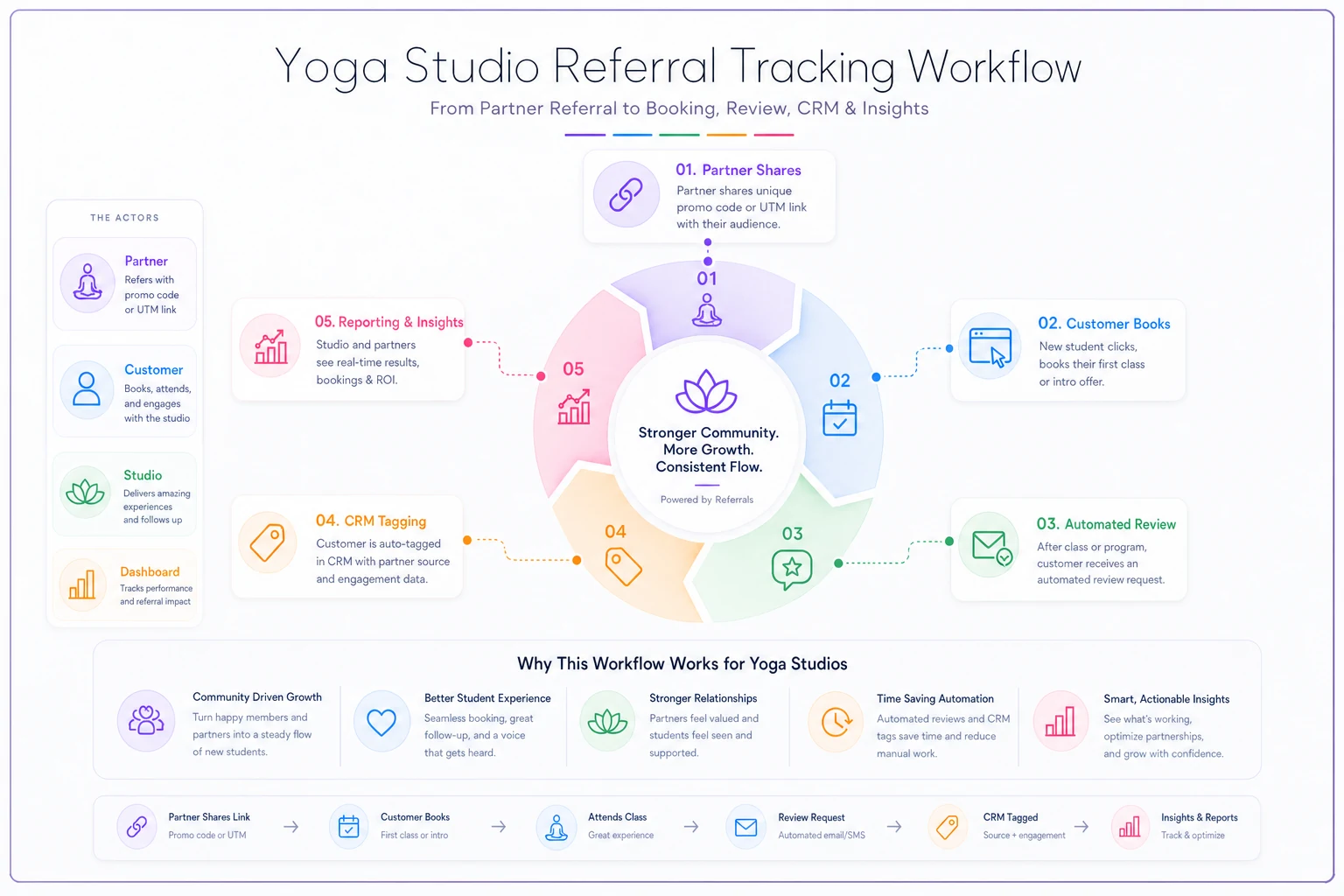
This maps how partner referrals become tracked bookings, reviews, and CRM entries.
The 90-day visibility plan
Getting all of this moving at once is too much. Spread it out across three months so each phase actually gets done properly instead of half-finished across everything.
-
Month 1
Foundation
- Week 1: Google Business Profile optimization - Week 2: Claim all directory listings - Week 3: Website location pages - Week 4: Review request system launch -
Month 2
Partnership development
- Weeks 1–2: Research 10 potential partners - Week 3: Send 5 customized proposals - Week 4: Follow up and get meetings on the calendar -
Month 3
Optimization
- Weeks 1–2: Launch first partnerships - Week 3: Review the numbers, cut what isn't working - Week 4: Add 5 more targets
The studios winning local search aren't always the best studios. They're the most findable and the most connected. Your best classes mean nothing if people can't discover you exist. Fix the SEO foundation, build real partnerships, track everything — and you stop being the neighborhood's best-kept secret.
That studio down the street is winning on visibility, not quality. That's worth fixing.
That studio down the street is winning on visibility, not quality. That's worth fixing.
Ready to elevate your studio operations?
Join 1,500+ yoga studios using Yoglyly to save time, reduce scheduling conflicts, and enhance member experiences.