


Nobody warns you about this: pop-ups don't fail at the event. They fail three weeks before, when your Saturday 9am flow suddenly has a sub because your lead teacher is knee-deep in vendor emails, and your front desk manager is answering DMs about wristband pricing instead of onboarding the four new intro-offer students who walked in that morning.
That's the real risk. The event itself usually goes fine. What quietly breaks is the machine that pays your rent every month — the regular class schedule, the retention flow, the new-student experience. Studio pop-up event planning done badly borrows time and attention from your base operations, and you don't feel the damage until attendance dips two weeks later and nobody can point to why.
So this isn't a "how to throw an amazing festival" post. There are plenty of those. This is about running a 200-person outdoor pop-up or a weekend festival booth without your core studio taking a hit. The whole thing is built around one idea: the event runs on a separate track with its own staffing overlay, its own budget line, and its own revenue attribution — so your regular operations stay boring and predictable while the event does its thing.
The core problem: events cannibalize the base without anyone noticing
Here's the pattern. A studio commits to a big outdoor class at a local park or a booth at a wellness festival. Exciting. The owner and one or two senior instructors get pulled into planning. For roughly six weeks, a chunk of their week goes to logistics — permits, sound, mats, water, insurance riders, coordinating with the festival organizer.
That time doesn't come from nowhere. It comes from the invisible work that keeps a studio healthy:
-
Following up with lapsed students
-
Watching the intro-offer pipeline
-
Covering sub requests fast so classes don't get cancelled
-
Keeping the schedule clean and posted on time
None of that shows up as a fire. It just quietly stops happening. Then a month after your "successful" event, new-student conversions are soft and a handful of regulars have drifted, and it's genuinely hard to connect the two because the event looked like a win.
That's why the fix has to be structural, not motivational. You can't just "try to stay organized." You need the event to live on a track that doesn't touch the people and routines running your base.
The overlay concept: two tracks, not one overloaded team
Think of your event staffing as an overlay on top of your normal roster — not a reshuffle of it. The mistake most studios make is pulling their best regular-schedule people onto event duty, which leaves gaps in the exact classes that generate reliable revenue.
Eliminate class scheduling chaos.
Yoglyly helps you book, confirm & manage every class seamlessly.
- Centralized class scheduling
- Member notifications
- Instructor and resource management
No credit card required
| Track | Owns | Who staffs it | Protected? |
|---|---|---|---|
| Base operations | Regular classes, front desk, subs, new-student flow, retention | Your normal roster, untouched | Yes — sacred |
| Event track | Permits, vendor coordination, event marketing, day-of logistics | Event lead + 1–2 dedicated helpers | No — flexible |
| Shared/on-call | Day-of instructor for the event, extra hands | Contractors or one senior teacher backfilled | Backfill required |
The rule that makes this work: if you pull a regular-schedule instructor to teach the event, you must backfill their classes first — not after. No exceptions. The backfill sub gets confirmed before you confirm the instructor for the event. This one sequencing habit prevents most of the "wait, who's teaching Saturday?" chaos.
A practical note: the "event lead" should almost never be you if you're the owner. Owners get sucked into decisions that don't need them and then can't watch the base. Assign a specific person — even a trusted senior teacher paid a small stipend — whose whole job for eight weeks is the event. Everyone else stays in their lane.
The 8-week readiness checklist
Eight weeks is the sweet spot for a mid-to-large pop-up. Less than six and you're rushing permits and marketing. More than ten and momentum dies. Here's the timeline broken down by what actually needs to happen when.
Weeks 8–7: Foundation and go/no-go
-
Lock the event concept, date, and capacity target (be specific
"120 mats, one 60-min all-levels flow, 5pm Saturday").
-
Confirm the venue, permits, and insurance rider. This is the slowest external thing — start it first.
-
Set the budget line as a separate ledger, not mixed into studio operating costs.
-
Do a real go/no-go
if permits or venue aren't secured by end of week 7, you postpone. Decide the rule now, while you're calm.
Weeks 6–5: Staffing overlay and backfill
-
Assign the event lead and the 1–2 event helpers.
-
Map every regular class in the event window and pre-confirm backfill subs for anyone touching the event.
-
Confirm the day-of instructor(s) and a rain/heat contingency.
Weeks 4–3: Ticketing and marketing
-
Open ticketing with clear rules (more on this below).
-
Launch event marketing — but keep it on a separate channel/segment so it doesn't drown your regular class comms.
-
Brief the front desk on exactly how to answer event questions in under 30 seconds so it doesn't eat their day.
Weeks 2–1: Logistics lockdown
-
Finalize equipment, sound, water, signage, volunteer/staff schedule with call times.
-
Run a 20-minute walkthrough with the event team.
-
Send the "know before you go" message to ticket holders.
Event week:
-
Protect the base. Owner's job this week is watching regular operations, not event minutiae.
-
Post-event
single debrief, reconcile the event ledger within 7 days.
The reason this is structured backward from the event date is that failures almost always happen at the front end — permits and backfill — not day-of. If weeks 8–5 are clean, the rest mostly runs itself.
Ticketing rules that protect your base (and your margins)
Ticketing is where studios accidentally train their members to devalue regular classes. If a festival pop-up is free or nearly free for the public but your members pay $22 a drop-in, you've just made your core product look overpriced to your most loyal people.
A few rules that hold up:
-
Members get a perk, not a giveaway. Free or discounted event access for active members reinforces membership value. But keep it clearly tied to being a member — a benefit, not a bribe.
-
Non-members pay a real price that includes a soft path back to the studio (a QR code intro offer on the wristband or mat tag).
-
Separate the event SKU entirely from your class packs. Don't let event tickets get paid for out of class credits, or your revenue attribution turns to mush and you can't tell what the event actually earned.
-
Cap capacity honestly and sell to it. Overselling a pop-up because "people always no-show" burns trust when 130 people show up for 120 mats.
The devaluation issue is subtle but real. It's closely related to the same logic behind protecting the structure of your paid programs — an event should feed your recurring revenue, not compete with it or make it look expensive by comparison.
Revenue attribution: knowing if the event actually made money
Most studios never calculate the fully-loaded cost of an event honestly — including the base-operations impact.
A typical example. A studio runs a 100-person outdoor pop-up. Direct numbers:
-
Ticket revenue
~$1,800 (100 tickets, mix of member-free and $25 non-member)
-
Permit, venue, sound, water, signage
~$650
-
Day-of instructor + 2 helper stipends
~$400
On paper: ~$750 profit. Feels good.
But then the hidden line: two regular Saturday classes got sub-covered by less experienced teachers because the leads were at the event, and one popular class was cancelled outright. That cancelled class normally does around $180, and the softer subs likely cost a small dip in the following week's rebookings. Call the base-operations hit somewhere around $300–$450 all-in.
Real event profit lands closer to $300–$450 — still positive, but roughly half of what the surface number suggested. Now imagine the same event without a proper backfill overlay, where three classes get cancelled instead of one. That "profitable" pop-up goes underwater fast.
A simple attribution template to run after every event:
-
Direct event revenue (tickets, day-of retail, sponsorships)
-
Minus direct event costs (permits, staff stipends, supplies)
-
Minus base-operations impact (cancelled classes + estimated retention/rebooking dip)
-
Plus attributable new-member value (intro offers from the event that convert — track these with a unique code)
Step 4 is where the real long-term payoff lives. A pop-up that converts even 6–8 new members over the following couple of months is worth far more than its ticket revenue. But you only know that if event tickets and intro-offer codes are tracked separately from your normal flow — which is exactly why keeping the event on its own ledger from week 8 matters. If you want the bigger picture on separating cash streams cleanly, it fits right into a proper monthly financial calendar.
Where scheduling software earns its keep
Most of the failure points above come down to visibility. When your regular schedule and your event staffing live in two different places — a booking system for classes, a spreadsheet or group chat for the event — that's where subs fall through and double-bookings happen.
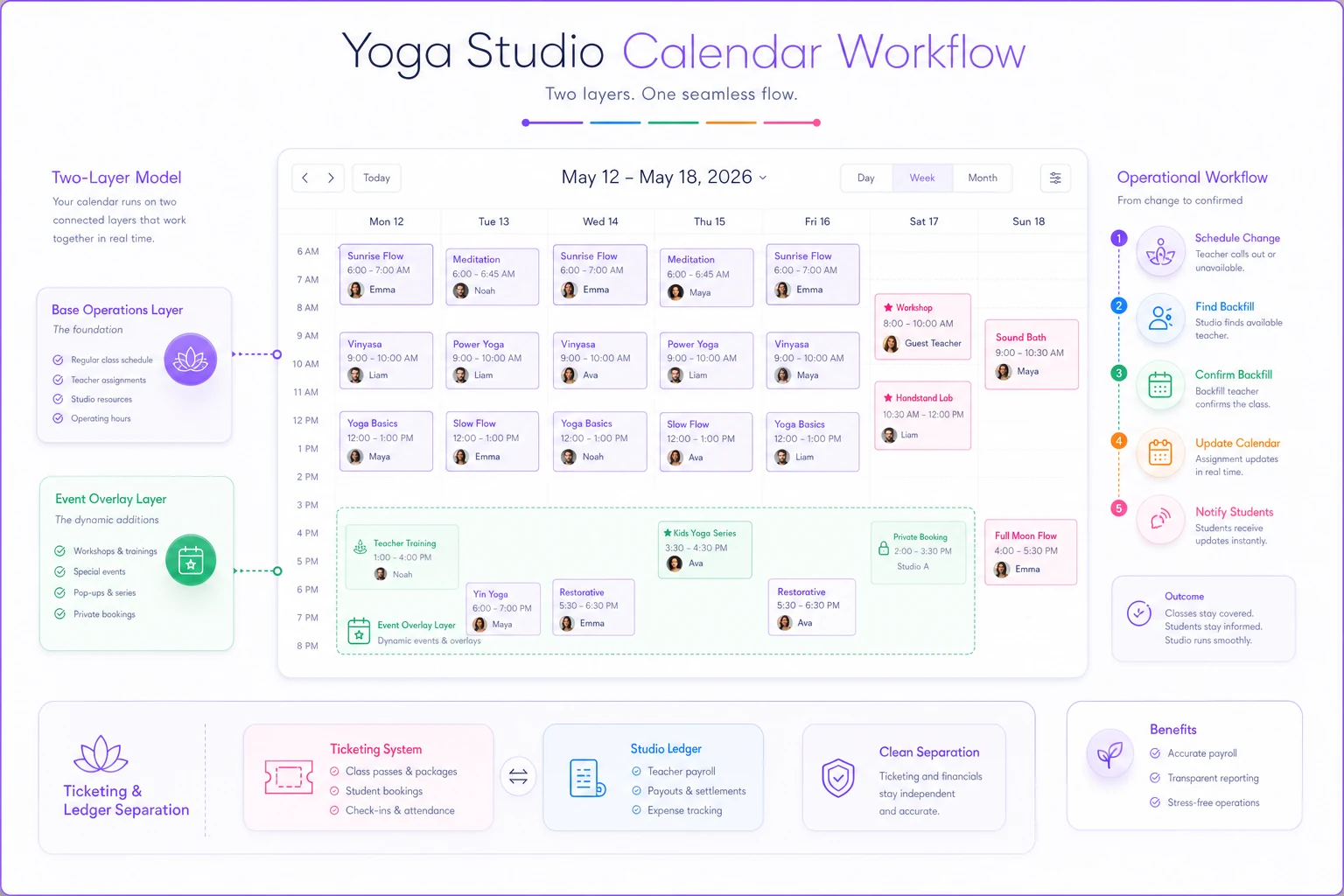
A studio management platform that lets you tag and view an event as a separate layer over your normal calendar removes a lot of this friction. You can see, in one view, which teachers are on event duty Saturday and which of their classes are already backfilled and confirmed. Automated sub-request flows mean the backfill gets locked before the instructor is committed to the event, instead of relying on someone to remember to chase it down. And when ticketing runs through the same system as your memberships, the revenue attribution stops being a manual reconciliation nightmare — the event SKU, the intro-offer conversions, and class credits stay cleanly separated on their own.
Here's a quick visual of the event-as-overlay workflow.
None of this replaces the eight-week discipline.
Tag event shifts and set automated sub-request rules so backfills are confirmed before any instructor is assigned to the event.
It just removes the manual tracking that tends to break under event pressure — which is exactly when people are too busy to catch mistakes by hand.
A quick real scenario
A two-studio operation with around 330 active members decided to run a summer festival pop-up. First year, no overlay: they pulled both lead teachers onto the event, cancelled four classes across the weekend, and never tracked event tickets separately. The event "made money" on paper. But the following month, new-student conversion dipped and a few regulars grumbled about the cancellations. Nobody connected it at the time.
Second year, same event, with a staffing overlay and separate ledger: one event lead, all pulled instructors backfilled before the event was confirmed, event tickets on their own SKU with a QR intro offer. They cancelled zero regular classes. Ticket revenue was about the same — around $1,900 — but roughly 7 new members converted from the wristband intro offer over the next eight weeks, and there was no retention dip. Same event, dramatically different real return. Almost entirely because the base never took the hit.
When a big pop-up makes sense — and when it doesn't
Do it when:
-
Your regular schedule is already stable and you have at least one person who can own the event without abandoning their normal role.
-
You can name a specific business goal — new-member acquisition, community visibility, a sponsorship relationship — not just "it'd be fun."
-
You can secure permits and backfill six-plus weeks out.
Skip it when:
-
You're currently short-staffed on the regular schedule. An event on a fragile roster guarantees cancelled classes.
-
The only person who can lead the event is you, and you're also the one holding base operations together.
-
You can't clearly separate event revenue from class revenue in your systems. If you can't measure it, you can't tell if it worked.
Who should genuinely not do this yet: brand-new studios in their first year, and studios in the middle of a retention problem. Fix the base first. A pop-up amplifies whatever state your operations are in — it won't rescue a wobbly schedule, it'll expose it.
Closing thought
The studios that run great events aren't the ones with the best marketing or the biggest crowds. They're the ones who treated the event as a parallel track and refused to let it touch the machine that pays the bills.
Backfill before you commit. Keep the money on its own ledger. Give one person the event and everyone else their normal job. Do that, and a pop-up becomes a genuine growth channel instead of a fun weekend you quietly pay for a month later.
The studios that run great events aren't the ones with the best marketing or the biggest crowds. They're the ones who treated the event as a parallel track and refused to let it touch the machine that pays the bills.
Backfill before you commit. Keep the money on its own ledger. Give one person the event and everyone else their normal job. Do that, and a pop-up becomes a genuine growth channel instead of a fun weekend you quietly pay for a month later.
Ready to elevate your studio operations?
Join 1,500+ yoga studios using Yoglyly to save time, reduce scheduling conflicts, and enhance member experiences.