


Most studios treat partnerships like weather. Something good happens — a gym down the street sends a few students your way, a corporate wellness manager books a workshop, a physical therapist starts referring people. It feels great, everyone smiles, and then three months later nobody can tell you if it actually made money or where the referrals went.
The gap isn't that studios don't try to partner. It's that they treat each partnership as a one-off favor instead of a channel that needs qualification, structure, and thresholds for when to double down or walk away. A real studio partnership strategy is a system — a repeatable way to decide who's worth your time, how you bring them on, how you track credit, and when a pilot earns the right to become a standing program.
This is the part almost nobody builds. And it's exactly what separates studios that grow through partners from studios that just occasionally get lucky.
Why partnerships stay stuck as favors
The default state of a studio partnership is informal. A yoga teacher knows the owner of a boutique gym, they cross-promote a couple times, and it works okay. The problem is that "works okay" is invisible. There's no scorecard telling you whether that gym partner sends 2 students a month or 20, whether those students stick, or whether the arrangement is worth the free classes you're comping their staff.
Good partnerships and dead-weight ones get treated identically. You keep watering plants that will never grow because you never set up a way to tell them apart. Meanwhile the actually valuable partner — the physical therapy clinic sending post-rehab clients who convert to memberships at a much higher rate — gets the same generic attention as the coffee shop that stuck your flyer in a window.
The other reason partnerships stall: nobody owns them. Marketing thinks the owner handles it. The owner thinks the front desk tracks it. Instructors doing corporate gigs assume someone's following up. So a corporate class that could have turned into an ongoing contract dies because the follow-up lived in someone's head and that head got busy. If you've read the B2B partnerships playbook for turning corporate gigs into recurring revenue, you already know how much money leaks out of that specific gap. This article is the layer above it — the system that governs all your partner relationships, not just corporate.
Start with a qualification scorecard, not a gut feeling
Before you build onboarding packets or attribution rules, you need a filter. Not every partner is worth onboarding, and the biggest waste in studio partnerships is spending equal effort on partners with wildly different potential.
Eliminate class scheduling chaos.
Yoglyly helps you book, confirm & manage every class seamlessly.
- Centralized class scheduling
- Member notifications
- Instructor and resource management
No credit card required
A qualification scorecard is just a short, honest rubric you run every potential partner through before you commit resources. Here's the kind of dimensions that actually predict whether a partner will produce:
| Factor | Weak signal (1) | Strong signal (3) |
|---|---|---|
| Audience overlap | Different demographic, no clear fit | Their clients literally need what you offer next |
| Referral intent quality | "We'll mention you" | Structured referral path (intake form, staff script) |
| Reciprocity | You do all the work | Both sides bring something tangible |
| Volume potential | A handful of people a year | Steady flow tied to their normal operations |
| Retention fit | One-time curiosity visits | Clients who match your best-retaining segment |
| Effort to maintain | Constant hand-holding | Runs mostly on its own after setup |
Score each factor 1–3, add it up. Anything scoring in the top range gets a full onboarding and a real program. Middle scores get a lightweight pilot. Bottom scores get a polite "let's stay in touch" and none of your energy.
The insight most owners miss: retention fit matters more than volume. A partner who sends you 5 students a month who all stick is worth far more than one who sends 25 tire-kickers who never rebook. Physical therapists, prenatal care providers, and running clubs tend to send high-retention referrals because those people already have a concrete reason to keep showing up. A general "wellness fair" almost never does.
When qualification actually matters
If you're onboarding one or two partners a year, a formal scorecard feels like overkill — and it kind of is. This system earns its keep when you have more partnership opportunities than time, which usually hits around the second location or when your reputation gets big enough that people start approaching you. At that point, saying yes to everything quietly drains your team.
Standardize onboarding so partners don't die in week two
The most fragile moment in any partnership is right after both sides agree to it. Everyone's excited, nobody knows exactly what happens next, and momentum leaks out through unanswered questions. "Wait, do we get a discount code or do they?" "Who's making the flyer?" "Is my staff getting free classes or discounted ones?"
An onboarding packet template kills that ambiguity. It's not fancy — it's a repeatable document you customize per partner that covers:
-
What each side is providing (classes, promo space, staff perks, content)
-
The exact referral mechanism — a code, a landing page, a form, a booking link
-
Who the point of contact is on both sides
-
The pilot timeframe and what "success" looks like in numbers
-
Comp and revenue terms in plain language, no assumptions
-
A check-in schedule — usually at the 30 and 60-day marks
Assign a single owner for partner onboarding so the 30- and 60-day check-ins actually happen.
Having this as a template matters because you'll reuse it dozens of times. The first version takes an afternoon to build. Every version after that takes maybe fifteen minutes to adapt. Studios that onboard partners with a consistent packet tend to get those partners actually sending people in days rather than weeks. The ones improvising each time lose the first month to logistics, which is often the whole pilot window.
One practical note on the referral mechanism: if your partner is sending people through word of mouth with no trackable link or code, you have no attribution and no program — you have hope. Even a simple dedicated booking link per partner turns an invisible favor into a measurable channel.
Attribution rules: decide who gets credit before the arguments start
Attribution sounds like a marketing-department problem, but for partnerships it's really about trust and money. If a partner believes they sent you 30 people and your records show 8, that relationship is over. And if you can't tell which channel a student came from, you can't decide where to invest.
The reason this breaks in studios specifically: students touch multiple channels before they book. Someone hears about you from their PT, sees your Instagram, googles you, reads a couple reviews, then books. Who gets credit? If your local search presence is weak, some of those partner-driven students never even find you — which is why fixing the local SEO gaps that keep studios invisible directly affects how many partner referrals actually convert. A great referral still needs to land somewhere findable.
You don't need a data science team. You need clear, written rules everyone agrees on up front:
-
Set a primary attribution rule. Most studios do well with "first meaningful touch" — the partner who introduced the student gets credit, even if the student browses around before booking.
-
Use unique identifiers per partner. A dedicated code, form, or booking link removes almost all the arguing.
-
Ask at intake anyway. A single "How did you hear about us?" field on the first-visit form catches referrals that slipped past your links.
-
Define an attribution window. If a partner-referred person books within, say, 60 days, it counts. After that, it doesn't. Write it down.
-
Reconcile monthly. Compare what partners report to what your system shows, and talk about gaps before they turn into resentment.
The mistake to avoid here is over-engineering. You do not need multi-touch weighted attribution models for a studio managing a few dozen partner referrals a month. Pick one rule, apply it consistently, and spend your energy on the relationships instead of the spreadsheet.
Scaling thresholds: when a pilot earns a program
Every partnership should start as a pilot with a defined window — commonly 60 to 90 days. At the end of that window, you make a decision based on numbers you agreed on in the onboarding packet, not on how much you like the person.
Set thresholds in advance. Something like:
-
Graduate to recurring program the pilot produced enough qualified, retained students to hit your ROI benchmark
-
Extend the pilot once it's trending positive but hasn't hit the bar yet, and you can name a specific reason it'll improve
-
Wind it down it produced little and there's no clear path to more
Partner ROI = (revenue from retained referred students over ~6 months) − (comps, discounts, and staff time to service the partnership)
A partner passing the bar isn't just one who sends people — it's one where the students who came through them are still around at month three and covering the cost of the arrangement several times over. Be honest about the comp side. Free classes for a partner's entire staff aren't free; if you're comping 20 spots a month in classes that would otherwise sell, that's real foregone revenue that belongs in the math.
A short worked example
A studio ran a 90-day pilot with a nearby prenatal clinic. The clinic added a small line to their post-appointment handout and gave patients a dedicated booking link. Over the pilot, roughly 18 students came through, and about 11 were still attending at the three-month mark — a much stronger retention rate than the studio's paid social traffic, which tended to churn hard after the intro offer.
The cost side was modest: a handful of comped classes for clinic staff and maybe two hours a month of coordination. Against that, the retained students were generating somewhere around $1,600–$2,000 a month in recurring membership revenue. Easy call — the pilot graduated into a standing program with quarterly check-ins and a small referral incentive for the clinic.
Compare that to a gym cross-promo the same studio ran around the same time, which sent a similar headcount but almost nobody stuck. That one got wound down, and nobody's feelings needed to be hurt because the threshold had been agreed to on day one.
How the pieces connect as you scale
[Scorecard] → [Onboarding Packet] → [Attribution Tracking] → [Scaling Threshold Decision]
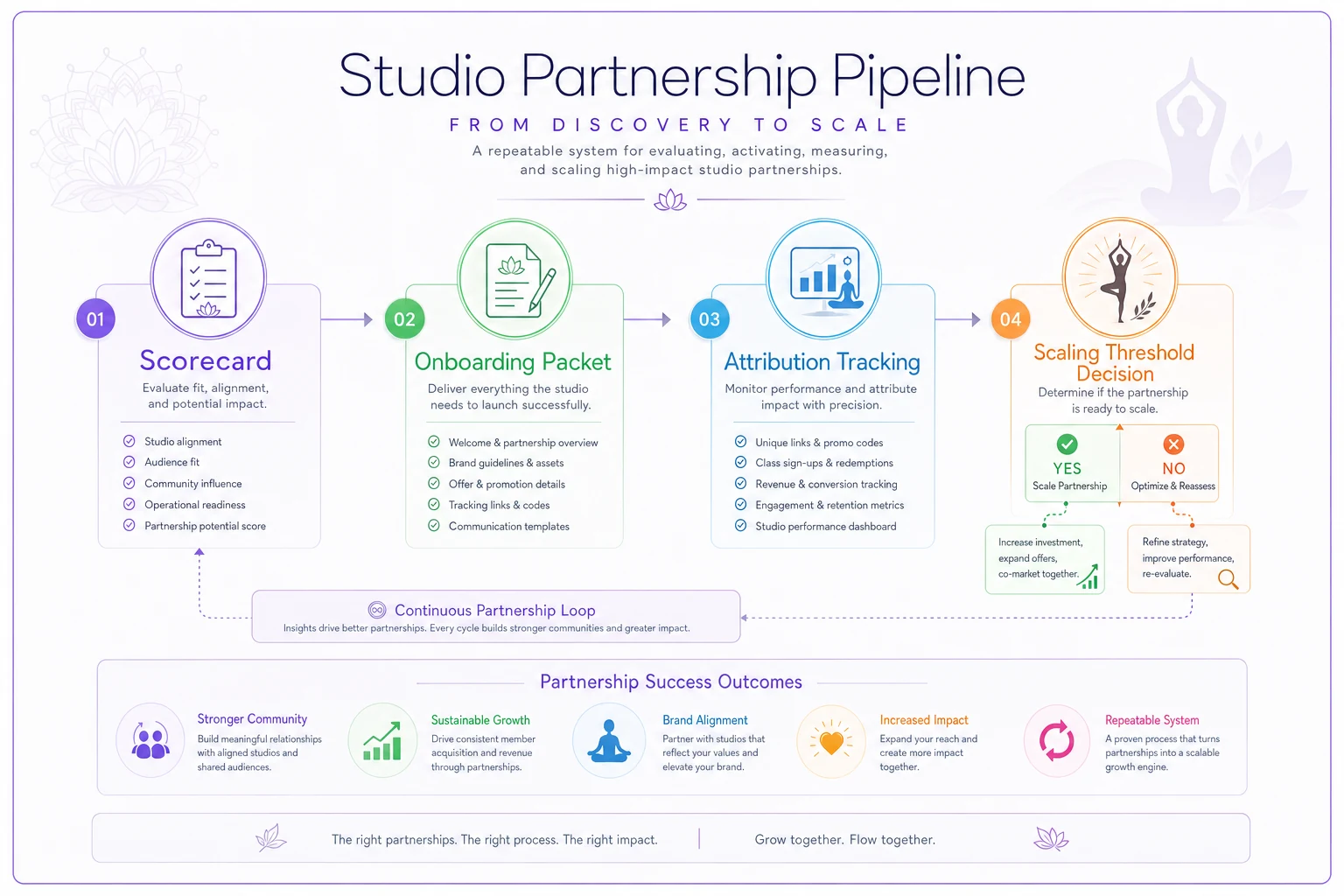
This shows the pipeline and how each stage feeds the next.
The scorecard decides who enters the pipeline. The onboarding packet gets them live quickly and sets the terms. Attribution rules make their results visible. Scaling thresholds decide what happens next based on those visible results. Break any link and the whole thing degrades — a great partner with no attribution looks like a failure, and a bad partner with sloppy tracking can look like a winner and quietly bleed you.
At one location with a couple of partners, you can run all of this in a spreadsheet and your own memory. The system starts to strain around eight or ten active partnerships across multiple locations. That's when partner codes get reused by accident, check-ins get skipped, and comped-class costs stop getting counted. This is where studios lean on their booking and CRM setup to carry the weight — tagging students by partner source at intake, tracking retention by cohort, flagging when a pilot window is closing so a real decision gets made instead of the partnership just drifting. The tooling isn't the strategy; it's what keeps the strategy from collapsing under its own volume.
Who should not build this out yet
If you're a single-location studio with one informal partner and plenty of open capacity, this is premature. You'd spend more time building scorecards than you'd save. Fill your classes first, tighten your first-timer experience, get retention solid — a leaky studio makes every partnership look worse than it is, because the students partners send you churn out the back door.
This system is for studios that either have more partnership opportunities than they can properly evaluate, or that are actively trying to make partnerships a real growth channel rather than a nice occasional surprise. If a partner asked you today "How many of the people I sent are still coming?" and you couldn't answer — that's the signal you've outgrown the informal approach.
Bringing it together
Partnerships fail quietly. There's rarely a blowup — just a slow fade where the flyers go stale, the corporate class never repeats, and nobody notices the channel died because nobody was measuring it in the first place. The studios that actually scale through partners aren't the friendliest or the best-connected. They're the ones who built a way to tell good partners from bad ones, get them running fast, track who's actually producing, and make unsentimental decisions when the pilot window closes.
Build the scorecard. Standardize the onboarding. Write down the attribution rules. Set the thresholds before you start. Do that, and partnerships stop being weather you wait on and become a channel you can actually steer.
Ready to elevate your studio operations?
Join 1,500+ yoga studios using Yoglyly to save time, reduce scheduling conflicts, and enhance member experiences.