



Most studios don't outgrow their space. They outgrow their org chart — which usually doesn't exist on paper anyway.
When you're running one location, the structure lives in your head. You know who's reliable, who can cover a Sunday morning, who's ready to teach a workshop, and who still needs a few more months. The problem shows up the moment you open a second site. Suddenly the knowledge that used to live in your head has to live somewhere else, because you physically can't be in two rooms at once. That's where a lot of studios stall — not because demand dried up, but because the way roles, promotions, and pay were "decided" no longer works when two, three, or five sites are all making their own quiet judgment calls.
This is really what multi-site studio organizational design is about. Not a fancy hierarchy chart. A repeatable way to define roles, move people up, and connect what someone is certified to do with what they're actually scheduled to do — consistently, across every location.
The real problem: informal structure doesn't copy-paste
A pattern that comes up constantly: a studio owner opens site two and hires a lead instructor to "kind of run things." No title definition, no clear scope, just trust. It works for a while because that person is good. Then site three opens with a different lead who interprets the role completely differently. One treats it like a full manager position. The other thinks they're just a senior teacher who occasionally handles the schedule.
Six months later, you've got two locations with wildly different standards, pay expectations, and promotion timelines — and nobody did anything wrong. There was just never a shared definition of what any role is.
The deeper issue is that studios grow through people, not process. Your best teacher becomes the unofficial manager. The front-desk person who's been around longest becomes the de facto trainer. These promotions happen by gravity, not design. Fine at one site. Across multiple sites it creates drift — every location slowly develops its own culture, its own quality bar, its own idea of who deserves what.
Start with a role taxonomy, not a hierarchy
Before you draw boxes and reporting lines, get specific about categories of work. A role taxonomy is just a clean way of grouping what people actually do so you can build ladders on top of it.
Eliminate class scheduling chaos.
Yoglyly helps you book, confirm & manage every class seamlessly.
- Centralized class scheduling
- Member notifications
- Instructor and resource management
No credit card required
-
Teaching — the instruction itself, from newer teachers to senior/master-level
-
Studio operations — front desk, scheduling, member experience, facility
-
Location leadership — someone accountable for a single site's numbers and team
-
Cross-site / craft leadership — people who own quality and consistency across locations (more on this below)
The mistake most owners make is collapsing all of this into "instructor" and "manager." That's too coarse. A senior teacher who mentors others is doing fundamentally different work than a location lead who owns retention and payroll for a site — even if they earn similar money. When the taxonomy is vague, promotions become arguments, because nobody agreed on what the next rung actually requires.
A cleaner taxonomy also makes hiring saner. When you post a role, you know exactly which family it belongs to and what the level above and below looks like. You're building slots that outlast whoever currently fills them.
Centers of excellence: how you keep quality consistent across sites
Once you have more than two locations, you need people who own a discipline rather than a building. Larger operations call this a "center of excellence," which sounds corporate until you see the problem it solves.
Say you have four studios. Who decides how new teachers get trained? Who sets the standard for what a Level 2 vinyasa class should actually feel like? Who audits whether your beginner series is being taught consistently at Location A versus Location D? If the answer is "each location handles its own," you don't have a brand — you have four studios that share a logo.
-
A Teaching Standards lead who owns curriculum, teacher onboarding, and class-quality audits
-
A Member Experience lead who owns the front-desk playbook, first-timer flow, and retention rituals
-
A Scheduling/Capacity lead who owns how classes get built and staffed everywhere
Make centers of excellence part-time roles with clear deliverables so they can actually drive consistency.
These aren't full-time executive jobs at a five-location studio. Often it's 20–30% of a senior person's week, with the rest spent teaching or managing a site. The value is that consistency now has an owner. When something works at one location, there's a person whose job is to spread it to the others — instead of hoping it travels by word of mouth.
Career-ladder templates that people can actually see
There's a quiet reason good instructors leave multi-site studios: they can't see a future. At a single studio, ambition and the owner's attention keep people motivated. Across five sites, a talented teacher at Location C might feel completely invisible — no idea what "the next level" even means or whether it exists.
A career-ladder template fixes this by making progression legible. Each rung should spell out three things: what you're expected to do, what you need to be certified/qualified to do it, and what you earn. Keep it boring and clear.
| Level | Scope | Requirements | Typical pay signal |
|---|---|---|---|
| Instructor I | Teaches core scheduled classes | 200-hr cert, cleared observation | Base per-class rate |
| Instructor II | Teaches core + one specialty format | 12+ months, format certification, retention meets bar | +10–15% per class |
| Senior Instructor | Teaches specialty + mentors new hires | 500-hr or equivalent, strong reviews, co-teaching sign-offs | Higher rate + mentor stipend |
| Lead / Standards | Owns a format or trains teachers across sites | Proven senior track record, audit responsibility | Salary component or retainer |
The exact numbers depend on your market and margins — the point is the shape. Someone at Instructor I should be able to look at this and know precisely what Instructor II demands. No mystery, no favoritism accusations, no quiet resentment about why someone else got promoted spreading across a team at multiple locations.
The developmental side of this — building mentorship progressions and pay triggers that feed a ladder — is covered in more depth in the instructor capacity workforce lifecycle playbook, which pairs well with the structural view here.
Where it usually breaks: certification and scheduling live in different worlds
This is the part almost everyone gets wrong, and it's where the whole system quietly falls apart at scale.
You have credentials on one side — who's certified for prenatal, who's cleared to teach Level 2, who finished the aerial training. And you have scheduling on the other — who's actually being put on the calendar for those classes. At one location, the manager just knows the overlap. At five locations, that knowledge is scattered and mistakes creep in.
The typical failure looks like this: a new manager at Location E schedules a teacher for a heated Level 2 class because they're available and enthusiastic — not realizing that teacher only completed Level 1 certification. Nobody's being reckless. The certification info lives in an onboarding folder somewhere, and the scheduling happens in a totally different tool. The two never talk.
The fix is a rule, not a reminder: certification should gate scheduling. A teacher shouldn't be schedulable for a class format they aren't credentialed for — full stop. When that connection is enforced systematically, you stop relying on any individual manager's memory. This is where operational software actually earns its keep — the credential record and the schedule aren't separate documents anymore. The platform simply won't let you assign someone to a class they're not qualified to teach, and it flags credentials that are expiring before they lapse.
That single link — credential-to-schedule — removes an entire category of quiet errors that multiply with every new site.
A simple process for connecting credentials to deployment
A workflow that keeps certification and scheduling honest across locations:
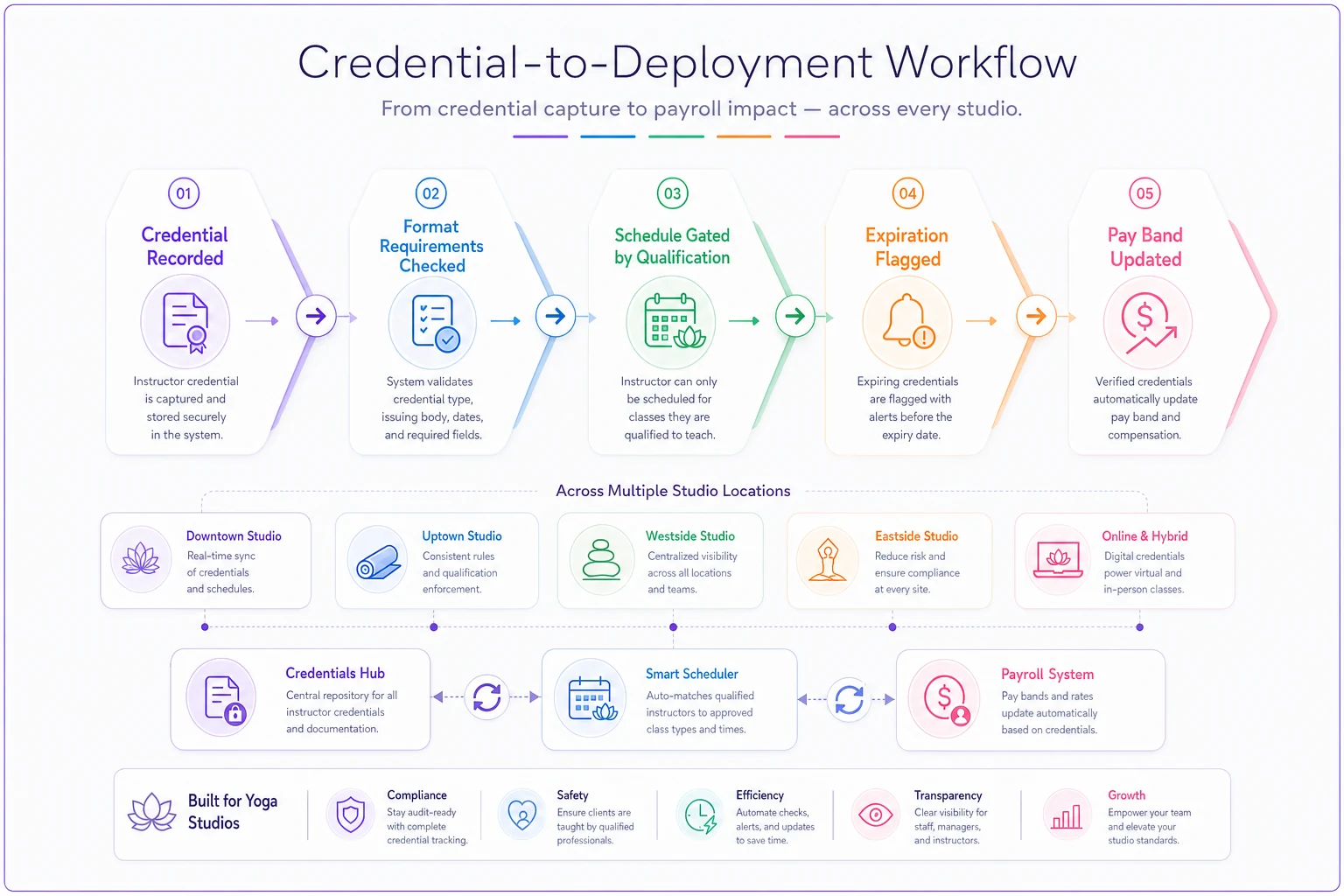
Follow these steps:
-
Define required credentials per class format. Every format on your schedule (beginner flow, heated, prenatal, aerial, Level 2) gets a list of what a teacher must hold to lead it.
-
Record credentials at the person level, once. Each instructor's certifications live in one place, with dates and expirations — not in a per-location spreadsheet.
-
Gate scheduling by qualification. When a manager at any site builds the calendar, only qualified teachers appear as options for that format.
-
Flag expirations before they hit. Certifications like CPR or specialty renewals should warn you 30–60 days out, so no one gets pulled from the schedule at the last minute.
-
Tie the credential to the pay band automatically. When someone earns a new certification that unlocks a higher-rate format, the ladder and pay should update in step — not three payroll cycles later after they have to ask.
That last step matters more than people expect. When credentials unlock pay but the update lags, teachers lose trust in the whole ladder. The system starts to feel arbitrary, which is exactly what you built the ladder to avoid. Getting the workflow right is what separates a career ladder that actually changes behavior from one that just looks good in a handbook.
Pay bands: linking what someone can do to what they earn
Pay bands are just ranges attached to each rung. Their real job in a multi-site studio isn't to be generous or stingy — it's to be consistent. The worst thing that happens without them is a strong teacher discovering that a peer at another location earns meaningfully more for the same work. Nothing erodes a multi-site culture faster.
-
Each ladder level gets a band, not a single number (a range with room for tenure and performance)
-
Movement within a band is about experience and reviews
-
Movement between bands requires meeting the next rung's defined requirements — including credentials
Linking pay to operational deployment specifically keeps the math honest. You're not paying for a certificate on the wall; you're paying for what that certificate lets someone actually do on the schedule. A prenatal certification only earns the prenatal rate when the teacher is actually being deployed for prenatal classes. That distinction protects your margins while still rewarding growth.
For the deeper financial mechanics — how to structure rates and revenue share without quietly destroying your margins as you add sites — the compensation and revenue-share models breakdown walks through worked examples that plug directly into these bands.
A real scenario: three studios, one messy structure
A studio group with three locations hit their second year of expansion with a familiar problem. Each site had grown its own leadership organically. Location one paid senior teachers on an old handshake rate. Location two had a "manager" doing full ops for barely more than a teaching rate. Location three had two people who both thought they were in charge.
The visible symptom was turnover — roughly one solid instructor per quarter walking out, and exit conversations kept circling the same themes: no clear path, and a nagging sense that pay depended on which building you happened to work in.
They spent about six weeks doing unglamorous work: writing a four-family role taxonomy, defining four teaching rungs with real requirements, setting pay bands that applied across all three sites. They designated one person as the teaching-standards owner across locations. Then they connected credentials to scheduling so no one could be booked for a format they weren't cleared to teach.
The change wasn't dramatic overnight. But over the following two quarters, unplanned instructor departures dropped noticeably, and the arguments about "why does that site get more" basically stopped. The bigger win was quieter — when they opened a fourth location later that year, they weren't inventing the org structure again. They copied it.
When this level of structure actually makes sense
You don't need any of this at one location. Formal ladders, centers of excellence, and pay bands are overhead — and overhead you don't need yet is just friction.
This makes sense when:
-
You're running two or more locations, or planning to within a year
-
You've caught yourself making inconsistent pay or promotion decisions across sites
-
You're losing good people who couldn't see a future
-
New managers are interpreting roles differently at each site
This is probably premature when:
-
You have one location and no near-term expansion plans
-
Your team is under eight or so people and everyone already knows the deal
-
You'd be building structure for a scale you're not actually approaching
One thing worth saying directly: don't try to solve a culture or trust problem with an org chart. Structure clarifies expectations; it doesn't fix a broken relationship with your team. If the underlying issue is that people don't trust how decisions get made, a ladder alone won't rescue it — though transparent, consistent rules do help rebuild that trust over time.
Bringing it together
The reason multi-site studios struggle with roles is pretty straightforward: structure that was implicit at one location has to become explicit at several. Your role taxonomy gives you clean categories. Career ladders make progression visible. Centers of excellence keep quality from drifting site to site. And the credential-to-scheduling-to-pay chain is the connective tissue that stops small coordination failures from multiplying every time you add a location.
None of this has to be elaborate. A studio group with five sites can run on a one-page taxonomy, a simple four-rung ladder, clear pay bands, and one rule that certification gates the schedule. What matters is that it's written down, applied the same way everywhere, and light enough that people actually follow it. The studios that scale cleanly aren't the ones with the most sophisticated org charts — they're the ones whose structure is simple enough to copy into the next location without the owner in the room.
None of this has to be elaborate. A studio group with five sites can run on a one-page taxonomy, a simple four-rung ladder, clear pay bands, and one rule that certification gates the schedule. What matters is that it's written down, applied the same way everywhere, and light enough that people actually follow it. The studios that scale cleanly aren't the ones with the most sophisticated org charts — they're the ones whose structure is simple enough to copy into the next location without the owner in the room.
Ready to elevate your studio operations?
Join 1,500+ yoga studios using Yoglyly to save time, reduce scheduling conflicts, and enhance member experiences.