


The first studio runs on the owner's brain. You know every teacher's availability, which regulars are about to churn, why the 6am Vinyasa keeps under-filling, and who to call when the boiler dies. That works beautifully at one location. It becomes the single biggest liability the moment you open a second.
Scaling yoga studio organizational design isn't really about hiring more people. It's about deciding where decisions live. Most owners get this wrong in a predictable way: they clone the first studio's staffing and hope the systems catch up later. They never do. The owner becomes a bottleneck sitting between two locations, answering the same twelve questions from two managers instead of one, and the "growth" quietly makes the business worse to run.
This piece is about the design underneath the growth — how you split HQ from site, what to centralize versus leave local, who to hire first, and the governance rituals that keep handoffs clean as you move from 1 to 10.
The real problem isn't people — it's undefined ownership
Here's the pattern that shows up again and again in multi-site studios. Nothing is technically broken. There's a schedule, there are teachers, there's a booking system. But every non-routine decision — a substitute request, a refund, a workshop pricing question, a broken card reader — still routes back to the owner. The org has grown but the decision map hasn't.
At one location, that centralization is actually a feature. The owner is fast, consistent, and cheap (they don't pay themselves for it). At three locations, the same instinct creates a queue. Two managers waiting on one person for approvals is a traffic jam that gets worse with every site you add. The math is brutal: if each new location generates even 15–20 small decisions a week that "need the owner," you hit a wall somewhere around studio #3 where the owner is doing nothing but triage.
So the first design principle: scaling is the act of deciding what you'll stop deciding. Everything else — org charts, hiring order, RACI — is just formalizing that choice.
HQ vs. site: draw the two diagrams before you hire anyone
Most studio owners think in terms of one org chart. You need two. One for HQ (the functions that serve all locations) and one for a single site (the template that repeats at every location). Keeping them separate is what stops you from accidentally duplicating overhead ten times over.
Eliminate class scheduling chaos.
Yoglyly helps you book, confirm & manage every class seamlessly.
- Centralized class scheduling
- Member notifications
- Instructor and resource management
No credit card required
The site diagram is the easy one because it repeats. A typical single-site structure looks like:
-
- Studio Manager (owns the physical space, the daily schedule, front-desk staff, local member experience)
-
- Lead Instructor / Teacher team (delivery)
-
- Front desk / member services (check-in, retail, first-timer handling)
That's it. Deliberately thin. The site should not carry marketing, finance, HR, or tech decisions. Those belong to HQ.
The HQ diagram is where owners overbuild or underbuild. Early on, HQ is the owner wearing five hats. That's fine — the point is to label the hats so you can hand them off one at a time. A realistic HQ function map for a studio scaling past three sites:
| Function | Lives at HQ or Site? | Why |
|---|---|---|
| Brand & marketing | HQ | Consistency across locations; one voice, one funnel |
| Pricing & memberships | HQ | Prevents price drift and margin erosion between sites |
| Payroll, taxes, insurance | HQ | Compliance and error risk scale badly if local |
| Hiring policy & pay bands | HQ | Fairness and cost control across the network |
| Tech stack & data | HQ | One source of truth beats five disconnected systems |
| Daily scheduling | Site (within HQ rules) | Local knowledge matters; policy is central |
| Substitute coverage | Site first, HQ pool as backup | Speed at the site, resilience across the network |
| Member complaints | Site (escalation path to HQ) | Handle locally, escalate exceptions |
| Facilities / vendors | Site (within HQ contracts) | Local execution, central purchasing power |
The column that matters most is the middle one. Notice how many functions are HQ-owned but site-executed. That gray zone — central policy, local action — is where handoffs break if you don't get specific. "Scheduling is local" and "scheduling follows central rotation rules" are two very different operating models, and confusing them is exactly what causes the chaos covered in multi-location scheduling: rotation policies, shared waitlists and revenue rules.
Here's a simple visual to think about the handoff flow between HQ policy and site action.
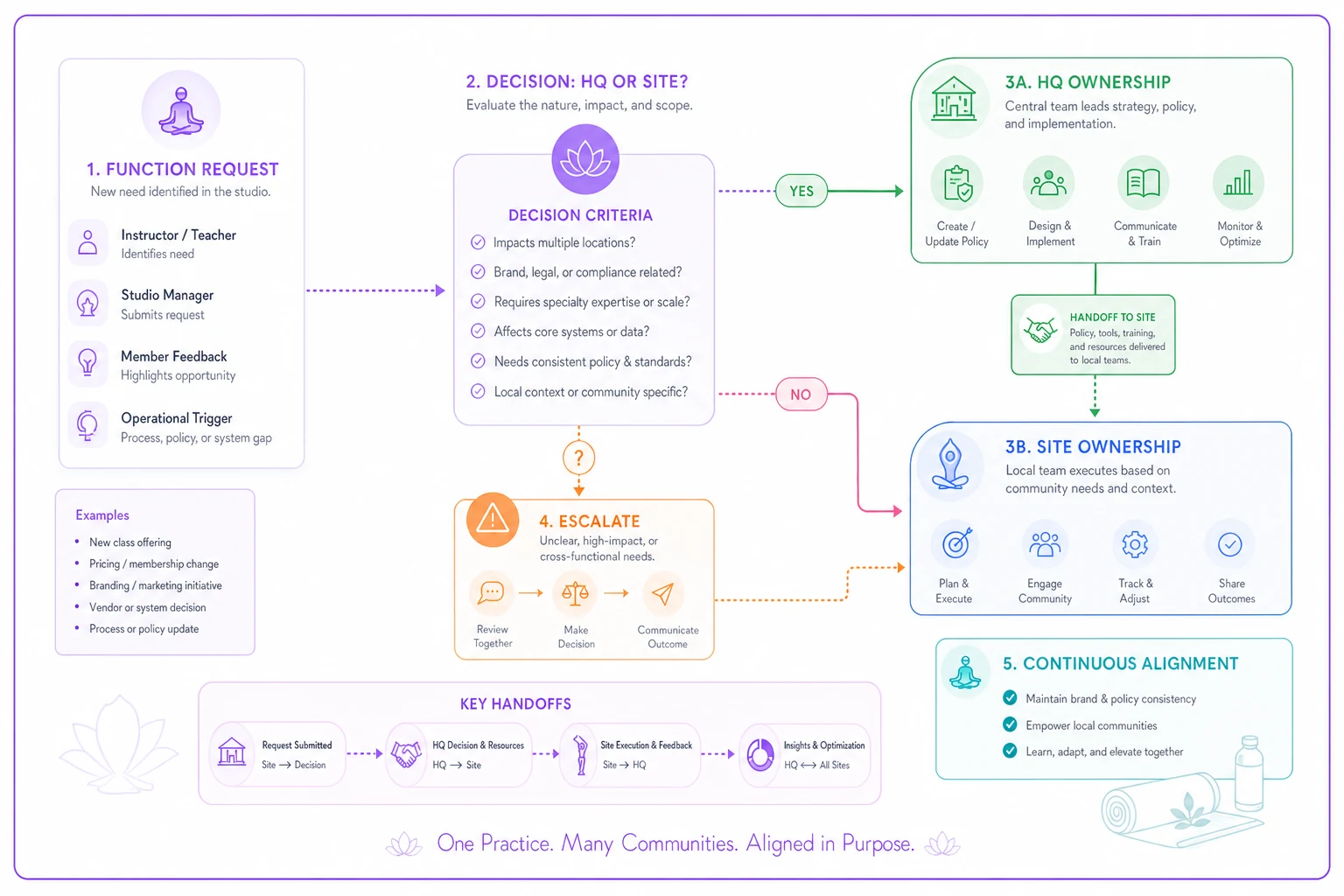
The graphic highlights the decision points: centralize policy, allow local execution, and define clear escalation thresholds.
The prioritized first-hire checklist (in the order that actually reduces owner load)
The mistake here is hiring for the loudest pain instead of the biggest bottleneck. Owners tend to hire another teacher because classes feel understaffed, when the thing actually strangling them is administrative. Teachers add capacity to deliver; they don't take decisions off your plate.
Hire in the order that removes you from the critical path:
-
Studio Manager for location #1 (before you open #2). This is the non-negotiable first hire. You cannot run two sites if you're still personally running one. Open the second location before someone else can fully run the first and you've built two half-managed studios instead of one scalable system.
-
A second Studio Manager (for location #2). Same role, cloned. If the role is well-defined, the second hire is dramatically easier to fill and onboard than the first.
-
An Operations/Area lead once you hit 3 sites. This person sits between HQ and the site managers so approvals don't all funnel to the owner. Most owners delay this hire by at least one location.
-
Finance/bookkeeping support (part-time or fractional first). Payroll and reconciliation errors compound across locations. This becomes urgent once you're running multi-site payroll.
-
Marketing owner around 4–5 sites, when local ad-hoc promos start cannibalizing each other and the brand gets inconsistent.
-
People/HR function as headcount crosses roughly 25–30 staff, when hiring, scheduling policy, and compliance become a real job rather than a recurring task.
The tell that you hired in the wrong order: you added headcount and your own week didn't get lighter. That means you hired capacity, not delegation.
One more thing worth flagging — your teacher bench is its own system, separate from this management ladder. How you develop, pay, and retain instructors across sites deserves its own structure, which is the focus of a workforce lifecycle playbook for hiring, pay and development. The org chart above assumes that bench exists and is healthy.
Shared services: a decision tree for what to centralize
Every function eventually forces the same question: do we run this once at HQ, or repeat it five times at the sites? Getting this wrong in either direction is expensive. Over-centralize and sites feel powerless and slow. Under-centralize and you're paying for the same overhead multiple times with slightly different versions of it at each location.
A practical decision tree — ask these in order for any function:
-
Does inconsistency here hurt the brand or the numbers? (Pricing, brand voice, member data → yes → centralize.)
-
Does it need local knowledge to do well? (Daily schedule tweaks, knowing which regulars are flaky → yes → keep local, within central rules.)
-
Does the error risk scale badly? (Payroll, tax, insurance → yes → centralize hard.)
-
Is it cheaper to buy once for the network? (Software, vendor contracts, insurance → yes → central purchasing, local use.)
-
Does speed at the site matter more than consistency? (Sub coverage in the next two hours, a member complaint at the desk → yes → local decision, escalate exceptions.)
The nuance most owners miss: centralizing the policy is not the same as centralizing the action. You want pricing decided centrally but sold locally. You want sub coverage handled locally but backed by a central pool. Draw the line at the decision, not the task, and most of the confusion disappears.
When centralizing is a bad idea
Centralize too early and you build HQ overhead before you have the revenue to carry it. At two locations, you probably don't need a full-time marketing hire or an HR department — you need clear policies the managers can actually follow. Structure should trail slightly behind need, not lead it by two years. The studios that get into real trouble aren't the under-built ones; they're the ones carrying a heavy HQ cost structure across three studios that can't cover it.
RACI, but the version studios actually use
RACI (Responsible, Accountable, Consulted, Informed) sounds like corporate overkill until you've watched a refund get issued twice because two people each thought the other one owned it. At scale, ambiguity isn't a personality problem — it's a missing table.
Keep it simple. For studios, the two columns that cause most of the pain are Accountable (the one person who owns the outcome) and Consulted (who has to be looped in before it happens). A workable slice of a studio RACI:
| Decision | Responsible | Accountable | Consulted | Informed |
|---|---|---|---|---|
| New teacher hire at a site | Studio Manager | Area/Ops Lead | HQ (pay band) | Owner |
| Membership refund > $X | Front desk | Studio Manager | — | Ops Lead |
| Schedule change (recurring class) | Studio Manager | Ops Lead | HQ (capacity/revenue rules) | Owner |
| Local promo / discount | Studio Manager | Marketing | Ops Lead | Owner |
| Vendor / facilities repair under $Y | Studio Manager | Studio Manager | — | Ops Lead |
The single most useful rule: exactly one name in the Accountable column, every time. Two accountable people means zero accountable people. Set dollar thresholds so the small stuff never travels up the chain — a manager who has to ask permission for a $40 refund is a manager you're not really using.
Governance rituals that keep the whole thing from drifting
Structure decays without rhythm. You can draw perfect diagrams and they'll be stale in a quarter unless there are recurring moments where the org actually runs on them. The rituals matter more than the documents.
A lean cadence that scales cleanly:
-
Weekly site huddle (15 min, per location). Studio Manager + team. Covers the coming week's coverage, at-risk classes, member issues. Stays local.
-
Weekly Ops sync (30 min). Ops/Area lead with all Studio Managers. Surfaces cross-site issues, shared waitlist decisions, patterns worth escalating. This is where site-level noise gets filtered before it hits the owner.
-
Monthly business review (60–90 min). Owner + Ops + Finance + Marketing. Numbers, hiring pipeline, anything that crosses functions. Once the structure matures, this is the only regular meeting the owner really needs to be in.
-
Quarterly org check. Revisit the HQ/site diagrams and RACI. What's routing to the owner that shouldn't be? What role is overloaded? Adjust before it breaks.
The failure mode here is having only the monthly meeting and nothing beneath it. Every small cross-site issue then waits three weeks or jumps straight to the owner's phone. The weekly Ops sync is the pressure valve — it's the ritual most single-owner studios skip and most well-run chains treat as non-negotiable.
A real scenario: three studios, one exhausted owner
A studio group ran three locations across a mid-size metro — roughly 900 active members, about 55 classes a week across the sites. On paper it was healthy. In practice the owner was fielding somewhere around 40–50 messages a day: sub requests, refund approvals, "can we run this promo," "the app double-booked someone."
The org chart existed but it was decorative. Each location had a "manager," but every one of them had learned that the fastest way to resolve anything was to text the owner. There was no Ops layer, no thresholds, no RACI. The managers weren't underperforming — they'd never been given the authority to decide.
The fix wasn't more staff. They defined dollar thresholds so managers could approve refunds and repairs under a set amount without asking, promoted the strongest Studio Manager into an Area/Ops role to absorb cross-site questions, and stood up the weekly Ops sync. Within a couple of months the owner's daily message volume dropped from that 40–50 range down to somewhere around 15–20, most of it genuinely strategic. Revenue didn't spike overnight — that wasn't the point. The owner got back roughly a day and a half a week, and opening location #4 stopped feeling impossible. The system could carry it, not just the owner.
What changes at each stage of growth
The design isn't static. What's correct at two locations is wrong at six. A rough map of the transitions:
-
1 location Owner is HQ and site. Don't build structure you don't need. Just start writing down how you decide things.
-
2 locations First Studio Manager must be able to run a site without you. Policies get written because now they have to be repeated.
-
3 locations The Ops/Area layer appears. This is the hardest transition — the moment the owner has to stop being the router.
-
4–6 locations Functional HQ roles (marketing, finance) become real jobs. Shared services solidify.
-
7–10 locations HQ is a genuine org. Area leads may each own a cluster of sites. The owner's job is now almost entirely governance and capital allocation.
Owners who scale cleanly treat each transition as a deliberate redesign, not a gradual drift. The ones who struggle keep bolting people onto a one-location org and wonder why every new site makes the whole thing feel heavier.
Where the systems have to connect
None of these pieces work in isolation, and that's what generic org-chart advice always misses. Your hiring order depends on your RACI. Your RACI depends on your HQ/site split. Your shared-services decisions depend on which functions you centralized. And all of it depends on governance rituals actually running, because a decision map nobody meets to enforce is just a nice PDF.
The through-line is this: scaling a studio is the process of moving decisions out of your head and into a system that other people can run. The org chart is where those decisions live. RACI is who owns them. Shared services is where they happen. Governance is how they stay current. Get those four aligned and going from 1 to 10 stops being a series of near-collapses and starts looking almost boring — which, when you're running ten locations, is exactly what you want.
Start with the two diagrams. Draw HQ. Draw a single site. Then, for every decision that currently lands on you, ask one question: where should this actually live? That single exercise will tell you more about whether you're ready to grow than any revenue projection.
The through-line is this: scaling a studio is the process of moving decisions out of your head and into a system that other people can run. The org chart is where those decisions live. RACI is who owns them. Shared services is where they happen. Governance is how they stay current. Get those four aligned and going from 1 to 10 stops being a series of near-collapses and starts looking almost boring — which, when you're running ten locations, is exactly what you want.
Start with the two diagrams. Draw HQ. Draw a single site. Then, for every decision that currently lands on you, ask one question: where should this actually live? That single exercise will tell you more about whether you're ready to grow than any revenue projection.
Ready to elevate your studio operations?
Join 1,500+ yoga studios using Yoglyly to save time, reduce scheduling conflicts, and enhance member experiences.