



Most studios treat retail like an afterthought bolted onto the front desk. A rack of leggings, a shelf of water bottles, a few blocks and straps, and whatever a vendor rep talked the owner into last spring. The money sits there, slowly aging, until it ends up on a clearance table at 40% off.
The bigger problem isn't dead stock, though. It's that retail, when handled badly, quietly competes with the thing that actually pays your rent — class attendance and memberships. A student with $120 to spend this month who drops $55 on a mat and a top is a student who might downgrade from an unlimited pass to a 10-class pack. That's a terrible trade, and most owners never see it happening because the POS and the CRM live in two different worlds.
This post is about closing that gap: building a retail setup inside your yoga studio retail POS that supports the booking business instead of cannibalizing it. We'll get into assortment rules by class type, what inventory targets actually make sense for a low-volume studio, how to set discount guardrails during promos, and how to tag purchases back to student records so you can tell the difference between incremental revenue and reshuffled revenue.
The core mistake: selling to everyone the same way
There's a pattern that shows up constantly. A studio runs one retail strategy for the whole floor — same products, same pricing logic, same impulse items near the register — regardless of who's walking in and what class they just took.
But a 6am power vinyasa crowd and a Saturday restorative crowd are two completely different buyers. The vinyasa group burns through grip socks, sweat towels, and replacement mats. The restorative and prenatal crowd buys bolsters, eye pillows, and slower-moving wellness items. When you merchandise the same five hero products to both, you under-serve both and over-order the wrong things.
The fix starts with assortment rules organized by class type, not by season or by what's trending on Instagram. Think of your schedule as a set of micro-markets. Each class type has a predictable attachment profile — the products people actually reach for after that specific experience.
| Class type | High-attach items | Low-attach / avoid stocking deep | Typical attach rate* |
|---|---|---|---|
| Hot / power vinyasa | Grip socks, sweat towels, electrolyte packs, replacement mats | Bolsters, chunky sweaters | ~12–18% |
| Restorative / yin | Eye pillows, bolsters, herbal teas, cozy layers | Grip socks, high-intensity gear | ~8–12% |
| Prenatal | Support props, nursing-friendly tops, gentle wellness | Hot-yoga accessories | ~10–15% |
| Beginner / intro series | Starter mats, blocks, straps, intro bundles | Premium apparel | ~20–25% |
| Advanced / teacher training | Premium mats, books, props, branded apparel | Cheap starter gear | ~15–20% |
Attach rate here means the share of attendees from that class type who buy something retail that visit. These are ranges across small studios — yours will differ, but the shape holds: beginners and trainees buy the most, mid-level regulars buy the least because they already own their gear.
The insight most owners miss: your beginner and intro-series students are your best retail buyers, and they're also the people you most want on class passes. So the retail strategy for them has to be handled carefully, which brings us to guardrails.
Inventory targets for a studio that doesn't move much volume
Retail advice written for actual stores will wreck a yoga studio. Those models assume weekly turns and hundreds of transactions a day. You're moving maybe 15–40 retail units a week across the whole shop. Ordering like a boutique leaves you with a back room full of medium-size tanks in last year's color.
Eliminate class scheduling chaos.
Yoglyly helps you book, confirm & manage every class seamlessly.
- Centralized class scheduling
- Member notifications
- Instructor and resource management
No credit card required
A cleaner way to set targets for low-volume retail is weeks-of-supply tied to class attendance, not a flat reorder point.
-
Consumables (socks, towels, electrolytes, teas)
target 4–6 weeks of supply based on trailing attach rate × attendance for the classes that drive them.
-
Props (mats, blocks, straps, bolsters)
target 6–8 weeks, and keep them tied to your beginner/intro pipeline. If a new intro series is starting, bump starter mats before it begins.
-
Apparel
this is where studios lose money. Treat it as 10–12 weeks and keep the assortment shallow and tall — fewer styles, full size runs — instead of lots of styles with gaps.
A quick worked example. Say your Tuesday/Thursday beginner series pulls around 18 students a cohort, and roughly 1 in 5 buys a starter mat. That's 3–4 mats per cohort. If you run a cohort every three weeks, you need maybe 5–6 starter mats on hand at any time — not the case of 20 the vendor wants to sell you. Tie the number to the schedule and the dead stock mostly disappears.
One pattern worth noting: owners order apparel emotionally ("I love this color") and props mathematically. Flip it. Order props on feel if you want — they rarely go out of style — and order apparel strictly to attach-rate math, because that's where the markdowns come from.
When a new intro series is scheduled, check attach rates from previous cohorts before bumping starter-mat inventory.
If you follow weeks-of-supply tied to attendance, your reorder choices stop being emotional guesswork and start being schedule-driven math.
Discount guardrails: where promos quietly eat your memberships
This is the part that matters most and gets the least attention.
Retail discounts during a promo window feel harmless. "Buy a pass, get 20% off any retail item." Sounds like a nice add-on. But without guardrails, you create a leak where students spend their monthly budget on discounted gear instead of renewing at full membership value.
The mechanism, step by step:
-
You run a New Year promo with retail discounts baked in.
-
A regular who'd normally renew an unlimited pass sees 25% off apparel.
-
She buys $90 of discounted gear this month.
-
Her discretionary budget is tapped, so she picks a cheaper class pack instead of the unlimited.
-
Your POS shows a great retail week. Your MRR quietly dropped.
The retail number looks great in isolation. That's the trap — it looks incremental and it's actually substitution. Protecting against this requires the same discipline as protecting your class revenue. If you want the broader version of that thinking, the breakdown in Avoid random promos: a 12-month marketing calendar that fills capacity and drives bookings walks through how to sequence offers so they don't collide.
Guardrails that actually hold:
-
Never discount retail and memberships in the same window to the same student. Pick one lever per promo. If the goal is renewals, retail stays full price. If the goal is clearing stock, memberships aren't on sale.
-
Cap retail discounts at the margin line. If your apparel carries a 50% markup, a 25% discount still leaves you money. A 40% "clearance" on an item you barely marked up means you're paying people to take inventory. Know your floor before the sale.
-
Gate the deepest discounts behind a renewal, not instead of one. "Renew your unlimited this month, get 20% off one retail item" rewards the behavior you want. "20% off everything" rewards budget-shifting.
-
Exclude new intro students from retail-heavy promos. They're your highest-attach, lowest-commitment group. You want their money going into the pass pipeline first. Let them buy gear at full price after they've committed.
That last one feels counterintuitive because new students buy the most retail. But a new student's first ninety days are about habit, not gear. Pull their spend toward attendance and the retail follows later at full margin.
The piece everyone skips: POS→CRM tagging
You cannot tell incremental retail from cannibalized retail unless the purchase is tied to the student record and the class they attended. When your POS and your CRM don't talk, every retail dollar looks identical, and you're making decisions blind.
What good tagging gives you:
-
Purchase tied to class type attended — so you can verify, not guess, your attach rates per class.
-
Purchase tied to membership status — so you can see whether your big spenders are unlimited members (good) or pass-buyers who skipped a renewal (bad).
-
Timing relative to promos — so you can run a clean before/after and actually catch substitution when it's happening.
A simple workflow that doesn't require a huge tech stack:
-
At checkout, the POS pulls up the student's CRM profile instead of ringing an anonymous sale.
-
The last class attended auto-tags onto the transaction — or the front desk selects it, which takes about two seconds.
-
Membership status and current pass type ride along on the record.
-
A weekly rollup groups retail revenue by class type and membership status.
-
You compare retail-per-member vs. retail-per-pass-buyer, and watch whether members who bought during a promo renewed on schedule.
The flow looks like this:
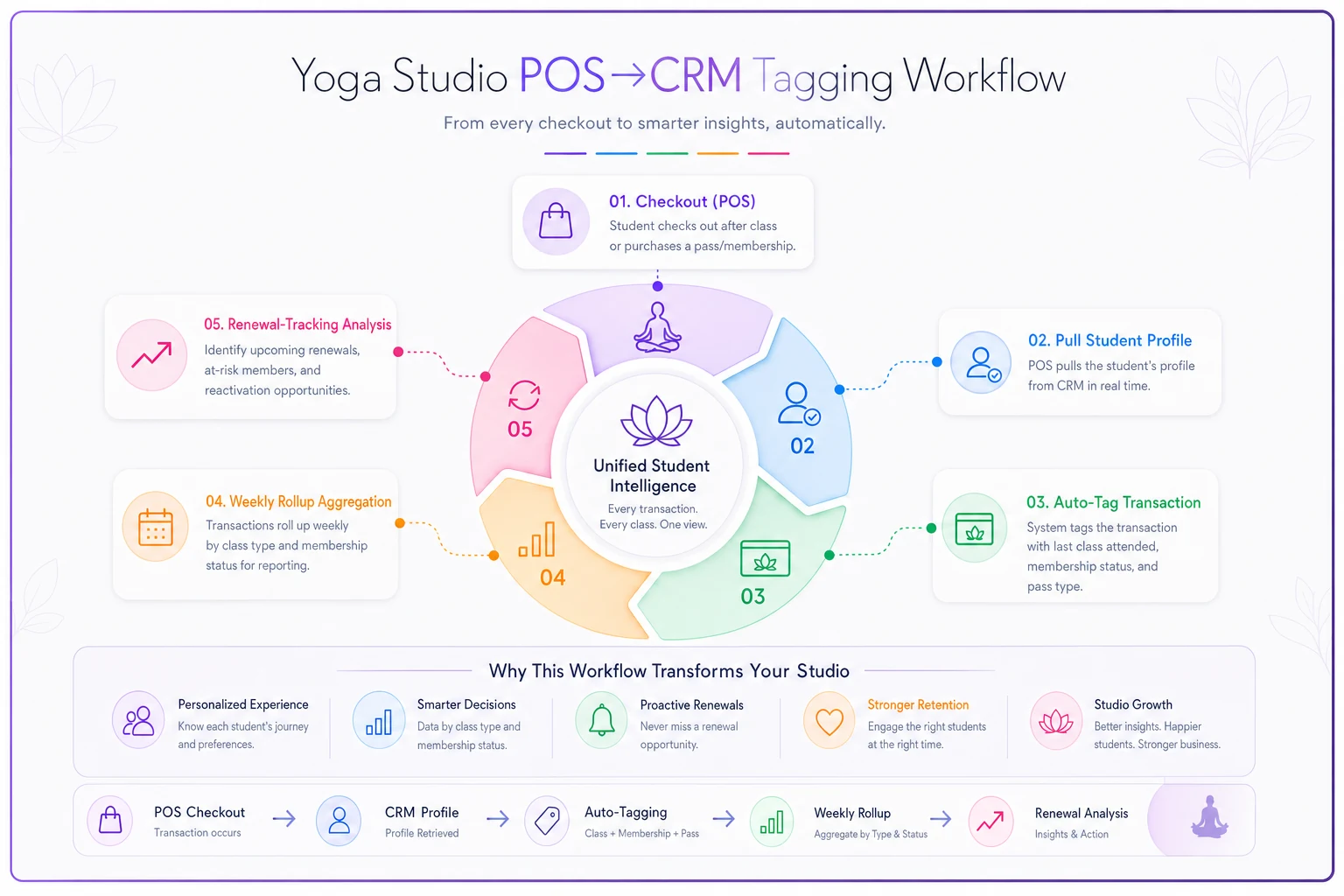
The value is really in steps 4 and 5. A platform that keeps bookings, attendance, and point-of-sale on one student record does this grouping automatically instead of you exporting two spreadsheets and hoping the names match. The point isn't the software — it's that the question "did this promo add revenue or just move it around?" is completely unanswerable when the systems are split.
This same single-record discipline is what makes your cash-flow picture trustworthy too. Retail and membership revenue behave very differently month to month, and separating them cleanly is part of building a monthly financial calendar that turns unpredictable months into predictable cash flow.
A real scenario
A single-location studio, roughly 330–360 class visits a week, ran retail as a flat shelf with occasional 30%-off clearance events. Retail brought in about $1,800–$2,200 a month, and roughly a third of that was clearance — basically selling product at or below cost to free up shelf space.
They changed three things over one quarter. First, they split assortment by class type, moving grip socks and electrolytes toward the hot-class entrance and props toward the beginner-series room. Second, they set discount guardrails: retail stayed full price during the winter renewal push, and clearance got capped at the margin floor instead of panic-dumping inventory. Third, they tagged purchases to student records so they could actually see who was buying what.
The tagging surfaced the uncomfortable part: during their previous promo, about a quarter of the "retail lift" came from members who then renewed into a cheaper pass. Substitution, not growth.
After the changes, monthly retail landed around $2,400–$2,700 — a real but unspectacular bump. The bigger win was that renewal rates during the promo window held steady instead of dipping, because retail discounts were no longer competing with membership decisions. Net, the studio kept a handful of memberships it would've otherwise shuffled downward, which was worth more than the retail delta.
Nothing dramatic. Just retail that stopped fighting the core business.
When this is worth doing — and when it isn't
This makes sense when:
-
Retail is already 5%+ of revenue and you can't tell if it's helping or just churning.
-
You run regular promos and suspect — but can't prove — they're moving spend around.
-
You have distinct class types with clearly different crowds.
This is a bad idea when:
-
You do fewer than a handful of retail transactions a week. Just carry the obvious essentials at full price and skip the machinery.
-
Your front desk is already overwhelmed. Adding tagging steps to a stressed checkout creates errors, not insight. Fix staffing first.
-
You're using retail purely as a brand or community gesture and don't care about the margin. That's a legitimate choice; this framework is for people treating it as revenue.
Who should skip deep assortment segmentation entirely: very small single-room studios with one dominant class style. If 80% of your schedule is one flow level, you have one micro-market, not five. Stock for that crowd and move on.
The one thing to take away
Retail at a studio isn't a store. It's a support system for attendance. Every rule here — assortment by class type, attendance-linked inventory targets, discount guardrails, tagging purchases back to the student — exists to answer one question: is this dollar adding to the business or just borrowing from the membership line?
Get the tagging in place first, because without it you're guessing. Then set your guardrails so a good retail week never quietly costs you a renewal. The studios that get this right aren't the ones with the trendiest leggings. They're the ones who know exactly which students bought what, after which class, and whether it came on top of their pass or instead of it.
Get the tagging in place first, because without it you're guessing. Then set your guardrails so a good retail week never quietly costs you a renewal. The studios that get this right aren't the ones with the trendiest leggings. They're the ones who know exactly which students bought what, after which class, and whether it came on top of their pass or instead of it.
Ready to elevate your studio operations?
Join 1,500+ yoga studios using Yoglyly to save time, reduce scheduling conflicts, and enhance member experiences.