

Co-taught classes are deceptively easy to sell and surprisingly hard to settle. Two instructors with different followings, a premium price point, a room that fills faster than a normal class — and then, three days after everyone goes home happy, somebody asks the question that ruins it: "Wait, how are we actually splitting this?"
That's the moment co-teaching goes from a good idea to a relationship problem. Not because anyone's greedy, but because nobody wrote the rules down before the money showed up.
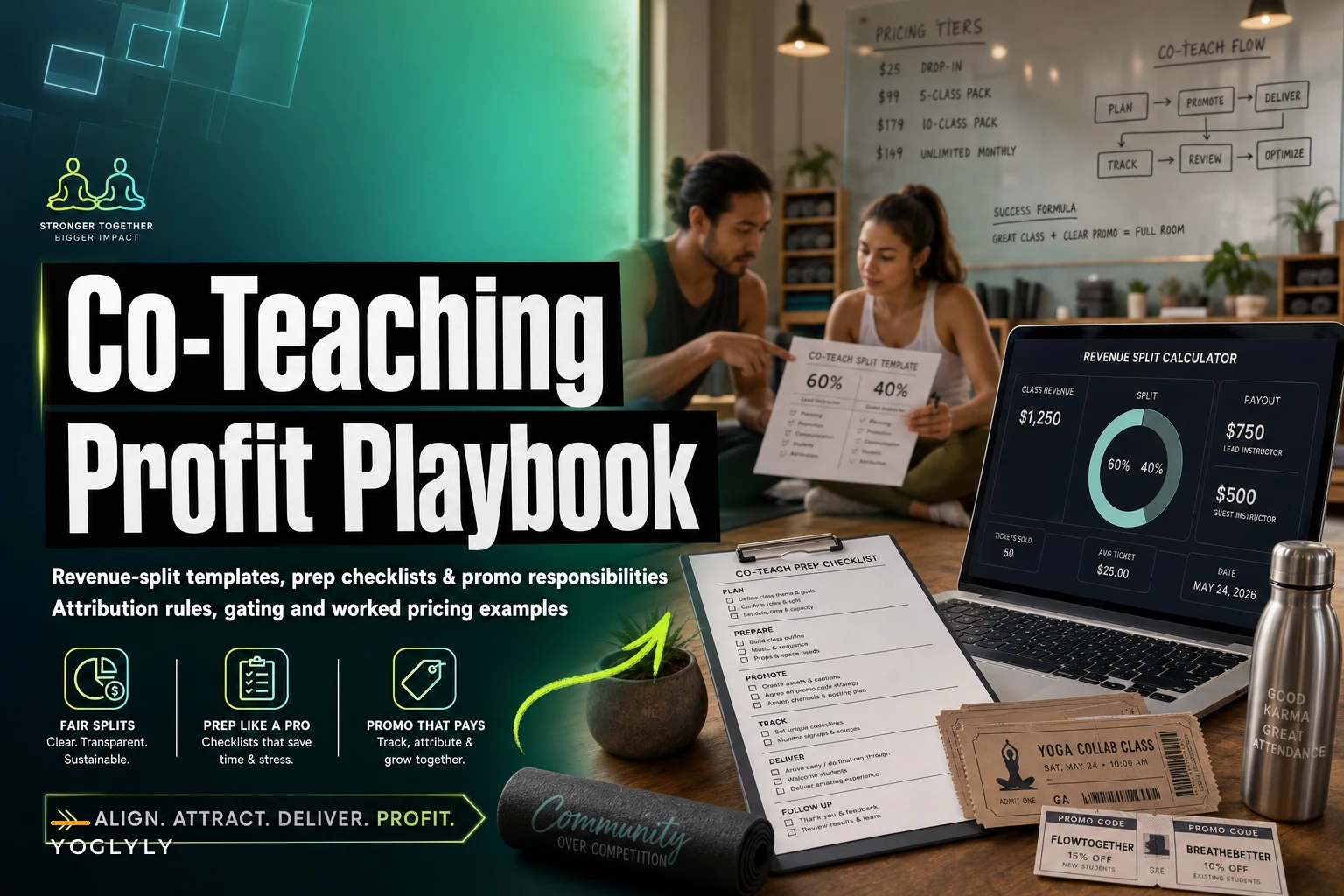
This post covers the boring paperwork that makes co-teaching worth doing more than once: revenue split templates, a prep checklist both teachers will actually use, promotion responsibilities that don't get dropped, gating rules that keep a premium class premium, and worked pricing scenarios so you can see the math instead of guessing at it. The co-teaching revenue split for yoga is the piece everyone forgets to formalize, so we'll spend the most time there.
Start with why the split arguments happen at all
Most co-teaching disputes aren't really about the percentage. They're about what the percentage applies to and who did the work to fill the room.
Here's the pattern. A visiting teacher with a solid Instagram following agrees to a 50/50 split. The host studio prints flyers, emails its list, pays the card processing fees, cleans the room, handles refunds, and eats the cost of the two no-shows who paid late. The guest posts twice and shows up. At the end, "50/50 of revenue" and "50/50 of profit" turn out to be very different numbers — and the host is the one holding the receipts.
-
Splitting gross revenue when one party carries all the costs
-
Not crediting whoever actually drove the bookings
-
Vague "we'll figure it out" promotion promises that never happen
Fix those three and co-teaching becomes repeatable instead of a one-time favor.
A revenue split template you can actually reuse
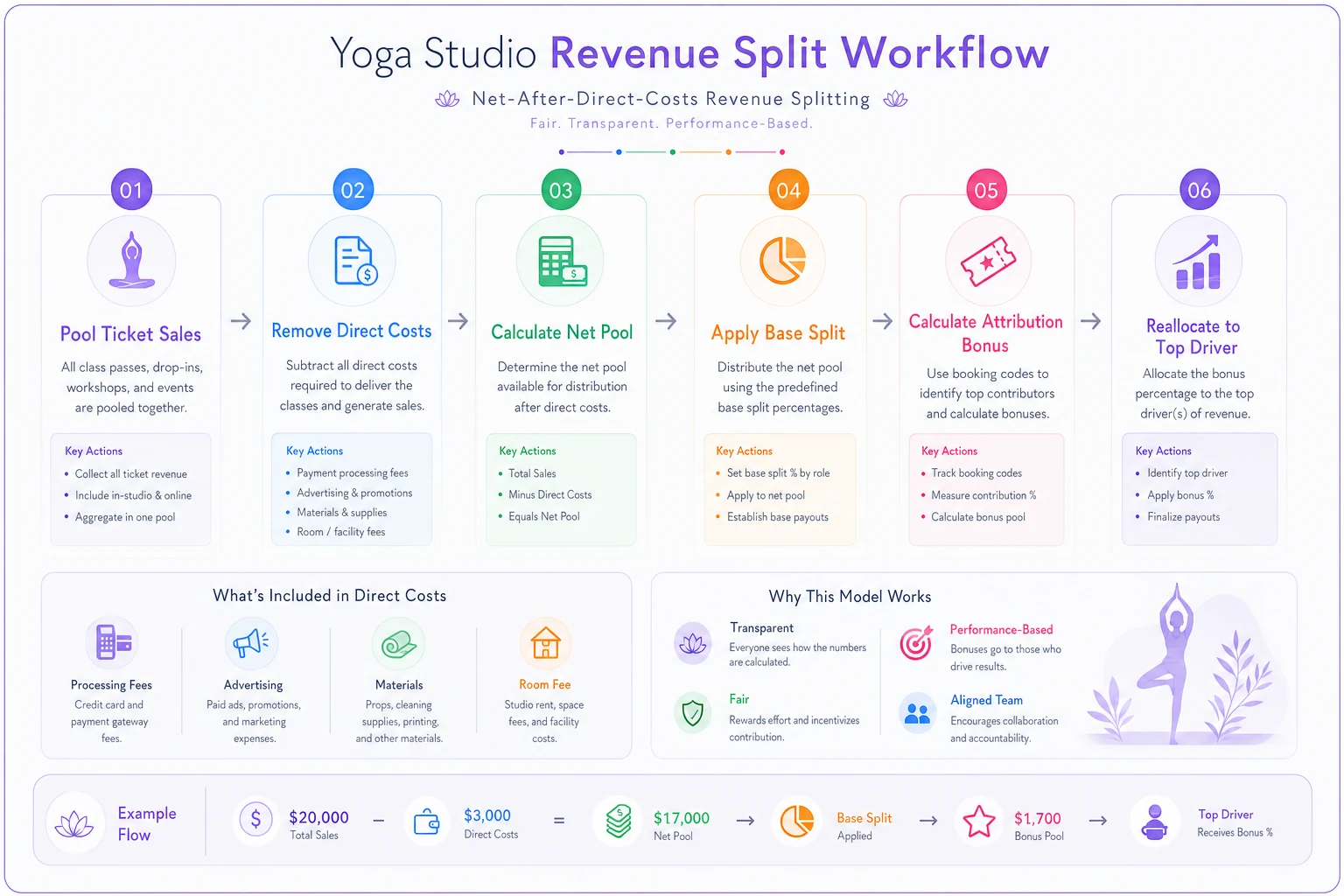
The cleanest approach is a net-after-direct-costs split with an attribution bonus layered on top. It sounds complicated; it's two lines of arithmetic.
Eliminate class scheduling chaos.
Yoglyly helps you book, confirm & manage every class seamlessly.
- Centralized class scheduling
- Member notifications
- Instructor and resource management
No credit card required
First, take direct costs off the top. Direct costs are only the things that exist because this class exists: payment processing, printed materials, any paid ads run specifically for it, and a flat room/overhead fee if the host studio wants one. Don't try to allocate rent or your front-desk salary — that way lies madness and resentment.
Then split what's left. The base split reflects teaching contribution. The attribution bonus reflects who filled the seats.
Here's a template you can copy into a shared doc before you agree to anything:
| Line item | Who pays / gets it | Notes |
|---|---|---|
| Gross revenue | Pooled | All ticket sales, including late adds |
| Payment processing (~3%) | Off the top | Comes out before split |
| Ad spend (specific to class) | Off the top | Only ads for this class |
| Printed/physical materials | Off the top | Mats, handouts, props rental |
| Room/overhead flat fee | To host | Agree on a number, e.g. $75–$150 |
| Net pool | Split | Everything remaining |
| Base split | 50/50 of net | Teaching contribution |
| Attribution bonus | 10–20% of net reallocated | To whoever drove more signups |
The base split handles "we both taught." The attribution bonus handles "but one of us filled the room." You decide the bonus size up front — 15% of the net pool reallocated toward the top driver is a fair, common number.
If you want to go deeper on the pay-fairness math behind these splits, the breakdown in fair teacher pay without burning margins pairs well with this, especially if one of your co-teachers is a W-2 employee rather than a guest contractor.
Attribution: the part everyone hand-waves
Attribution is where co-teaching splits either feel fair or feel rigged. The guest "knows" they brought everyone. The host "knows" their email list did the heavy lifting. Both are partly right and neither can prove it, so they argue.
The fix is simple: give each teacher a unique booking path and count.
In practice this usually means two discount codes or two booking links — one per teacher — even if the discount is $0. The code isn't about the money; it's about the tag. When a student books through the guest's link, that seat is attributed to the guest. Everything else defaults to the host.
A typical example looks like this. A $65 workshop sells 28 seats. Fourteen come through the guest's code, nine through the host's email link, and five walk up or book direct with no code. You've now got hard numbers: guest drove 14, host drove 9, and the 5 untagged bookings go to whoever owns the default channel — usually the host, since it's their studio.
-
Last-touch wins for the code. If a student saw the guest's post but booked through the host's email, the host's link gets credit. Keep it simple; don't try to litigate the customer journey.
-
Walk-ins go to the house unless a teacher is physically at the desk converting them.
-
Comps and friends-of-teacher tickets don't count toward attribution — they're a cost, not a win.
Set the bonus to trigger on a real gap. If the split of driven bookings is within roughly 10% of even, skip the bonus and just do the base split. The bonus should reward a meaningful difference, not penalize a near-tie.
Worked pricing scenarios
Numbers make this concrete. Two scenarios, same template, different outcomes.
Scenario A — guest teacher drives the room.
-
Processing (~3%)
$55
-
Studio printed props/handouts
$40
-
Room flat fee to host
$100
-
Net pool
$1,625
Base 50/50 is $812.50 each. Attribution: guest drove 18 of the attributed 23 coded bookings (the other 5 were house). That's a clear gap, so the 15% bonus kicks in. Fifteen percent of the net pool is about $244, reallocated to the guest.
Final: guest $812.50 + $244 = ~$1,057. Host $812.50 − $244 = ~$569, plus the $100 room fee already taken off the top, landing around $669. The guest earned more because they filled the room — and the host still covered overhead and walked away with real money instead of a headache.
Scenario B — host studio's list fills it, guest is the draw.
-
Processing
~$51
-
Materials
$40
-
Room fee
$100
-
Net pool
$1,499
Base 50/50 is $749.50 each. Host drove the clear majority, so the ~15% bonus (~$225) flows to the host.
Final: host $749.50 + $225 + $100 room fee = ~$1,074. Guest $749.50 − $225 = ~$524. The guest still got paid fairly for teaching, and the studio that did the marketing work got rewarded for it.
What this prevents in both cases: nobody can claim they got shortchanged, because the split mechanically reflects who did the work.
The prep checklist both teachers actually use
Premium co-taught classes fall apart in the room when the two teachers haven't agreed on who leads what. One starts talking over the other, the sequencing clashes, transitions get awkward, and students feel the tension even if they can't name it.
-
Format and arc — who opens, who closes, who holds the middle
-
Hard handoff points — the exact cues where one teacher takes over
-
Hands-on assist policy — who assists, consent language, boundaries
-
Playlist ownership — one person owns audio, full stop
-
Prop/setup list — confirmed against what the studio actually has
-
Timing blocks — minute ranges per segment so nobody runs long
-
Refund/no-show policy — agreed before tickets go on sale
-
Who's at the desk — door, late arrivals, walk-in conversions
-
Post-class CTA — what you're offering students next, and who says it
Fill the prep checklist at least a week before the class so there’s time to resolve any overlap.
That last line matters more than it looks. A premium workshop that ends with no next step wastes the warmest room you'll have all month. Decide the offer and who delivers it before you walk in.
Promotion responsibilities nobody skips
"We'll both promote it" is how co-taught classes end up half full. When promotion is everyone's job, it's nobody's job.
-
Announcement post — both teachers, same week, each on their own channel
-
Host email #1 — host studio, 2–3 weeks out
-
Guest story/reel — guest, 10 days out, with their code
-
Host email #2 (last-chance) — 3 days out
-
Day-of reminder — host, to everyone already booked
-
Post-class thank-you + next offer — host, within 48 hours
The point isn't the exact sequence — it's that each item has a name and a date attached. A promotion plan without owners and deadlines is a wish, not a plan. If you're treating co-taught workshops as part of a repeatable program rather than one-offs, the programization playbook for series, workshops and cohorts is worth reading for how to template this at the schedule level.
Gating rules that keep "premium" actually premium
Premium co-taught classes lose their value when they're priced like a drop-in or bundled into an unlimited pass. If a member can walk into a $65 special workshop for free on their membership, you've trained your best customers to never pay for it.
-
Not included in unlimited/membership passes — or only with a members-only discount, not free
-
No class-pack redemption — these sell as standalone tickets
-
Early access window for members — reward loyalty with timing, not price
-
Cap stays firm — don't oversell a premium room; scarcity is the product
-
Refund cutoff — e.g. 48 hours, so late no-shows don't eat into the split
The early-access-not-free move is the one most studios underuse. Members feel like they're getting something, you still collect full price, and the class keeps its premium positioning.
When co-teaching makes sense — and when it doesn't
When it works well: you've got a guest with a genuinely different audience, a format that benefits from two voices (think anatomy-heavy workshops, partner work, or a themed intensive), and a price point high enough that the net pool is worth splitting after costs. Co-teaching works when 1 + 1 actually fills more seats than either of you could alone.
When it's a bad idea: two teachers with heavily overlapping audiences — you're splitting the same people's money two ways and calling it growth. Also skip it for regular weekly classes; the attribution and prep overhead isn't worth it below a premium price point.
Who should not do this: anyone unwilling to put the split in writing before tickets go on sale. If a co-teaching conversation stalls at "let's just keep it casual," that's your signal it'll end in a casual argument.
A real scenario
A mid-size studio ran guest workshops roughly four times a year and kept them, in the owner's words, "vibes-based." Splits were verbal, promotion was assumed, attribution didn't exist. Two of the four workshops in a year ended in some version of an awkward money conversation, and one guest quietly declined to come back.
They switched to a written template: net-after-direct-costs, 50/50 base, 15% attribution bonus triggered by unique booking codes, and a shared prep and promo doc with owners and dates. No fancy tools — a shared spreadsheet and two discount codes per class.
The next three co-taught workshops ran without a single settlement dispute. Attendance on the guest-driven ones climbed, probably because promotion actually happened on schedule instead of getting forgotten. The owner put it bluntly: the classes made roughly the same money, but she stopped dreading the follow-up email. The guest who'd declined before agreed to come back once she saw the split was spelled out in advance.
That's the real return. Co-teaching doesn't usually fail on the math — it fails on the ambiguity around the math.
The one thing to do before your next guest class
Write it down first. The split formula, what comes off the top, who promotes what and when, how attribution gets counted, and the gating rules — all of it, in a shared doc, before a single ticket sells.
The arithmetic in this post isn't the hard part. The discipline of agreeing before the money arrives is. Teachers who do the paperwork up front get to do the fun part — actually teaching together — again and again. The ones who wing it get one good workshop and one awkward aftermath. Pick the paperwork.
Ready to elevate your studio operations?
Join 1,500+ yoga studios using Yoglyly to save time, reduce scheduling conflicts, and enhance member experiences.