

Most studio owners don't get into trouble because they made one huge legal mistake. They get into trouble because a dozen small, boring gaps quietly stacked up while they were busy filling classes and hiring teachers. The 1099 that should've been a W-2. The insurance certificate that lapsed on the second location. The waiver that still has the old business name on it. Individually, none of these feel urgent. Together, they're the reason a single wage claim or slip-and-fall can cost more than a full quarter of profit.
Legal and risk exposure scales faster than revenue. When you have one studio and eight teachers, you can hold most of the risk in your head. Add a second location, a teacher-training program, some corporate contracts, and a retail line — and suddenly you've got four different insurance requirements, two jurisdictions with different worker-classification rules, and a contract file nobody has looked at in a year. Studio legal risk governance isn't a document you write once. It's a system that has to grow at the same rate your operation does.
This is the piece I wish more owners read before the second lease gets signed.
Why risk hides until it's expensive
Legal exposure in a studio is almost always invisible right up until it isn't. There's no dashboard that flashes red when a substitute teacher technically qualifies as an employee under your state's test. Nothing pings you when your general liability policy quietly excludes the aerial classes you started offering last spring.
What shows up repeatedly across small operations is a predictable pattern: the business outgrows its original legal setup, but the paperwork stays frozen at "founding day" settings. The LLC was formed for one location. The waiver was copied from a template a friend used. The teacher agreement was a two-paragraph email. All of that works fine until volume, headcount, or geography change the math.
-
Risk is uncorrelated with daily pain. A broken booking system annoys you every morning. A misclassified contractor causes zero friction — until an audit or an unemployment claim three years later.
-
The people creating exposure aren't the people watching for it. A studio manager hires a sub to cover a class. Nobody's thinking about classification. They're thinking about not canceling a 6am.
-
Growth adds jurisdictions silently. Open across a city line or a state border and you've inherited a whole new set of payroll, tax, and insurance rules without anyone formally "deciding" to.
Risk governance gets treated as a legal task when it's really an operations task. It lives in the same messy space as tech integration and data sync — a bunch of small systems that only cause problems when they drift out of alignment with each other.
The five domains that actually matter
You don't need a hundred-item compliance binder. For a scaling studio, exposure concentrates in five areas. Govern these well and you've covered the large majority of real-world risk.
Eliminate class scheduling chaos.
Yoglyly helps you book, confirm & manage every class seamlessly.
- Centralized class scheduling
- Member notifications
- Instructor and resource management
No credit card required
| Risk domain | What usually breaks | Cost when it breaks |
|---|---|---|
| Worker classification | 1099 teachers who function like employees | Back taxes, penalties, unemployment claims |
| Insurance coverage | Policies that don't match current activities/locations | Uncovered claim = out of pocket |
| Contracts | Outdated or missing clauses with teachers, landlords, vendors | Disputes with no clear terms to fall back on |
| Data & privacy | Client health info, payment data handled loosely | Breach liability, platform violations |
| Jurisdictional compliance | Rules that differ by city/state you now operate in | Fines, license issues, tax surprises |
These aren't independent domains. A new location changes your insurance needs and your payroll rules and possibly your contract terms with a new landlord. That's why a checklist-per-domain approach eventually fails — the domains talk to each other, and a risk register has to reflect that.
Payroll classification: the trap that grows quietly
This is the single most common expensive mistake in growing studios, and it's worth spending real time on.
Most studios start by treating teachers as 1099 contractors because it's cheaper and simpler. No payroll tax, no benefits, no unemployment insurance. And for a genuinely independent teacher — someone who sets their own rates, brings their own students, teaches at five studios, and controls how they run class — that classification can be defensible.
-
Fixed schedules teachers can't move
-
A mandated sequence or brand style they must follow
-
Required trainings and onboarding
-
Studio-provided props, space, sound, software
-
Non-competes or exclusivity expectations
Every one of those factors pushes a worker toward employee status under most classification tests. The better and more consistent your brand experience gets, the weaker your 1099 argument becomes. That's the trap — the operational maturity you're proud of is the same evidence an auditor would use against you.
Keep a contractor packet that documents independence factors (schedules, outside work, equipment) for each teacher.
A typical scenario looks like this: a studio with roughly 12 teachers, all 1099, all teaching fixed weekly slots on the studio schedule, following the studio's signature sequence, using studio equipment. On paper, contractors. In practice, employees. If one teacher files for unemployment after being let go, a state agency reviews the relationship, reclassifies them — and often the whole roster follows. The bill isn't just that one person's back taxes. It's back payroll taxes across all of them, plus penalties and interest, potentially several years deep. That can land somewhere in the mid five figures for a small studio, which is enough to sink a location.
-
Map each teacher against your state's actual test (some states use the strict ABC test, others a looser common-law standard — this is jurisdiction-specific and matters enormously).
-
Decide deliberately which teachers are genuinely independent and which should be W-2.
-
Align the paperwork and behavior. If someone's a contractor, stop dictating everything. If you need to dictate everything, make them an employee.
-
Re-check whenever you cross a state line, because the same teacher setup can be legal in one state and illegal in the next.
Classification is a decision you should be able to defend on paper — not a default you inherited from the day you opened.
Insurance minimums: match the policy to what you actually do today
Insurance gaps are sneaky because coverage feels binary — you either "have insurance" or you don't. In reality, you can be fully insured and still completely exposed, because the policy covers a business you no longer run.
The common drift points:
-
You added heated classes, aerial, or equipment-based work, but your general liability was written for basic mat yoga.
-
You opened a second location that isn't listed on the policy.
-
You started a teacher training and now have a whole new category of liability (professional/E&O around the training itself).
-
Your landlord requires you to name them as additional insured and carry a specific minimum — and you never confirmed you actually meet it.
-
Teachers are covered as contractors, but you now have employees and no workers' comp.
A practical baseline for a scaling studio usually includes general liability, professional liability, property coverage for your buildout and equipment, workers' comp once you have employees, and cyber/data coverage given the client information you hold. The exact minimums are often dictated by your lease, so read that section before you shop policies.
Treating insurance as an annual set-and-forget renewal is where owners get caught. It should be reviewed every time the activities or footprint of the business change — not every twelve months on autopilot. A new class format or a new location is an insurance event, full stop.
Contracts: the clauses that save you later
Most studio contracts are fine when everyone's happy and useless when things go wrong — which is exactly backwards, because contracts only matter when things go wrong.
Three contract relationships to get right:
Teacher agreements. Whether contractor or employee, spell out pay structure, cancellation and sub policies, intellectual property (who owns the sequences and recorded content — this matters a lot if you do VOD), confidentiality around client lists, and clear termination terms. Vague verbal agreements are how you end up with a former teacher poaching your client roster with no recourse.
Client waivers and terms. This is your first line of defense on injury claims. The waiver needs to be current (correct legal entity name, all locations, all class types you actually offer), signed before first participation, and stored where you can actually retrieve it. A waiver you can't produce is a waiver that doesn't exist.
Vendor and landlord agreements. Your lease dictates your insurance minimums, your buildout obligations, and often your exit terms. Software vendors dictate what happens to your client data. Read the auto-renewal, data-ownership, and termination clauses specifically.
The clauses that quietly matter most across all three: indemnification, limitation of liability, data ownership, and termination. Nobody enjoys reading these. That's precisely why they get skipped, and why they show up as expensive surprises.
Data risk: you're holding more sensitive information than you think
Studios collect a surprising amount of sensitive data: names, contact info, payment methods, and — critically — health information. Injuries, pregnancies, medical conditions people disclose so a teacher can modify a pose. That last category quietly elevates your data risk profile.
The exposure points:
-
Client health notes stored in spreadsheets or teacher DMs instead of a secured system.
-
Payment data handled outside a compliant processor.
-
Staff access that never gets revoked when someone leaves.
-
Marketing consent that was never actually collected before you started texting people.
The governance basics here are unglamorous but effective: use compliant tools for payments and client records, limit who can see what, revoke access the day someone leaves, and keep marketing consent clean. A single centralized system where client information lives — rather than scattered across personal phones, spreadsheets, and three different apps — is both an operational win and a real risk reduction. When your data lives in one governed place instead of everywhere, you can actually control who touches it.
This is where good tech hygiene and risk governance overlap heavily. The same fragmentation that causes booking and payment sync problems also creates data exposure, because information scattered across systems is information nobody's securing.
Jurisdiction: the multiplier that catches expanding studios
Everything above gets harder the moment you cross a boundary. Different states classify workers differently. Cities have their own business licenses, sales-tax rules on retail and memberships, and sometimes their own labor ordinances — paid sick leave, minimum wage, scheduling laws.
The failure mode is assuming your existing playbook transfers. It usually doesn't. A studio that runs perfectly compliant in one state opens across a border, keeps the exact same teacher contracts and payroll setup, and is now non-compliant on day one without realizing it.
Before opening in any new jurisdiction, run this checklist:
-
[ ] Confirm the worker-classification test used in that state
-
[ ] Register for the correct state/local business licenses and tax accounts
-
[ ] Check whether memberships/classes/retail are taxable there
-
[ ] Verify local labor rules (sick leave, minimum wage, predictive scheduling)
-
[ ] Update insurance to list the new location and meet local lease requirements
-
[ ] Confirm your waiver and contracts name the correct entity and location
-
[ ] Check any local health/occupancy/permit rules for the space
Treating each new location as a fresh compliance setup — not a copy-paste — is the whole game here.
The quarterly legal-audit ritual
None of this works as a one-time cleanup. Risk drifts continuously, so the review has to be recurring. The most effective approach is a lightweight quarterly ritual that fits alongside your existing operating rhythm — the same cadence you'd use for your monthly and quarterly financial planning.
A workable quarterly flow:
-
Register review (30 min). Pull up your risk register — a simple living document listing every known exposure, its owner, and its status. Update anything that changed.
-
Classification check. Any new teachers this quarter? Any change in how existing teachers work? Re-test anyone whose situation shifted.
-
Insurance vs. reality. Did you add class types, locations, equipment, or employees? If yes, flag for policy review.
-
Contract expirations & renewals. What auto-renews next quarter? Which agreements are missing or outdated?
-
Access & data audit. Who left? Was their access revoked everywhere? Where is client data actually living?
-
Jurisdiction watch. Any new locations planned? Any local rule changes you've heard about?
The register is the anchor. Without a single document tracking exposures and owners, every review starts from scratch and things fall through cracks. With one, the quarterly review takes an hour or two instead of a panicked scramble.
A real scenario
A two-location studio, around 16 teachers, all classified as 1099. Growing steadily — roughly $40k–$45k monthly across both sites, a small teacher training, some corporate classes. No formal risk process; the owner handled legal stuff "when it came up."
What came up: a teacher was let go, filed for unemployment, and the state reviewed the relationship. Fixed schedule, mandated sequence, studio equipment — reclassified as an employee. The review didn't stop there; the agency looked at the whole roster. Between back payroll taxes, penalties, and the scramble to reclassify and re-contract the team, the total hit landed in the low-to-mid five figures, plus months of the owner's time.
The fix afterward was mostly process, not lawyers. They built a risk register, moved genuinely-dependent teachers to W-2, kept a few truly independent ones as contractors with cleaner agreements, aligned insurance to both locations and their actual class mix, and set a quarterly review. The ongoing cost of that governance is a few hours a quarter and a modest payroll increase. Compared to the reclassification bill, it's trivial — and the second time they expanded, the jurisdiction checklist caught two issues before they became problems.
Here’s a simple visual of the quarterly flow.
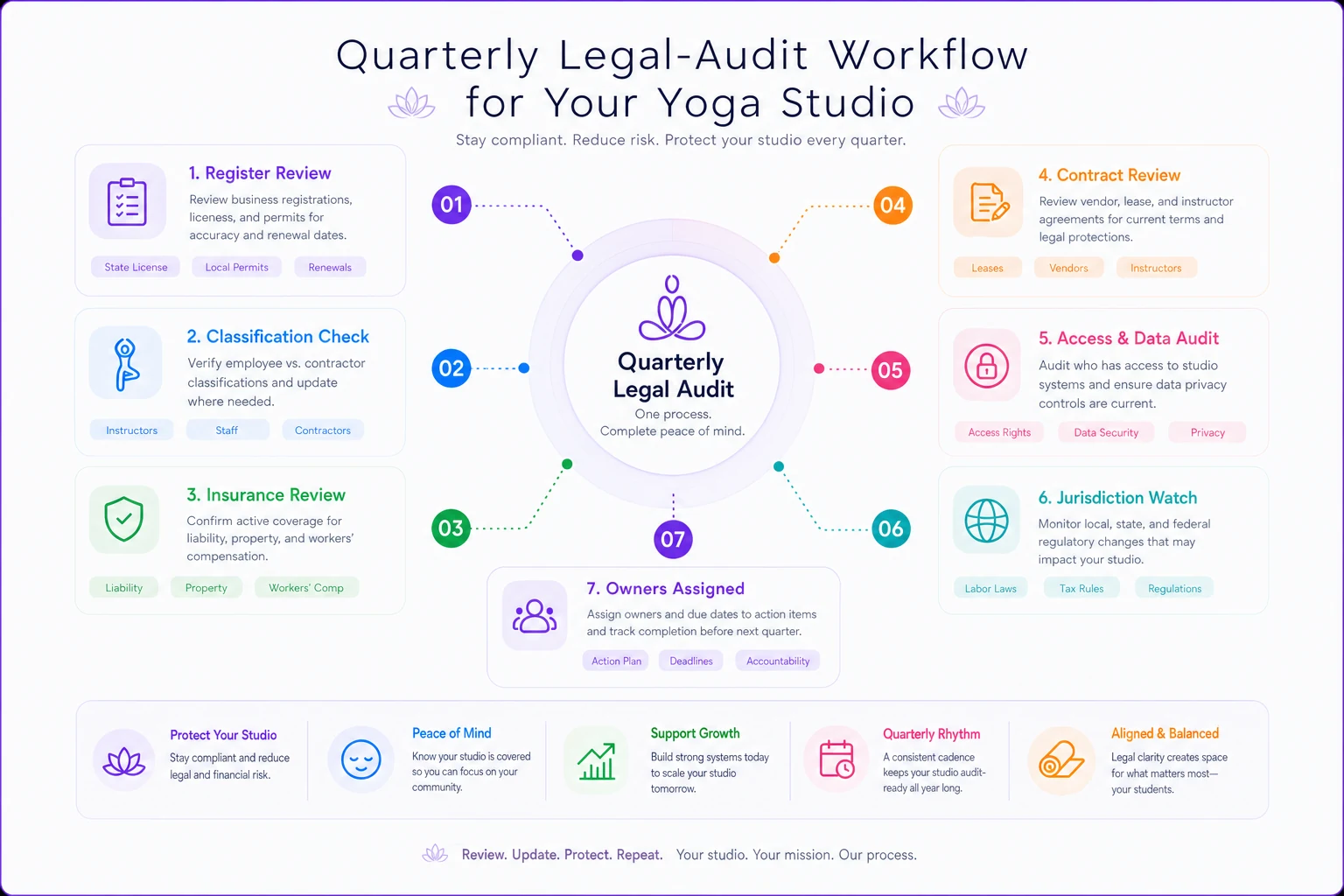
Use this as a quick reference during your quarterly review.
When to invest in this — and when it's overkill
When formal risk governance makes sense:
-
You have employees or a mixed 1099/W-2 team
-
You operate in more than one location or jurisdiction
-
You run programs beyond basic classes (training, retail, corporate, VOD)
-
You're actively planning expansion
-
You're preparing for a sale or bringing in a partner
When lighter-touch is fine:
-
Single location, tiny team, one clear jurisdiction
-
No employees, genuinely independent contractors
-
No plans to expand in the near term
Even then, you want the basics locked: a current waiver, correct classification, and insurance that matches what you do. The full quarterly ritual is overkill for a solo operation — but a risk register that fits on one page is not.
Who should not try to DIY the whole thing: anyone crossing into a strict-classification state, anyone with a teacher-training or franchise ambition, or anyone whose lease has complex insurance and indemnification terms. Those are the moments to spend real money on an employment attorney and an insurance broker who actually understands studios. Governance is the system you run between those consultations — it's what makes the expensive advice stick.
The point
Legal and risk exposure isn't a wall you hit once. It's a tide that rises with your revenue, your headcount, and your map. The studios that scale without blowing up aren't the ones with the fanciest lawyers — they're the ones who treat classification, insurance, contracts, data, and jurisdiction as connected operational systems, reviewed on a rhythm, tracked in one place.
Build the register. Run the quarterly check. Re-decide your classifications every time your operations mature or your footprint changes. It's not exciting work. But it's the difference between an expansion that compounds and one that quietly accumulates the exact liability that undoes it.
Legal and risk exposure isn't a wall you hit once. It's a tide that rises with your revenue, your headcount, and your map. The studios that scale without blowing up aren't the ones with the fanciest lawyers — they're the ones who treat classification, insurance, contracts, data, and jurisdiction as connected operational systems, reviewed on a rhythm, tracked in one place.
Build the register. Run the quarterly check. Re-decide your classifications every time your operations mature or your footprint changes. It's not exciting work. But it's the difference between an expansion that compounds and one that quietly accumulates the exact liability that undoes it.
Ready to elevate your studio operations?
Join 1,500+ yoga studios using Yoglyly to save time, reduce scheduling conflicts, and enhance member experiences.