

Most studios didn't plan their way into hybrid. They stumbled into it — added livestream during a slow season, built a VOD library because a few regulars asked, kept everything running because cancelling felt like a step backward. And now there are three revenue formats all pulling from roughly the same pool of members, the same instructors, and the same 24 physical spots in a room.
The problem isn't that hybrid doesn't work. It's that nobody set the rules for how the formats relate to each other. Without governance, your cheapest-to-deliver format starts stealing attendance from your most profitable one, and you don't notice until your prime-time in-studio classes have soft spots they never used to have.
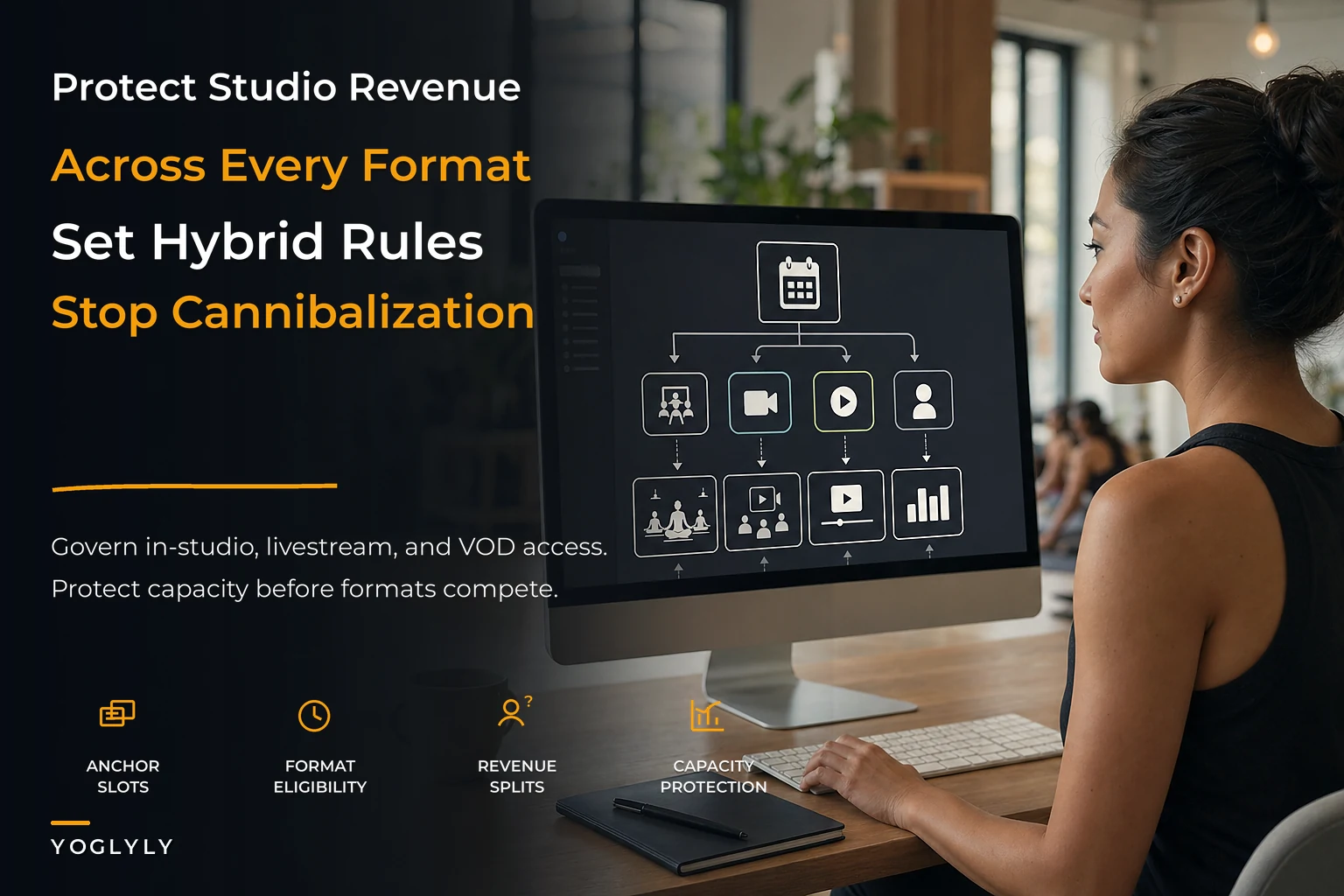
That's the whole topic here. Not "should you offer hybrid" — you probably already do — but how to govern it so the formats reinforce each other instead of cannibalizing. Hybrid studio governance is really a set of eligibility rules, revenue-split logic, capacity protections, and a decision framework for which format owns a given time slot. Here's how the system works and where it tends to fall apart.
The core tension: three formats, one shared pool
What makes hybrid tricky — in a way that multi-location isn't — is the unit economics. With two physical locations, a member who goes to Site B instead of Site A still costs you roughly the same to serve. With hybrid, the formats have wildly different margins but compete for the same member's attention.
| Format | Marginal cost per attendee | Capacity ceiling | Revenue per head | Who it best serves |
|---|---|---|---|---|
| In-studio | High (room, heat, turnover, staff) | Hard (physical cap) | Highest | Members who value the room and community |
| Livestream (live) | Low (same class, streamed) | Soft (bandwidth only) | Medium | Members who'd otherwise skip |
| On-demand / VOD | Near zero after production | Unlimited | Lowest per use | Convenience + off-peak demand |
The danger is obvious once you lay it out like this. If a member who would have booked a Saturday 9am in-studio spot instead streams it from home — or catches the recording Tuesday night — you've traded your highest-margin seat for your lowest. Multiply that across a few hundred members and a few dozen weekly classes and you've got a slow leak that never shows up as a single line item.
What we've seen across a lot of studios is that this leak stays invisible for the first year. Total revenue looks fine. Total attendance looks fine. What's quietly shifting is the mix — and mix is where margin lives.
Why it happens everywhere (and why good intentions make it worse)
The cannibalization isn't caused by bad members. It's caused by friction asymmetry. In-studio takes effort: drive there, park, bring your mat, make the specific time. Livestream and VOD remove that friction on purpose. So every time you make the convenient format too good, you're nudging your most loyal in-studio regulars toward the couch.
Eliminate class scheduling chaos.
Yoglyly helps you book, confirm & manage every class seamlessly.
- Centralized class scheduling
- Member notifications
- Instructor and resource management
No credit card required
-
Studios price livestream and in-studio the same, so there's zero economic reason to pick the room.
-
The VOD library includes recent recordings of the exact live classes, so members learn to "just catch it later."
-
Unlimited memberships cover all three formats with no distinction, training members to optimize for convenience over community.
None of these are mistakes in isolation. Each one came from a reasonable "let's not nickel-and-dime our members" instinct. But stacked together, they remove every reason a borderline member has to show up physically. And physical attendance is what fills the room, drives retail, sustains the energy that makes people renew, and justifies your rent.
What breaks at scale
At 150 members with one instructor-owner, you can feel the room. You know if Saturday morning is softer than it should be. Governance is intuitive because you're there.
Past 400–500 members and a second location, that intuition stops working. Here's what starts cracking:
Attribution gets muddy. When a member attends livestream for three weeks then returns in-studio, which format "earned" the retention? If instructor pay is tied to class attendance, does the streaming headcount count toward their in-studio class, or is it a separate pool? Most studios never answer this cleanly and end up either overpaying or underpaying teachers in ways that breed resentment.
Capacity decisions become political. Someone requests the popular 6pm Vinyasa be streamed. Seems harmless. But the 6pm in-studio was your most reliably full class — the one that didn't need help. Now you've given your strongest slot a convenient alternative, and six months later it has empty spots nobody can explain.
Revenue splits across sites get contested. If you run multi-location and a member at Site A streams a class taught out of Site B, which location's P&L gets the credit? Which instructor pool? This sounds like accounting trivia until a location manager's bonus depends on it.
The deeper issue is that these decisions get made one request at a time, reactively, by whoever's asking loudest — not against any policy. That's the governance gap.
The eligibility layer: deciding which classes go hybrid
The first governance decision is the most important and the one studios skip: not every class should be available in every format. Eligibility is a deliberate choice, not a default.
A workable framework for deciding format eligibility per class:
-
Protect your anchor slots. Identify the 4–6 classes a week that are reliably 80%+ full in-studio. These are your margin engine. Default rule: in-studio only, or stream with a meaningful friction cost. Don't give your best rooms an escape hatch.
-
Use hybrid to rescue soft slots. Midday, early weekday mornings, the awkward 2pm — this is where livestream adds genuinely incremental attendance instead of substituting. A member streaming the empty-ish Wednesday 11am isn't a member you were going to fill the room with anyway.
-
Reserve VOD for evergreen, not fresh. Recording and posting your signature Saturday class next-day teaches substitution. Build a VOD library around foundational, skills-based, and short-format content that doesn't map one-to-one onto a specific live class members could otherwise attend in person.
-
Set a format cap per member per week. A quiet but effective rule: unlimited plans can include, say, up to three streamed or on-demand sessions weekly before the next one carries a small per-class fee. Preserves the "unlimited" feel while nudging regulars back into the room.
Here's a quick visual of that decision flow.
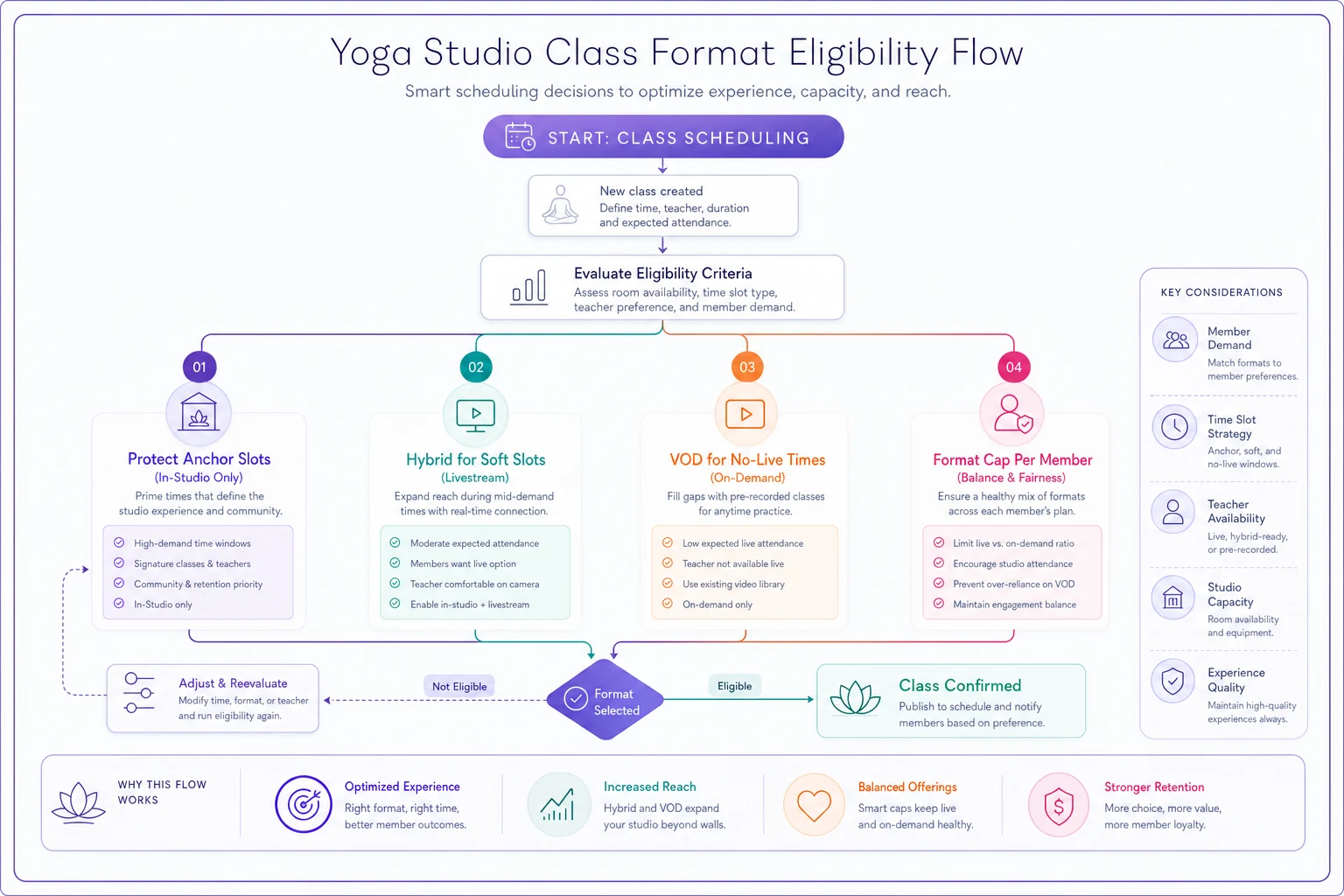
The logic behind all of this: you want each format pulling from different demand, not the same demand. In-studio owns prime community slots. Livestream owns otherwise-lost attendance. VOD owns the hours no class is running at all. When formats overlap in what demand they serve, that overlap is exactly where cannibalization lives.
Consider restricting same-day VOD for anchor classes to avoid teaching members to substitute attendance with recordings.
If you're building out a serious on-demand catalog, the packaging and tiering decisions matter as much as the content — we went deep on that in Turn your VOD into recurring revenue: packaging, tiering and retention hooks for studio on-demand, and it pairs directly with the eligibility rules here.
Revenue splits and instructor pay across formats
This is where governance quietly protects both your margins and your teacher relationships. If instructor compensation doesn't account for format, two bad things happen: either teachers feel streamed or recorded attendance is "free labor" being monetized without them, or you end up paying full in-studio rates on near-zero-margin VOD views.
A reasonable structure most studios can adapt:
-
In-studio headcount pays the standard per-head or guarantee — these seats carry the cost, so they carry the pay.
-
Livestream headcount attaches to the same class but at a reduced per-head rate, since the marginal cost is low and the format shouldn't incentivize teachers to push people out of the room.
-
VOD pays differently entirely — usually a one-time production fee plus a small ongoing royalty pool tied to total library engagement, not to any single class. This decouples teacher pay from the format you don't want cannibalizing anything.
The checklist for setting this up cleanly:
-
[ ] Every class is tagged by format at the point of scheduling, not reconstructed later
-
[ ] Livestream attendance is logged separately from in-studio attendance
-
[ ] VOD views are tracked at the library level, not forced into per-class pay
-
[ ] Instructors know the rate card for each format before they agree to teach hybrid
-
[ ] Multi-site revenue is credited to the originating studio with a documented rule, not case-by-case
Studios that tag format at scheduling time have clean data forever. Studios that try to untangle it at month-end from a messy booking export spend hours and still get it wrong. The governance has to live upstream — in how the class is set up — not downstream in reporting.
Measuring cannibalization without a data team
You don't need a fancy model to catch cannibalization. You need two things tracked consistently over time: format mix per member and in-studio fill rate on protected slots.
Pull a cohort of your reliable in-studio regulars from before you launched or expanded a format. Track what share of their monthly visits are now in-studio vs. streamed vs. recorded. If in-studio visits hold steady and the streamed or VOD visits are additive, that's incremental — the format is working. If in-studio visits drop as streamed visits rise for the same members, that's substitution, and you're trading margin for convenience.
A simple monthly scorecard:
-
Protected-slot fill rate — are your anchor classes still 80%+ full? A slide here is the earliest warning.
-
Substitution ratio — for regulars, is streamed attendance replacing or adding to in-studio visits?
-
Revenue per visit by format — watch the blended number. If it's drifting down while total visits hold, your mix is shifting toward cheaper formats.
-
Net new members by entry format — are streamers and VOD users converting to in-studio, or staying remote permanently?
That last one is the hopeful case. Hybrid done well is a funnel — someone starts on VOD, tries a livestream, eventually shows up in person. The governance question is whether your rules push members up that funnel toward the room, or let them settle into the cheapest format and stay there.
A real scenario
A two-location studio, roughly 520 active members, added same-day VOD recordings of their most popular evening classes about a year in. Felt like a member win. Nobody complained.
Over the next two quarters their total attendance barely moved — which is exactly why nobody panicked. But their prime-time in-studio fill rate on the 6pm and 7pm slots drifted from the low 90s down into the mid-70s. Retail per visit softened too, because fewer bodies were in the building before and after class. Blended revenue per visit dropped by somewhere around 8–11% even though headcount looked flat.
What they changed wasn't dramatic. They pulled same-day recordings of their anchor evening classes out of VOD entirely, kept livestream available for those slots but added a small per-class cost on unlimited plans, and rebuilt the VOD library around foundational and short-format content that didn't map onto any specific live class. Within about a quarter the evening fill rates recovered into the mid-80s, retail stabilized, and — this is the part they didn't expect — a chunk of the former same-day-VOD users started showing up in person again because the convenient substitute was gone.
The lesson wasn't "VOD is bad." Their on-demand library ended up more profitable after the change because it stopped competing with the room and started serving genuinely different demand.
The format-priority decision framework
When two formats could win a time slot, you need a default rule so the decision isn't made by whoever's loudest. A priority logic that holds up:
-
Is this slot reliably full in-studio? → Protect it. In-studio only, or stream with friction cost. No same-day VOD.
-
Is this slot soft but has remote demand? → Hybrid live. Livestream adds incremental attendance without cannibalizing a full room.
-
Is this a time with no live class running? → VOD territory. Fill the empty hours, not the full ones.
-
Is a member requesting a specific class be streamed? → Check which bucket it falls in first. A request isn't a reason to compromise a protected slot.
The point of the framework is that it turns a hundred one-off judgment calls into a repeatable policy. When your location managers and scheduling leads all apply the same logic, the system protects itself even when you're not in the room.
When hybrid governance this strict makes sense
If you're above roughly 400 members, running prime-time classes that regularly fill, or operating more than one location, you need these rules. The cost of getting it wrong compounds silently.
When it's overkill
A single-location studio with 120 members and plenty of open capacity doesn't need format caps and protected slots. You want substitution flexibility — any attendance is good attendance when your rooms aren't full. Governance here just adds friction for no margin gain. Grow into it.
Who should NOT bolt on hybrid at all
If your in-studio classes are already consistently full and you have a waitlist, adding livestream to those slots is one of the clearest own-goals in studio operations. You'd be building a convenient off-ramp from the exact experience people are competing to get into. Keep them scarce and physical.
Tying it back to the broader system
Hybrid governance doesn't live alone. It connects directly to how you structure your class programming overall — whether a format belongs in a series, a drop-in, or an evergreen library is a packaging decision as much as a capacity one. If you're thinking about how series, workshops, and cohorts fit into all this, the format eligibility rules here sit right on top of the logic in Stop inconsistent class revenue: a programization playbook for series, workshops and cohorts.
The cleaner your underlying systems — scheduling that tags format at creation, attendance logged by format, revenue credited by documented rule — the easier all of this becomes. Studios that try to track this manually across spreadsheets eventually give up and govern by gut, which works until it doesn't. Software that keeps format, attendance, pay rules, and capacity in one place turns governance from a monthly reconciliation headache into rules that just run.
The real shift is in how you think about the three formats. They're not three products competing for the same customer. Done right, they're three doors into the same studio, arranged so that the most profitable door is also the most appealing one for the members who matter most — and the convenient doors fill the gaps the room was never going to fill anyway. Governance is just the set of rules that keeps those doors from cannibalizing each other while nobody's watching.
Ready to elevate your studio operations?
Join 1,500+ yoga studios using Yoglyly to save time, reduce scheduling conflicts, and enhance member experiences.