


Shared passes look great on a pricing page. "One household, two spots, better value." Members love them. And then, three months in, you're staring at a booking log wondering why a two-person household pass is somehow covering four distinct people across six classes a week.
This isn't a rare edge case. Household and family passes are one of the most common sources of silent revenue leakage at yoga studios, precisely because the rules feel obvious when you launch them and turn out to be full of holes the moment real families start using them. The problem isn't that members are scamming you — most aren't. It's that your pass logic never defined what "household" actually means operationally, so everyone, staff included, fills in the blanks differently.
This is a walkthrough of the operational rules that make shared passes work: who's eligible, how seat reservations should behave, how you track usage across linked accounts, the fraud patterns worth watching, and the onboarding messages that prevent the confusion in the first place.
Where household pass yoga studio operations actually break
Start with the failure, because it tells you exactly what rules you're missing.
-
The pass holder books a spot, then a friend uses it when the second household member is out of town.
-
Both named members book the same popular 6pm class, filling two of your twelve spots, and one of them no-shows every week.
-
A couple splits up, and now two separate households are both using one pass from two different addresses.
-
The teenager in the household starts coming, so three people are rotating through a two-person pass.
-
During a sold-out workshop, the household pass holders each reserve a seat "just in case," locking capacity they don't use.
None of these are dramatic fraud. They're the natural result of a pass that was defined by price but not by rules. The member isn't thinking about your margin. They're thinking "we paid for a family thing, so family uses it."
The core issue: a household pass is a shared quota wrapped in a membership, and shared quotas need boundaries that single memberships never require.
The four rules that actually define a shared pass
Before you touch software settings, write down answers to four questions. Most studios skip this and regret it.
Eliminate class scheduling chaos.
Yoglyly helps you book, confirm & manage every class seamlessly.
- Centralized class scheduling
- Member notifications
- Instructor and resource management
No credit card required
1. Who counts as eligible?
-
Named individuals only (2 people, listed by name, non-transferable)
-
Same billing address (verifiable at signup)
-
A hard cap on linked people regardless of relationship
Named individuals is almost always the right call. "Household" invites the roommate, the visiting cousin, the on-again-off-again partner. "These two specific people" closes most of that off without you having to police anyone.
2. Is the quota shared or per-person?
-
Shared pool (10 credits, either person draws them down)
-
Per-person allotment (each gets 5, no borrowing)
-
Unlimited-per-person (just a bundled discount, simplest to run)
3. Can both named members hold a seat in the same class?
Seemingly trivial. Operationally huge. If both members can reserve the same high-demand class, a two-person household can lock 2 of 14 spots in your packed Tuesday evening flow — and if one no-shows habitually, you're losing a sellable seat every single week.
4. What happens on cancellation, no-show, and late cancel — per person or per pass?
If your no-show penalty is tied to the account, but the pass is shared, which named member gets penalized? Leave that undefined and your front desk will improvise inconsistently.
Seat-reservation logic: the rule that saves the most capacity
On low-demand classes, shared-pass seat behavior doesn't matter much. On your three or four highest-demand slots, it matters enormously — that's where capacity is the constraint and every locked-but-unused seat is lost revenue.
A workable seat-reservation policy for shared passes:
| Scenario | Open class (plenty of spots) | High-demand class (near capacity) |
|---|---|---|
| One member books | Allowed, normal | Allowed, normal |
| Both members book same class | Allowed | Allowed, but second seat auto-releases to waitlist 2 hrs prior if unconfirmed |
| Member no-shows | Standard no-show flag | Counts against the pass, triggers temporary single-seat limit |
| Waitlist exists | N/A | Shared pass limited to 1 active reservation per sold-out class |
Enforce the one-seat-on-packed-classes rule automatically rather than relying on staff reminders; it recovers more bookable capacity than chasing sporadic misuse.
The key rule in that table: on sold-out or near-sold-out classes, a shared pass gets one seat, not two. Members who genuinely both want to attend a packed class can — one books, one waitlists like everyone else. You stop subsidizing "reserve two, use one."
That single rule recovers more capacity than any fraud crackdown. The leakage isn't malicious double-use; it's habitual double-reservation on exactly the classes you can't afford to leave half-empty.
Cross-account tracking: how to actually see shared usage
You can't enforce a shared quota you can't see. The tracking problem is that most booking platforms treat each person as a separate account, so a shared pass "lives" on one account and the second person is either a bolt-on profile or, worse, a totally separate login that staff manually associates.
Here's a simple workflow to visualize how account linking, booking attribution, and household reporting should work.
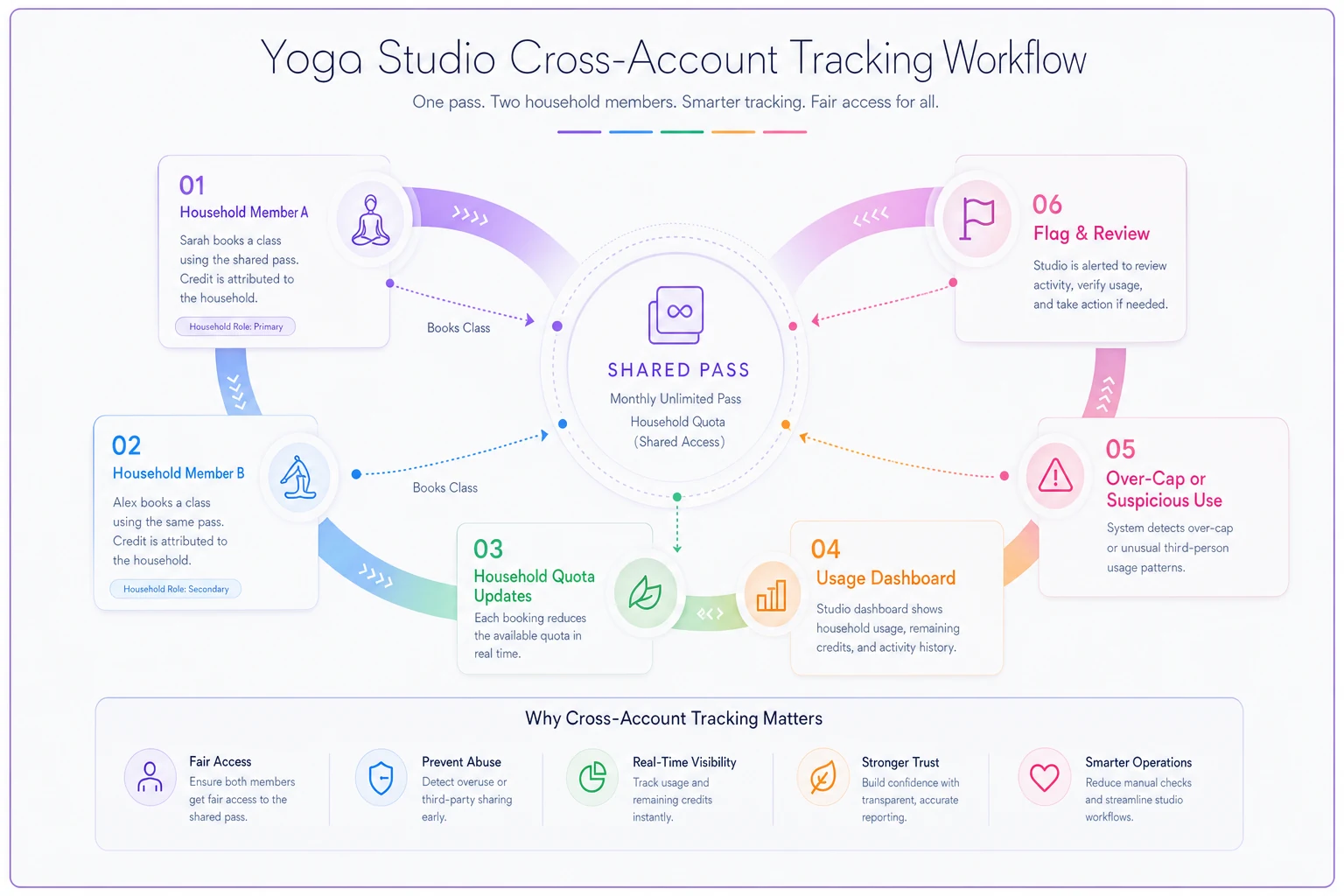
That manual association is where tracking falls apart. Two patterns to avoid:
-
The ghost second member. The pass is attached to Account A. Member B books under their own old account out of habit, draws from a different credit pool, and now your usage numbers for the household are meaningless.
-
The reassignment drift. Member B leaves; staff "just reuses" the slot for a new person without updating records. Now your eligible-persons list is fiction.
What you actually need is a single linked record where both named members draw from the same visible quota, every booking is attributed to a specific person, and your reporting can show per-household usage at a glance. If your platform can't link accounts into one pass entity with per-person attribution, you're going to be reconciling this by hand every month — and realistically, you won't, which is how leakage compounds quietly.
A practical weekly check: pull a short report of any household pass where total monthly bookings exceed what two people could realistically attend — more than roughly 12 classes per week between two "unlimited" members, or any shared-pool pass over its cap. You're not accusing anyone. You're just looking for cases where the math says more than two people are using it. This fits neatly into a studio operations dashboard and weekly playbook.
Fraud heuristics worth watching (and the ones that waste your time)
Most "fraud" on household passes is drift, not deception. A few patterns are worth flagging early so you catch them before renewal becomes an argument.
-
Booking location/time overlap that's physically impossible for one household. Two named members booking classes at two different locations within the same hour, repeatedly. Occasionally legit, often a shared login being passed around.
-
A sudden third name on the account. Staff adding a "guest" more than once to a two-person pass.
-
Attendance where the checked-in person doesn't match either named member. This is where front-desk check-in actually earns its keep — if you check names at a packed class, impersonation dies quickly.
-
Rapid member swaps. Changing the second named person every month or two. A real household doesn't rotate members.
-
Address mismatches at renewal if you tie eligibility to a billing address.
The heuristics not worth obsessing over: occasional guest use, a household member attending a lot in a single week, or two people with different last names (plenty of households have those). Chasing these just annoys good members and eats staff time.
The honest framing: you're not building a fraud department. You're setting a few automatic flags so the two or three genuinely abused passes a quarter surface before they quietly compound.
Onboarding messages that prevent most of the confusion
This is the part studios underinvest in and really shouldn't. Most household-pass problems are preventable at signup with three or four clear sentences. If the member never understood the rule, enforcing it later feels like a bait-and-switch — and that's where you lose the member and the revenue.
-
Exactly who the pass covers — "This pass covers two named people: [Name] and [Name]. It's not transferable to guests or other family members."
-
How the quota works — shared pool vs. per person, with the number.
-
The seat rule on busy classes — "For classes near capacity, one seat per pass; the second person is welcome to join the waitlist."
-
What counts as a no-show and who it affects.
-
How to update the second person — and that swaps are limited, such as once per membership year, so it reads as a real household benefit rather than a rotating door.
A short confirmation screen or welcome email with these five points, acknowledged at signup, does more for your margins than any after-the-fact enforcement. It also gives your front desk something to point to, which turns an awkward "actually, you can't do that" into "here's what you agreed to when you signed up."
If you're thinking about when to promote these passes — around back-to-school, New Year, partner-and-friend campaigns — fold that into your broader calendar so the rules and the push are designed together rather than bolted on. A structured approach like the one in this 12-month marketing calendar for filling capacity keeps you from launching a shared pass as a one-off promo with no operational backing.
A quick real-world scenario
A single-location studio with around 330 active members launched a two-person "household unlimited" pass priced at about 1.5x single unlimited. Within a quarter they had roughly 40 household passes. Looked like a win.
-
About 6 had a third person using them regularly.
-
Around a dozen were double-booking the two busiest evening classes, with one no-show most weeks.
-
Three had been quietly reassigned to new people with no record update.
The fix wasn't dramatic. They did four things: switched eligibility to two named people — non-transferable, one swap per year — capped shared passes to one seat on near-sold-out classes, added name-check at check-in for their three busiest slots, and rewrote the signup confirmation to spell out all of it.
-
switched eligibility to two named people — non-transferable, one swap per year
-
capped shared passes to one seat on near-sold-out classes
-
added name-check at check-in for their three busiest slots
-
rewrote the signup confirmation to spell out all of it
Over the next two months, the double-booked prime seats freed up roughly 8–12 bookable spots a week — seats that had been locked and unused — and the mystery-third-person cases dropped to near zero because check-in made it awkward. No members quit over it. A couple grumbled, got pointed to the signup terms they'd acknowledged, and moved on. The recovered prime-time capacity was worth more than the handful of household passes that downgraded.
When shared passes make sense — and when to skip them
They make sense when:
-
You have genuine couples or families asking for them, and your prime classes aren't chronically sold out.
-
You can link accounts and attribute bookings per person.
-
You're comfortable enforcing a one-seat rule on peak classes.
They're a bad idea when:
-
Your best classes are already capacity-constrained and a shared pass just locks seats faster.
-
Your platform can't link accounts, so you'd be tracking usage by hand.
-
You haven't decided whether the quota is shared or per-person — launching before that decision guarantees the leakage described above.
Who should probably not run them: a small single-room studio where almost every popular class sells out. There, a household pass mostly converts two full-price potential members into one-and-a-half, while consuming your scarcest resource — seats in the classes people actually want. You'd make more selling two single memberships and managing the waitlist well.
The real takeaway
A household pass isn't a discount — it's a shared quota with eligibility rules, seat behavior, and tracking requirements that a normal membership never needs. The studios that lose money on them almost always defined the price and skipped the rules.
Define the four boundaries up front, set one firm seat rule on your busy classes, make sure both members draw from one visible pool, and say all of it clearly at signup. Studios that skip any one of those steps tend to find themselves in a renewal conversation with a member who's been using the pass in ways you never intended — and by that point, enforcing anything feels confrontational. Get the structure right at the start and family plans become what they're supposed to be: a reason more people in the same home keep practicing with you, without quietly eating the capacity and revenue you depend on.
Define the four boundaries up front, set one firm seat rule on your busy classes, make sure both members draw from one visible pool, and say all of it clearly at signup. Studios that skip any one of those steps tend to find themselves in a renewal conversation with a member who's been using the pass in ways you never intended — and by that point, enforcing anything feels confrontational. Get the structure right at the start and family plans become what they're supposed to be: a reason more people in the same home keep practicing with you, without quietly eating the capacity and revenue you depend on.
Ready to elevate your studio operations?
Join 1,500+ yoga studios using Yoglyly to save time, reduce scheduling conflicts, and enhance member experiences.