



Most studio owners think about selling the way they think about their taxes: something to deal with later, once the real work is done. Then a buyer shows up — a local competitor, a boutique fitness group, sometimes just a student with money who loves the place — and the whole conversation collapses into a discount because the business can't answer basic questions cleanly.
What almost nobody tells you: your studio is worth two different numbers at the same time. There's what it's worth to you, based on the years you've put in and the community you've built. And there's what it's worth to a buyer — a cold calculation of predictable cash flow, transferable systems, and risk. Exit readiness is the work of closing that gap before you ever sit at a negotiating table.
This isn't a "clean up your books" article. This is about the operational structure a buyer is actually pricing — and the specific things that either add zeros or knock them off.
How buyers actually value a small studio
Before you fix anything, you need to understand what you're being scored on. Studios in the sub-$1M revenue range almost always sell on a multiple of Seller's Discretionary Earnings (SDE) — roughly your net profit plus the owner's salary, personal add-backs, and one-off expenses. A healthy independent studio typically lands somewhere in the 1.8x to 3.2x SDE range, depending on how transferable and predictable the business looks.
That multiple is the whole game. A studio doing around $80k in SDE might sell for $150k or $250k — same earnings, wildly different outcome — based entirely on how much risk the buyer perceives.
-
Owner dependency. If you teach 15 classes a week and every regular comes for you, the buyer isn't buying a business. They're buying a job that leaves when you do.
-
Revenue predictability. Drop-ins and lumpy workshop income get discounted. Memberships and recurring billing get a premium.
-
Clean, provable numbers. If your bookings, payments, and CRM tell three different stories, the buyer assumes the worst version.
-
Transferable systems. Documented SOPs, working software, and staff who can run the place without you.
Owners tend to over-invest in the wrong lever. They obsess over squeezing another few percent of profit in the final year, when the thing actually capping their multiple is that the business is a set of habits living inside their head.
The valuation-killers hiding in plain sight
These rarely surface until a buyer's advisor starts poking around.
Eliminate class scheduling chaos.
Yoglyly helps you book, confirm & manage every class seamlessly.
- Centralized class scheduling
- Member notifications
- Instructor and resource management
No credit card required
Concentrated revenue. If one corporate client, one blockbuster teacher training, or a handful of unlimited members make up a big slice of income, that's fragility. Picture a studio with roughly $260k in revenue where a single corporate wellness contract accounts for $45k of it. To a buyer, that's not $45k of reliable income — it's a $45k hole that might open the day you leave.
Founder-taught marquee classes. The 6pm Vinyasa that fills to 32 people every week because you teach it. Great for the P&L, terrifying for the buyer. This is probably the most common thing that pins a studio at the bottom of its multiple range.
Personal expenses tangled into the business. Your car lease, your phone, that "workshop research" trip — mixed into the business financials. These can legitimately be added back to SDE, but only if they're documented and separable. If they're just noise in a QuickBooks file nobody's touched in two years, the buyer won't give you credit for them.
Systems that don't reconcile. When your booking platform says 340 active members, your payment processor says 298, and your email list says 1,100 "members," due diligence turns into a forensic exercise. Every discrepancy becomes justification to lower the price or hold money in escrow. Getting these to agree is foundational — the kind of governance work that makes bookings, payments, and CRM actually tell one consistent story is exactly what a buyer's advisor will check first.
No lease certainty. For a physical studio, the lease is the business. A lease with eight months left and no renewal option can single-handedly tank a deal.
The buyer-focused KPIs to start tracking now
Buyers don't care about your Instagram following. They care about numbers that predict future cash flow. Start reporting these monthly, at least a year out — a buyer wants to see a trend, not a snapshot.
| KPI | Why buyers care | Healthy signal |
|---|---|---|
| Recurring revenue % | Predictability of cash flow | 60%+ from memberships/recurring |
| Member churn (monthly) | Retention risk | Under ~4–5% monthly |
| Revenue per available class slot | Capacity efficiency | Trending up or stable |
| Owner-taught class % | Transfer risk | Ideally under 20% |
| Trailing-12 SDE | The actual valuation base | Stable or growing |
| New-member CAC vs. LTV | Growth sustainability | LTV comfortably ahead of CAC |
| Revenue concentration | Fragility | No single client/source over ~10–15% |
Every marquee class you successfully hand off to a well-trained instructor — without losing attendance — literally raises your multiple.
The one people always forget: owner-taught class percentage. It's not a financial metric, which is exactly why it gets ignored. But it might be the most valuation-relevant number on this list. Every marquee class you successfully hand off to a well-trained instructor — without losing attendance — literally raises your multiple.
The 6–12 month readiness timeline
You can't cram this. Buyers want to see that improvements are durable, which means you need runway. Here's a sequencing that actually works, front-loaded with the things that take longest to prove out.
Months 1–3: Reduce owner dependency and clean the foundation
-
Identify every class where you're the draw, and start transitioning the two or three biggest ones to other instructors. Co-teach first so attendance holds.
-
Separate personal from business expenses going forward, and document every add-back you'll want to claim.
-
Reconcile your booking, payment, and CRM systems so member counts actually match. This takes longer than you expect.
-
Pull your lease and understand your renewal position. If it's weak, start the landlord conversation now.
-
Push membership and recurring billing over drop-ins wherever it makes sense. A buyer pays more for $10k of predictable monthly revenue than $12k of unpredictable revenue.
-
Stabilize your cash flow rhythm so the business looks calm and legible. If your months swing wildly, a monthly financial calendar that smooths income and expense timing makes the P&L far easier for a buyer to trust.
-
Start writing down how the studio actually runs — opening and closing procedures, sub policies, retail ordering, the stuff currently living in your head.
-
Finish your SOP library. It doesn't need to be beautiful — it needs to exist.
-
Reduce revenue concentration. Diversify that one big corporate contract, or at minimum get it renewed and signed so it transfers cleanly.
-
Get instructor and contractor agreements in writing, with clear classification. Misclassified contractors are a real deal risk that buyers will flag.
-
Build the data room (see below).
-
Prepare a clean trailing-12-month financial package with add-backs clearly labeled.
-
Draft the growth story — a credible, un-hyped list of things a new owner could realistically do to grow, because you're partly selling potential.
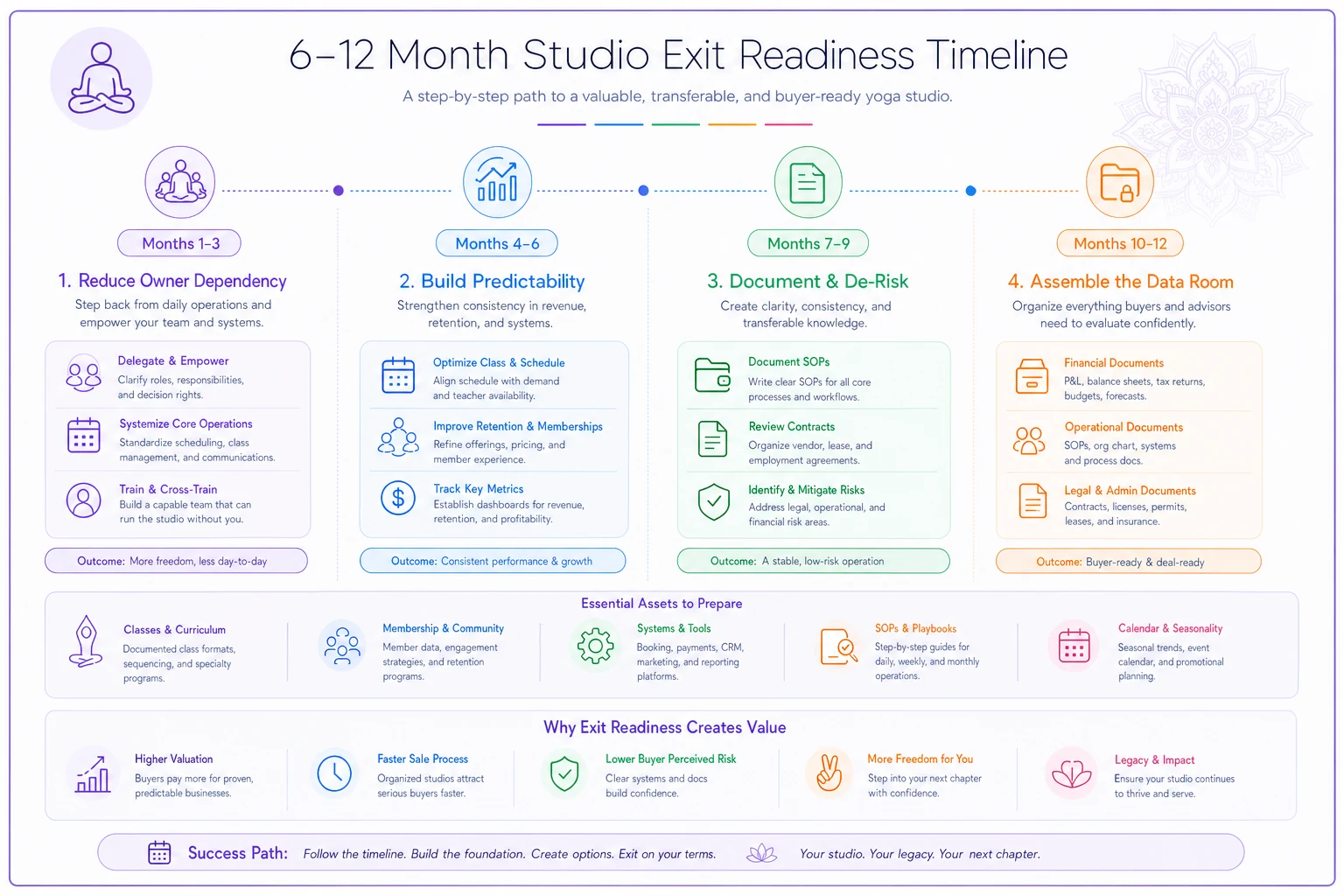
A visual like this clarifies the sequencing for your team.
You can't cram this. Buyers want to see that improvements are durable, which means you need runway.
The data room: what to actually assemble
The data room is where deals speed up or fall apart. A disorganized one signals a disorganized business, and buyers price that in. A clean one builds trust — and honestly, justifies a higher number by itself.
-
[ ] Trailing 24–36 months of P&L and balance sheets
-
[ ] Tax returns for the last 3 years
-
[ ] Bank statements matching the financials
-
[ ] SDE calculation with every add-back documented and justified
-
[ ] Membership roster with join dates, plan types, and MRR
-
[ ] Churn and retention history, month by month
-
[ ] Full lease and any amendments or renewal options
-
[ ] Instructor and staff agreements, with pay and classification
-
[ ] Vendor and software contracts (including renewal and cancellation terms)
-
[ ] Equipment and asset list included in the sale
-
[ ] SOPs and operational documentation
-
[ ] Marketing performance summary (channels, CAC, what actually works)
-
[ ] Outstanding liabilities, gift card balances, and prepaid packages
That last one catches people off guard. Unredeemed class packs and gift cards are a liability that transfers to the buyer. If you've sold 200 unused class packs, the new owner has to honor them — and a sharp buyer will subtract that from the price. Know your outstanding balance before they discover it.
Contract tidy-ups that quietly protect your number
A lot of value leaks through sloppy paperwork. Unglamorous stuff, but it directly affects whether the deal closes at the agreed price.
Instructor classification. If you've been paying regular teachers as 1099 contractors when they function like employees, that's a hidden liability a buyer will either discount for or demand you indemnify. Clean it up before diligence, not during.
Assignable contracts. Check whether your key contracts — lease, software, that corporate client — can actually be transferred to a new owner. A contract that terminates on "change of ownership" is a landmine. Some can be renegotiated with an assignment clause ahead of time.
Software and vendor terms. Buyers hate inheriting surprise auto-renewals or locked-in multi-year contracts they can't exit. Know your renewal dates and cancellation terms cold.
Membership terms. Your member agreements should clearly allow the business and its obligations to transfer. Ambiguity here creates friction at exactly the wrong moment.
A real scenario
A single-location studio doing roughly $240k in annual revenue put itself on the market and received an initial offer around $180k — just over 2x SDE. The sticking points were predictable: the owner taught the four highest-attended classes, about $38k of revenue came from one corporate contract with no signed renewal, and the booking system showed member counts that didn't match the payment processor.
They pulled the listing and spent ten months on cleanup. They transitioned three of their four marquee classes to two strong instructors, co-teaching for six weeks each so attendance barely moved. They got the corporate contract re-signed on a two-year term with an assignment clause. They reconciled their systems so every number matched, and they surfaced roughly $14k in add-backs that had been buried in the financials.
Same studio, similar revenue. The next round of offers came in closer to $255k–$270k. Nothing dramatic changed at the top line — they just removed the risk the first buyer was pricing in. The reduced owner-dependency alone was probably worth more than any single financial adjustment.
When this makes sense — and when it doesn't
When exit readiness is worth the effort: You're one to three years from wanting out, you have real recurring revenue to build on, and the business is fundamentally healthy but disorganized. That's the sweet spot — cleanup work translates almost directly into a higher multiple.
When it's a bad idea to rush: If the studio is currently unprofitable or shrinking, exit readiness work won't fix that in six months. Fix the business first. Buyers can smell a declining trend, and no amount of clean paperwork overcomes it.
Who should probably not sell yet: Owners whose entire revenue depends on their own teaching, with no bench and no systems. You can sell, but you'll sell a job at a job's price. The year of building transferability is what converts it into an actual business sale — and that's the entire difference between a low offer and a good one.
The mindset shift that ties it together
The uncomfortable truth is that the most valuable thing you can do before a sale is make yourself unnecessary. Everything in this playbook — handing off classes, documenting SOPs, reconciling systems, getting contracts assignable — points in the same direction: proving the studio runs without you.
That's genuinely hard, because most owners built their studio around their own energy and presence. But a buyer isn't paying for your presence. They're paying for a machine that keeps producing cash after you walk out the door.
Start the timeline earlier than feels necessary. The owners who get the top of their valuation range aren't the ones with the best studios. They're the ones whose businesses were legible, transferable, and boring in exactly the ways a buyer rewards.
Start the timeline earlier than feels necessary. The owners who get the top of their valuation range aren't the ones with the best studios. They're the ones whose businesses were legible, transferable, and boring in exactly the ways a buyer rewards.
Ready to elevate your studio operations?
Join 1,500+ yoga studios using Yoglyly to save time, reduce scheduling conflicts, and enhance member experiences.