

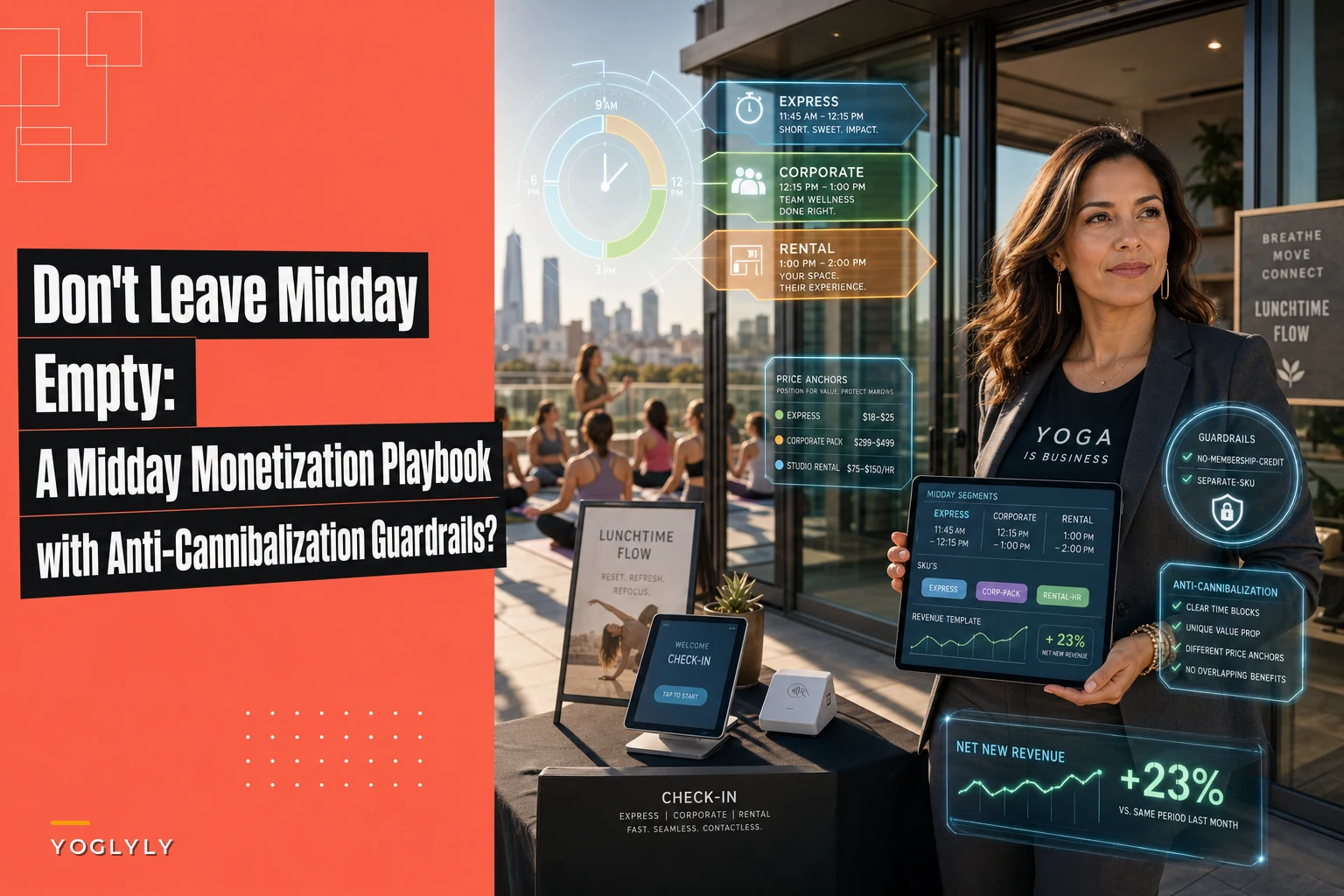

The midday window is the part of the schedule most studio owners quietly give up on. The 6am and 6pm slots fight for themselves. Weekends sell. But that stretch between the morning rush and the after-work surge just sits there — lights on, rent running, instructor hours going nowhere.
The instinct is to "fill it." Add a flow class at noon, maybe discount it a little, see who shows. Then one of two things happens. Either nobody comes, or the people who do come are your existing 6pm regulars who figured out that midday is cheaper and quieter. You didn't generate new revenue — you moved revenue to a worse-margin time slot and trained your best members to pay you less.
That second outcome is the one nobody plans for. This post is about midday yoga monetization with actual guardrails — so the 11am–2pm window becomes a distinct revenue stream, not a slow leak in the one you already have.
Why "just add a noon class" almost always underperforms
Midday demand is structurally different from evening demand. Treating it the same is the core mistake.
Your 6pm crowd is people ending a workday. They want a predictable, recurring class they can build a routine around. Midday demand comes from three completely different buckets: remote workers taking a lunch break, retirees and parents with flexible schedules, and nearby businesses who might send employees over for a short reset. None of those groups behave like your evening regulars. None of them want a standard 60-minute vinyasa dropped into the calendar at noon.
So when you clone an evening class into a midday slot, you've built a product for an audience that isn't there. The people who actually show up are the ones whose schedule already flexes — which disproportionately means your current members shifting their attendance. That's the cannibalization trap. Headcount looks fine on the surface, but total member revenue hasn't moved.
The fix isn't a better class at noon. It's a different product, priced and positioned so your existing base has no real reason to switch into it.
Segment the day before you price it
Before anything goes on the midday calendar, decide what the window is for. Time-segmentation is just the discipline of deciding which offers live in which hours — and then holding that line.
Eliminate class scheduling chaos.
Yoglyly helps you book, confirm & manage every class seamlessly.
- Centralized class scheduling
- Member notifications
- Instructor and resource management
No credit card required
| Time block | Primary audience | Product type | Who it must NOT attract |
|---|---|---|---|
| 6–9am | Pre-work regulars | Standard membership classes | — |
| 11am–2pm | Remote workers, retirees, local businesses | Short-format + corporate packs + rentals | Your evening members |
| 4–8pm | After-work regulars | Standard membership classes | — |
That right-hand column is the one most studios skip, and it's the most important. If a midday product is genuinely appealing to your 6pm member, you've designed it wrong. The whole point is building something that pulls in people who'd otherwise never walk through the door, while being structurally unappealing to people already paying you full price.
That sounds counterintuitive — why build something your best customers won't buy? Because they're already getting full value. New midday revenue has to come from new wallets, or it isn't actually new.
Anti-cannibalization guardrails that actually hold
Guardrails only work when they're baked into the mechanics of the offer, not just the marketing language. Four that hold up in practice:
1. Don't let membership credits apply to midday products.
If an unlimited or 10-class pass covers the noon class, you've guaranteed cannibalization. Midday short-format classes, corporate packs, and rentals should sit outside the membership system entirely. Separate SKUs. A member who wants the midday express pays for it separately — or it simply isn't available to them.
2. Make the format different, not just the time.
A 25–35 minute express class, a lunchtime mobility session, or a private rental is not a substitute for a 60-minute evening flow. Format difference is your best natural guardrail. Nobody downgrades their main practice to a 30-minute express. They either add it as something extra, or they don't engage with it at all.
3. Price on a different logic.
Evening classes are priced per-class inside a membership framework. Midday products should be priced as what they actually are — a corporate pack sold to a business, a per-seat express drop-in, a flat rental rate. Different pricing logic signals "different product" and keeps customers from comparing the two directly on your own schedule.
4. Gate visibility.
Your evening members don't need the midday express class pushed at them on the app home screen. Market midday offers to separate lists — local business contacts, a daytime-interest segment, walk-in signage near nearby offices. The less your core base sees the cheaper midday option, the less drift you get.
Clearly label midday SKUs in your POS and booking system so staff don't accidentally apply membership credits to midday purchases.
The less your core base sees the cheaper midday option, the less drift you get.
Four midday products worth testing
These formats tend to work in the 11am–2pm window because they match how daytime audiences actually move through their day. Test them small before committing calendar space.
-
- Short express classes (25–35 min). Low time-cost for a remote worker on a break. The short format is the actual feature, not a compromise. Price it as a standalone drop-in, not a membership perk.
-
- Corporate lunchtime packs. Sell a block of seats to a nearby business — say, 10 pre-paid seats per week for employees, invoiced monthly. This is the highest-value midday product because it's recurring and B2B. If you've done any one-off corporate work before, this is the natural next step toward turning those gigs into something reliable.
-
- Space rentals. The room is empty and heated anyway. Rent it midday to a pilates instructor, a sound-healing practitioner, a meditation group, or a small corporate offsite. Pure margin on space you're already paying for. Flat hourly rate, booked in advance, no membership interaction at all.
-
- Specialty daytime series. A 4-week daytime mobility or prenatal series aimed at people with flexible schedules. Sold as a package upfront, which also smooths cash flow. The mechanics of running these well are covered in the programization playbook for series, workshops and cohorts.
The mechanics of running these well are covered in the programization playbook for series, workshops and cohorts.
Pricing anchors so midday doesn't read as "cheap"
The risk with midday pricing is that a low number makes your whole studio feel discounted. You avoid that by anchoring — presenting the midday price next to a reference point so it reads as efficient, not desperate.
-
- Anchor the express class against time, not against your full class. "30 minutes, $14" next to "your lunch break is 60." You're anchoring to their day, not to your $22 evening drop-in. This keeps the two prices from being compared directly.
-
- Anchor corporate packs against the per-head cost of not doing it. A 10-seat weekly pack at, say, $160/week reads differently when framed as "about $16 per employee per session — less than a coffee run." The business buyer is comparing to a wellness stipend, not your retail drop-in rate.
-
- Anchor rentals to your actual slot cost. Know your fully-loaded hourly cost for the room — rent, utilities, cleaning. If that lands somewhere around $25–$35/hour, any rental above it is margin. Price rentals at a number that clears cost comfortably and don't second-guess it.
The mistake here is pricing midday by feel. Owners guess low because the room is empty and they're anxious. But a too-low number both leaves money behind and risks pulling your evening base in. Anchor every midday price to something other than your core class rate.
How midday monetization flows in practice
Getting the structure right matters, but execution is where it tends to break down. Here's a rough sequence of how a studio moves from dead midday hours to a functioning secondary revenue stream:
Audit the window (Who's in the building? New faces or existing members drifting over?) ↓ Segment your offers (Express class / Corporate pack / Space rental / Daytime series) ↓ Build the guardrails into the mechanics (No membership credits, separate SKUs, separate pricing logic) ↓ Market to the right lists (Local businesses, daytime-interest segments — not your core evening base) ↓ Track net-new revenue weekly (Not attendance — actual incremental dollars from new customers) ↓ Tighten or expand based on what the numbers show
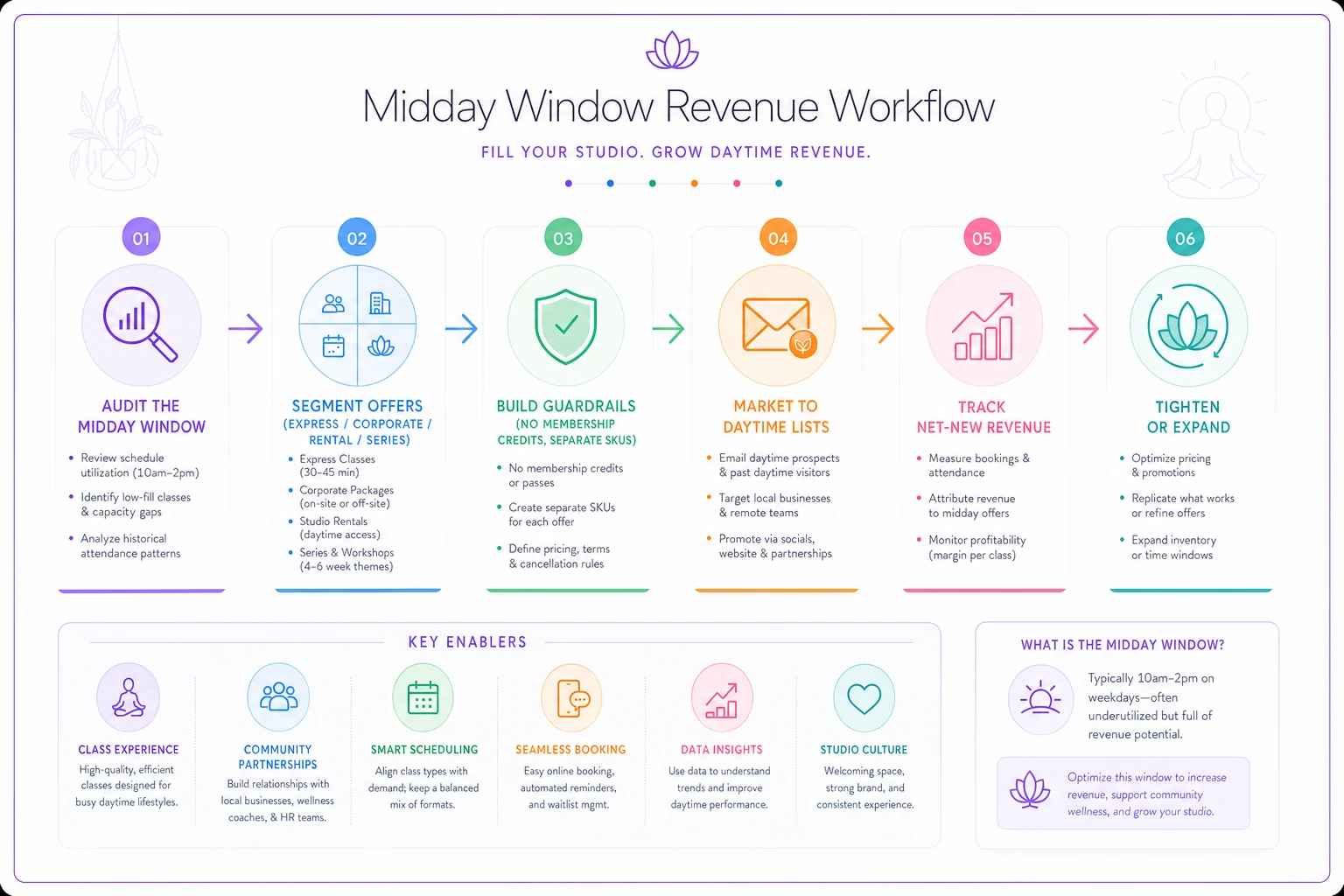
This diagram visualizes the sequence above.
Most studios skip the last step. They look at midday attendance, feel good about a fuller room, and don't notice that half those faces are regulars who shifted from 6pm. Checking the member column weekly is the only way to catch that drift early.
A real scenario
A single-location studio in a mid-size downtown had a dead midday window — two or three drop-ins a day, mostly existing members who'd shifted over from evenings. Net new revenue from noon: close to zero. And their 6pm headcount had softened slightly as a handful of regulars drifted to the quieter noon slot.
They rebuilt the window with guardrails. Membership credits stopped applying midday. They launched a 30-minute express at $14, outside the membership entirely. They pitched a lunchtime pack to two nearby offices. They started renting the room Tuesday and Thursday afternoons to a meditation teacher at a flat hourly rate.
Over about a quarter, midday went from near-zero net new to roughly $2,400–$3,000 a month in genuinely incremental revenue. One office signed a recurring 10-seat pack, the rentals cleared cost comfortably, and the express class pulled mostly new daytime faces. Just as important, 6pm numbers recovered — because the midday option no longer competed with it. The format and pricing gap kept the two audiences from overlapping.
Not a dramatic transformation. A quiet, durable improvement on hours they were already paying for.
Measuring it so you know it's actually incremental
The only metric that matters for midday monetization is net new revenue, not midday attendance. Attendance can rise entirely from cannibalization and tell you nothing useful. Track these instead:
-
Midday revenue by source — express drop-ins, corporate packs, rentals, series — kept as separate line items.
-
Member migration rate — what share of midday attendees are existing members vs. genuinely new faces. If it's trending toward existing members, your guardrails are leaking.
-
Evening headcount, watched as a control — if 6pm softens as midday grows, you're moving revenue, not adding it.
-
Revenue per midday hour — total midday revenue divided by hours the room is open midday. This tells you whether the window is earning its rent.
A simple weekly template works fine here: four rows (express / corporate / rentals / series), columns for revenue, new-customer count, and existing member count. If the member column creeps up over a few weeks, pause and tighten your gating before adding more offers. The tracking doesn't need to be sophisticated — it just needs to happen consistently enough that you actually catch drift before it compounds.
When midday monetization makes sense — and when it doesn't
It makes sense when you've got a genuine daytime population nearby — offices, remote workers, retirees — the room would otherwise sit empty, and your instructor capacity isn't already stretched covering peak hours.
It's a bad idea when your instructors are already running hard on peak classes and midday would just stack more load on a tired team. Quality slips fast in that situation. It's also wrong for neighborhoods that empty out by 9am with no daytime foot traffic. No pricing strategy creates demand that physically isn't there.
Skip it entirely if you're still struggling to fill peak hours consistently. Midday is a margin optimization layered on top of a working business. If 6pm isn't reliably full, fix that first — the 12-month marketing calendar approach to filling capacity is the better place to start.
The real lesson
The empty midday window isn't a scheduling gap to plug with more of the same. It's a separate small market sitting right next to your studio — different people, different needs, different willingness to pay — and it only becomes real revenue if you build products specifically for them while deliberately keeping those products away from the members you already have.
Get the segmentation right, build the guardrails into the mechanics rather than the marketing, anchor your prices to something other than your core rate, and measure net-new rather than raw attendance. Do that consistently, and those quiet midday hours stop being overhead you're absorbing and start covering their own costs.
Get the segmentation right, build the guardrails into the mechanics rather than the marketing, anchor your prices to something other than your core rate, and measure net-new rather than raw attendance. Do that consistently, and those quiet midday hours stop being overhead you're absorbing and start covering their own costs.
Ready to elevate your studio operations?
Join 1,500+ yoga studios using Yoglyly to save time, reduce scheduling conflicts, and enhance member experiences.