



Most studio budget problems don't look like budget problems at first. They look like a good month. Ads are performing, intro offers are selling, the 6pm vinyasa is full three nights running. Then the complaints start. People can't get into the classes they signed up for. Waitlists stop converting because the slots were never realistic. Teachers burn out covering overflow. And somewhere in the spend report, a chunk of your acquisition money is quietly buying new students for rooms that are already at capacity.
That gap — between what marketing is buying and what the schedule can actually absorb — is the single most expensive blind spot in studio growth. You can have great creative, a tight funnel, a solid intro offer, and still burn money because nobody connected the spend to the seats.
This is where cross-channel acquisition governance becomes less of a marketing idea and more of an operations discipline. It's the set of rules that decide how much you spend, on which channels, based on how much room you actually have to teach. Not projected demand. Not last year's numbers. Real, bookable capacity.
Why capacity and acquisition drift apart
Marketing and scheduling run on two different clocks, and almost nobody syncs them.
Marketing thinks in campaigns, budgets, and monthly targets. Scheduling thinks in rooms, mat counts, instructor availability, and class times. When a channel starts performing, the natural instinct is to pour more into it. But the schedule doesn't flex that fast. You can't add a 7pm class because Meta had a good week. Your Tuesday evening slot holds 24 mats whether you spent $400 or $4,000 driving people toward it.
This drift is invisible until it's painful. A typical pattern: the studio runs an intro offer, it converts well on paid social, and the owner raises the budget mid-month. Three weeks later the popular evening classes are overbooked, midday classes are still empty, and the new students who couldn't get their preferred times churn before they ever become members.
The money wasn't wasted because the ad was bad. It was wasted because it bought demand for a time slot that was already sold out, while ignoring the slots that actually needed filling.
If you've read our breakdown on capacity-aware growth and a CAC, LTV and payback model that prioritizes channels by class capacity, this is the governance layer that sits on top of it. That post covers which channels to prioritize. This one is about the rules that stop you from overspending once those channels start working.
What breaks as you scale
At one location with a couple of instructors, you can manage this by feel. The owner teaches, sees the room, knows Thursday is tight and Monday mornings are dead. The correction happens in their head.
Eliminate class scheduling chaos.
Yoglyly helps you book, confirm & manage every class seamlessly.
- Centralized class scheduling
- Member notifications
- Instructor and resource management
No credit card required
Add a second room, a second location, or just more class times and teachers, and that intuition stops scaling. A few places where it tends to break first:
-
Attribution gets muddy. A new student might see an Instagram ad, get a referral text, search your name on Google, and finally book through a local listing. If every channel claims that signup, you'll over-fund three channels for one student.
-
Capacity becomes location-specific. Your downtown studio might be slammed at peak while the suburban one has open evening slots. A blanket budget treats them as one pool. They aren't.
-
Reallocation lag gets expensive. When one channel caps out, the money should move. In most studios it keeps running on autopilot for another two or three weeks because nobody owns the decision.
-
Off-peak stays empty. Paid channels naturally optimize toward what's easiest to sell, which is usually the already-popular times. Without governance, you systematically overspend on your fullest classes and underspend on the ones with actual room.
The failure isn't one bad decision. It's a bunch of small, uncoordinated ones that compound. And the bigger you get, the more each one costs.
The governance model: caps, scoring, and triggers
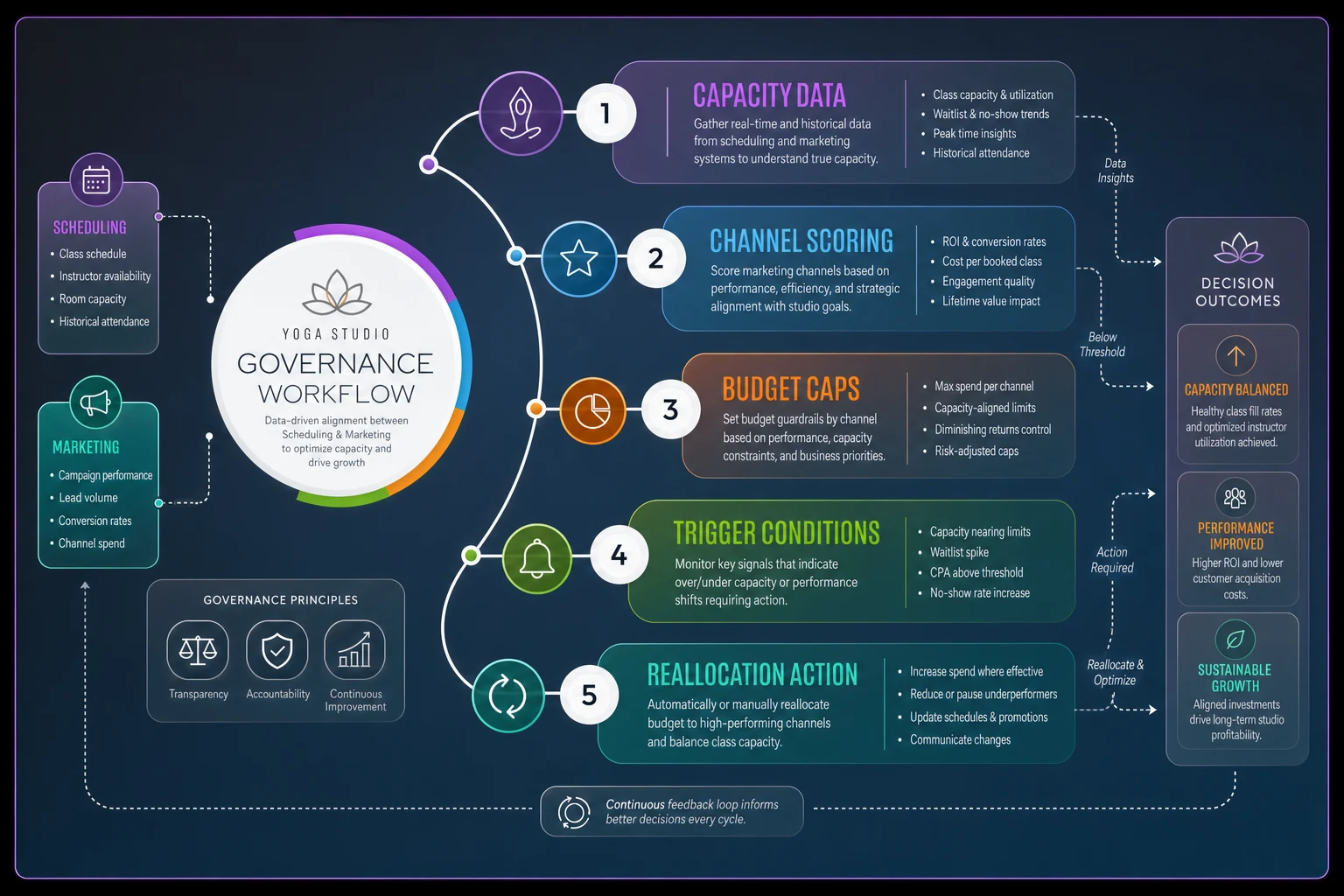
Three connected pieces. Channel caps tell you the ceiling. Channel scoring tells you where money should go. Budget triggers tell you when to move it.
Here's a simple diagram of that flow.
1. Set channel caps tied to real capacity
A channel cap isn't a spend limit pulled from a budget spreadsheet. It's derived from how many bookable, net-new seats you actually have in a given period.
Start with open capacity, not total capacity. If a week has 40 classes averaging 20 mats, that's 800 possible attendances. But a big share of those seats go to existing members and regulars. The number that matters for acquisition is the remaining seats — the ones a new student could realistically fill without crowding out a member.
A rough working example: a studio runs around 36 classes a week, holds about 22 mats per class, and averages roughly 60% fill. That leaves somewhere near 300 open seats weekly — but once you strip out peak classes that are effectively full and off-peak classes that structurally won't fill regardless, your realistic acquisition capacity might be closer to 120–150 seats a week.
That number sets your spend ceiling. If a new student costs you roughly $40–$55 to acquire and you have room for about 140 new attendances a week, your total acquisition spend has a natural cap. Blow past it and you're paying to overfill. The math is uncomfortable but it's the right place to start.
2. Score channels by capacity fit, not just cost
Most studios score channels on cost-per-acquisition alone. That's incomplete. A cheap channel that only fills your already-packed 6pm classes is worse than a slightly pricier channel that fills your dead midday slots.
| Channel | Approx. CAC | Converts to off-peak? | Capacity fit | Priority |
|---|---|---|---|---|
| Referral program | $20–$30 | Mixed | Medium | High |
| Local SEO / Maps | $25–$40 | Yes (searchers flexible) | High | High |
| Paid social (peak creative) | $35–$50 | Rarely | Low | Cap tightly |
| Paid social (off-peak offer) | $45–$60 | Yes | High | Scale carefully |
| Partnerships / corporate | $15–$35 | Yes (daytime) | High | High |
The pattern worth noticing: your cheapest channel on paper is often your worst for capacity, because it sells the easy seats you'd have filled anyway. Partnerships and off-peak-targeted campaigns tend to cost more per head but fill the slots that actually need bodies — which is why a 12-month marketing calendar built to fill capacity rather than run random promos pays off more than chasing the lowest CAC.
3. Define budget triggers that force reallocation
Caps and scoring are useless if nobody acts when limits hit. Triggers make the reallocation automatic instead of a debate.
-
If peak-class fill rate crosses ~85% for two consecutive weeks → then cut peak-targeted spend by 30% and shift it to off-peak campaigns.
-
If a channel's CAC rises more than ~25% above its 4-week average → then pause new scaling and reallocate that increment to the next-highest-scoring channel.
-
If off-peak fill drops below ~40% → then increase off-peak-specific spend and partnership outreach regardless of overall budget.
-
If waitlist length on a given class exceeds the room size → then stop all acquisition pointing at that time slot and evaluate adding a class instead.
Writing these down removes the emotion. When ads are "working," nobody wants to cut spend. A pre-agreed trigger makes the cut non-negotiable.
A monthly reallocation playbook
A straightforward monthly rhythm that keeps spend aligned with capacity. One person, two hours a month, consistent data.
-
Pull last month's fill rates by class and time block. Separate peak, mid, and off-peak. This is your capacity truth.
-
Pull acquisition by channel. Note CAC and, as best you can, which time slots each channel's new students booked into.
-
Flag the mismatches. Where did spend go toward already-full slots? Where are open seats not being marketed at all?
-
Check your triggers. Did any thresholds get crossed? Act on them before anything else.
-
Reallocate the next month's budget. Pull from channels feeding full classes, push toward channels and offers that fill open seats.
-
Set one capacity goal. Example
"raise Wednesday midday fill from ~35% to ~55%." Point a specific channel and offer at it.
-
Write down what you expect. So next month you can tell whether the move worked or you're just guessing.
Have one person own the monthly pull and reallocation to avoid coordination lag.
Studios that run this cycle consistently stop having the "why is marketing so expensive" conversation, because spend starts tracking the seats it can actually fill. It's not complicated — it just requires someone to own it.
A real scenario
A two-location studio was running close to $4,500 a month across paid social, local listings, and a referral program. Both locations looked healthy on top-line numbers — new signups were steady. But member complaints about overbooked evening classes were climbing, and midday classes were running at maybe 30% full.
When they broke spend down by slot, the picture was blunt: roughly 70% of acquisition spend was feeding classes that were already near or over capacity. They were paying full CAC to create waitlists and frustration.
They set caps on peak-targeted campaigns, built an off-peak intro offer, and redirected about $1,200 of monthly spend toward daytime-friendly channels — partnerships with nearby offices and local search. Nothing dramatic overnight. Over about two months, midday fill climbed into the low 50s, evening overcrowding eased, and total spend actually dropped slightly because they stopped pouring money into slots that couldn't convert. The new students who came in through daytime slots also retained better, probably because they could actually book the times they wanted.
The ad creative barely changed. The governance did the work.
Where tools fit (and where they don't)
A lot of this can live in a spreadsheet when you're small. The reason it eventually needs a system is coordination lag. Pulling fill rates by slot, matching them against channel spend, and catching a trigger before two weeks of overspend happens — that's genuinely hard to do manually across multiple locations and class times.
An operational platform with AI-assisted automation helps here: it can watch fill rates and CAC in the background, flag when a trigger condition is met, and surface "you're overspending on the Thursday 6pm slot" without you having to go digging. The automation isn't making the strategic calls — you still set the caps and the rules. It just closes the gap between a capacity limit tripping and someone actually noticing. For a studio juggling two or three locations, shrinking that lag from three weeks to a few days is often the difference between governed growth and quiet overspend.
The mistake is thinking a tool replaces the governance. It doesn't. The rules, caps, and scoring logic still have to come from you. The software just enforces them faster than a busy owner can.
When this is worth the effort — and when it isn't
This makes sense when:
-
You're spending enough on acquisition that a 20–30% misallocation actually hurts.
-
You have real capacity variation — some classes full, others empty.
-
You're running more than one channel, so reallocation decisions exist.
-
You're adding locations or class times and intuition no longer covers it.
This is overkill when:
-
You're a single instructor with one room and a handful of classes. Your schedule is small enough to manage by feel.
-
Nearly every class is already full. At that point your problem isn't acquisition governance — it's capacity expansion, and you should be adding classes, not optimizing spend.
-
Your total monthly spend is small enough that the time spent governing it costs more than the waste it prevents.
Who should not do this: studios that haven't nailed down basic attribution yet. If you genuinely don't know which channels bring students in, start there. Governance built on bad attribution just makes confident wrong decisions faster.
The studios that grow without bleeding money aren't the ones with the cleverest ads. They're the ones who treat acquisition spend as something that has to match physical capacity, class by class, slot by slot.
Caps keep you from overbuying. Scoring points money at the seats that need it. Triggers force the reallocation before the waste piles up. Get those three working together and marketing stops being a monthly gamble. It becomes a system that fills the room you actually have — not the room you wish you had.
Ready to elevate your studio operations?
Join 1,500+ yoga studios using Yoglyly to save time, reduce scheduling conflicts, and enhance member experiences.