

There's a strange gap in most studios. You put real energy into filling a beginner series or a 6-week cohort. Twelve people sign up, show up, sweat, bond, hit the final class... and then they vanish. The intro-to-vinyasa graduates who paid $180 for six weeks disappear into the "maybe someday" pile, right alongside the drop-ins who came once on a Groupon.
That's backwards. Someone who completed an entire cohort has already told you something: they can commit to a schedule, they tolerated the awkward first-week soreness, they liked the room enough to keep returning. They're warmer than any lead you'll buy on Instagram. And yet the average studio treats "series done" as an ending instead of the exact moment to start a different conversation.
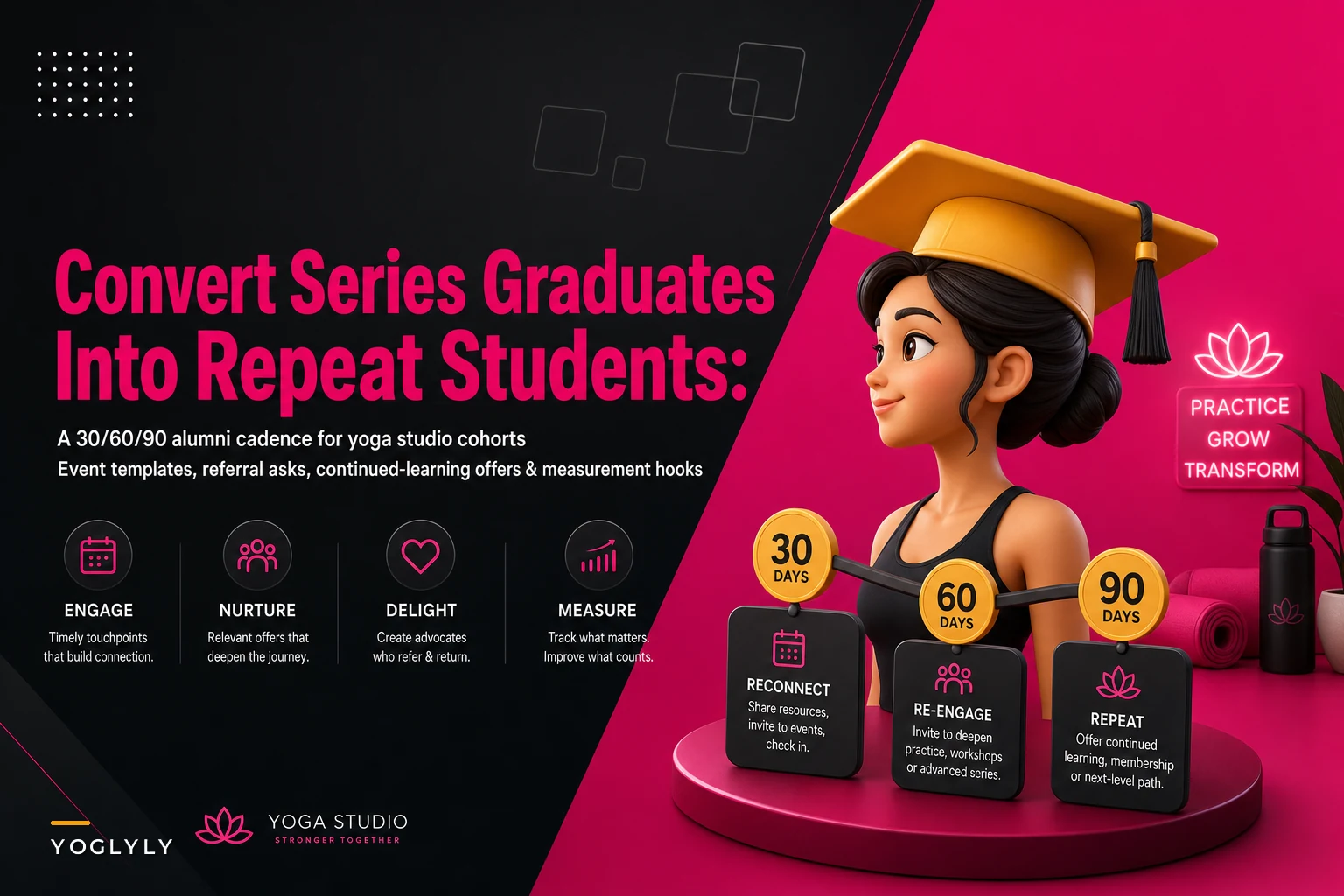
This post is only about that window. Not lifecycle theory, not general retention. Just the 90 days after a cohort graduates — a specific cadence with event formats, referral moments, and continued-learning offers — to turn those graduates into people who keep showing up and paying. If you want the broader picture of how programized series fit into revenue, the programization playbook for series, workshops and cohorts covers that. Here we're zooming into the aftermath.
Why the drop-off happens (and it's not that they lost interest)
The instinct is to blame motivation. "They just fell off." But watch the actual behavior and it's almost never a sudden loss of interest. It's a structural void.
During the cohort, three things carried the student: a fixed time on their calendar, a group they recognized, and a sense of progression. The Tuesday 6:30 slot was theirs. They knew Dana would be on the mat next to them. Each week built on the last. Remove all three at once — which is exactly what graduation does — and even an enthusiastic student has nothing to attach to. Open drop-in schedules are a wall of options with no obvious next step, no familiar faces guaranteed, and no arc.
What shows up again and again at studios running beginner series is that the students who don't convert usually aren't unhappy. They'll say the series was great. They just never got a nudge that answered the only question they actually had: "Okay, so what do I do now?" Silence answers that question with "nothing."
The second reason is timing. Studios that do follow up tend to do it once — a single "we miss you" email three weeks later — and treat that as the effort. One touch, at a random moment, competing with a flooded inbox. That's a coin flip at best.
The real cost of letting graduates cool off
Run the numbers on a small studio and this stops looking like a soft problem.
Eliminate class scheduling chaos.
Yoglyly helps you book, confirm & manage every class seamlessly.
- Centralized class scheduling
- Member notifications
- Instructor and resource management
No credit card required
Say you run a 6-week beginner series four times a year, 12 students each. That's 48 graduates annually. If you convert around 25% into some kind of ongoing membership or pack — which is roughly what studios see with no structured follow-up — you keep about 12 of them. A member paying around $120/month who stays even eight months is worth close to $960. Twelve of them is roughly $11.5k.
Push that conversion to 45% with a real re-engagement cadence and you're retaining around 21 graduates instead of 12. Nine additional members, same $960-ish value each, is roughly $8.6k in additional annual revenue — from students you already paid to acquire, already taught, and already have contact info for. No new ad spend. The only thing that changed was someone gave them a next step at the right moment.
And that's before referrals. Cohort graduates are unusually good referral sources because they went through the experience with people. They have a story and a group memory attached to it. Miss the window and that warmth fades into a vague good feeling nobody acts on.
The 30/60/90 structure at a glance
Three distinct phases, each with a different job. The first month keeps the habit warm. The second month rebuilds community and belonging. The third month converts commitment into a recurring relationship — and mines for referrals while the goodwill is still fresh.
| Phase | Primary goal | What the student needs | Main offer |
|---|---|---|---|
| Days 0–30 | Prevent the habit gap | A next class to walk into | Bridge pass / "graduate rate" pack |
| Days 31–60 | Rebuild belonging | Their cohort, their people | Alumni event / reunion class |
| Days 61–90 | Convert to recurring | A reason to commit long-term | Membership offer + referral ask |
The offer only gets aggressive at day 60+. Pushing a full membership on day 3 post-graduation tends to backfire — the student hasn't yet felt the void, so the pitch feels like an upsell rather than a solution. Let them miss it a little first.
Days 0–30: keep the mat warm
The single most important move in the whole flow happens in the first two weeks: get them into one regular class before the habit dies. Motivation from the final cohort session has a short shelf life.
What works better than "come to any class" is naming the class. Graduates freeze when handed the full schedule. Point them instead to a specific ongoing class that's a natural step up from the series — same instructor if possible, or one who taught a guest session during the cohort. "Your Level 1 flow continues Thursdays at 6:30 with Dana" converts far better than "check out our schedule."
Bridge pass. Offer a low-friction pack that only exists for recent graduates — say, 4 classes for $40, valid 30 days. It's not about the margin. It's a ramp. The goal is attendance frequency, because a student who comes three times in the first month is dramatically more likely to still be around in month three.
-
Day 1–2
A genuine congrats message plus the one named class recommendation
-
Day 7
"Did you make it in yet?" — short, personal, no offer
-
Day 14
Bridge pass reminder with the expiry date visible
-
Day 21
A note from the cohort instructor, not the studio account
An instructor-sent note has far higher open and reply rates than a generic studio email.
That instructor note matters more than people expect. Graduates bonded with a person, not a brand. A message that reads like it came from Dana lands differently than one that reads like it came from the front desk.
Days 31–60: rebuild the room they miss
By week five or six post-graduation, what's actually gone is the group. This is where an event format does heavy lifting, and where most studios do absolutely nothing.
The highest-converting format is a cohort reunion class — a single session, invite the exact graduating group back together, ideally with the same instructor. Frame it as a reunion, not a sales event. Put it about six or seven weeks after graduation. People who've drifted will come back for the people even when they wouldn't come back for the yoga. And once they're in the room again, the void becomes obvious to them without you saying a word.
-
Reunion class — the original cohort, same time-slot feel, followed by tea or 20 minutes of hanging around. Low cost, high emotional pull.
-
Alumni-only workshop — a themed 90-minute session (backbends, restorative, breathwork) offered at a graduate rate. Gives progression-minded students a "next level" feeling.
-
Bring-a-friend reunion — the reunion class, but each graduate can bring one guest free. This quietly plants the referral seed without a formal ask.
The bring-a-friend version is where phase two starts overlapping with phase three's referral engine. A graduate who brings a friend is doing your outreach for you, and the friend arrives pre-warmed by someone they trust.
Keep the offer soft here. The event is the offer. Don't bolt a membership pitch onto the reunion — let the reconnection do its work, then follow up individually in the next phase.
Days 61–90: convert and ask for referrals
By now the student has finished, missed it, been pulled back once, and felt the gap. A membership offer actually makes sense at this point — because you're solving a problem they now feel instead of inventing one.
The framing that works: position membership as the thing that removes the decision. During the cohort they never had to choose whether to come — it was just on the calendar. A membership recreates that. "Stop deciding class by class" resonates more than any discount.
A graduate-specific offer beats a generic promo. Something like first month at a reduced rate, or a founding-alumni price locked in as long as they stay continuous. The lock-in framing is powerful because it rewards exactly the behavior you want — continuity.
-
"Know someone who keeps saying they want to try yoga but feels intimidated? Our next beginner series is exactly for them — here's a link that gives them $20 off."
-
Give them something concrete to hand over. A referral that comes with a specific offer and a specific next series converts far better than goodwill floating in the air.
Continued-learning offers also live in this phase for students who love progression. Graduates of a beginner series are natural candidates for the next cohort — a Level 1.5 or an intro-to-arm-balances series. Selling the next series to a satisfied graduate is one of the easiest sells you'll ever make, and it drops them right back into the structure that worked the first time. That's the loop: cohort → re-engagement → next cohort → membership.
A real scenario
A small neighborhood studio — two rooms, one main teacher plus a few contractors — ran a beginner series three or four times a year and quietly accepted that most graduates evaporated. Their honest guess was that maybe a quarter turned into anything ongoing.
They didn't overhaul anything. They built the 30/60/90 flow: a named next-class recommendation and a $40 bridge pack in month one, a reunion class at week six with a bring-a-friend option, and a founding-alumni membership offer plus a referral link at day 65.
Over the next two series cycles, graduate conversion moved from roughly 25% to somewhere in the low 40s. On a group of 12, that's about two extra people per cohort sticking around. Not dramatic in isolation — but across four cohorts a year, plus the friends the reunion classes pulled in, it added up to a meaningful chunk of recurring revenue they'd been leaving on the table every quarter. The teacher's comment was the tell: "These were people who already liked us. We just never asked them to stay."
When this makes sense — and when it doesn't
When it works well:
-
You run any kind of series, cohort, or multi-week program with a defined start and end
-
Cohorts are small enough that a reunion feels personal (roughly 8–20 people)
-
You have the same instructor teaching the series and available for follow-up touches
When it's a bad idea:
-
Your "series" is really just a punch card with no group cohesion — there's no cohort to reunite
-
You're running cohorts so large the reunion loses its intimacy; split them
-
You don't yet have clean contact records for who graduated when — fix that first, or the whole cadence collapses on bad timing
That last point is where a lot of studios quietly fail. The cadence only works if the right message hits the right graduate on the right day. When graduation dates, contact info, and purchase history live in three different places — a spreadsheet, a booking tool, and someone's memory — follow-ups go out late, to the wrong people, or not at all. This is less about fancy software and more about knowing, on any given day, exactly which cohort just finished and where each graduate sits in the 30/60/90 window. Studios that treat that tracking as part of their broader lifecycle system — the same logic behind what a customer lifecycle model should actually measure — are the ones who can run this consistently instead of scrambling to remember who finished last month.
Where automation quietly earns its keep
The reason this cadence usually doesn't happen isn't that owners don't believe in it. It's that it's a lot of small, time-sensitive touches per graduate, multiplied across every cohort, indefinitely. Nobody has the bandwidth to hand-track 48 graduates through nine touchpoints each.
That's the narrow spot where operational software helps — not by replacing the personal feel, but by making sure the touches happen on time. Tag a student the day their cohort ends and the day-1, day-7, day-14 messages fire on schedule; the reunion invite goes out at week six; the membership-plus-referral prompt lands at day 65 with the instructor's name attached, not a generic sender. You still write the words. The system just makes sure the timing never slips — which is exactly what breaks when you're trying to manage it manually between teaching classes and running the front desk.
Here's a simple visualization of the touchpoint workflow.
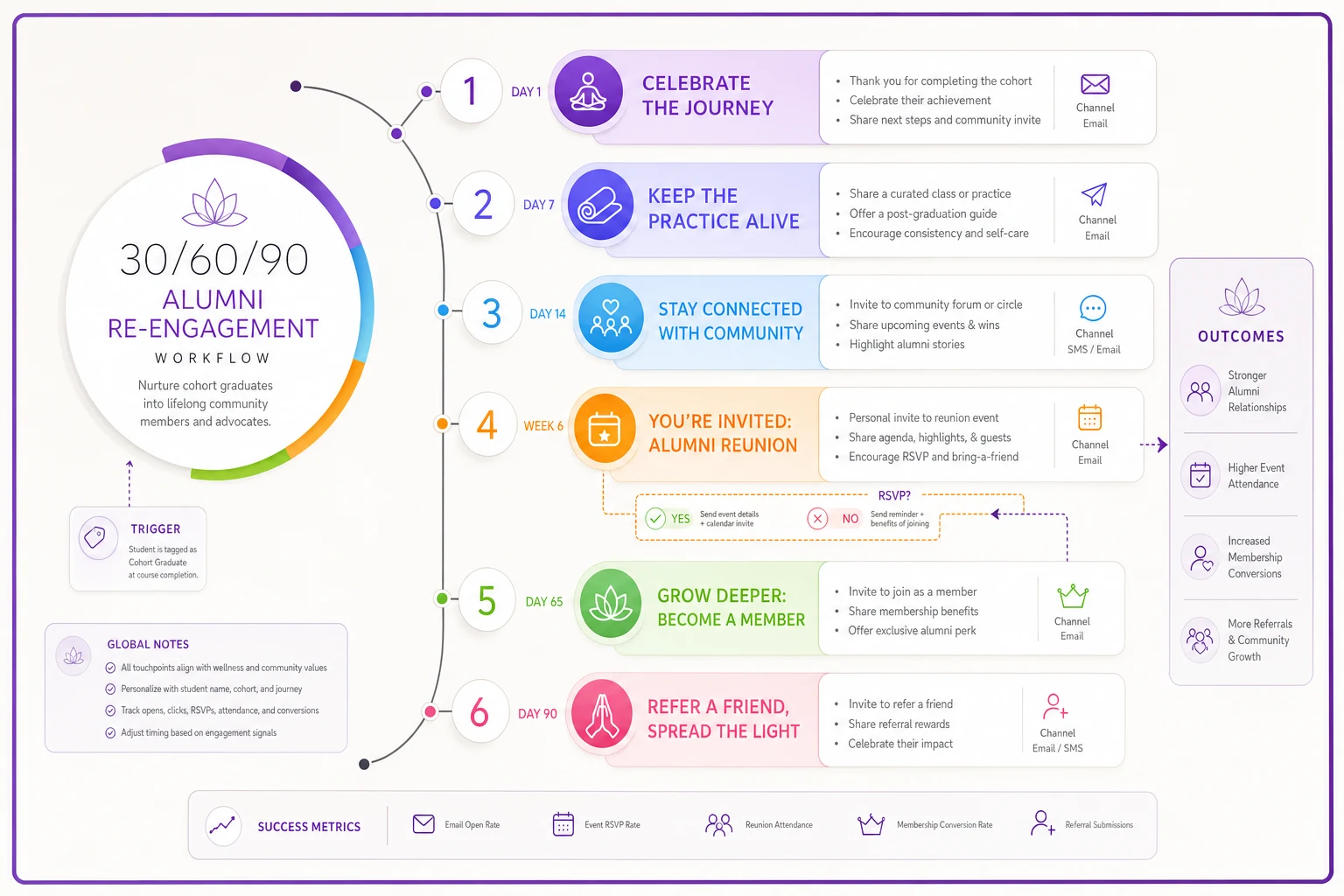
Done right, the graduate never feels automated. They feel remembered — nudged at the moment they were quietly wondering whether to come back.
The takeaway
Graduation isn't the finish line for the student relationship; it's the riskiest moment in it. The habit, the group, and the sense of progress all disappear on the same day, and without a deliberate cadence to replace them, even a happy graduate drifts. A 30/60/90 flow doesn't require a bigger marketing budget or new students. It just requires treating the end of a cohort as a beginning — keep the mat warm, rebuild the room they miss, then give them a reason to stay and someone to bring with them. The graduates already told you they like it here. The only real question is whether anyone follows up before that feeling fades.
Ready to elevate your studio operations?
Join 1,500+ yoga studios using Yoglyly to save time, reduce scheduling conflicts, and enhance member experiences.