


Most yoga studios track the wrong things at the wrong times for the wrong people. They send the same reminder emails to someone who's been coming for three years and someone who just signed up yesterday. They use the same re-engagement campaign for someone who gradually stopped coming versus someone who disappeared overnight after an injury.
The real problem isn't that studios don't care about member retention. It's that they're running blind — no clear lifecycle stages, no trigger points, no diagnostic signals. They react to problems after members have already churned instead of catching early warning signs when intervention still matters.
A proper yoga studio customer lifecycle model breaks down member behavior into distinct operational phases, each with specific metrics, automated triggers, staff responsibilities, and intervention playbooks. It's the difference between scrambling to fill empty spots and systematically moving members through predictable stages toward long-term retention.
Why generic retention tactics fail yoga studios specifically
Yoga studios face unique lifecycle challenges that generic fitness retention strategies completely miss. Unlike gyms where members might work out solo, yoga creates community dependencies. When one regular stops coming, it affects the energy of their usual Tuesday morning class. When a beginner feels lost in an advanced flow, they don't just skip that class — they often never come back at all.
The operational complexity multiplies because yoga studios typically run multiple modalities (vinyasa, yin, hot yoga), skill levels, and instructor styles under one roof. A member might love Sarah's Wednesday evening slow flow but hate the Saturday power class. Without tracking these preferences across lifecycle stages, studios waste time promoting the wrong classes to the wrong people.
Then there's the psychological component unique to yoga. Members often start during life transitions — new job stress, divorce, health scare — which means their engagement patterns follow emotional cycles, not just scheduling logistics. A lifecycle model that ignores these context clues will miss critical intervention windows.
Scale makes everything worse. A 50-member studio can personally track who's struggling. But once you hit 200+ active members across multiple class types, manual tracking becomes impossible. That's when you need systematic lifecycle management with clear handoff points between automation and human touch.
Breaking down the three core lifecycle stages
Activation Stage (Days 0-30)
Eliminate class scheduling chaos.
Yoglyly helps you book, confirm & manage every class seamlessly.
- Centralized class scheduling
- Member notifications
- Instructor and resource management
No credit card required
This is where studios hemorrhage potential long-term members. The activation window is brutally short — if someone doesn't attend their third class within 14 days of their first, they're statistically gone. Yet most studios focus all their energy on the first visit and then hope for the best.
Activation KPIs that actually matter:
-
Time to second visit (target
within 7 days)
-
Classes tried by day 14 (target
3+ different instructors/styles)
-
Community touchpoints (mat neighbor interactions, instructor name recognition)
-
Setup completion (parking figured out, favorite spot identified, water bottle routine)
The operational challenge is coordination. Front desk needs to track first visits, instructors need to know who's new without making it awkward, and automated systems need to trigger follow-ups at exactly the right moments. One studio I analyzed was losing around 40% of new members because their "welcome series" emails assumed everyone started with a package purchase — drop-in students got zero follow-up.
Activation triggers should fire based on behavior, not just time:
-
No second visit within 5 days → personalized check-in
-
Attended same instructor twice → introduction email from that instructor
-
Struggled in class (instructor notes) → beginner class recommendations
-
Package about to expire unused → extension offer with specific class suggestions
Staff responsibilities get murky here without clear ownership. Who notices when someone seems lost after class? Who follows up when the new member leaves quickly without changing? These micro-moments determine activation success, but they require systematic observation protocols, not just good intentions.
Retention Stage (Months 2-12+)
Once members establish a routine, the lifecycle focus shifts from exploration to embedding. This stage is about preventing gradual erosion — the slow decline from three classes per week to two, then one, then "I'll start again next month."
Retention metrics that reveal problems early:
-
Attendance frequency changes (weekly average over rolling 4 weeks)
-
Booking-to-attendance ratio (no-shows and late cancels)
-
Class variety index (trying new instructors/times vs. same routine)
-
Social engagement markers (staying after class, bringing friends)
The diagnostic signals here are subtle. Someone might maintain twice-weekly attendance but switch from evening to morning classes — job change? Or keep their regular slot but stop trying workshops — boredom setting in? These patterns predict future churn months before it happens.
This is where AI-powered operational software becomes genuinely useful — not for fancy predictions, but for pattern recognition across hundreds of members. When someone's attendance drops 30% month-over-month, that's obvious. But when 15 members slowly shift their patterns in similar ways, that might indicate a studio-wide issue: a new instructor not resonating, temperature problems in the hot yoga room, parking construction nearby.
Retention triggers based on pattern changes:
-
Attendance drop >25% over 2 weeks → wellness check from regular instructor
-
Multiple late cancels → schedule flexibility consultation
-
Same class for 8+ weeks straight → variety challenge or workshop invite
-
Haven't seen regular workout partner → social reconnection prompt
The staff playbook during retention focuses on preemptive intervention. Instead of waiting for someone to cancel their membership, catch the early signals and adjust. Maybe they need a schedule change, a modification refresher, or just acknowledgment that they've been consistent for six months.
Reactivation Stage (Lapsed 30+ days)
Most studios either give up too early or try too hard with the wrong approach. Generic "we miss you" emails run around a 2% success rate. Targeted reactivation based on why someone left can hit 15-20% return rates.
Reactivation requires different KPIs:
-
Lapse reason categories (schedule, injury, financial, interest)
-
Response rate to reactivation attempts by channel
-
Return rate by offer type
-
Second-lapse prevention rate (do they stick after coming back?)
The segmentation makes or breaks reactivation. Someone who disappeared after expressing frustration about class difficulty needs a completely different approach than someone who mentioned moving apartments. Yet most studios blast the same "come back for 50% off" message to everyone.
Reactivation triggers should be sequenced and personalized:
-
30 days lapsed → soft check-in, no sales pitch
-
45 days lapsed → specific class recommendation based on past preferences
-
60 days lapsed → limited-time personalized offer
-
90 days lapsed → final touchpoint before moving to quarterly campaigns
The playbook also changes based on lapse indicators. Injury lapse? Wait longer, focus on gentle return options. Price sensitivity? Offer a reduced commitment option. Gradual decline? Address the underlying pattern, not just the symptom.
Building your diagnostic dashboard
A lifecycle model without proper reporting is just theory. You need a dashboard that shows cohort flow, not just point-in-time metrics. Here's the minimum viable reporting structure:
| Lifecycle Stage | Primary Metric | Warning Threshold | Check Frequency | Owner |
|---|---|---|---|---|
| Activation | 14-day second visit rate | <60% | Daily | Front Desk Lead |
| Activation | 30-day third class rate | <40% | Weekly | Studio Manager |
| Retention | Monthly attendance variance | >30% drop | Weekly | Instructor Team |
| Retention | Cohort 6-month retention | <50% | Monthly | Owner |
| Reactivation | 60-day return rate | <10% | Bi-weekly | Marketing |
Assign a clear owner to each metric so alerts lead to action.
The diagnostic signals need to be actionable, not just informational. When activation rates drop, is it a specific instructor? A scheduling issue? A seasonal pattern? The dashboard should highlight anomalies and patterns, not just show numbers.
This connects directly to your studio operations dashboard, but with lifecycle-specific breakdowns. Instead of just tracking overall attendance, you're tracking attendance by member lifecycle stage. Instead of just measuring revenue, you're measuring revenue contribution by cohort over time.
Early warning systems for at-risk cohorts
The most valuable part of a lifecycle model is catching problems before they become permanent losses. At-risk cohorts share predictable patterns that most studios miss until it's too late.
The "second-month cliff" cohort: Members who had strong activation but suddenly drop off around week five or six. Usually indicates expectation mismatch — they thought yoga would be easier, faster results, or a different kind of community. These members need proactive check-ins around day 35-40, not after they've already decided to quit.
The "gradual ghoster" cohort: Steady decline from three times a week to twice, then once every two weeks. Often signals life changes — new job, relationship shift, health issue — that could be accommodated with schedule flexibility or a temporary hold instead of a full cancellation.
The "workshop avoider" cohort: Consistent class attendance but zero participation in special events, workshops, or community activities. These members are transactional and will leave the moment a cheaper option appears nearby. They need deeper integration attempts before patterns get too entrenched.
The "instructor dependent" cohort: Only attend one instructor's classes. When that instructor leaves or changes schedule, these members vanish. Proactive variety introduction during the retention stage prevents this single point of failure.
Each cohort needs a specific playbook:
Second-month cliff playbook:
-
Day 35
Instructor sends personal note about their progress
-
Day 40
Offer free 15-minute alignment session
-
Day 45
Invite to beginner-friendly workshop
-
Day 50
Schedule adjustment consultation if still struggling
Gradual ghoster playbook:
-
Week 1 of decline
Automated gentle check-in
-
Week 2
Instructor reaches out directly
-
Week 3
Offer temporary hold instead of cancellation
-
Week 4
Present modified membership options
The key is having these playbooks ready before you need them. When someone starts showing at-risk patterns, the intervention should be automatic, not a scrambled reaction.
Integrating lifecycle automation with human touchpoints
Pure automation fails because yoga is inherently personal. Pure manual tracking fails because it doesn't scale. The solution is strategic integration — automation handles pattern recognition and triggering, humans handle the actual intervention.
Automation should handle:
-
Tracking attendance patterns across all members
-
Identifying statistical anomalies in behavior
-
Triggering alerts to appropriate staff
-
Sending initial touchpoints for low-risk situations
-
Scheduling follow-up reminders for staff actions
Humans should handle:
-
Personal check-ins with at-risk members
-
Customizing intervention based on context
-
Making judgment calls on holds and extensions
-
Building actual relationships during classes
-
Noting qualitative observations that inform future triggers
The handoff points matter enormously. When the system flags someone as at-risk, who gets notified? How quickly must they respond? What information do they see? One studio had beautiful automation that nobody acted on because alerts went to a general inbox nobody checked. Another studio overwhelmed instructors with so many alerts that they started ignoring them entirely.
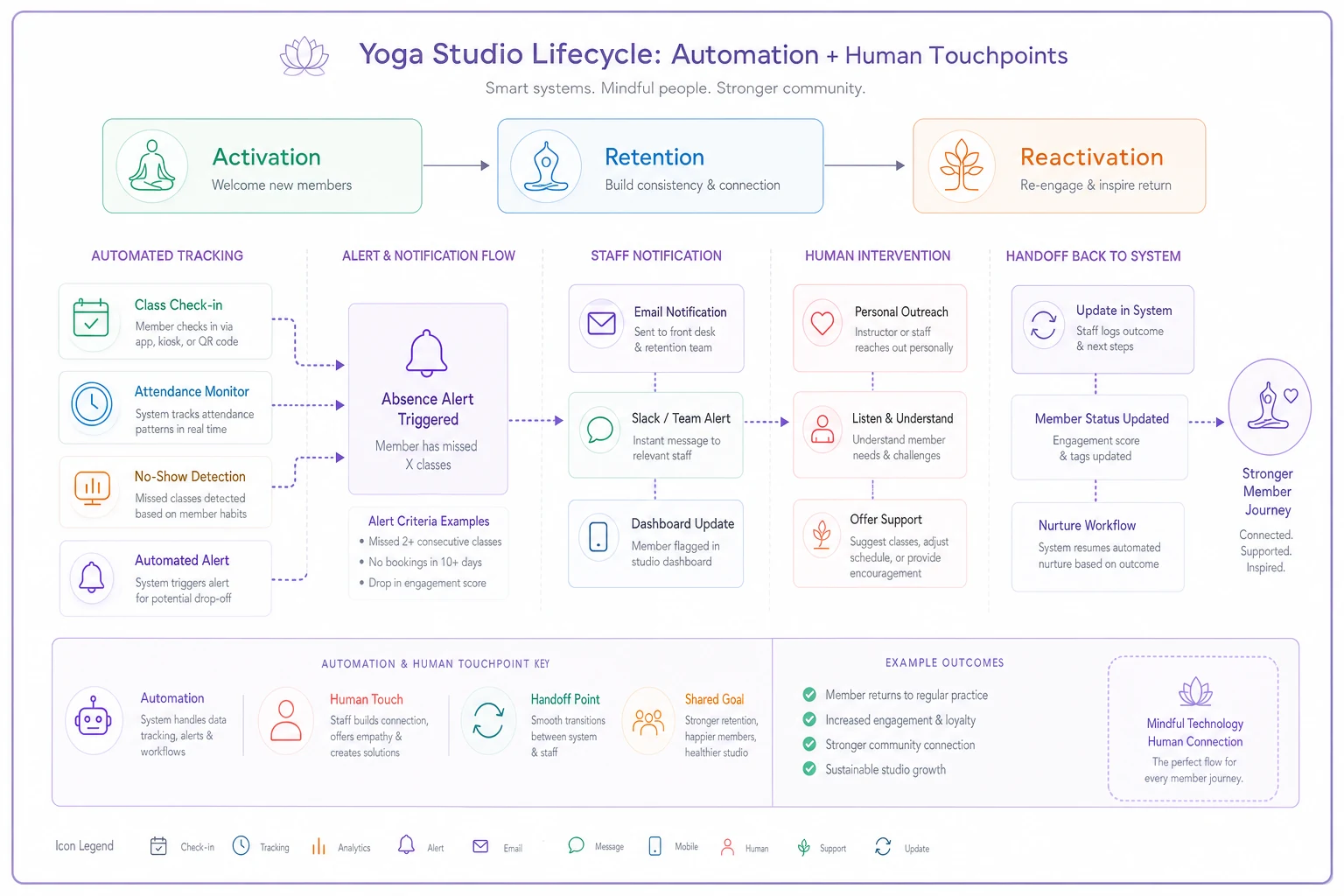
This is exactly where well-designed email and SMS sequences integrate with lifecycle stages. Instead of blasting everyone with the same "check out our workshop" message, automation sends stage-appropriate content. New members get navigation help. Retained members get variety encouragement. Lapsed members get specific win-back offers.
Setting up your reporting cadence
Daily reporting focuses on activation emergencies — new members who seem lost or confused need immediate intervention. The front desk lead should check every morning: who started this week but hasn't returned? Who bought a package but hasn't booked their second class?
Weekly reporting covers retention trends. Are specific classes seeing attendance drops? Are certain cohorts showing warning signs? This is pattern recognition across the full membership base, looking for problems before they cascade. The studio manager owns this rhythm, adjusting staffing and programming based on what comes up.
Monthly reporting examines lifecycle flow rates. What percentage of last month's new members successfully activated? What's the 6-month retention rate trending? How effective were reactivation campaigns? This strategic view informs pricing, marketing spend, and capacity planning.
Reporting shouldn't just track metrics — it should trigger specific actions. When activation rates drop below 60%, that's not just a number to note. It should trigger a full review of the onboarding process, instructor briefings on welcoming new students, and analysis of which touchpoints are failing.
Financial impact of lifecycle optimization
Most studios focus on new member acquisition while hemorrhaging money through poor retention. The math is pretty stark: improving activation from 40% to 60% can have the same revenue impact as adding 50% more new members, without the marketing cost.
A realistic breakdown for a 200-member studio:
-
Current
20 new members/month, 40% activate, 50% retain at 6 months = 4 long-term members
-
Optimized
20 new members/month, 60% activate, 65% retain at 6 months = ~8 long-term members
-
Revenue impact
roughly $6,000/month additional at $150/month average membership
The compound effect is even stronger. Better activation creates better retention because properly onboarded members develop stronger habits. Better retention creates better reactivation because lapsed members have positive associations to return to. It becomes a self-reinforcing cycle once the lifecycle model is running properly.
Common lifecycle model failures
The first failure is treating lifecycle stages as rigid categories instead of fluid transitions. Someone might technically be in "retention" but showing "reactivation" patterns after an injury. The model should flag these edge cases for human review, not force them into rigid automation paths.
Another failure is measuring the wrong things. Studios track "member count" when they should track "engaged member count." They celebrate new signups while ignoring activation failures. They measure revenue without connecting it to lifecycle stages. The metrics have to map to operational reality, not vanity statistics.
The biggest failure is implementing a lifecycle model without the operational capacity to act on it. If instructors are already overwhelmed, adding "check in with at-risk members" to their plate won't work. If the front desk barely handles current volume, they can't manage activation tracking on top of everything else. The model must match your operational reality, then grow with capacity.
Over-automating is another common problem. Studios set up elaborate trigger sequences but lose the personal touch that makes yoga studios special. A member who gets three automated emails after missing a few classes feels surveilled, not supported. The balance between efficiency and humanity is what actually determines success.
Adapting your model as you scale
A 50-member studio needs a simple model: new, active, lapsed. The owner can personally track everyone's status and intervene accordingly. Growth demands more sophistication, but done wrong, that sophistication just creates more noise.
At 200 members, you need automated tracking but can still maintain personal interventions. The system flags issues, humans handle solutions. Lifecycle stages can expand to include sub-categories like "activated but irregular" or "retention risk — price sensitive."
At 500+ members, you need full lifecycle automation with designated owners for each stage. The activation specialist handles all new members. The retention coordinator manages ongoing engagement. The win-back lead focuses on reactivation. Without clear ownership, things fall through the cracks constantly.
The technology stack evolves too. Spreadsheets work at 50 members. Basic CRM gets you to around 200. Beyond that, you need integrated systems connecting scheduling, payments, communications, and reporting into a unified lifecycle view. This is where AI-powered operational platforms start earning their keep — not for the AI itself, but for the ability to surface patterns across hundreds of data points that no one person could track manually.
Implementation roadmap
Start with measurement before intervention. Track your current baseline: what percentage of new members attend a second class within a week? What's your 3-month retention rate? How many lapsed members return within 90 days? Without baselines, you can't measure improvement.
Next, implement basic lifecycle stages — just three to start: activation (0-30 days), retention (active), and reactivation (30+ days lapsed). Assign one metric to each stage and track weekly. Don't try to build the perfect model immediately. Start simple and add sophistication based on what you actually learn.
Then add basic triggers. When someone doesn't attend their second class within a week, someone checks in. When a regular member misses two weeks, someone notices. These can be manual at first, then automated as you verify what works.
Build playbooks through experimentation. Try different approaches with at-risk cohorts and document results. Maybe personal calls work better than emails for your demographic. Maybe Saturday morning members respond differently than Tuesday evening members. Let data guide the playbooks, not assumptions.
Finally, integrate technology carefully. Don't automate everything at once. Start with pattern recognition and alerting, keep interventions human. As you verify what works, gradually automate the routine parts while preserving human judgment for complex situations.
Conclusion
A proper yoga studio customer lifecycle model isn't about treating members like numbers in a funnel. It's about systematically ensuring every member gets the right support at the right time to build a sustainable practice. The studios that thrive long-term aren't necessarily the ones with the best instructors or facilities — they're the ones that consistently move members through activation into retention while catching at-risk signals before they become permanent losses.
The operational sophistication required might seem like a lot, but the alternative is worse: constantly churning through new members while wondering why revenue never stabilizes, reacting to problems after they've already cost you members, and running marketing campaigns that bring in new people just to lose them through the same broken activation process.
Whether you're managing 50 or 500 members, the principles stay constant: define clear lifecycle stages, track meaningful metrics, create intervention triggers, and balance automation with human connection. Get this right, and you'll stop scrambling to fill classes and start building a community that grows through retention, not just acquisition.
Ready to elevate your studio operations?
Join 1,500+ yoga studios using Yoglyly to save time, reduce scheduling conflicts, and enhance member experiences.