


The math on opening a second studio usually looks clean. You've got demand, a waitlist you can't clear, and a build-out budget you've stress-tested. What almost nobody plans for is that the second those doors open in a new town, county, or state, you're running two payroll systems that don't agree with each other — and the disagreements cost real money.
Most of the pain doesn't come from obvious stuff like paying two rents. It comes from the quiet compliance layer underneath: where each instructor's wages get taxed, whether that new city has its own payroll tax, whether your workers' comp policy actually covers the second address, and whether the person you labeled a 1099 contractor is legally a contractor in that jurisdiction, not just the one where you started.
This tends to surface in April, after returns are filed and something doesn't reconcile. So this is a working checklist for multi-location studio payroll compliance — the traps, the cadence, the insurance touchpoints, and a clean handoff structure for your accountant so nothing slips between locations.
The misclassification trap moves with the ZIP code
Worker classification isn't a national decision you make once. A yoga instructor you legitimately treat as a 1099 contractor in one state can be a clear employee in the state 40 minutes away.
California's ABC test is the famous example, but it's far from the only one. Several states apply their own version, and some cities layer on additional rules. A studio owner sets up a contractor arrangement that worked fine at location one — teacher sets their own schedule, carries their own liability insurance, teaches at multiple studios — then copies that exact structure to location two without checking whether the new state uses the same test.
A typical scenario: a studio treats twelve teachers as contractors across both locations. At the original location, that holds up. At the new one, the state applies a stricter test, and because those teachers only teach at your studio and follow your class schedule and sub policies, three of them clearly fail the "independent business" prong. Now you're looking at reclassification, back payroll taxes, unpaid workers' comp premiums, and potentially penalties — per worker.
What to actually check before you finalize classification at a new location:
-
Which classification test the new state uses (ABC, common-law/IRS 20-factor, or a hybrid)
-
Whether the city or county adds its own worker-status rules on top of the state
-
Whether "teaches only at your studio" pushes a contractor toward employee status there
-
Whether your sub/cancellation policies undercut the "controls their own work" argument
-
Whether other studios in that specific market treat teachers as W-2 (a signal, not a rule)
Studios that expand within the same state usually stay compliant by default. Studios that cross a state line — or expand into a city with its own labor ordinances — get caught because they assumed the rules travel with the brand. They don't. They stay with the location.
Payroll cadence gets messy when two locations run on different clocks
Once you've got employees in more than one jurisdiction, a boring-sounding detail becomes a real headache: pay frequency requirements differ by state. Some states mandate at least semi-monthly pay. Some require weekly pay for certain worker types. A cadence that's perfectly legal at your flagship can be non-compliant at the new one.
Eliminate class scheduling chaos.
Yoglyly helps you book, confirm & manage every class seamlessly.
- Centralized class scheduling
- Member notifications
- Instructor and resource management
No credit card required
The second wrinkle is where wages are taxed when a teacher works across both studios. If an instructor lives in one state and subs a few classes across the border, you may owe withholding in both — and reciprocity agreements (or the lack of them) determine how that plays out. Teachers rarely think about this. They just pick up a class. But payroll has to track which classes were taught at which address so withholding lands correctly.
This is exactly the kind of coordination problem that gets worse when your multi-location scheduling isn't tightly controlled. If a teacher can freely float between locations without the system tagging which site each class belongs to, your payroll data loses the one field it needs most: work location per shift.
A simple cadence table to build before you run the first cross-location payroll
| Item | Location A | Location B | Do they match? |
|---|---|---|---|
| Required pay frequency | e.g., semi-monthly | e.g., bi-weekly | If not, pick the stricter one |
| State income tax withholding | Yes / No | Yes / No | Note reciprocity if teachers cross |
| Local/city payroll tax | Yes / No | Yes / No | Flag any city-specific tax |
| Overtime threshold rules | State default | State default | Some states differ from federal |
| Paid sick leave accrual | Required? | Required? | Accrual rates often differ |
The practical move is standardizing on the stricter requirement across both locations wherever possible. Running one pay cadence that satisfies the toughest jurisdiction is far easier than maintaining two, and teachers appreciate the consistency. The exception is tax withholding and location-specific taxes — those you can't standardize away, so they have to be tracked per class, per site.
One pattern worth noting: teachers who teach at both studios in the same pay period are where mistakes cluster. Build your payroll review so that "split-location teachers" are a separate review bucket, not mixed in with everyone else. It's usually a handful of people, and they cause most of the reconciliation errors.
Insurance touchpoints that quietly expire when you add an address
Insurance is where expansion silently breaks. General liability, workers' comp, sometimes professional liability — these are typically written against your locations and payroll figures. Add a location and change your headcount, and several policies need updates that don't happen automatically.
An owner signs the new lease, opens, and starts teaching classes weeks before anyone tells the insurance broker the second address exists. If something happens at the new location during that gap, coverage can be contested. Same with workers' comp — premiums are based on payroll and location, so adding staff at a new site without updating the policy can leave a class of workers effectively uncovered.
The insurance checklist to run before opening day at any new location:
-
[ ] Add the new address to your general liability policy (get the endorsement in writing, not "we'll handle it")
-
[ ] Confirm workers' comp covers the new state — many policies are state-specific and won't extend automatically
-
[ ] Update payroll estimates with your comp carrier so premiums reflect the added staff
-
[ ] Verify your landlord's certificate-of-insurance requirements for the new lease and issue the COI before move-in
-
[ ] Check whether the new jurisdiction mandates state-run workers' comp (a few states do)
-
[ ] Confirm professional/instructor liability extends to teaching at the new address
-
[ ] Re-check policy limits — two locations may push you into needing higher aggregate coverage
Owners tend to treat insurance as a set-it-and-forget-it line item. In a single-location studio, that's mostly fine. The moment you're multi-site, insurance becomes a touchpoint you trigger with every location and payroll change, not something you revisit at annual renewal.
The accountant handoff is where compliance actually lives or dies
You're not going to personally track state withholding rules, reciprocity agreements, and local payroll taxes across locations. Nor should you. But most studio owners hand their accountant mixed, disorganized data and then act surprised when the returns are painful.
The fix is a structured handoff — the same package, every period, organized by location. When your accountant gets clean, location-tagged data on a predictable schedule, they catch problems early instead of at filing. This pairs naturally with running a real monthly financial calendar for your studio so the handoff is a scheduled event rather than a last-minute scramble.
A repeatable accountant-handoff process
-
Tag every payroll run by location. Each teacher's hours and classes should carry a work-location field. This is the single most important thing you can do — everything downstream depends on it.
-
Separate contractor vs. employee reports per location. Don't merge them. Your accountant needs to see classification by jurisdiction to flag risk early.
-
Deliver a per-location payroll summary each period. Gross wages, taxes withheld by state/city, and any split-location teachers called out explicitly.
-
Include the insurance change log. Any address additions, headcount changes, or policy updates that period.
-
Flag anything unusual before they ask. New teacher crossing state lines? A workshop taught at a third temporary venue? Note it. Temporary venues create their own tax and insurance questions.
-
Do a quarterly classification review together. Not annual. Rules change, and a teacher's working pattern can drift from contractor toward employee without anyone noticing.
Here's a simple visual of that handoff process.
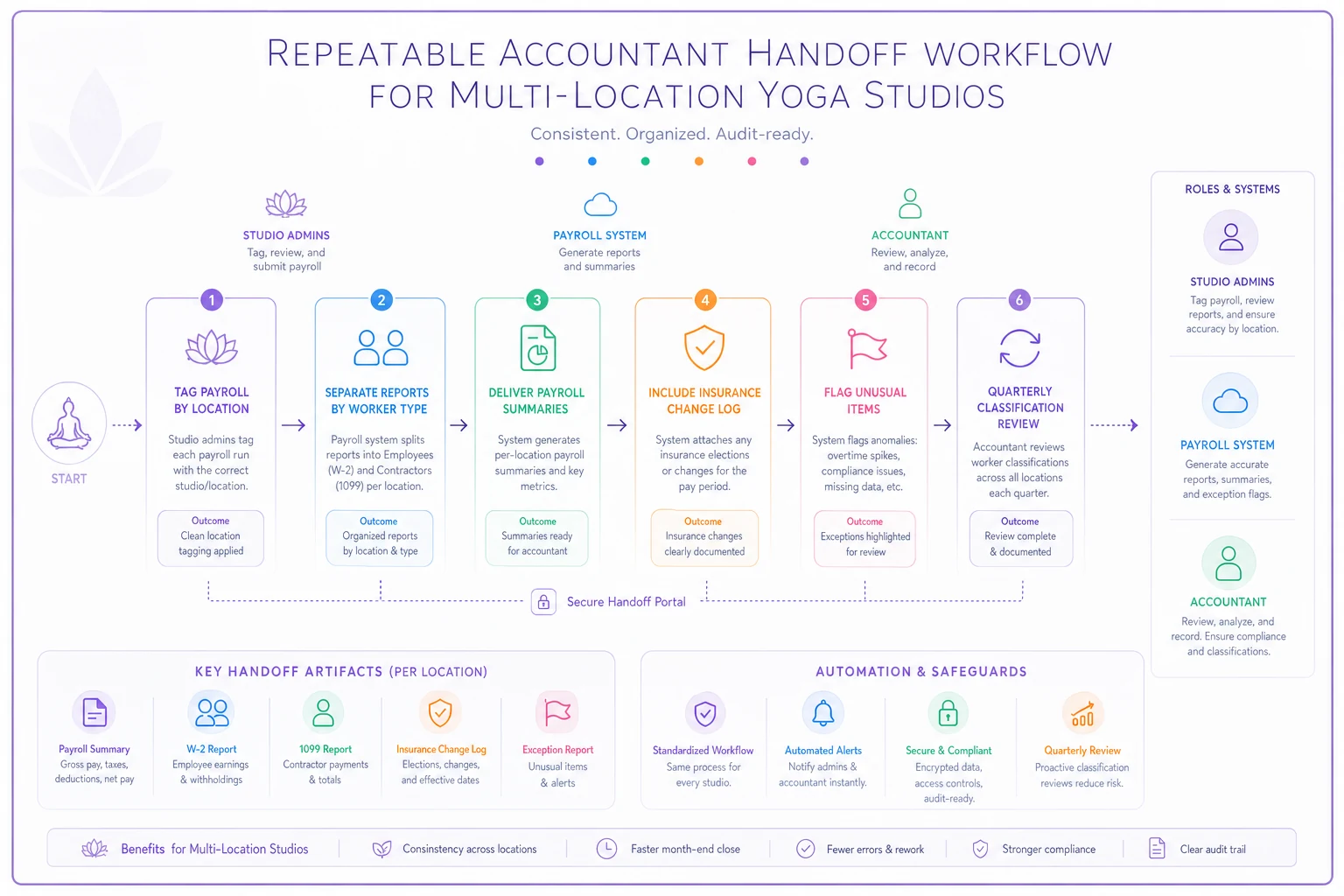
Accountants don't create compliance problems, but they can only prevent the ones they can see. A location-tagged, consistently formatted handoff turns your accountant from a once-a-year firefighter into an early-warning system. That shift alone is worth the extra ten minutes of organization each pay period.
A real scenario: the two-state studio that got surprised
A studio owner ran a well-established location and opened a second about an hour away, across a state line. Both used the same contractor setup — roughly ten instructors, a mix of regulars and subs. A few teachers picked up classes at both studios because the drive wasn't bad.
The problem surfaced at tax time. The new state used a stricter classification test, and two of the regular teachers there clearly qualified as employees. On top of that, the split-location teachers had wages that should've been withheld and reported in both states, but everything had been lumped under the original location. Between the reclassification, back payroll taxes, and the workers' comp premium adjustment that hadn't been filed for the new address, the cleanup ran somewhere in the $4k–$6k range, plus the accountant's extra hours untangling it.
The fix wasn't complicated, just overdue. They reclassified the two teachers to W-2, standardized on the stricter pay cadence across both sites, added a work-location tag to every class so payroll and the accountant could see which state each shift belonged to, and updated the workers' comp policy properly. The following year's filing was uneventful — which, in this world, is exactly the goal.
When expanding across a state line makes sense — and when it doesn't
When it makes sense: you have genuine demand in the new market, the classification rules there are manageable for your teacher model, and you're willing to run the compliance layer as a real process rather than an afterthought. Crossing a state line is fine — it's just more overhead you need to plan for.
When it's a bad idea: you're expanding mainly to chase growth on paper, your teacher model relies heavily on contractors, and the new jurisdiction applies a strict classification test that would force most of them to W-2. That changes your entire cost structure at the new site. If you didn't model it, your margins there will be thinner than the flagship — sometimes badly so.
Who should slow down: any owner who hasn't yet nailed single-location payroll and insurance discipline. If your current books are messy, duplicating that across a state line multiplies the risk instead of the revenue. Get one location's compliance genuinely clean first.
The short version
Expansion doesn't punish studios for growing. It punishes them for assuming that the rules, the pay cadence, the insurance coverage, and the worker classifications that worked at location one automatically travel to location two. They don't. Compliance lives at the location, not in the brand.
Run the classification check per jurisdiction. Standardize your pay cadence on the stricter requirement and track withholding per class. Treat every new address and headcount change as an insurance touchpoint. Hand your accountant clean, location-tagged data on a schedule so they catch the small things before they become April-sized things. Do that, and the second location becomes what it should be — more revenue, not more surprises.
Ready to elevate your studio operations?
Join 1,500+ yoga studios using Yoglyly to save time, reduce scheduling conflicts, and enhance member experiences.