



Most studio owners don't get into trouble because a single location fails. They get into trouble because a good location convinced them the next one would be just as easy. You sign a second lease on the strength of one strong year, then the buildout runs long, the ramp takes longer than expected, and suddenly your healthy studio is bankrolling a sick one while you tell yourself it's "just a slow start."
That's the real problem with studio capital planning at the portfolio level. Each location looks fine in isolation. It's the connections between them—shared cash, shared staff, shared founder attention—that decide whether growth compounds or quietly bleeds you. This piece is less about spreadsheets and more about the decision system underneath them: how to greenlight, how to structure the money, and how to know when a location is dragging the whole portfolio down.
The trap of judging studios one at a time
The pattern that shows up constantly once a studio owner runs two or more locations: they evaluate each one on its own P&L and feel reasonably good. Location A does roughly $32k/month and throws off decent margin. Location B is younger, doing maybe $18k, "almost breakeven." Founder concludes the portfolio is fine.
Except that's not how the money actually moves. Location B's shortfall is being covered by Location A's surplus, the owner's own unpaid hours are propping up both, and the line of credit that funded B's buildout is quietly eating margin nobody assigned to any single studio. On paper you have two businesses. In reality you have one cash pool with two drains of very different sizes.
The insight most owners miss: portfolio margin is not the average of studio margins. It's the blended result after you account for shared overhead, cross-subsidies, and the opportunity cost of capital sitting in a slow location. A studio that's "breakeven" on its own line often loses money once you load it with its fair share of central costs and the interest on the money that built it.
This is why a decision framework matters more than a single good instinct. Instinct scales badly. When you're picking your fourth location under time pressure, with a landlord waiting and a build slot to fill, you don't want to be relying on the same gut feeling that happened to work for location two.
A decision tree for greenlighting a new studio
Before any new location or major reinvestment, run it through a fixed sequence. The point isn't to make the decision robotic—it's to force the questions you skip when you're excited.
Eliminate class scheduling chaos.
Yoglyly helps you book, confirm & manage every class seamlessly.
- Centralized class scheduling
- Member notifications
- Instructor and resource management
No credit card required
-
Is the existing portfolio healthy enough to expand? If your current locations aren't collectively producing a stable cash surplus over a rolling 3–4 month window, stop. Expansion doesn't fix a cash problem; it magnifies it. A studio that can't fund its own slow months has no business funding a new one.
-
Does the demand signal exist independent of hope? Waitlists, sold-out prime-time classes, a service area you're clearly turning people away from, corporate inbound you can't service. If the "demand" is really just "I think this neighborhood would love us," that's a marketing hypothesis, not a capital decision.
-
Can you staff it without cannibalizing? New locations that steal your best instructors from existing studios don't grow the portfolio—they redistribute it. If you can't name the lead teacher and 2–3 backups before signing, you're not ready.
-
Does the unit economics clear your payback threshold? More on this below, but if projected payback is longer than 18–24 months under a conservative ramp, the answer is usually no.
-
What breaks if this location underperforms by 30%? Model the miss, not just the plan. If a 30% shortfall would force you to cut pay at your healthy studio or draw down your reserve past a comfortable floor, the risk is too concentrated.
Only if you clear all five does the location get greenlit. Four of those five questions have nothing to do with the new location's own projections—they're about whether the rest of the system can carry the risk. That's the part single-studio thinking ignores.
When expansion actually makes sense
Green light territory usually looks like: existing locations consistently at 70%+ prime-time capacity, a reserve that covers 3+ months of fixed costs across the portfolio, a bench of teachers ready to lead, and a demand signal you can point to with data rather than optimism. When those line up, adding capacity is often the highest-return move available.
When it's a bad idea (even if the numbers look okay)
If you're the only person who can run each studio well, a new location doesn't expand your business—it stretches your one bottleneck thinner. If current growth is entirely promo-driven and margins are thin at full price, a new location inherits that fragility. And if you're expanding mainly because a lease "came up" or a competitor moved, that's reacting, not planning.
Setting payback thresholds you'll actually hold to
The number that keeps portfolios out of trouble is payback period—how long until a location returns the cash you put into it. Buildout, first-and-last, equipment, pre-opening marketing, and the losses during ramp all count. Owners routinely forget the ramp losses, which are often the biggest chunk.
| Payback period | What it usually means | Typical decision |
|---|---|---|
| Under 12 months | Strong demand, low buildout, fast ramp | Greenlight if staffing checks out |
| 12–18 months | Normal, healthy expansion | Greenlight with conservative assumptions |
| 18–24 months | Workable but tight | Only with a strong reserve and proven playbook |
| Over 24 months | Slow, capital-heavy | Usually pass or restructure the deal |
The discipline isn't picking the "right" number—it's refusing to move the goalposts mid-decision. What shows up across a lot of multi-location operators is that the threshold quietly stretches to fit the deal they already want. "It's really an 18-month payback… well, 22 if the ramp is slow… but this location is special." The word special is where portfolio margins go to die.
Pair the payback view with a proper unit-economics model so you're not guessing at ramp. The CAC, LTV and payback model that prioritizes channels by class capacity is worth working through per-location, because a studio's payback is only as good as its ability to actually fill classes at a sustainable acquisition cost.
Covenants: the rules you set for yourself before things get emotional
Banks impose covenants because they don't trust borrowers to stay disciplined under pressure. Smart portfolio owners impose covenants on themselves for the same reason. These are pre-committed rules—triggers that force a decision when a location or the portfolio crosses a line, before denial and sunk-cost thinking take over.
-
Reserve floor Portfolio cash reserve never drops below roughly 3 months of total fixed costs. Hit the floor, and all new-location spend pauses automatically—no debate.
-
Location drag limit No single studio runs a cash loss for more than two consecutive quarters without triggering a formal "fix, restructure, or exit" review.
-
Cross-subsidy cap Healthy locations can support a newer one during ramp, but not past a set dollar or percentage of their own surplus. Beyond that cap, the newer location has to stand on its own or shrink.
-
Debt service comfort Portfolio cash flow should cover total debt payments with meaningful headroom—say 1.4–1.5x, not scrape by at 1.05x. Thin coverage means one bad month becomes a crisis.
-
Founder-hours covenant If keeping a location afloat requires the owner to personally teach or manage more than an agreed number of hours per week, that location is failing—it just isn't showing up in the P&L because the labor is unpaid.
Write the founder-hours covenant as an explicit weekly hour cap tied to a dollar value so the unpaid labor shows up in decision-making.
That last one is the covenant nobody writes down and everybody violates. Unpaid founder labor is the most expensive form of financing in a studio portfolio, because it hides the true cost of a weak location until you burn out.
A 12–24 month capital plan, laid out simply
A portfolio capital plan isn't a forecast—it's a sequence of decisions with triggers attached. Over a 12–24 month horizon, it should answer: what are we funding, in what order, out of what money, and what has to be true before each next step releases cash.
-
Months 0–3 Stabilize existing locations. Confirm reserve is at or above the floor. Validate demand signal for the new site. Gate: don't sign a lease until reserve and demand both clear.
-
Months 3–6 Lease and buildout for location three. Cap buildout spend at a hard number; overruns come from a contingency line, not the operating reserve.
-
Months 6–9 Pre-open marketing and staffing. This is where ramp losses begin—budget for them explicitly as part of payback.
-
Months 9–15 Ramp. Track actual vs. plan monthly. Gate: if location three is more than roughly 30% behind plan at month 12, trigger the restructure/exit review instead of pouring in more cash.
-
Months 15–24 Either location three hits its payback trajectory and you begin evaluating location four, or it doesn't and you've already got a covenant-driven decision in motion rather than a slow bleed.
Here's a simple visual for the sequence and gates.
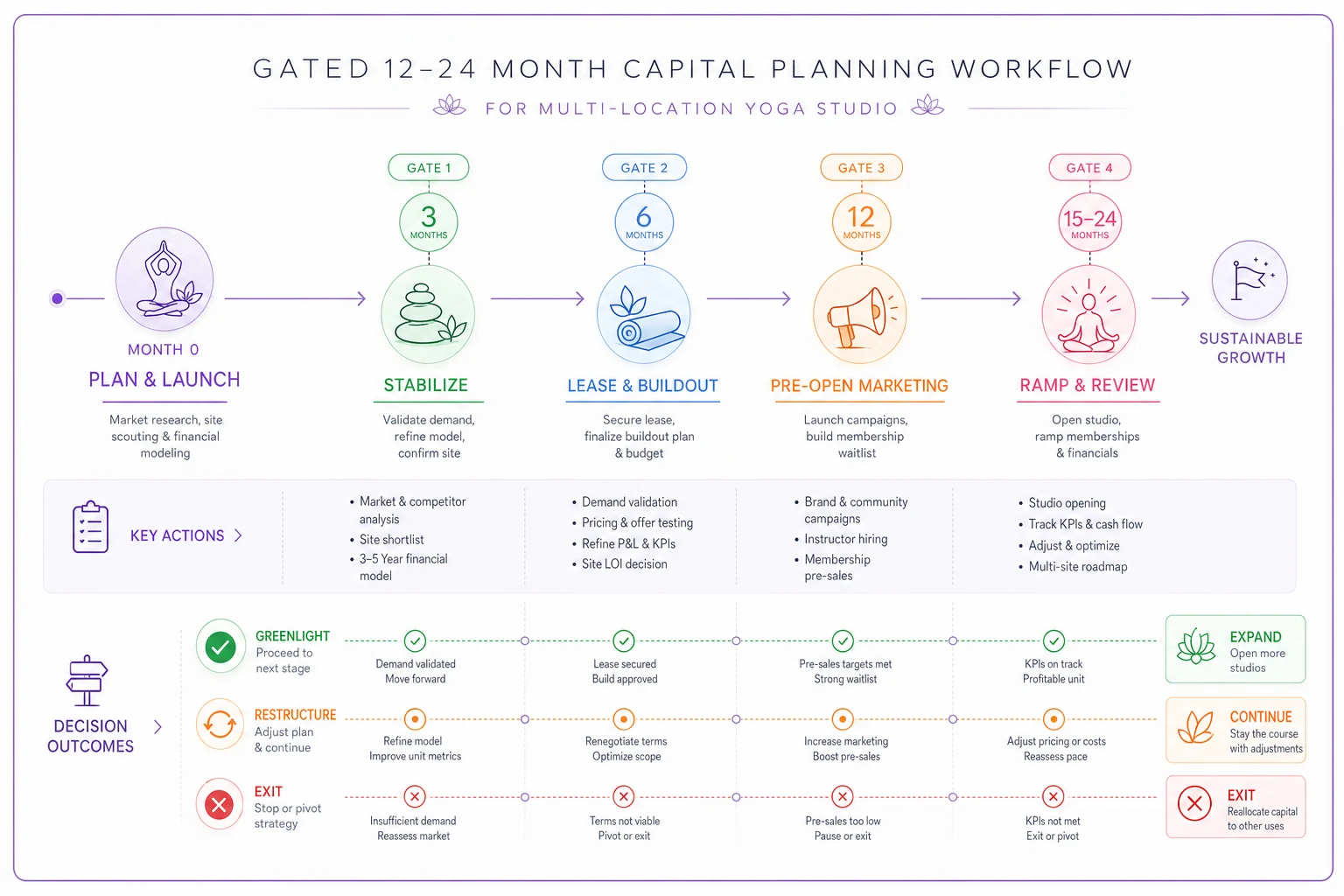
The most important feature here isn't the timeline—it's the gates. A capital plan without pre-set gates is just a wish list with dates. And because so much of this rides on knowing your true monthly cash position, this plan only works sitting on top of disciplined monthly financial tracking. If you can't see your cash clearly month to month, you can't run gates at all.
Worked scenario: how one weak location reshapes the whole portfolio
Starting point:
-
Location A (mature)
~$34k/month revenue, strong margin, throwing off roughly $6k–$7k monthly surplus.
-
Location B (year two)
~$22k/month, modestly profitable, maybe $1.5k surplus.
-
Location C (new, month 8)
~$11k/month, running a cash loss of about $4k/month during ramp.
On a location-by-location glance, the owner sees "two profitable studios and one ramping." Feels fine. But blend it: total monthly surplus across A and B is around $7.5k–$8.5k, and C is eating roughly $4k of it. So the portfolio is netting maybe $4k/month before the owner's unpaid teaching hours—and the owner is covering 6 extra classes a week at C to keep payroll down.
Now run the covenant test. C has been loss-making for two quarters. Founder hours at C are well past any reasonable cap. Cross-subsidy is consuming roughly half of the healthy locations' combined surplus. Three covenants are tripping at once.
Path 1 (no rules): Owner keeps subsidizing, keeps teaching, tells themselves C just needs "a few more months." If C's ramp stays slow, payback slides past 24 months, founder burnout hits, and one bad quarter at A—a lease renewal, an instructor departure—turns the whole portfolio cash-negative.
Path 2 (rules in place): The month-12 gate forces a review. Options get evaluated honestly: cut C's schedule to its 3–4 genuinely strong classes and shrink its fixed cost, renegotiate the lease, or wind it down and redeploy A and B's surplus into what's working. Suppose they cut C to its best classes—revenue drops to ~$8k but the monthly loss shrinks to ~$1k, and the founder stops teaching there. Portfolio surplus recovers toward $7k+/month, and C either finds its footing at a smaller size or gets a clean exit decision instead of a slow one.
Same underlying business. The difference in outcome is entirely the decision system.
Who should NOT run a portfolio capital plan like this
If you're a single-location studio with no near-term expansion plans, most of this is overkill. Your version of capital planning is really cash-flow discipline and a healthy reserve, full stop.
And if you're expanding purely on borrowed money with no reserve buffer, don't dress it up with covenants and gates and call it a plan. Covenants only work when you have the reserves to honor them. Building the buffer first is the actual prerequisite; the decision framework comes after.
Where the system usually breaks
Even owners who understand all of this get tripped up by the same three failure points. First, visibility lag—they're looking at last quarter's blended numbers, so a drifting location is two months into trouble before it shows up. Second, cross-subsidy blindness—money moves between locations invisibly through one shared account, so nobody sees Location A quietly financing Location C. Third, founder-labor masking—the true cost of a weak studio is hidden inside unpaid hours that never touch the P&L.
All three are fundamentally coordination and information problems. Consolidating your portfolio's numbers into one operational view—each location's real margin after loaded overhead, reserve position against the floor, covenant triggers flagged in one place—turns capital planning from a quarterly panic into a running dashboard. AI-assisted operational platforms are increasingly useful here not because they make the decisions, but because they surface the trigger early: flagging when a location crosses into its second loss-making quarter, or when the reserve approaches the floor, while you still have room to act rather than scramble.
The goal isn't more software for its own sake. It's making sure the gate fires on time. A capital plan is only as good as your ability to see the moment a rule is tripped—and most portfolio damage happens in the gap between when a location starts failing and when the owner finally admits it.
The takeaway
Studio portfolios rarely fail on the math of any single location. They fail because the connections between locations—shared cash, shared people, shared founder energy—go unmanaged until a good studio is quietly funding a bad one and the owner is teaching six classes a week to hide the loss.
A decision tree for greenlighting, honest payback thresholds, self-imposed covenants, and a gated 12–24 month capital plan don't just protect margins. They protect you from the very human tendency to keep believing a struggling location is "almost there." Set the rules while you're calm. You'll need them most when you're not.
Studio portfolios rarely fail on the math of any single location. They fail because the connections between locations—shared cash, shared people, shared founder energy—go unmanaged until a good studio is quietly funding a bad one and the owner is teaching six classes a week to hide the loss.
A decision tree for greenlighting, honest payback thresholds, self-imposed covenants, and a gated 12–24 month capital plan don't just protect margins. They protect you from the very human tendency to keep believing a struggling location is "almost there." Set the rules while you're calm. You'll need them most when you're not.
Ready to elevate your studio operations?
Join 1,500+ yoga studios using Yoglyly to save time, reduce scheduling conflicts, and enhance member experiences.