


The first studio always feels like magic. You know every regular by name, you notice when the music is too loud, you can tell within thirty seconds if a class is running behind. The whole vibe lives in your head — and in the heads of the two or three people you trained personally.
Then you open location two. And somewhere around month four, a longtime member walks into the new spot and quietly tells you it "feels different." Not bad, exactly. Just off. The lighting, the way they were greeted, the smell of the lobby, the pace of the intro talk before class. Something's not translating.
That gap — between the experience you think you're delivering and what actually happens when you're not in the room — is what studio brand experience systems are meant to close. Not a logo. Not a color guide. The actual felt experience of walking in, taking class, and deciding whether to come back.
Most owners try to fix this with more rules. That's the trap. Over-standardize and your best instructors feel like factory workers reading off a script. Under-standardize and every location drifts into its own little kingdom. The real work is figuring out what's mandatory and what's allowed to flex — and then building something that keeps checking whether reality matches intent.
The two failure modes, and why studios usually pick the wrong one
Drift is the slow one. No single decision causes it. A front desk person at location three starts skipping the "first time here?" question because it's busy. A manager reorders the retail shelf because it "makes more sense." An instructor drops the closing dedication because the previous class ran long. Individually, none of it matters. Stacked over eight months, the location no longer feels like your brand.
Rigidity is the loud one. You panic about drift, so you write a 40-page manual dictating everything down to the exact greeting phrase. Now your strongest teachers — the ones members actually come back for — feel scripted and micromanaged. They either leave, or they quietly ignore the manual, which means you're back to drift anyway but with more resentment baked in.
The pattern worth noticing: studios that grow past three or four locations almost never fail from too little control. They fail from controlling the wrong things. They'll mandate the exact wording of the welcome email but leave the in-studio greeting completely undefined. They'll obsess over Instagram grid consistency and never audit whether the bathrooms are clean and stocked, which is actually what members judge you on.
The system has to separate what must be identical from what should adapt to the neighborhood, the teacher, and the local crowd.
Mandatory vs. local variation: the core decision
Everything in your experience falls into one of three buckets. Getting this sort right is honestly 80% of the work.
Eliminate class scheduling chaos.
Yoglyly helps you book, confirm & manage every class seamlessly.
- Centralized class scheduling
- Member notifications
- Instructor and resource management
No credit card required
| Element | Bucket | Why |
|---|---|---|
| Greeting-within-30-seconds standard | Mandatory | Sets the emotional tone; drift here is invisible but costly |
| Class start/end on time | Mandatory | See our turnover SOP for back-to-back classes — this protects every downstream class |
| First-timer intro flow | Mandatory (structure) | The steps are fixed; the words can flex |
| Cleanliness & prop standards | Mandatory | Non-negotiable baseline members judge instantly |
| Playlist / music curation | Flexible | Local teacher personality lives here |
| Workshop themes & community events | Flexible | Should reflect the actual neighborhood |
| Retail product selection | Semi-flexible | Core line mandatory, local add-ons allowed |
| Studio décor accents | Flexible within palette | Same palette, room to breathe |
| Refund/late-cancel policy | Mandatory | Consistency here prevents member arbitrage between sites |
A useful test for which bucket something belongs in: ask whether inconsistency would confuse or annoy a member who visits two of your locations. Someone who trains at both your downtown and suburban spots should never get charged a different late-cancel fee. That's mandatory. But they'd expect the suburb location to have a slightly different vibe and different community events. That's healthy variation, not a defect.
The mistake is treating everything member-facing as mandatory. Members don't want two identical clones. They want the same trustworthiness and the same care, delivered by locations that feel like they actually belong to their neighborhood.
The living playbook (and why "living" matters)
A static brand manual dies the day you print it. The version that actually works is a living document — owned, dated, and revised on a schedule, not a PDF gathering dust in a shared drive.
Studios that scale cleanly tend to have playbooks that are short on rules and long on examples. Instead of "greet warmly," they show two or three actual greeting examples and mark which parts are fixed:
-
Fixed acknowledge the person within 30 seconds, use their name if known, ask if it's their first visit
-
Flexible the exact phrasing, the small talk, the joke, the energy level
Fixed intent, flexible delivery — that's the whole philosophy. It gives your team room to be human while protecting the parts that actually matter.
A working playbook usually has five components:
-
The mandatory standards list — the short, non-negotiable set (usually under 15 items)
-
The flex zones — explicitly named areas where local judgment is expected and encouraged
-
A scripts library — not word-for-word scripts, but example language for the moments that matter
-
A signage library — pre-designed, on-brand templates so no location is making its own ugly laminated signs
-
The audit template + cadence — how you check reality against intent
Notice the ratio. The mandatory list is tiny. Most of the document is examples and flex guidance. When owners flip this — a huge rulebook with a small "use your judgment" footnote — the studio usually heads toward the rigidity failure before long.
Keep the mandatory list short and focused; long lists become checklists people ignore.
A working playbook usually has five components:
The scripts library: guardrails, not cages
The word "script" scares good instructors, and honestly it should. Nobody wants to teach yoga off a call-center flowchart. So reframe it. A scripts library isn't about controlling what people say — it's about making sure the high-stakes moments don't get fumbled.
The moments worth scripting loosely are the ones where a bad improvisation costs you a member:
-
The first-timer welcome (this connects directly to your minute-by-minute first-timer blueprint — the front-desk language should match the flow you've already designed)
-
Handling an injury disclosure or medical concern
-
Explaining a price increase or membership change
-
Responding to a complaint at the desk
-
The "we missed you" reconnect when a lapsed member comes back
For each of these, the library gives two or three example responses and the principle behind them. A new front-desk hire at a fifth location should be able to read the injury-disclosure guidance and know exactly how to respond — not because they memorized the words, but because they understand what the studio actually cares about.
Good scripts specify outcomes and boundaries. Bad scripts specify words. "Never diagnose or recommend medical treatment; always offer a modification and note it for the instructor" is a boundary. It works in any phrasing, delivered by anyone.
The signage and visual library
This sounds minor. It isn't. The moment you have three locations, someone is going to print a sign. A "please remove shoes" sign. A "class starts in 5 minutes, please silence phones" sign. A handwritten "back in 10" note taped to the desk.
Every one of those DIY signs is a small brand leak. Multiply across locations and years and you've got a studio that looks coordinated on Instagram and chaotic in person.
A signage library solves it cheaply: pre-built, editable templates for every routine sign a location might need. Locked fonts, locked colors, editable text. When the suburb location needs a holiday schedule sign, they pull the template, type the dates, print. No Comic Sans, no rogue clip art, no eight different versions of your logo floating around.
The insight most owners miss: signage consistency isn't really about looking premium. It signals operational competence. Members subconsciously read a clean, consistent physical space as "these people have their act together," which directly affects whether they trust you with a long membership commitment.
The mystery-shop audit: your reality-check engine
Everything above is intent. This is where you find out what's actually happening. Without an audit cadence, your playbook is just a wish.
A mystery shop is simple: someone visits a location as an anonymous first-timer and scores the experience against your mandatory standards. It can be a paid shopper, a friend the local team doesn't know, or a staff member from a different region.
A workable audit template looks something like this:
-
Arrival & greeting - Was I acknowledged within 30 seconds? (Y/N) - Was I asked if it was my first visit? (Y/N) - Did the greeting feel warm or transactional? (1–5)
-
Space & environment - Lobby clean and uncluttered? (1–5) - Bathrooms stocked and clean? (1–5) - Signage on-brand and current? (Y/N) - Props clean and organized? (1–5)
-
Class experience - Did class start on time? (Y/N) - Did the first-timer intro cover the fixed elements? (Y/N) - Did the instructor check in about injuries/experience? (Y/N) - Did class end on time and transition cleanly? (Y/N)
-
Departure & follow-up - Any farewell or "come back" moment? (Y/N) - Did I receive an appropriate follow-up within 48 hours? (Y/N)
Score it, but don't just score it. The number is only useful next to the notes. A location can score 8/10 and still have one glaring problem — the instructor never asked about injuries — that matters more than the two points it lost on lobby clutter.
Cadence matters more than perfection
The most common audit mistake is doing it once, feeling good or bad about the results, and never repeating it. One audit is a snapshot. Drift is a movie.
A cadence that holds up in practice:
-
Every location, once per quarter — full mystery shop
-
Monthly self-audit — the location manager scores their own space against the same template (keeps standards top-of-mind between real shops)
-
Twice a year — an experience adaptation review, where you revisit which elements should stay mandatory and which flex zones need updating
That last one is the piece almost everyone skips. Your playbook shouldn't be frozen. If the suburb location proved that a certain community event format works really well, that insight should get folded into the flex-zone guidance for other sites. If a "mandatory" rule turned out to make no real difference to members and just annoyed staff, kill it. The adaptation review is where the system learns.
Here's a quick visual of the audit workflow.
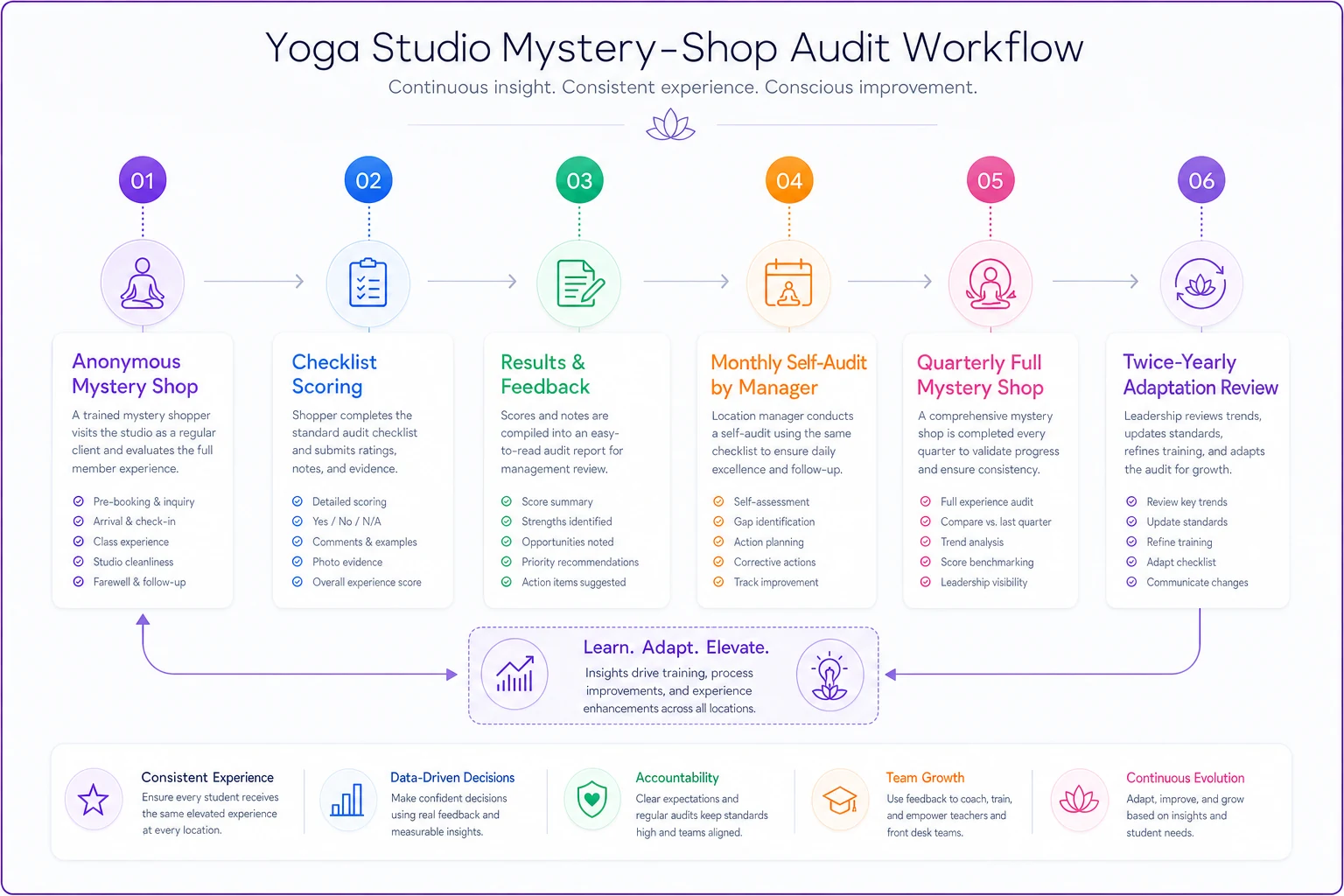
Use the cadence to create a feedback loop, not a one-time judgement.
A real scenario
A three-location studio — two urban, one suburban — noticed retention at the newest suburban site running noticeably below the other two, somewhere in the range of 8–10 percentage points lower at the 90-day mark. The owner assumed it was the teachers or the neighborhood.
The first mystery-shop round told a different story. The suburban location scored fine on class quality but consistently missed the first-timer intro elements and the follow-up. New members weren't being asked about injuries, weren't getting greeted by name on return visits, and the 48-hour follow-up was hit-or-miss. Nothing dramatic — just a pile of small drift, exactly the invisible kind.
They didn't rewrite the whole brand. They tightened four mandatory items, gave the front desk the scripts-library examples for greeting and follow-up, and ran a self-audit monthly. By the next quarterly shop the suburban site was scoring in line with the others, and over the following couple of months the retention gap narrowed to a few points. No new hires, no rebrand — just closing the gap between intent and reality.
Where the tools quietly help
You can run all of this on spreadsheets and calendar reminders, and plenty of studios do at first. It starts creaking around location four or five, when the number of things to track — audit scores per site, follow-up completion, self-audit compliance, which signage version each location is using — outgrows anyone's memory.
This is where an operational platform earns its keep: keeping the playbook versioned and accessible to every location, triggering follow-up messages so they don't depend on someone remembering, logging audit results over time so you can actually see drift instead of guessing at it, and flagging when a location's self-audits and real mystery shops start diverging (which usually means the manager is grading themselves generously).
AI-assisted automation is useful here mostly for the boring, easy-to-forget parts — sending the timed first-timer follow-up, nudging a manager when a monthly self-audit is overdue, surfacing patterns across audit notes. None of that replaces judgment. It just keeps the system running when you're not personally watching every location.
But no tool fixes a badly-sorted playbook. If you've labeled the wrong things mandatory, better software just enforces the wrong rules faster. Get the mandatory-vs-flexible sort right first. The technology is for scaling a good system, not rescuing a broken one.
When to build this — and when not to bother
Build it now if: you're at two locations and planning a third, or you're already at three-plus and hearing "it feels different" from members. Retrofitting consistency onto five drifted locations is far more expensive than building the system early.
Don't over-invest yet if: you have a single studio. A full mystery-shop cadence and signage library is overkill for one room you're standing in every day. Write down your five mandatory standards and save the rest for when you actually expand.
Be careful if: your instructors are your main draw and they're already feeling squeezed. Lead with the flex zones, not the rules. If the first thing your team hears about "brand systems" is a list of things they can't do, you'll lose the people who made location one worth cloning in the first place.
Studios that scale their experience well aren't the ones with the thickest rulebooks. They're the ones who figured out the handful of things that must never vary, gave their people real room everywhere else, and built a steady rhythm of checking whether the two actually match. Small mandatory core, generous flex zones, and an honest audit loop that never stops running.
Studios that scale their experience well aren't the ones with the thickest rulebooks. They're the ones who figured out the handful of things that must never vary, gave their people real room everywhere else, and built a steady rhythm of checking whether the two actually match. Small mandatory core, generous flex zones, and an honest audit loop that never stops running.
Ready to elevate your studio operations?
Join 1,500+ yoga studios using Yoglyly to save time, reduce scheduling conflicts, and enhance member experiences.