


Yesterday's 6pm vinyasa class ran four minutes late. The 7:15pm restorative students stood in the lobby watching through the glass doors as the previous class hurried to roll up mats. By the time everyone filed in, set up their spaces, and settled down, class started at 7:24pm.
Nine minutes late. For a 60-minute class that people rushed through traffic to attend.
This plays out in yoga studios everywhere, and the damage compounds. Students who paid for 60 minutes get 51. Teachers feel rushed. The energy shifts from calm to chaotic. And your studio quietly builds a reputation for running behind.
The root cause is almost always the same: no clear turnover process between back-to-back classes.
Why studios struggle with room turnovers
Most studios operate on hope. Hope that the morning teacher ends on time. Hope that students clear out quickly. Hope that props get reset properly. Hope that the next instructor arrives early enough to handle whatever mess awaits.
This works until it doesn't. Maybe your 9am teacher loves to chat after class. Maybe the noon group leaves blocks scattered everywhere. Maybe someone spills their water bottle right as the next class arrives.
Without a documented turnover process, every transition becomes its own emergency. Staff handle things differently. Some teachers obsess over perfect prop alignment while others barely glance at the room. Students get wildly different experiences depending on who's working that day.
The real problem runs deeper than tardiness. Inconsistent turnovers create operational chaos that ripples through your entire schedule. That 9-minute delay at 7:15pm means the 8:30pm class also starts late. Closing staff stays past their shift. Tomorrow morning's opener finds props in the wrong places.
Building a bulletproof turnover system
A proper yoga studio room turnover SOP transforms chaos into clockwork. Not through motivational speeches or stern reminders—through clear processes that actually account for reality.
Eliminate class scheduling chaos.
Yoglyly helps you book, confirm & manage every class seamlessly.
- Centralized class scheduling
- Member notifications
- Instructor and resource management
No credit card required
Start by mapping your real transition windows. If you schedule classes at 9am and 10:30am, you have 90 minutes on paper. The realistic turnover window is much smaller:
-
First class runs 60 minutes (9
00–10:00)
-
Students need 5–8 minutes to gather their stuff and clear out
-
Next instructor arrives 15–20 minutes early to prepare
-
Students for the next class start trickling in 10 minutes early
Your true turnover window: roughly 12–17 minutes, at best.
The 4-zone turnover checklist
Break your studio into zones and assign specific tasks to each. This prevents the "someone else will handle it" problem that plagues most studios.
Zone 1: Practice floor
-
Check for forgotten items (jewelry, water bottles, phones)
-
Straighten or roll studio mats if provided
-
Quick sweep for visible debris
-
Verify heating/cooling settings for next class style
Zone 2: Prop wall
-
Return all props to designated spots
-
Stack blocks with same colors together
-
Hang straps on assigned hooks
-
Roll blankets uniformly
-
Wipe down any visibly dirty props
Zone 3: Entry/cubby area
-
Clear any items left in cubbies
-
Wipe down high-touch surfaces
-
Reset sign-in tablet or papers
-
Verify next class roster is displayed
Zone 4: Teacher station
-
Switch music playlist
-
Adjust lighting for next class type
-
Place teaching props (blocks, straps) at front
-
Set out essential oils or tools for next instructor
Role assignments that actually work
Vague responsibilities create turnover failures. "Everyone helps" means no one helps. Assign specific roles based on who's actually present during transitions.
Departing instructor:
-
End class on time (use a watch, not a vibe)
-
Direct students to return props before leaving
-
Complete Zone 4 teacher station reset
-
Note any maintenance issues on the daily log
Arriving instructor:
-
Arrive at least 20 minutes before class
-
Complete Zone 1 practice floor check
-
Verify room temperature settings
-
Greet early arrivals without letting it derail setup
Desk staff (if staffed):
-
Monitor departing class end time
-
Complete Zone 3 entry area reset
-
Handle late departures from previous class
-
Assist with Zone 2 prop wall if time allows
Float (during busy transitions):
-
Focus entirely on Zone 2 prop wall reset
-
Handle spills or unexpected messes
-
Support arriving instructor with special setup needs
Time blocking your transitions
A minute-by-minute timeline removes confusion about what happens when. Here's a working example for classes at 6:00pm and 7:15pm:
-
6
55–7:00pm
– Departing instructor winds down, final savasana -
7
00pm
– Class ends, instructor reminds students about prop return -
7
00–7:05pm
– Students return props, gather belongings -
7
05pm
– Desk staff begins entry area reset -
7
06pm
– Arriving instructor enters for floor check -
7
08pm
– Departing instructor completes teacher station handoff -
7
10pm
– Early arrivals for next class can enter -
7
12pm
– Final prop wall check by float or desk staff -
7
15pm
– Next class begins
This assumes nothing goes wrong. Build in buffer time by aiming to finish everything by 7:12pm, not 7:15pm.
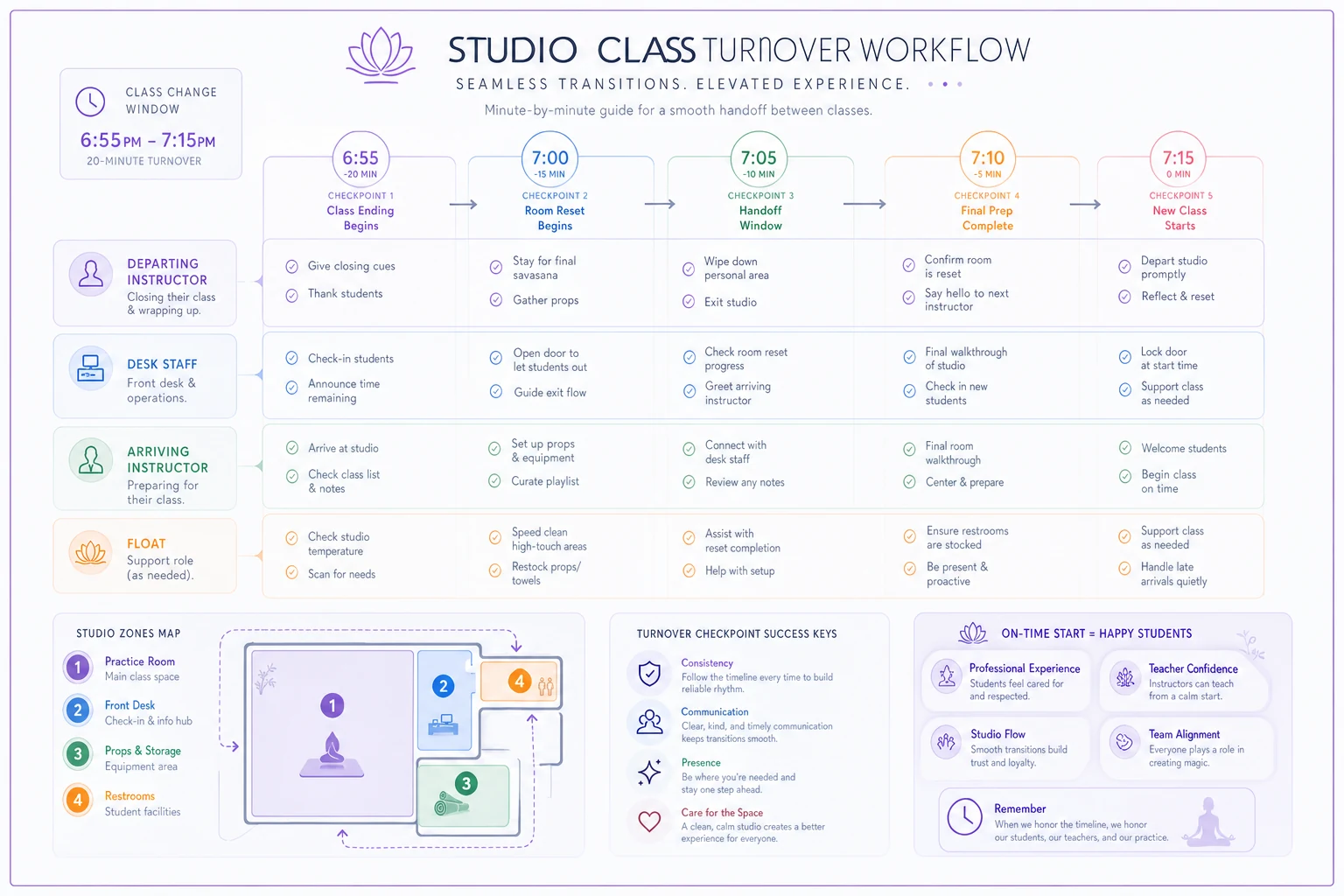
This diagram shows the minute-by-minute handoff workflow and who handles each checkpoint.
Aim to finish all turnover tasks by the final check at 7:12pm to avoid late starts.
Build in buffer time by aiming to finish everything by 7:12pm, not 7:15pm.
Handling common disruptions
Perfect turnovers rarely happen. Real studios deal with chatty students, late instructors, and unexpected messes. Your SOP needs protocols for the problems that actually show up.
The lingering student problem
Some students treat post-class as social hour. They cluster near the door, block prop return areas, or corner the instructor with questions.
Solution: Implement a "lobby transition" protocol. Desk staff announces at five minutes post-class: "Feel free to continue conversations in our lobby so we can prepare for our next group." If unstaffed, the arriving instructor handles this announcement while entering.
The late instructor crisis
Your 4:30pm teacher texts at 4:14pm that they're stuck in traffic. Class starts in 16 minutes.
Solution: Keep an "emergency opener" sequence that any staff member can run:
-
Unlock studio and turn on lights
-
Set temperature to default (68–70°F works for most classes)
-
Queue up a generic playlist
-
Place basic props at front—two blocks, one strap
-
Greet students and let them know the instructor is on the way
The prop disaster scenario
Sometimes the 12:30pm class leaves props everywhere. Blocks mixed with blankets, straps tangled, bolsters in random corners.
-
Clear the practice floor first—that's the priority
-
Sort props into "correct zone" vs. "temporary pile" rather than fully reorganizing under pressure
-
Get students into the room on time
-
Finish proper prop organization during class when possible
Finish proper prop organization during class when possible
Creating accountability without micromanaging
The best turnover SOP means nothing if nobody follows it. But hovering over staff with a stopwatch creates resentment, not results.
Build accountability into the process itself. A simple daily transition log that takes 30 seconds to fill out works well:
| Class Time | End Time | Clear by | Next Ready | Issues? | Initials |
|---|---|---|---|---|---|
| 9:00am | 10:01am | 10:07am | 10:28am | None | KL |
| 10:30am | 11:31am | 11:36am | 11:58am | Spill in corner | KL |
| 12:00pm | 1:02pm | 1:09pm | 1:27pm | Props scattered | MJ |
This log shows patterns—which classes consistently run late, which instructors struggle with timing—and creates gentle peer accountability without anyone having to say a word. Nobody wants their initials showing up next to the same problems every week.
Technology and tools that actually help
Clipboards and printed checklists work fine. But simple digital tools can take real friction out of your turnover process.
A basic operations platform can automate a few pain points:
-
Send automatic reminders to instructors 30 minutes before class
-
Track turnover times without manual logging
-
Alert staff when classes run past their scheduled end time
-
Generate reports that surface problem patterns over time
Connecting your scheduling system to a simple task management tool tends to work well in practice. When a class ends, it automatically creates a turnover task assigned to the right staff member. They check off each zone as complete. The system tracks completion times and flags delays.
This removes the "nobody told me" excuse and gives you a clear accountability trail. More importantly, it lets you spot problems before they become habits. If Tuesday evenings consistently run behind, you can actually investigate and adjust instead of just hoping things improve.
Staffing models for different studio sizes
Not every studio can afford dedicated turnover staff. Your approach depends on your size and budget.
Solo instructor model (no desk staff)
-
End class 5 minutes early (schedule 55-minute classes as "60 minutes")
-
Use wall-mounted hooks for immediate prop return
-
Keep prop variety minimal to speed resets
-
Set 20-minute minimum gaps between classes
Instructor plus desk model (1 desk person)
-
Instructor handles Zones 1 and 4 (floor and teacher station)
-
Desk handles Zones 2 and 3 (props and entry)
-
During transitions, desk prioritizes studio prep over check-ins
Full support model (desk plus dedicated staff)
-
Instructor handles only Zone 4 (teacher station)
-
Desk handles Zone 3 and student flow
-
Support staff handles Zones 1 and 2
-
Float between roles as needed
Not every studio can afford dedicated turnover staff. Your approach depends on your size and budget.
Measuring success
On-time start percentage: What percentage of classes begin within 2 minutes of the scheduled start? Aim for 90% or higher.
Average turnover time: How long does it typically take from one class ending to the next room being ready? This should trend downward as your team gets the process down.
Student complaints: Track any feedback about late starts, messy rooms, or rushed entries. These should drop close to zero.
Most studios see real improvement within a week or two of implementing a clear turnover process. The chaos doesn't disappear overnight, but it becomes manageable. Teachers stop dreading what they'll walk into. Students stop standing in lobbies watching the clock.
The difference between studios that run smoothly and those that constantly scramble isn't talent or dedication—it's systems. A solid turnover SOP turns good intentions into consistent execution, and twelve minutes, handled properly, is genuinely enough to reset a room and create the calm environment your students came for.
Ready to elevate your studio operations?
Join 1,500+ yoga studios using Yoglyly to save time, reduce scheduling conflicts, and enhance member experiences.