
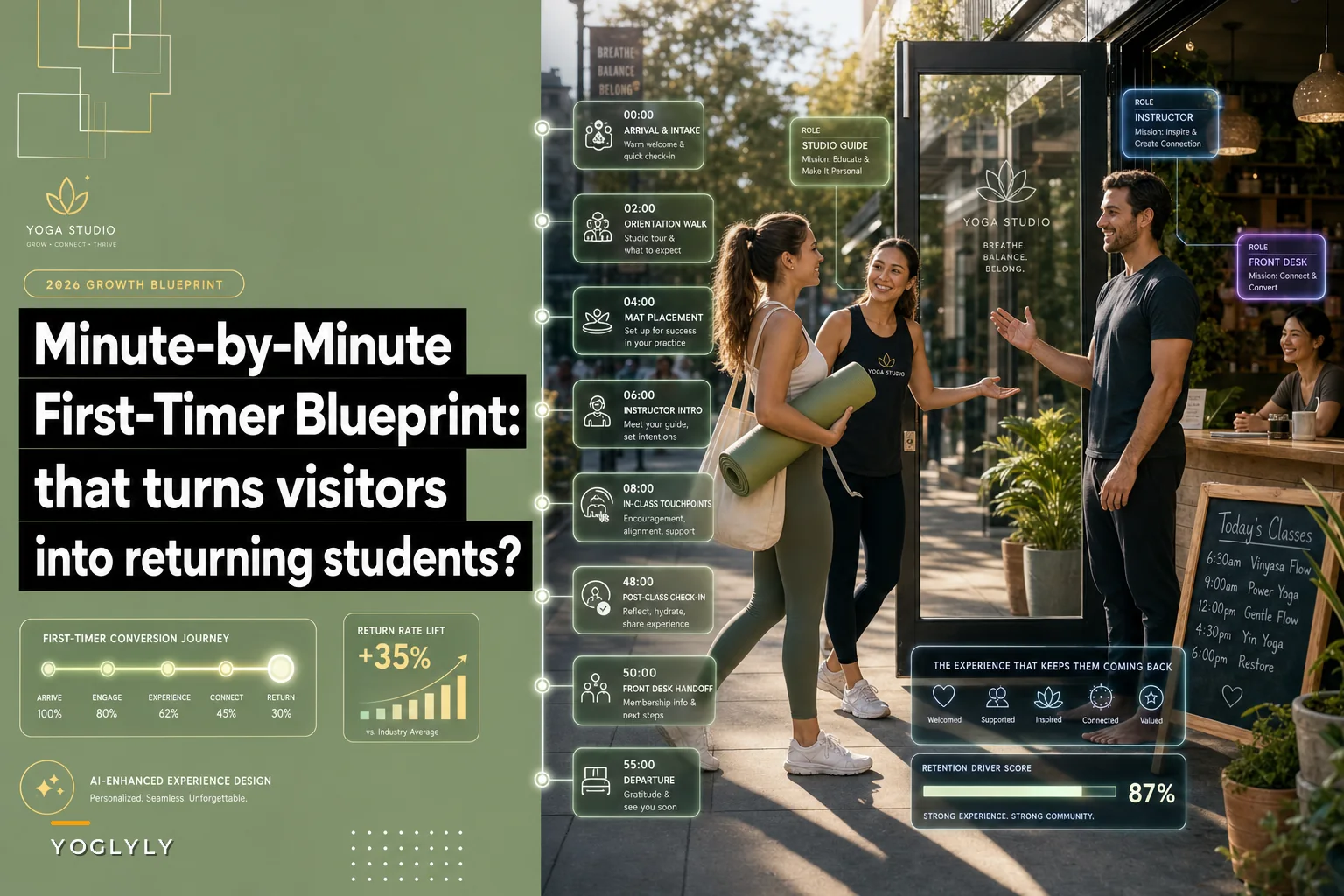

Your first-timer conversion rate probably sits around 15-20%. That means for every 10 people who walk through your door for the first time, only 2 become regular students. The other 8 disappear forever.
This isn't about your teaching quality or studio vibe. It's about having zero operational consistency in how you handle new students. Every instructor wings it differently. Your front desk person changes their approach depending on how slammed they are. Nobody follows the same process twice.
Most studios treat first-timers like regular drop-ins who just happen to be new. They get a rushed check-in, get thrown into class without context, and maybe receive a generic follow-up email three days later that they ignore. Then owners wonder why conversion rates stay flat while spending thousands on marketing to bring in more first-timers who also never return.
The 47-minute window that determines everything
A new student decides whether they'll return before they even step onto their mat. Their experience starts the moment they open your door and ends when they leave the building. That's roughly 47 minutes for a standard 60-minute class—15 minutes before, 60 during, 12 after if you execute properly.
During those 47 minutes, they're forming opinions about your professionalism, whether they belong there, if they can actually handle the practice, and whether coming back feels worth the cost and effort. Miss any critical touchpoint in that window and they're gone.
Studios converting 40-45% of first-timers into members operate with real consistency during this window. Not because they're rigid, but because consistency creates comfort for anxious newcomers.
Think about what's running through a first-timer's head when they arrive:
-
Will I look stupid?
-
Where do I put my stuff?
-
What if I can't do the poses?
-
Is everyone going to stare at me?
-
Did I bring the right clothes?
-
Where's the bathroom?
-
Am I supposed to tip?
Your operational system either answers those questions smoothly or lets the anxiety build until they decide yoga just isn't for them.
Breaking down the minute-by-minute timeline
Here's a quick visual of the minute-by-minute workflow.
Eliminate class scheduling chaos.
Yoglyly helps you book, confirm & manage every class seamlessly.
- Centralized class scheduling
- Member notifications
- Instructor and resource management
No credit card required
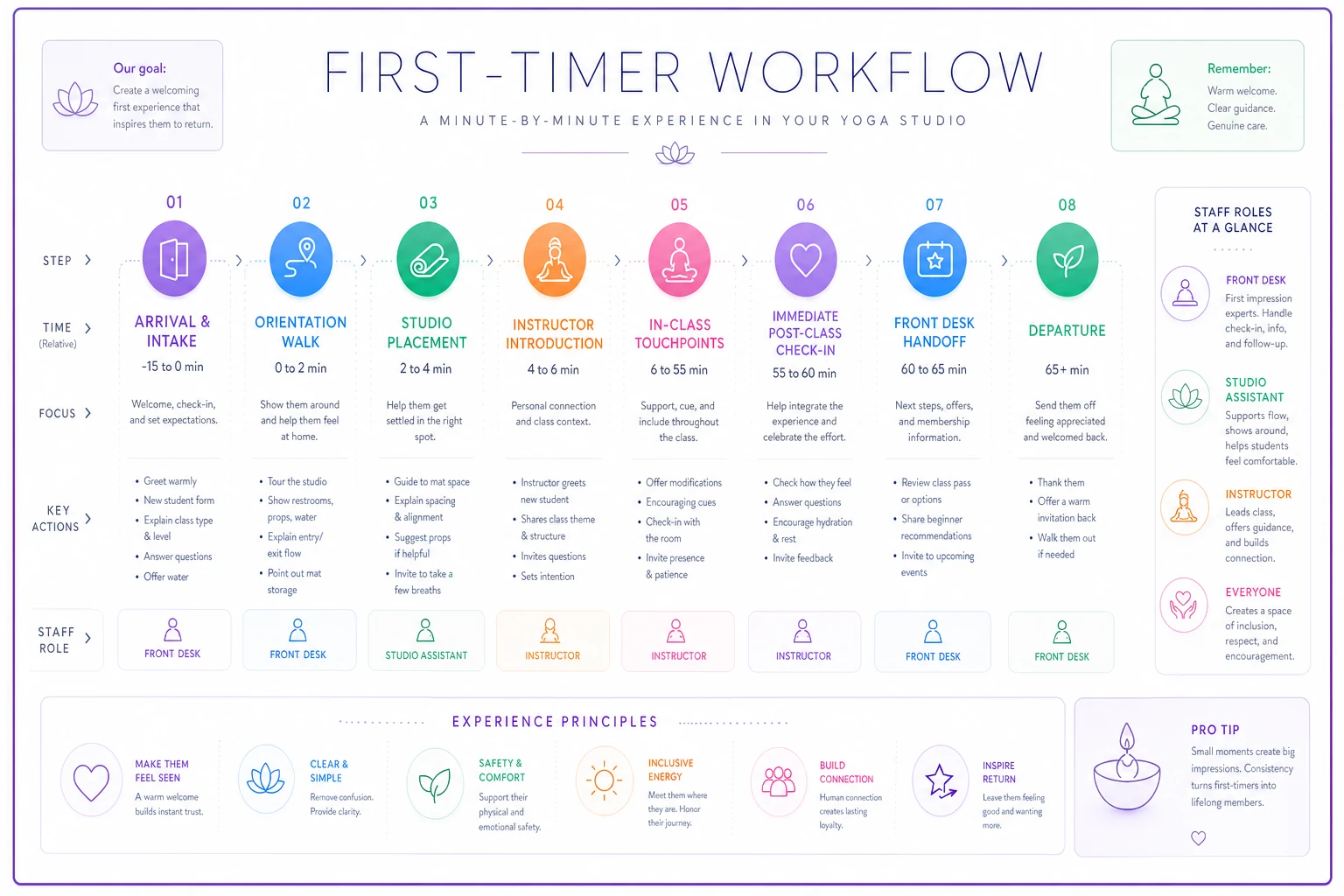
Use it to train staff and map responsibilities.
T-minus 15: Arrival and intake (3 minutes)
The moment they walk in, your designated greeter—not whoever happens to be free—makes eye contact within 3 seconds and says their name if you have it from pre-registration. "You must be Sarah! Welcome to your first class with us."
Hand them a single-page intake form. Name, email, phone, injuries, how they heard about you. That's it. While they fill it out, the greeter preps their mat spot and props.
T-minus 12: Orientation walk (4 minutes)
Don't just point. Physically walk them through:
-
Cubbies or lockers (show them exactly how the locks work)
-
Bathrooms and changing areas
-
Water fountain or station
-
Where they'll set up in the studio
-
The props they might need
This isn't a tour. It's anxiety reduction. Each location you show eliminates one more worry.
T-minus 8: Studio placement and setup (3 minutes)
Place first-timers in the second row, slightly off-center where they can see the instructor and at least one other student. Never front row (too exposed), never back row (can't see), never directly behind a pillar or a regular who does their own thing.
Set up their basic props beside the mat and tell them clearly: "These are here if you need them. The instructor will let you know when."
T-minus 5: Instructor introduction (2 minutes)
The instructor needs to personally greet every first-timer before class starts. Not a wave from across the room—a real introduction with three elements:
-
Acknowledge it's their first time
-
One modification they'll almost certainly need
-
Permission to rest whenever they want
"Sarah? I'm Jamie. First class with us? Perfect. If forward fold feels intense, just bend your knees like this. And seriously—child's pose whenever you need it."
T-minus 3: Final check (1 minute)
Greeter does a quick final check. Water bottle visible? Props within reach? Any last questions? Then: "Jamie's great with beginners. Just follow along best you can. I'll check in with you after class."
T+0 to T+60: During class
The instructor makes three deliberate first-timer touchpoints without singling anyone out:
-
Minute 5
Eye contact during the first challenging pose, an encouraging nod
-
Minute 25
Walk by and quietly adjust or say something brief
-
Minute 50
During final relaxation, a quiet "you did great" while moving through the room
T+60: Immediate post-class (4 minutes)
Instructor catches them before they reach the door: "How did that feel? Any questions about what we did today?" This isn't a sales pitch. It's a genuine check-in that also tells you what they actually need next.
Common responses tell you a lot:
-
"Harder than I expected" = needs beginner series info
-
"My wrists hurt" = needs modification guidance
-
"I was pretty lost" = needs a fundamentals workshop
-
"I loved it" = ready for a membership conversation
T+64: Front desk handoff (5 minutes)
Greeter takes over with a structured close:
-
"How was your first class?" (Let them talk)
-
"What does your normal weekly schedule look like?" (Understand their availability)
-
"Our new student special is..." (One clear option, not a menu)
-
"Can we save your spot in Thursday's gentle class?" (Specific next step)
No package menu. No overwhelming choices. One clear path forward.
T+69: Departure (3 minutes)
Before they leave, three quick confirmations:
-
Next class booked, or a scheduled follow-up if they're undecided
-
Phone number verified for text reminders
-
Parking validated or transit info shared
Hand them a small card with the wifi password, class schedule, and cancellation policy. Nothing else. Information overload kills return rates.
The staff choreography that makes it work
This whole system falls apart without clear role ownership. You need three defined positions, even if the same person covers multiple roles during slower periods.
The Greeter (usually front desk)
-
Owns minutes -15 to -5
-
Handles intake and orientation
-
Manages studio placement
-
Does post-class scheduling
The Instructor
-
Owns the minute -5 introduction
-
Tracks first-timers during class
-
Conducts the immediate post-class check-in
-
Hands off to the greeter
The Follow-up Coordinator (can be automated)
-
Sends day-after text
-
Manages 7-day email sequence
-
Tracks conversion metrics
-
Flags no-shows for personal outreach
During busy periods, explicitly assign these roles rather than relying on who happens to be free—role clarity preserves the experience.
During busy periods, these roles can't blur together. During slow periods, one person might handle all three, but they still need to execute each distinct phase.
Physical cues and environmental design
Your signage and layout either support or sabotage the whole process. Every surface is communicating something to nervous newcomers.
Door signage that actually helps:
"First time? Come right in! We'll get you set up." Not: "Remove shoes. No phones. No talking."
Check-in desk:
-
Clear sightlines from the entrance
-
Uncluttered, with one obvious place to stand
-
Name badges for all staff
Directional markers:
-
Arrows to bathrooms
-
Cubbies clearly labeled
-
"Props here" signs
-
Exit marked from inside the studio
Comfort signals:
-
Water station visible from entry
-
Clean props obviously displayed
-
Natural or warm lighting
-
Background music at conversation level
One studio increased first-timer conversion by around 12% just by moving their retail display. It was blocking the sightline to the front desk, leaving newcomers hovering uncertainly near the door. Small fix, real result.
The follow-up cadence that actually converts
The in-studio experience gets them interested. The follow-up sequence gets them committed. But most studios send generic emails that completely ignore what actually happened during the visit.
Day 0 (2 hours post-class): The immediate touch
Text: "Great job today! How are you feeling? -Jamie from [Studio Name]"
This shouldn't be automated. It comes from the actual instructor. Response rates run around 70% when it feels personal.
Day 1: The check-in
If they responded to the text, keep that conversation going. If not, email: "Yesterday was your first class with us. Some people feel sore the day after—totally normal. Light stretching helps. Want to try our Thursday evening class? It's a little gentler."
Day 3: The education
Send one useful piece of content based on what you noticed. If they struggled with poses, send something like "3 modifications that make sun salutations easier." If they loved the workout angle, explain why yoga strength training hits differently. If they seemed stressed, share the breathing exercise from class. Match the content to the person, not to a generic template.
Day 7: The decision point
Email sequences that convert new students into repeat attendees work best when tied to specific behaviors. But the day 7 email always follows the same structure:
-
Acknowledge it's been a week
-
Share one success story from someone in a similar situation
-
Present one clear offer
-
Create some urgency (class filling up, special expiring, etc.)
Day 14: The last touch
If they haven't come back: "We haven't seen you since your first class two weeks ago. Was something not quite right? Reply and let me know—I read every response. -[Owner name]"
This email gets about a 15% response rate, usually with fixable concerns around scheduling, intimidation, or confusion about packages.
Measuring what matters (and ignoring what doesn't)
Track these four metrics every week:
-
First-timer show rate (registered vs. actually attended)
-
Immediate rebook rate (booked next class before leaving)
-
Second visit rate (actually came back for that class)
-
30-day conversion rate (purchased a package or membership)
Ignore vanity metrics like email open rates or social follows. A first-timer who opens every email but never returns isn't helping your business. Someone who never opens a single email but shows up every week is.
Benchmark targets for optimization:
| Metric | Poor | Average | Excellent |
|---|---|---|---|
| Show rate | <60% | 60-75% | >75% |
| Immediate rebook | <30% | 30-50% | >50% |
| Second visit | <40% | 40-60% | >60% |
| 30-day conversion | <20% | 20-35% | >35% |
When numbers start dipping, audit your process. Usually one person has started improvising, or a specific operational step got quietly dropped during busy periods.
The script templates that remove guesswork
Your team needs exact words, not vague direction. Here's what actually works:
Initial greeting:
"Hi! First class with us? I'm [name]. Let me get you set up—takes about 2 minutes."
Not: "Is this your first time doing yoga?" (implies judgment)
Not: "Have you done hot yoga before?" (invites unfavorable comparisons)
Injury inquiry:
"Any injuries or parts of your body that need extra care today?"
Not: "Do you have any injuries?" (sounds clinical)
Not: "Anything I should know about?" (too vague to be useful)
Post-class check:
"How did that feel in your body?"
Not: "Did you like it?" (pushes them toward a positive answer)
Not: "Was it hard?" (implies it should be easy)
Package presentation:
"Most people who enjoyed today do our 30-day unlimited for $89. Want me to set that up?"
Not: "We have lots of options..." (overwhelming)
Not: "What are you looking for?" (they genuinely don't know yet)
When automation helps (and when it hurts)
The right operational software handles the repetitive stuff while keeping humans in the moments that actually matter. You can automate reminder texts, follow-up sequences, and metric tracking. You can't automate a warm greeting, personal mat placement, or a genuine post-class conversation.
AI-powered operational platforms now exist that track each first-timer through their journey and flag when something deviates from the expected pattern. Someone books but doesn't show? You get an alert. They attend but don't rebook? A personal outreach gets triggered. They buy a package but haven't used it within five days? It prompts a check-in call.
The automation handles the tracking and triggering. The humans handle the actual interaction. That combination tends to push conversion rates up noticeably because nothing quietly falls through the cracks, but the personal feel that makes people want to return stays intact.
The reality check most studios need
If you're thinking "we don't have enough staff for all this," you're solving the wrong problem. You don't need more people. You need the people you already have to follow a consistent process instead of improvising every time.
One instructor-owner ran her entire studio solo for about two years using this exact blueprint. She wore different hats for each phase—greeter hat for arrival, instructor hat for class, admin hat for follow-up. The consistency mattered more than having separate people for each role.
Your first-timer blueprint isn't about perfection or some complicated system. It's about deciding exactly how you want that first visit to unfold, then making it happen the same way every single time. When someone's first experience feels thoughtful and organized, they assume the rest of their experience there will feel that way too.
The studios struggling with conversion usually have no blueprint at all. They rely on natural talent, good vibes, and hope. That worked when yoga studios were rare. Now, with three competitors within a mile and ClassPass offering endless variety, your operational consistency is what determines whether someone becomes a student or just someone who tried yoga once.
Start with the 47-minute window. Map out every moment. Assign every task. Script the critical conversations. Measure the results. Within 30 days, you'll see conversion start to climb as anxiety drops and consistency rises.
Stop treating first-timers like they should already know how everything works. They don't. They're nervous, a little overwhelmed, and looking for any excuse to never come back. A solid first-timer experience eliminates those excuses one operational detail at a time.
Ready to elevate your studio operations?
Join 1,500+ yoga studios using Yoglyly to save time, reduce scheduling conflicts, and enhance member experiences.