

Most studio owners think about accessibility as a ramp and a bathroom grab bar. Then a wheelchair user calls to ask if they can take your 6pm vinyasa, the front desk freezes, says something vague like "I'm not sure that class would work for you," and you've just created a problem that's both a compliance exposure and a story that spreads.
Yoga studio accessibility operations rarely fail at the building level. They fail at the script level, the instructor-prep level, and the signage level — the small operational moments where staff improvise because nobody gave them a process. And improvised answers around accessibility are where studios get into real trouble.
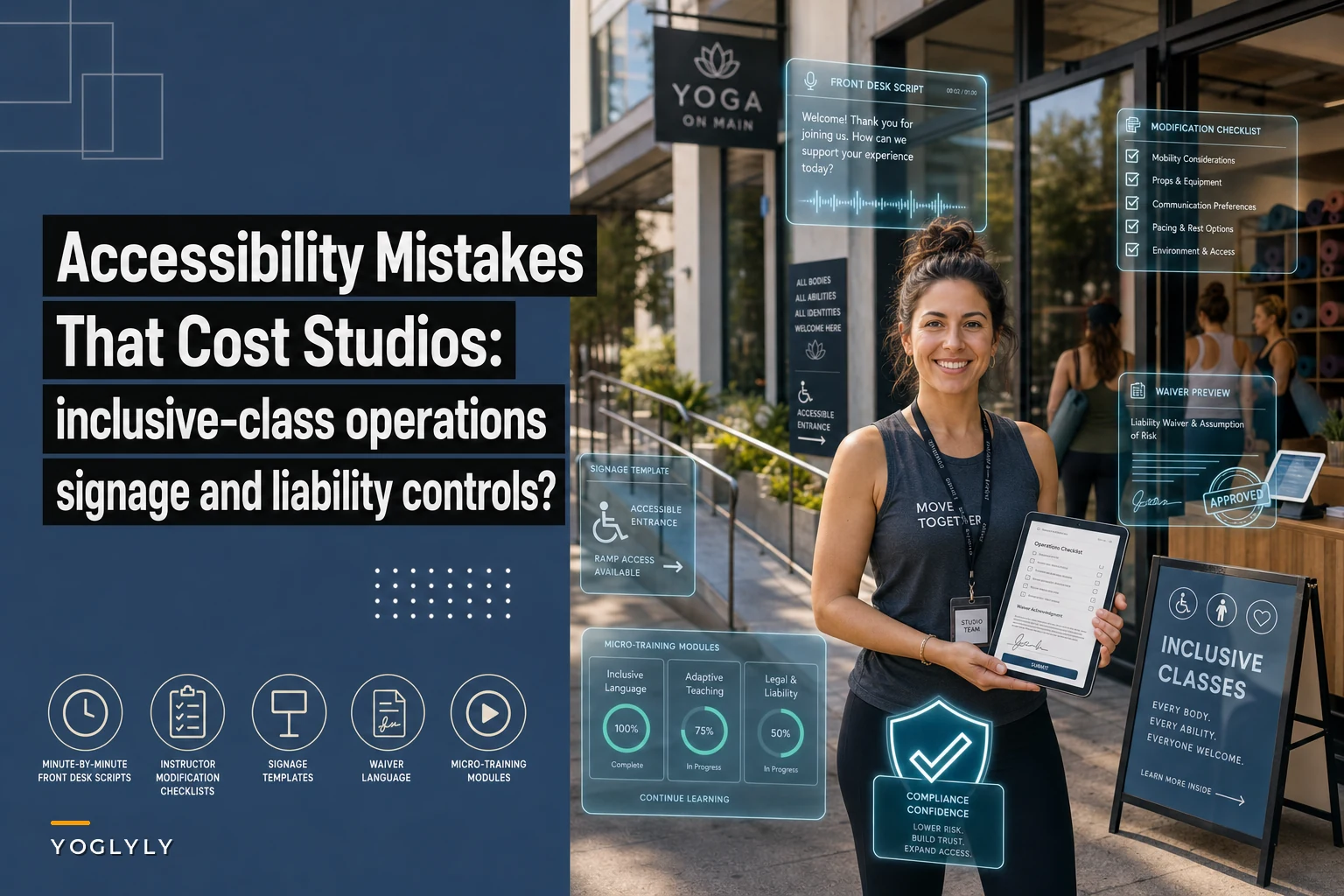
This isn't about turning your studio into a medical facility. It's about building a handful of tight operational tools — front-desk scripts, instructor modification checklists, signage standards, and waiver language — so your team stops guessing.
Where it actually breaks: the front desk improvising
There's a pattern that shows up over and over. A prospective student emails or calls with a request: "I have limited mobility in my right knee, can I still do your classes?" or "I'm deaf — do your instructors cue verbally only?" or "I use a cane, is there space near a wall?"
-
Over-promises "Oh yeah, totally fine, any class works!" (Then the student shows up to a heated power class and gets hurt or humiliated.)
-
Gatekeeps "I don't think that's a good fit, maybe try a gentler studio." (This is the one that becomes a public complaint, and depending on your jurisdiction, a discrimination claim.)
-
Defers forever "Let me check with the instructor and get back to you." (And then nobody does, and the student just doesn't come.)
None of this happens because your staff are bad people. It happens because you never gave them language. The front desk is making a liability-sensitive decision with zero training and no script. That's an operational failure, not a staffing one.
What a real accessibility request script looks like
The fix is a short, repeatable response flow. Not a legal essay — a conversational path that collects the right info, avoids making medical judgments, and connects the student to the right class.
A workable front-desk script has four moves:
-
Acknowledge warmly, don't evaluate. "Thanks for reaching out — we want to help you find the right fit. Can I ask a couple of quick questions?"
-
Ask about goals and context, not diagnosis. "Are you looking for something slower-paced, or do you want modifications within a regular class?" You're not asking what's wrong with them. You're asking what they need.
-
Match, don't gatekeep. Point them toward specific classes with specific instructors who are briefed. "Our Tuesday 10am Gentle with Maya is a good starting point — she's great with modifications and there's wall space available."
-
Hand off with a note. Log the request so the instructor knows before the student walks in. No surprises on either side.
The single biggest mistake here is letting front-desk staff make a yes/no fitness-to-participate decision. That's not their job, it's not your job, and making that call is exactly what creates both the injury risk and the discrimination risk. The script exists to route, not to judge.
Instructor modification checklists: the gap between "welcoming" and "prepared"
Say the front desk nails the handoff. The student arrives, and the instructor — who got a two-line note an hour ago — is now improvising modifications live, in front of 18 other people, while trying to run a class.
Eliminate class scheduling chaos.
Yoglyly helps you book, confirm & manage every class seamlessly.
- Centralized class scheduling
- Member notifications
- Instructor and resource management
No credit card required
This is where good intentions collapse. An instructor who genuinely wants to help but has no prepared modifications will either over-correct (hovering, singling the person out) or under-correct (ignoring them to avoid making it awkward). Both make the student feel like a problem.
What's missing is a pre-class modification checklist — a standing reference instructors review when they know an accessibility request is coming. Not a medical protocol. A practical cheat sheet.
A usable instructor checklist covers:
-
Entry/exit logistics Where will this person set up? Near a wall? Close to the door? Away from the heater?
-
Props staged in advance Chair, extra bolsters, blocks within reach — set before class so there's no mid-class scramble.
-
Known substitutions for common needs Chair-based versions of standing poses, verbal-plus-visual cueing for hearing-impaired students, floor-level alternatives for anyone who can't get up and down quickly.
-
Cueing adjustments Face the student when giving verbal cues if they read lips; add physical demonstration rather than name-only cues.
-
What NOT to do Don't announce the person's situation to the class. Don't offer hands-on adjustments without asking first. Don't use them as a "see, everyone can do yoga" example.
Studios that handle this well have instructors who've rehearsed the modifications before the student arrives, so the in-class experience looks seamless. The student never feels like an interruption, because operationally, they aren't one.
Room layout and signage: the silent failures
A lot of accessibility complaints never involve a conversation at all. The student just can't figure out where to go, can't park their mobility device, can't read the schedule, or can't find the accessible bathroom — and quietly leaves.
Signage and layout failures are invisible to you because you already know where everything is. Walk your studio as someone who's never been there and has a specific need. It changes what you see pretty quickly.
| Problem area | Common mistake | What it actually costs |
|---|---|---|
| Entrance | Step up with no visible ramp or buzzer for assistance | Student can't enter, leaves, tells people online |
| Signage | Small print, low contrast, no directional cues to restroom/props | Confusion, students feel lost before class |
| Prop station | Props stored on high shelves only | Limited-mobility students can't self-serve |
| Room layout | Wall space all taken by regulars, no reserved accessible spots | Student who needs wall support has nowhere to go |
| Bathroom | "Accessible" labeled but blocked by storage or a tight door swing | Technically compliant, practically unusable |
| Audio/visual | Verbal-only announcements, no written schedule at eye level | Hearing-impaired students miss key info |
The sneaky one on this list is the prop station. Studios spend money on a grab bar and then stack every bolster on a shelf five feet up. A wheelchair user or someone with shoulder issues now needs to flag down staff just to get set up — which defeats the whole point of letting them participate independently.
Layout fix that costs almost nothing: reserve two wall-adjacent spots per class that aren't claimed by regulars on autopilot.
It means a student who needs wall support never has to negotiate for space in front of a full room.
Waiver language: where studios quietly expose themselves
Most studio waivers were copied from a template years ago and never touched. Two failure modes keep showing up.
First, the waiver says nothing about modifications or self-assessment, so when something goes wrong, there's no documented acknowledgment that the student agreed to work within their own limits. Second — and this is the one that bites harder — the waiver contains language so broad and medical-sounding ("participant certifies they are in good physical condition") that it effectively discourages or excludes anyone with a disability from honestly participating.
You don't want either. You want waiver language that:
-
Acknowledges the student is responsible for communicating their needs and working within their own limits
-
Confirms the studio offers modifications and the student can request them
-
Does not require the student to self-certify "good health" in a way that reads as a filter
-
Documents that the student was invited to disclose anything that affects their practice — without requiring a diagnosis
This is a conversation to have with an actual attorney in your state, not a template to grab off the internet. The operational point stands though: your waiver should protect you and signal inclusion, not accidentally do the opposite. A waiver that reads like a medical screening is both a liability risk and a signal to disabled students that they're not welcome here.
Short staff-training micro-modules tied to liability
Most studios write solid scripts and checklists, drop them in a Google Doc, and never train on them. Six months later a new front-desk hire has never seen the document and everyone's back to improvising.
The fix isn't a day-long training. It's micro-modules — 10-to-15-minute segments each staff member completes, tied directly to the liability point they address.
A practical micro-module set:
-
Handling accessibility requests at the front desk (the four-move script, plus three practice scenarios)
-
The modification handoff (how to log a request so the instructor is prepped)
-
In-class modifications without singling anyone out (for instructors)
-
What we never say (the gatekeeping language that creates legal exposure)
-
Signage, props, and layout standards (a walk-through, done once, repeated for new hires)
This illustrates how micro-modules flow into operational checks.
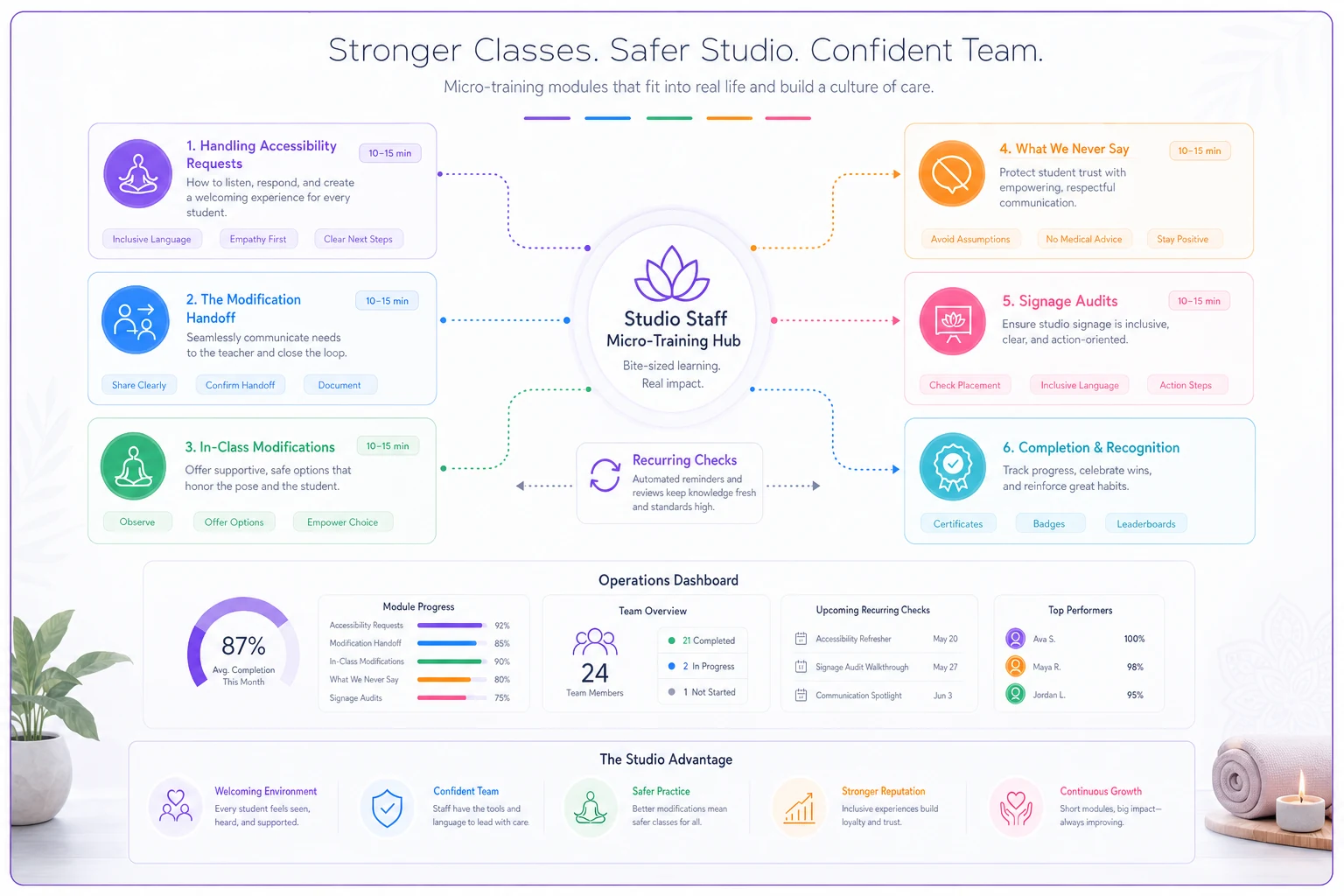
If you're already tracking operational standards somewhere — and your studio operations dashboard is a natural home for this — add "accessibility script completion" and "signage audit" as simple recurring checks. These need to be living standards, not a doc that gets forgotten after the first month.
A real scenario
A two-room studio in a mid-size city — somewhere around 300–350 weekly check-ins — kept losing accessibility-related prospects without even realizing it. The owner only noticed when a one-star review mentioned a front-desk person telling a prospective student with MS that the classes "probably weren't for her."
They rebuilt three things over about a month: a front-desk request script, a one-page instructor modification checklist with props staged before relevant classes, and a signage refresh — contrast-readable schedule at eye level, prop baskets at floor level, two reserved wall spots per gentle class.
The revenue change wasn't dramatic. Maybe a handful of new regulars over the next quarter, somewhere around $400–$600 in additional monthly membership value. But the review problem stopped, instructors said class flowed better because nobody was scrambling mid-session, and the owner stopped quietly worrying about the one phone call that could spiral into a formal complaint. The operational anxiety dropped more than the revenue rose, and that was the real win.
When to prioritize this (and when it's lower on the list)
Do this now if: you've had even one awkward accessibility conversation, you've gotten any complaint or review mentioning fit or exclusion, or you're in a jurisdiction with active accessibility enforcement. These situations don't stay small.
This can wait a few weeks if: you're mid-crisis on something more urgent like payroll or a lease issue. But "a few weeks" is the ceiling, not "someday."
Who should NOT treat this as optional: any studio marketing itself as "inclusive," "all bodies," or "beginner-friendly." If your brand promise is inclusion and your operations can't back it, the gap between the promise and the experience is exactly what generates the worst reviews and the clearest liability. Marketing inclusion you can't operationally deliver is worse than not marketing it at all.
Tie it to the first impression
Accessibility handling is often part of a student's very first interaction with your studio — before they've taken a single class. The same discipline that makes your general onboarding smooth applies here. It's worth looking at how your first-timer experience handles someone with a specific need. A first-timer flow that assumes every new student is able-bodied and self-sufficient will quietly fail the exact people who most need a clear, welcoming path in.
Getting that first interaction right matters for everyone, but it matters most for people who already had to work up the nerve to ask.
The takeaway
The studios that get accessibility right aren't the ones with the biggest renovation budgets. They're the ones that treated it as an operations problem — scripts, checklists, signage standards, short trainings — instead of hoping staff would improvise the right thing in the moment.
Improvisation is where the risk lives. Give your front desk the words, give your instructors the prep, make your signage readable, get your waiver reviewed by a real attorney, and train on all of it in short, concrete modules. None of it is expensive. All of it protects you — and more importantly, it means the next person who calls asking if they can practice at your studio gets a warm, prepared "yes, let's find the right fit" instead of a nervous pause.
Ready to elevate your studio operations?
Join 1,500+ yoga studios using Yoglyly to save time, reduce scheduling conflicts, and enhance member experiences.