



Most studio owners don't have a data problem. They have a data sequencing problem. They try to build dashboards before they've cleaned their booking records, or they buy a fancy analytics add-on when they can't even trust their own headcount numbers. The result is a pile of half-used tools and a nagging feeling that the data is lying to them.
A studio data maturity model fixes the sequencing. It tells you what to work on now, what to ignore until later, and what actually pays off at each stage of growth. The goal isn't more data — it's fewer decisions made on gut feel about things you could easily know.
What makes yoga studios different from a SaaS company running this same exercise is scale. You're not sitting on millions of events. You might run 40 classes a week with 8–14 people in each. That small-sample reality changes everything about what you can and can't actually conclude, and it's the thing most generic "data maturity" frameworks completely miss.
So this is a maturity ladder built for the actual size and mess of a real studio. Four stages, moving from descriptive (what happened) toward prescriptive (what we should do next), with prioritized use-cases, a tooling checklist, and a rough 12-month roadmap you can actually run.
The four stages, quickly
Before the detail, here's the shape of the climb. Each stage assumes the one before it is roughly working. Skipping ahead is the single most common mistake — a studio at Stage 1 trying to run Stage 3 experiments is just generating expensive noise.
| Stage | What it answers | Core question | Typical studio size |
|---|---|---|---|
| 1. Descriptive | What happened? | "How many people came last month?" | Single location, owner-operated |
| 2. Diagnostic | Why did it happen? | "Why did Tuesday nights drop?" | Growing, 2–6 instructors |
| 3. Predictive | What's likely next? | "How full will next month be?" | Established or multi-location |
| 4. Prescriptive | What should we do? | "Which class do we add, and when?" | Multi-site or scaling portfolio |
Most studios live somewhere between Stage 1 and Stage 2 and think they're at Stage 3. They have a lot of numbers but very little trust in them. That gap — between having data and trusting data — is what this ladder is really about closing.
Stage 1 — Descriptive: get one honest version of what happened
This is the foundation, and it's the least glamorous. At Stage 1 you're not trying to predict anything. You're trying to answer basic questions consistently and without doing manual math every time.
Eliminate class scheduling chaos.
Yoglyly helps you book, confirm & manage every class seamlessly.
- Centralized class scheduling
- Member notifications
- Instructor and resource management
No credit card required
The failure here is almost always the same: numbers that don't reconcile. Your booking software says 312 attendances last month. Your payment processor implies more revenue than that headcount should produce. Your class roster PDF shows something different again. When three sources disagree, owners default to whichever number feels best — and that's the beginning of self-deception.
Prioritized use-cases at Stage 1
-
Reliable attendance counts — actual butts on mats, not bookings, not sign-ups. The gap between "booked" and "attended" is often 15–25% and it hides here.
-
Revenue by class type — not total revenue, but broken out
memberships vs. drop-ins vs. class packs vs. workshops.
-
New vs. returning students — the single most useful cut you can make early.
-
No-show and late-cancel rates — even just a monthly number.
That's it. Four things. If you can pull those four reliably every month without a data-wrangling headache, you're solidly at Stage 1 — and you'd be surprised how many established studios can't.
The tooling reality
You don't need analytics software here. You need your source systems to agree with each other. This is where getting your bookings, payments, and CRM to actually reflect the same reality matters more than any dashboard. If those systems drift, everything you build on top of them inherits the drift. The groundwork for this is exactly what a single source of truth for bookings, payments and CRM is for — decide who owns which number and how often it syncs, before you try to analyze anything.
Stage 1 tooling checklist:
-
Booking system that distinguishes booked from attended
-
Payment records tagged to product type (membership / drop-in / pack)
-
One monthly export you trust, even if it's just a clean spreadsheet
-
A single agreed definition of "active member" written down somewhere
When you can answer "how did last month go?" in under five minutes with numbers you'd defend to an accountant, you're done with Stage 1.
Stage 2 — Diagnostic: stop guessing why things moved
Once you trust what happened, the natural next question is why. Tuesday 6pm dropped from 12 to 7 average attendees over two months. Is that seasonal? A teacher change? A schedule conflict with a competitor? A pricing thing? At Stage 1 you'd shrug. At Stage 2 you can actually investigate.
The trap is over-interpreting small numbers. A class dropping from 12 to 9 across four weeks feels like a trend. With those sample sizes, it's often just noise. This is where small-sample discipline becomes non-negotiable, and where a lot of studios talk themselves into changes they didn't need to make.
Prioritized use-cases at Stage 2
-
Cohort retention by entry month — do students who joined in January stick around differently than September joiners?
-
Class-level attendance trends with enough history to separate signal from noise (usually 8–12 weeks minimum)
-
Instructor-linked attendance patterns — carefully, because correlation gets abused here
-
Funnel drop-off — intro offer → second visit → membership conversion
That last one is where the real money hides. A typical example: a studio sees around 60 intro-pass buyers a month, of whom maybe 22 come back for a second class, and only 9 convert to any paid ongoing product. Knowing which step leaks tells you where to focus. Fixing the second-visit gap is almost always cheaper than buying more intro-pass buyers.
Small-sample considerations (the part everyone skips)
-
Look at rolling averages, not single weeks
-
Group classes into buckets (all Tuesday evenings, all heated classes) to get usable sample sizes
-
Resist declaring a "trend" from anything under 6–8 weeks of movement
-
Ask "how many people would need to change behavior for this number to move?" — if the answer is two, it's not a trend
This is the same discipline behind measurement governance for low-volume studios — knowing your minimum detectable effect so you don't chase ghosts. Diagnostic maturity is mostly the discipline of not over-reacting.
Tooling checklist for Stage 2
-
Cohort/retention view (many booking platforms have a basic one buried in reports)
-
Ability to segment by class time, type, and instructor
-
Rolling-average calculation, even manual
-
A simple funnel from intro to conversion
Getting comfortable with what the numbers can't tell you at this sample size is honestly half the work.
Stage 3 — Predictive: see next month before it arrives
Predictive is where studios start feeling genuinely in control. You're forecasting attendance, spotting churn risk before members lapse, and planning capacity instead of reacting to it. But prediction at studio scale is coarse. You won't get "this exact person will cancel." You'll get "members who haven't attended in 21 days are much more likely to lapse." That's still hugely valuable.
Prioritized use-cases at Stage 3
-
Attendance forecasting by class and by month, for staffing and schedule planning
-
Churn-risk flagging based on attendance frequency dropping off
-
Capacity planning — knowing which classes will hit their ceiling and which are chronically empty
-
Seasonal modeling — quantifying the summer dip and January surge instead of just bracing for them
A realistic churn signal for a studio looks less like a machine-learning model and more like a rule: a member who averaged 3 visits a week and hasn't shown in 18 days is at risk. Simple, explainable, and actionable — someone reaches out before that person mentally cancels.
When predictive actually makes sense
Only after Stage 2 is solid. If your attendance data still doesn't reconcile, a forecast just launders bad inputs into confident-looking outputs. Predictive is worth it when you're deciding whether to add classes or hire, when seasonal swings are genuinely hurting cash flow, or when you have at least a year of clean historical data to work from.
When it's a bad idea
If you're a single-location studio with 12 months of messy records, skip formal forecasting. Your gut plus a rolling average will be about as accurate and far cheaper. Predictive tooling earns its keep when the cost of being wrong — an overstaffed schedule, a missed capacity ceiling — is measured in real thousands, not hundreds.
Stage 4 — Prescriptive: from insight to recommended action
This is the top of the ladder and, honestly, most single studios never need to fully get here. Prescriptive means the system doesn't just tell you what will happen — it recommends what to do. "Add a second heated class Tuesday at 6pm; here's the expected fill and margin." "Move this underperforming class to Sunday morning where demand is unmet."
At this stage, the different data streams you've been building finally connect. Attendance forecasts feed scheduling. Churn risk feeds retention campaigns. Capacity ceilings feed hiring plans. The value is in the coordination — no single insight is new, but acting on all of them together, consistently, is what separates a scaling portfolio from a busy one.
Who should NOT bother reaching Stage 4
-
Owners still doing everything themselves — the recommendations create work you can't absorb
-
Studios without clean Stage 1–2 foundations — garbage in, confident garbage out
-
Anyone treating this as a status symbol rather than a decision aid
Prescriptive is genuinely useful for multi-location operators making dozens of scheduling and staffing calls a month, where small optimizations compound across sites. For a single 40-class-a-week studio, Stage 3 is often the sensible ceiling.
A 12-month roadmap you can actually run
Here's a realistic pace. It's slow on purpose — foundations take longer than anyone wants, and rushing them is why so many studios stall.
Months 1–3 — Descriptive foundations Reconcile your three core systems. Nail down definitions. Get four numbers you trust: attendance, revenue by type, new vs. returning, no-show rate. Expected ROI: mostly indirect — you stop making decisions on wrong numbers. Real value, just hard to put a dollar on.
Months 4–6 — Diagnostic layer Build cohort retention and the intro-to-conversion funnel. Start finding the leaks. This is usually where the first hard ROI shows up — fixing a second-visit gap that converts even a few more intro-buyers per month into members can be worth several thousand dollars a year.
Months 7–9 — Early predictive Attendance forecasting and a simple churn rule. Use it for staffing and one retention outreach flow. Fewer overstaffed classes, a modest lift in retained members. In a mid-size studio, catching even 3–4 at-risk members a month before they lapse adds up quietly.
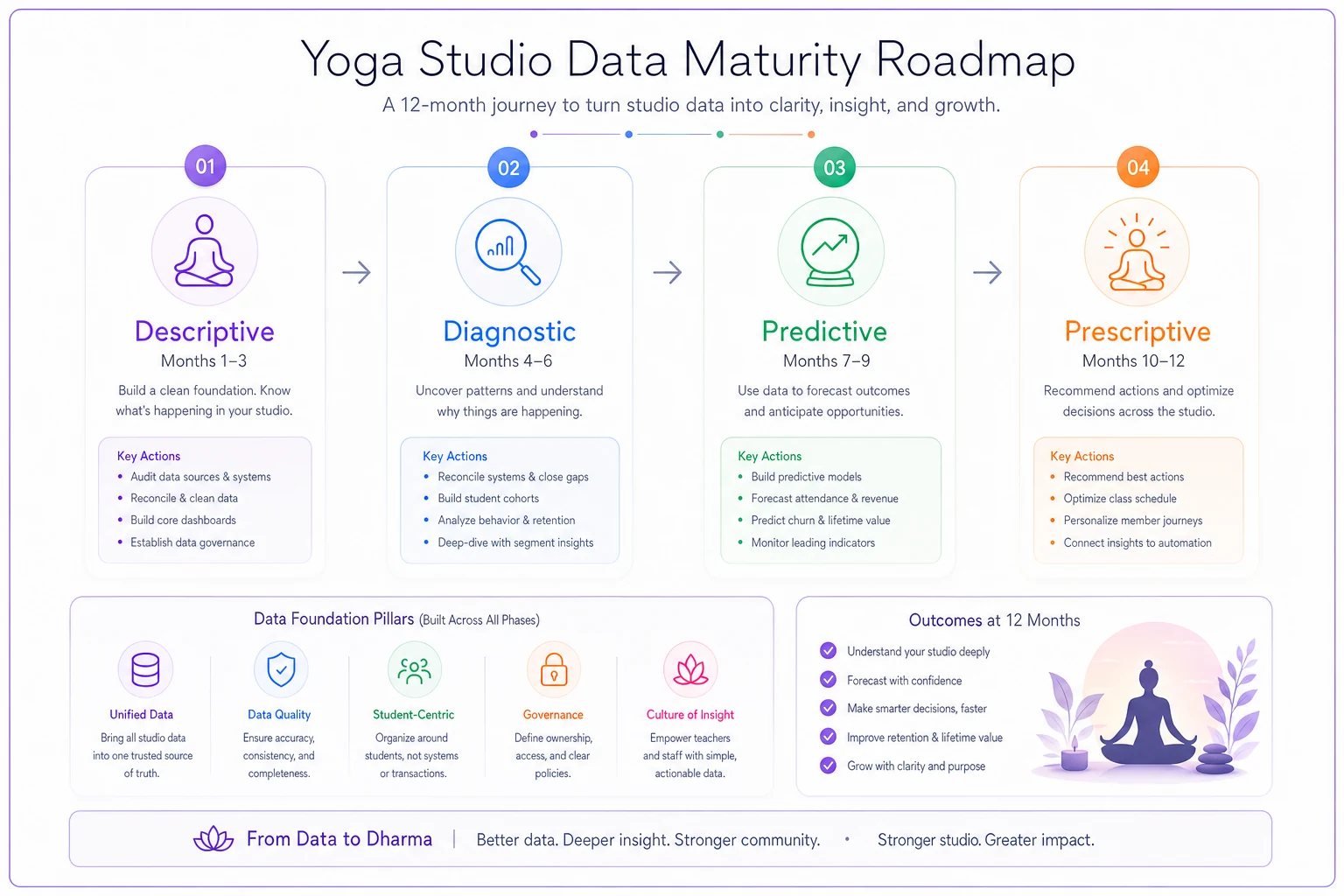
Months 10–12 — Toward prescriptive Connect the streams. Let forecasts inform schedule decisions. If you're multi-site, this is where coordination gains appear. If you're single-site, this is where you decide whether Stage 4 is even worth it for you — often it isn't yet, and that's fine.
Visual roadmap for the 12-month plan.
A real-ish scenario
A two-location studio, roughly 330 combined weekly attendances, was convinced Tuesday and Wednesday evenings were "dying." They almost cut two classes.
At Stage 1, they discovered their booking export was double-counting some members who'd re-booked after canceling — actual attendance was more stable than it looked. At Stage 2, the rolling average showed the "decline" was two regulars who'd temporarily stopped, not a trend. At Stage 3, a simple churn rule flagged both of those members early enough that a quick check-in text brought one back.
Net effect over about four months: they didn't cut the classes (which would've quietly killed roughly $1,800–$2,400 in monthly membership value tied to those slots), tightened their intro-to-membership funnel by fixing the second-visit follow-up, and stopped arguing about numbers in staff meetings because everyone finally trusted the same report. No dramatic revenue explosion — just fewer expensive mistakes and calmer decisions.
That's what maturity actually buys you. Not magic predictions. Just decisions you can defend.
Where studios get stuck — and how to keep moving
The pattern is consistent: studios overinvest in tools and underinvest in trust. They'll pay for an analytics add-on before they've agreed on what "active member" means. Fancy tooling on a shaky foundation just gives you wrong answers faster, with more decimal places.
One thing worth taking from this: advance one stage at a time, and don't skip the boring foundation. Descriptive before diagnostic. Diagnostic before predictive. Prediction only earns trust when the underlying counts already do.
Where AI-assisted operational tools genuinely help is the grunt work — reconciling systems that don't naturally agree, flagging the at-risk member before you'd notice manually, keeping rolling averages current so you're not rebuilding a spreadsheet every month. Real leverage, but only after you've done the sequencing right. A tool that automates a broken process just automates the brokenness.
Start where you actually are — probably Stage 1 or a shaky Stage 2 — and climb deliberately. The studios that win at data aren't the ones with the most dashboards. They're the ones who trust the four numbers that matter and act on them before the month is over.
Ready to elevate your studio operations?
Join 1,500+ yoga studios using Yoglyly to save time, reduce scheduling conflicts, and enhance member experiences.