

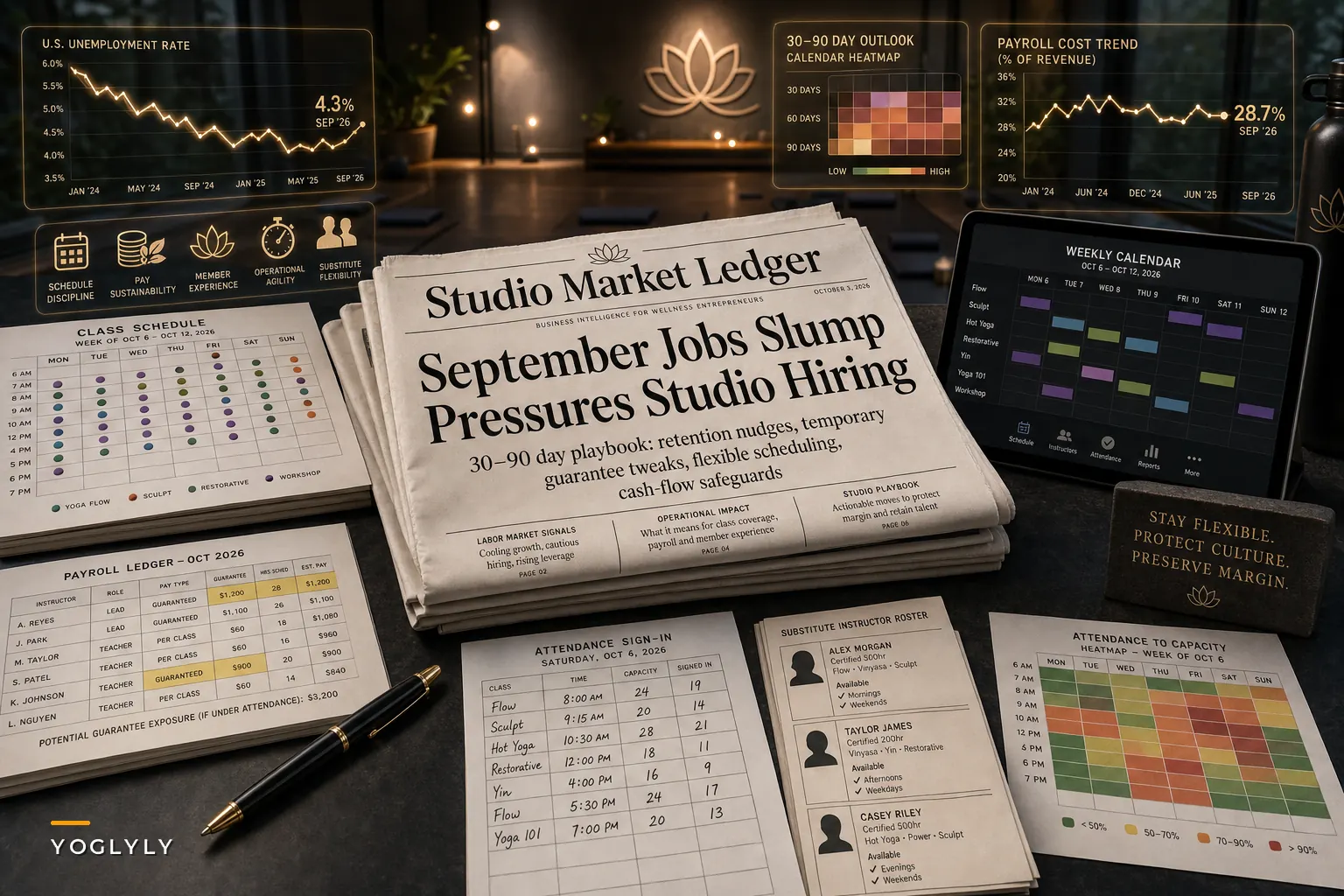

The September numbers were weak enough to give anyone planning a Q4 schedule pause. Nonfarm payrolls grew by just 29,000 and unemployment nudged up to 4.2%, a slowdown CNBC described as the labor market faltering. For the national economy, that's one data point. For a yoga studio owner sitting on a holiday schedule, three instructor guarantees you're not sure you can afford, and a member base that's getting pickier about spending — it's worth reading carefully.
Most studio owners get this wrong when a report like this drops. They either treat it as irrelevant ("I'm a 180-member studio, what does payroll data have to do with me?") or use it as a reason to panic-cut. Both are mistakes. What shifts is your negotiating position and your demand assumptions at the same time — and those two things pull in opposite directions.
Two things move at once — and they conflict
When wage growth cools and hiring slows, two separate levers swing for a studio owner.
Your hiring leverage improves. Instructors who were fielding three offers in 2024 are fielding one now. The teacher who ghosted you last spring because a competitor offered a $5 higher per-class rate is suddenly reachable again. Substitute pools deepen. The people you wished you could lock in at reasonable terms become a lot easier to talk to.
Your demand softens. The same cooling that gives you pricing power over labor also tightens your members' wallets. Unlimited memberships get downgraded to class packs. The "I'll drop in when I can" crowd drops in less. Disposable-income-sensitive add-ons — workshops, retreats, the $38 branded leggings — slow down first.
So you have better leverage to buy teaching capacity at exactly the moment you may need less of it. Studios that handle this well don't make a single blanket decision — they separate the labor-cost question from the demand question and solve each on its own timeline.
The underlying problem this exposes
When demand starts to wobble, most studios have no reliable way to distinguish normal seasonal noise from an actual decline. December is always weird. The week after Thanksgiving is always weird. So when attendance dips 12% in a given stretch, the owner genuinely doesn't know whether to cut a class, swap an instructor, or just wait.
Eliminate class scheduling chaos.
Yoglyly helps you book, confirm & manage every class seamlessly.
- Centralized class scheduling
- Member notifications
- Instructor and resource management
No credit card required
That uncertainty is what makes a cooling market dangerous — not the cooling itself. A studio that knows its true baseline can react in days. A studio flying blind either overreacts (cuts a class that would've recovered) or underreacts (keeps paying a guarantee on a 4-person 6am that's been dying for a month).
The pain almost never comes from the macro event. It comes from decisions made on gut feel during the window the macro event creates. The jobs report doesn't hurt you. Your reaction to a soft January you can't properly read does.
The hiring decision: lock talent now, but be specific about *which* talent
A cooling labor market is a genuine buying opportunity for instructor capacity — if you're precise. This isn't the moment to "hire a couple more teachers because they're available." It's the moment to fix the specific holes that have been quietly costing you.
-
- The anchor instructor whose classes fill but who's always one competing offer away from leaving
-
- The reliable sub you lean on constantly but have never formalized, so they're free to say no at the worst moments
-
- The weak slot — a recurring class that underperforms because you've never had the right person for it
A soft market is when you shore up the first two and finally fill the third. The mistake is spreading a small hiring budget across "more teachers generally" instead of locking the two or three people whose departure would actually hurt.
When accelerating hiring makes sense
-
You've been running on a thin substitute bench and one injury away from canceling classes
-
A strong instructor you've wanted is suddenly available or reachable
-
You have a proven, consistently-full class you could duplicate with the right teacher
When a hiring freeze is the smarter call
-
Attendance has been trending down for six or more weeks with no clear seasonal explanation
-
You're already carrying guarantees you're struggling to cover
-
You're adding classes hoping demand will follow — it rarely does in a tightening consumer environment
The mistake is spreading a small hiring budget across "more teachers generally" instead of locking the two or three people whose departure would actually hurt.
Repricing guarantees before Q4 locks in
Guarantees are where cooling wage momentum actually hits your P&L, and most studios renegotiate them far too late — usually only after a class has been losing money for months.
A guarantee made sense when you had to overpay to secure anyone. In a softer market, the same instructor may accept a structure that protects your margin while still being fair to them. The move isn't to slash pay — it's to shift from flat guarantees toward hybrid structures that track actual attendance.
Here's how the common pay structures behave when demand is uncertain:
| Pay structure | Studio risk if class is empty | Instructor appeal | Best used when |
|---|---|---|---|
| Flat guarantee ($X per class regardless) | High — you eat the full cost | High | Launching a new slot, unproven time |
| Per-head only | Low — you pay for what shows | Lower, feels unstable | Established, reliably-full classes |
| Base + per-head hybrid | Medium — floor protects teacher, upside shared | High | Uncertain demand, most Q4 situations |
| Revenue share (% of class revenue) | Low — scales with reality | Varies | Workshops, series, premium offerings |
In a cooling market, the base + per-head hybrid is usually the right default for anything that isn't a dead-certain full class. The instructor gets a floor so they're not gambling, and you cap your downside if January comes in soft. The key is renegotiating before you publish the Q4 schedule — once a teacher is on the calendar at a flat guarantee, you've lost your window until the next cycle.
A practical sequence for the next three weeks
If you want to turn this into action rather than anxiety, here's a workable order of operations:
-
Pull your true attendance baseline by class and time slot — ideally the last 12–16 weeks, so you can separate seasonal softness from a real decline before you touch anyone's schedule.
-
Rank your classes into keep / watch / cut based on contribution after instructor cost, not just headcount. A full class of discounted-pack members may be worth less than a half-full one of full-price drop-ins.
-
Identify your two "must-keep" instructors and open a conversation now, while your leverage is good, about a structure that locks them in.
-
Convert your top informal sub into a formal arrangement — a small retainer or priority-pay deal that guarantees availability for your worst-coverage windows.
-
Reprice any flat guarantee on a "watch" class to a base + per-head hybrid before the winter schedule publishes.
-
Stress-test your promo plan against a lower-spend January — assume package downgrades and model what happens to cash flow if 15–20% of unlimited members shift to class packs.
Notice that hiring and cutting both appear on the same list. That's intentional. A soft market usually calls for both at once — tightening weak spots while locking the strong ones.
A real scenario
A single-location studio running about 42 classes a week had three instructors on flat guarantees of roughly $65–$75 per class, set during the tight 2024 hiring market. By late 2026, two of those classes were averaging 5–7 attendees against a room that breaks even around 9.
The owner had been avoiding the conversation for months, assuming any renegotiation would push the teachers out. When the fall slowdown made it obvious something had to give, she moved both flat-guarantee classes to a $35 base plus $7 per head. On a 6-person class that came out close to the old guarantee for the instructor — but on a strong 14-person week they earned more than before. And on a 3-person week, the studio's exposure dropped by roughly half.
Across the two classes, the shift saved somewhere in the $600–$900 a month range in downside risk without a single instructor leaving. The teachers actually preferred it, because the upside weeks finally paid them for filling the room.
The real win wasn't the dollar figure. She made the move before the slow season instead of three months into it.
The coordination problem nobody talks about
Even when studios make the right strategic calls, executing across a roster of 8–15 part-time instructors is a mess of texts, spreadsheets, and half-remembered verbal agreements.
You renegotiate a guarantee verbally, but the pay rate in your scheduling tool still shows the old number. Your "formalized" sub arrangement exists only in a DM thread. You decide to cut a class but the recurring booking stays live and three members sign up for something that's supposed to be gone.
This is where good decisions quietly die — not in the strategy, but in the handoff between deciding and executing.
Here's a quick workflow that shows how centralizing attendance, pay structures, scheduling and guarantee terms turns decisions into executable updates.
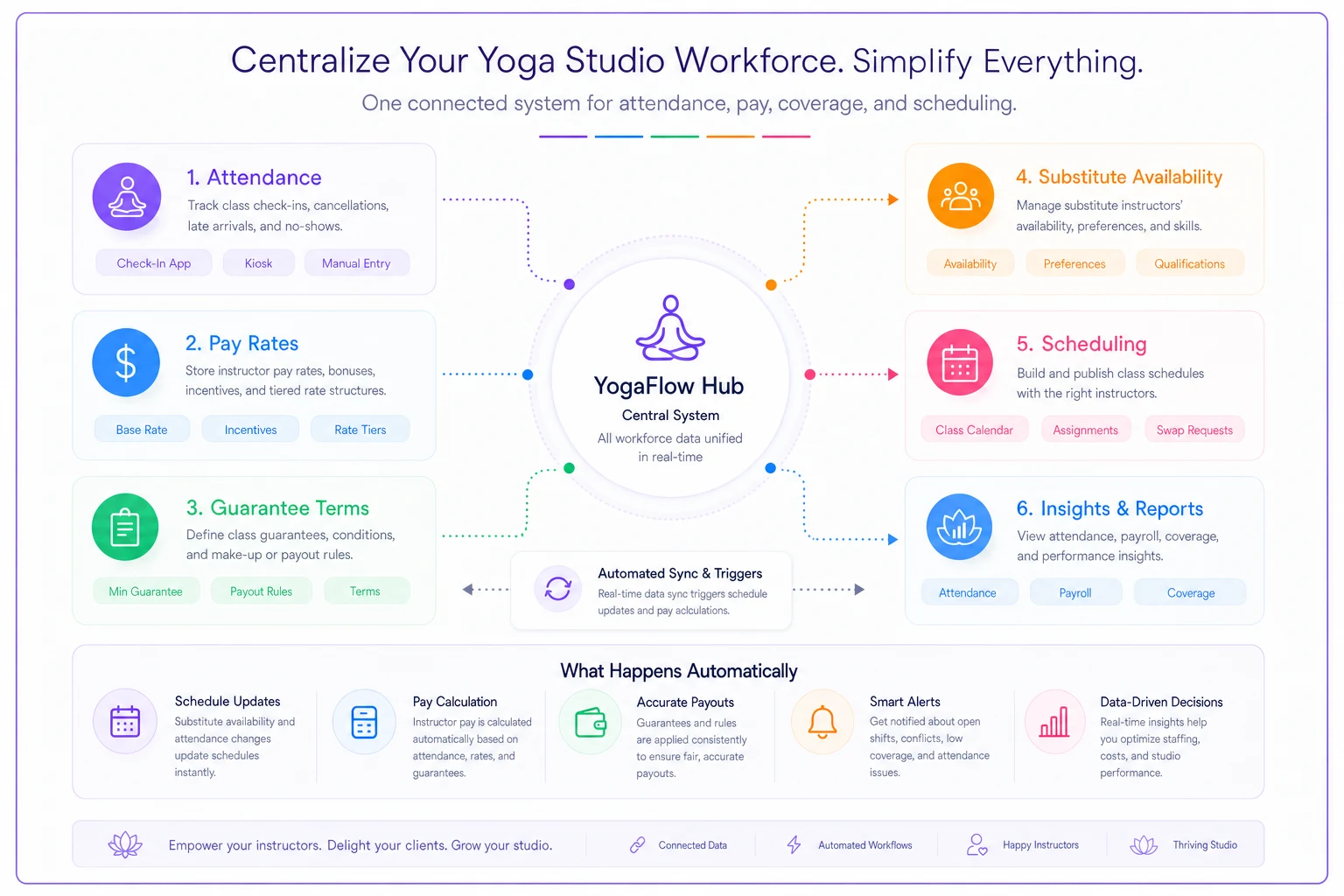
Centralize pay rates and guarantee terms in the same tool you use for scheduling so execution matches decisions.
When attendance data, pay structures, and scheduling all live in the same system, repricing a guarantee or spotting a dying class is a five-minute task instead of a weekend of reconciling spreadsheets. Operational software that connects attendance to pay structure doesn't make the strategic call for you, but it makes the call visible and executable — which is most of the battle.
If you want to build this foundation so you're not scrambling every time the market shifts, our workforce lifecycle playbook for hiring, pay and development walks through how to structure instructor capacity so these decisions become routine rather than reactive.
Who should NOT make big moves right now
Not every studio should treat this as an action trigger.
-
If your attendance is genuinely stable, don't invent a crisis. Repricing guarantees on full, healthy classes just to feel proactive risks souring good instructor relationships for no real margin gain.
-
If you're mid-expansion with newly launched classes, those need flat guarantees to give the slot time to mature. A cooling market isn't a reason to yank the floor out from a class that's only eight weeks old.
-
If you don't have clean attendance data yet, fix that first. Making staffing cuts off gut feel during a soft stretch is exactly how studios cut the wrong class and regret it by spring.
If you don't have clean attendance data yet, fix that first. Making staffing cuts off gut feel during a soft stretch is exactly how studios cut the wrong class and regret it by spring.
The real takeaway
A single jobs report — one the AP described as a disappointing month for hiring — isn't going to make or break your studio. What it does is open a short window where your leverage over instructor pay improves right as your members get more cautious with their own spending.
The studios that use that window well separate the two questions, lock their key people on fairer terms, quietly reprice guarantees that no longer make sense, and stress-test their cash against a slower season — all before the schedule prints. The ones that struggle will do the same work six months from now, except by then they'll be reacting to a problem instead of getting ahead of one. The difference isn't the macro environment. It's whether you can read your own numbers clearly enough to act while the acting is still cheap.
The difference isn't the macro environment. It's whether you can read your own numbers clearly enough to act while the acting is still cheap.
Ready to elevate your studio operations?
Join 1,500+ yoga studios using Yoglyly to save time, reduce scheduling conflicts, and enhance member experiences.