

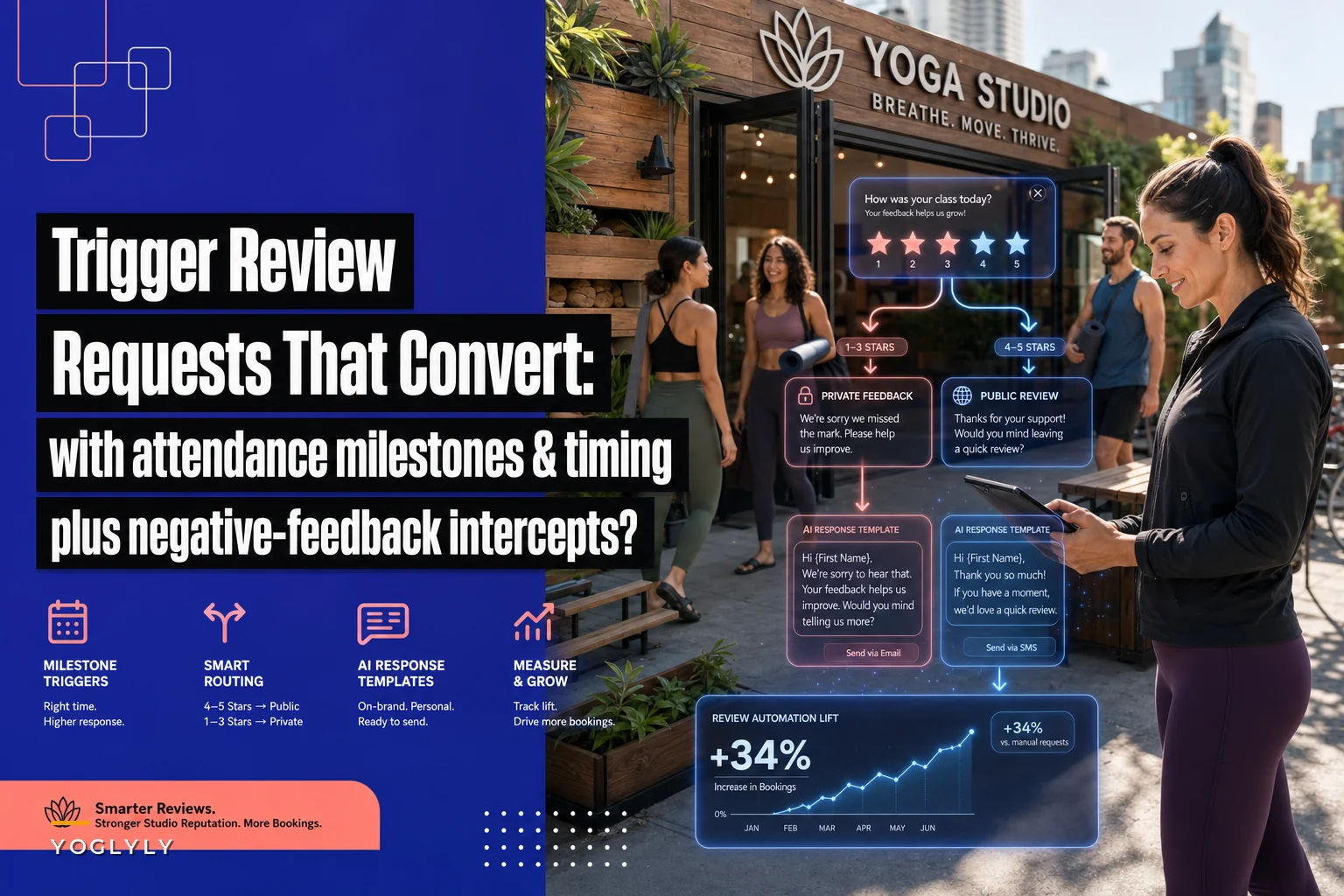

Most studios collect reviews backwards. They blast a "leave us a review!" email to their entire list once a quarter, get three responses (two from staff), and wonder why their Google rating has been stuck at 4.6 with 41 reviews for two years.
The problem isn't that your students don't like you. It's that you're asking the wrong people at the wrong moment. Someone who dropped in once and never came back is on that same email list as your Tuesday 6am regular who's hit 200 classes. Sending them identical asks means you're either annoying loyal students or begging reviews from people who feel nothing about your studio either way.
Attendance data fixes this. Your booking system already knows exactly who loves your studio — it's the people who keep showing up. The whole game is tying the review request to a moment where the student is already feeling good about being there.
The milestone moment: where enthusiasm actually lives
There's a window right after someone becomes a regular where they're genuinely enthusiastic and haven't yet taken you for granted. That window is your gold.
What we've noticed across a lot of studios is that the emotional peak isn't the first class. First-timers are nervous, still comparing you to other studios, still deciding. The real peak sits somewhere around the point where the studio becomes part of their routine — roughly class 8 to 15 for most people. They've felt progress. They know instructors by name. They've told a friend. That's when a review ask lands as "yeah, of course I'll do that" instead of "ugh, another email."
The mistake studios make is picking one milestone and stopping there. A single trigger at "10th class" misses two other high-value moments:
-
The streak milestone — someone who's attended consistently for a set period (say 4+ classes a month, three months running). These are your ride-or-die members.
-
The comeback moment — a student who lapsed and returned. They just re-chose you. That's a surprisingly strong emotional moment for a review ask.
Here's a practical breakdown of which milestones tend to convert and why:
| Milestone trigger | Typical conversion to review | Why it works |
|---|---|---|
| 1st class completed | Low (2–4%) | Too early, no attachment yet |
| 8th–12th class | High (12–18%) | Habit formed, enthusiasm still fresh |
| 25+ classes | Moderate (7–10%) | Loyal but may feel "asked already" |
| 3-month consistent streak | High (10–15%) | Strong identity as a "member" |
| Returned after 30+ day lapse | Moderate–high (8–12%) | Just actively re-committed |
The numbers shift studio to studio, but the pattern holds: the middle-of-the-relationship asks beat both the too-early and the too-late ones.
The negative-feedback intercept (the part most studios skip)
Here's the mistake that quietly wrecks review campaigns. Studios automate a review ask, it goes out to everyone who hits the milestone, and then a student who's been irritated about the parking situation or a specific instructor uses that public review to vent. Now you've got a detailed 2-star review sitting at the top of your Google profile, generated by your own automation.
Eliminate class scheduling chaos.
Yoglyly helps you book, confirm & manage every class seamlessly.
- Centralized class scheduling
- Member notifications
- Instructor and resource management
No credit card required
The fix is a two-step flow instead of a one-step ask.
-
Happy responses (4–5) get routed to your public review link — Google, Yelp, wherever you want the visibility.
-
Unhappy responses (1–3) get routed to a private feedback form that comes straight to you, plus a genuine "we'd love to make this right" message.
This isn't about hiding bad feedback. It's about giving unhappy students a direct line to you before they broadcast frustration publicly — which most of them actually prefer. People rarely want to trash a small studio they've been attending for months. They want the problem fixed. The intercept gives them that path.
A studio doing around 300 monthly bookings might have 5–8 mildly frustrated regulars in any given month. Without an intercept, one or two of those eventually land as public 2-stars. With it, they land in your inbox where you can actually do something about it — and often turn into a save.
What the intercept flow looks like in practice
-
Student hits milestone → automation waits for the right moment (more on timing below)
-
System sends the "how's it going?" message with a simple rating
-
Rating comes back → the flow forks
-
4–5 "So glad to hear it! Would you mind sharing that on Google? Takes 30 seconds → [link]"
-
1–3 "Thanks for the honest answer — I want to fix this. Can you tell me what happened?" → routes to owner/manager
-
Owner gets an alert on the low ratings so nothing sits ignored for a week
The single most common failure here is the low-rating alert going into a shared inbox nobody checks. If a frustrated student reaches out and gets silence, you've made it worse than doing nothing. Whoever owns member experience needs that alert hitting their phone directly.
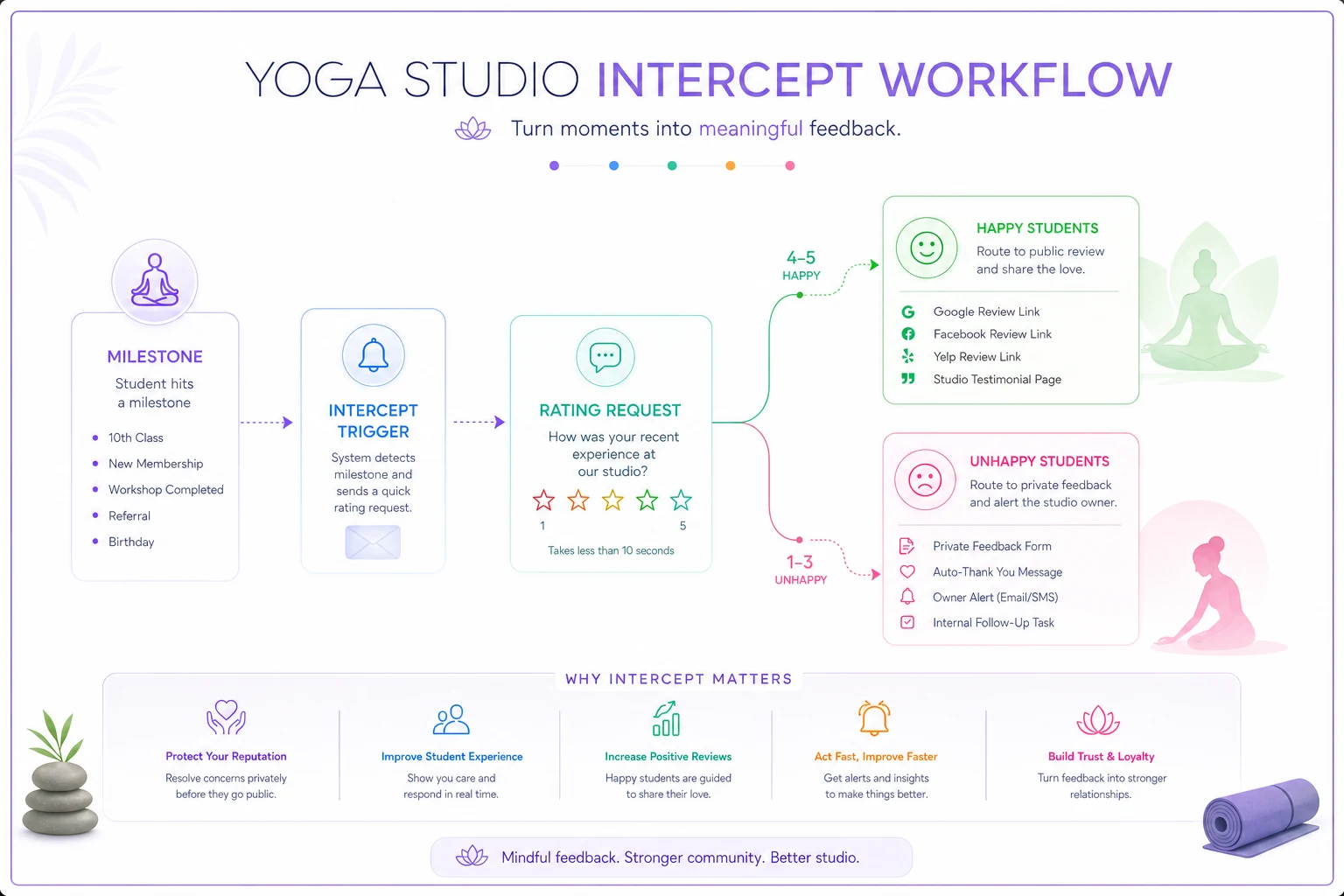
A quick visual like this makes it easier to map the automation steps when setting up the flow.
Timing: the detail that quietly doubles response rates
Sending the ask at the wrong hour kills otherwise good automation. A few timing patterns worth knowing:
-
Send within a few hours of class, not days later. The feeling fades fast. Same-evening or next-morning beats "three days later" by a wide margin.
-
Avoid the mid-class dead zones. A message at 6
15pm when half your list is on a mat gets buried under later notifications.
-
Weekend-morning regulars respond differently than weekday-evening ones. If your data lets you segment by schedule, a Saturday 9am student getting a Saturday 11am ask is right in the pocket.
-
Space the ask from the last one. Nobody should get a milestone ask, then a streak ask, then a comeback ask inside the same three weeks. Set a cooldown of at least 60–90 days between any review-related messages to the same person.
The cooldown rule is the one people forget. Multiple overlapping triggers firing at the same student is how automation starts feeling like spam. Build the guardrail once and stop worrying about it.
Set a 60–90 day cooldown in your automation platform to prevent overlapping triggers.
Multiple overlapping triggers firing at the same student is how automation starts feeling like spam. Build the guardrail once and stop worrying about it.
Response templates that don't sound like a form letter
The template is where most automated review requests go generic and die. "We value your feedback, please leave us a review" reads like it came from a bank.
What works better is specific, short, and human. A few patterns:
The milestone template (happy path): > "You just hit your 10th class 🎉 — honestly love seeing you on the mat every week. If you've got 30 seconds, a quick Google review helps other people find us and it genuinely means a lot to a small studio like ours. [link]"
The streak template: > "Three months of showing up consistently — that's real dedication. If our classes have become part of your routine, would you share a few words on Google? It helps us more than you'd think. [link]"
The intercept opener (before the fork): > "Quick one — how've the last few classes been for you? Tap a number: 😐 1 2 3 4 5 🔥"
The low-rating recovery: > "Really appreciate the honest answer. I'd genuinely like to understand what's been off — mind telling me a bit more? I read every one of these myself. — [Owner name]"
Signing the recovery message with a real name, from the actual owner, changes the whole tone. It tells the student a person is listening, not a system.
When this makes sense — and when it doesn't
This makes sense when:
-
You've got at least a couple hundred monthly bookings, so milestones actually fire regularly
-
Your booking software tracks attendance per student (nearly all do)
-
Someone owns responding to the low-rating intercepts
This is a bad idea when:
-
You haven't fixed obvious experience problems yet. Automating review asks while your 6am class starts 10 minutes late every day just accelerates the bad reviews. Fix the room first.
-
You're a brand-new studio with 30 members. At that scale, ask people in person — it's warmer and works better than any automation.
Who should skip it entirely: studios with unresolved staffing or scheduling chaos. Pushing reviews when the underlying experience is shaky is like turning up the volume on a broken speaker.
A quick real scenario
A mid-sized vinyasa studio running around 320–360 bookings a month had been stuck at 44 Google reviews and a 4.5 rating for over a year. Their old approach: one quarterly blast to the whole list.
They switched to attendance-triggered asks — a message at the 10th class and another at a 3-month consistent streak — with a rating intercept in front of both. Low ratings routed straight to the owner's phone.
Over roughly four months, they added about 60 new reviews and the average nudged up to 4.8. Just as useful: the intercept caught around a dozen frustrated students privately — a couple of them about the same crowded 6pm class — which the owner then fixed by adding a second slot. Two of those students later left positive reviews on their own.
The lift to bookings is harder to isolate cleanly, but a stronger rating and fresher review count tends to help discovery, and that connects directly to the local SEO fundamentals that keep studios visible — reviews and search presence feed each other.
Measuring whether it's actually working
Don't just count reviews. Track the pieces that tell you the system is healthy:
-
Milestone-to-review conversion rate — of people who hit the trigger, how many left a public review?
-
Intercept catch rate — how many low ratings got captured privately vs. landing public? A rising catch rate means the flow is doing its job.
-
Rating trajectory — is your average moving, and is the review count staying fresh (recent reviews matter more for ranking than old ones)?
-
Recovery rate — of intercepted unhappy students, how many did you actually re-engage?
If your milestone-to-review rate is under 5%, your timing or template is off — start there. If the intercept is catching almost nothing, your rating scale might be too forgiving, or the ask is going out too late to matter.
Most booking and studio-management platforms can trigger these flows off attendance data automatically, so once the milestones, cooldowns, and intercept branching are configured, the whole thing runs quietly in the background. The setup takes an afternoon. The payoff is a review profile that actually reflects the students who love your studio — not whoever happened to open a mass email.
Stop asking everyone the same thing at the same time. Ask the right student at the moment they're happiest, and catch the unhappy ones before they reach for the public keyboard.
Ready to elevate your studio operations?
Join 1,500+ yoga studios using Yoglyly to save time, reduce scheduling conflicts, and enhance member experiences.