



The September PCE numbers landed on October 29 and they weren't great. The Personal Consumption Expenditures index climbed 0.5% month-over-month and 3.6% year-over-year. A Reuters report on the September data noted that consumer spending rose alongside the price jump — which sounds fine until you remember that "spending rose" at the macro level often masks households quietly re-ranking where their money goes.
For a yoga studio, you don't feel inflation as a headline. You feel it as a member who downgrades from unlimited to an 8-class pack. A workshop that used to sell out in four days now limping to 70% capacity. A landlord floating a CAM adjustment. It's death by a thousand small decisions, most of which happen without anyone telling you.
So skip the economics lecture. What matters is where this pressure actually shows up in your operation, and what to do about it before Q1 — because Q1 is when discretionary spending gets cut hardest.
Where inflation actually hits a studio (and where owners look in the wrong place)
Most owners react to inflation by staring at their price list. That's the wrong first move. Your price list is the last thing you should touch, because raising prices into softening demand is how you lose your best, most price-insensitive members while keeping the ones who were already on the fence.
-
Variable revenue lines — drop-ins, single workshops, retail, guest passes. These are the first things a cost-conscious member cuts. They're also, annoyingly, your highest-margin lines.
-
Fixed cost creep — rent escalators, utilities, insurance renewals, software seat increases, laundry/towel service. None of these announce themselves loudly, but a 6–9% bump across the board can erase a month of profit.
-
Instructor pay expectations — when teachers' own grocery and rent bills climb, your per-class rates start feeling thin to them, and your best instructors get recruited away or start asking for more.
The pattern worth noticing: inflation doesn't lower your membership count first. It lowers the stuff around the membership. A member keeps their unlimited pass but stops buying the $38 workshop, skips the retail mat, brings a friend less often. Your headcount looks stable while revenue per member quietly erodes. Owners who only watch active-member count miss this entirely.
The 7 moves, in the order that actually protects margin
These aren't ranked by how exciting they are. They're ordered by how fast they protect cash without damaging demand.
Eliminate class scheduling chaos.
Yoglyly helps you book, confirm & manage every class seamlessly.
- Centralized class scheduling
- Member notifications
- Instructor and resource management
No credit card required
1. Freeze your discounting reflex before you do anything else
The instinct during a demand softening is to run a promo. Resist it for at least two weeks. A reflexive "20% off packs" campaign during inflation does two bad things at once: it trains your loyal base to wait for discounts, and it barely moves the truly price-sensitive prospect who wasn't going to commit anyway.
Before any promo goes out, answer one question: is demand soft, or is intent soft? Soft demand means fewer people walking in the door. Soft intent means the same people hesitating longer. Those require completely different responses — and a promo fixes neither if the real issue is that your workshop pricing jumped past a psychological threshold.
2. Reprice your variable lines, not your core membership
Your core unlimited and class-pack prices are your anchor. Leave them stable — stability itself becomes a selling point when members feel like everything else is getting more expensive.
Adjust the variable lines instead:
-
Bundle drop-ins so the per-class price drops but the total ticket rises (a 3-pack priced slightly below three singles).
-
Tier your workshops
an early-bird rate, a standard rate, and a members-only rate that makes membership feel more valuable, not less.
-
Protect retail margin by shifting toward a tighter, faster-moving SKU set instead of discounting slow inventory.
3. Audit your fixed costs line by line — this is where the quiet money is
This is the least glamorous move and the one with the highest return. Pull your last three months of expenses and flag anything that rose without a decision being made.
| Cost line | Typical quiet creep | What to actually do |
|---|---|---|
| Software/SaaS seats | 5–15% at renewal | Consolidate overlapping tools; drop unused seats |
| Towel/laundry service | per-unit increases | Renegotiate or move to member-provided |
| Utilities | seasonal + rate hikes | Stagger HVAC in low-traffic midday windows |
| Insurance | renewal bumps | Re-shop annually, don't auto-renew |
| Card processing | effective rate drift | Audit the effective rate, not the headline rate |
Re-shop insurance and avoid auto-renewals to capture immediate savings.
A studio doing roughly $45k–$55k monthly revenue can often find $600–$900/month of recoverable margin here without touching a single price or cutting a single class. That's the equivalent of adding 20–30 memberships — except you don't have to sell anything.
4. Tighten attendance forecasting so you stop paying for empty rooms
Instructor pay guarantees are a silent margin killer during a soft patch. A class running with four people on a guaranteed rate loses money every time. Inflation makes those low-attendance classes more common because members get choosier about which sessions they actually show up to.
The move isn't to cut classes blindly. It's to get honest about which time slots are structurally weak versus temporarily soft, then consolidate the structurally weak ones. If your Tuesday 2pm has averaged five people for three months straight, that's not a slump — that's a slot that should probably merge into a stronger adjacent time.
5. Have the instructor pay conversation proactively
Don't wait for your best teacher to come to you with a competing offer. When their cost of living rises, a flat per-class rate quietly becomes a pay cut in real terms, and good instructors notice.
You don't have to raise everyone's base rate — that compresses margin exactly when you can't afford it. Move toward attendance-linked bonuses or revenue-share on workshops they build. That ties pay to value created and protects your margin when rooms are thin. A teacher who fills a workshop gets rewarded; a teacher coasting through an empty 2pm doesn't put you underwater.
6. Build (or refill) your cash reserve before you need it
Inflationary stretches are unpredictable. A CNBC breakdown of the September PCE report pointed to uncertainty around how sticky these price pressures will be — and uncertainty is the real enemy of a cash-thin studio.
Aim for a reserve covering six to eight weeks of fixed costs. If you're not there, this is the quarter to get there, even if it means temporarily routing a slice of workshop revenue into reserves instead of reinvesting. The studios that survive soft patches aren't the ones with the best marketing. They're the ones that didn't run out of runway in week six.
7. Shift marketing spend from acquisition to reactivation
New-member acquisition gets more expensive when everyone's tightening budgets — ad costs don't drop just because member intent does. Meanwhile you almost certainly have a list of lapsed members who already liked your studio and just drifted.
Reactivation is cheaper, faster, and converts better during inflation because you're not fighting price objection from scratch. These people already valued what you offer. A simple, well-timed "we miss you, here's what's new" outreach to members who went quiet in the last 90 days usually outperforms any cold-traffic campaign dollar for dollar.
Here's a quick visual of the sequence.
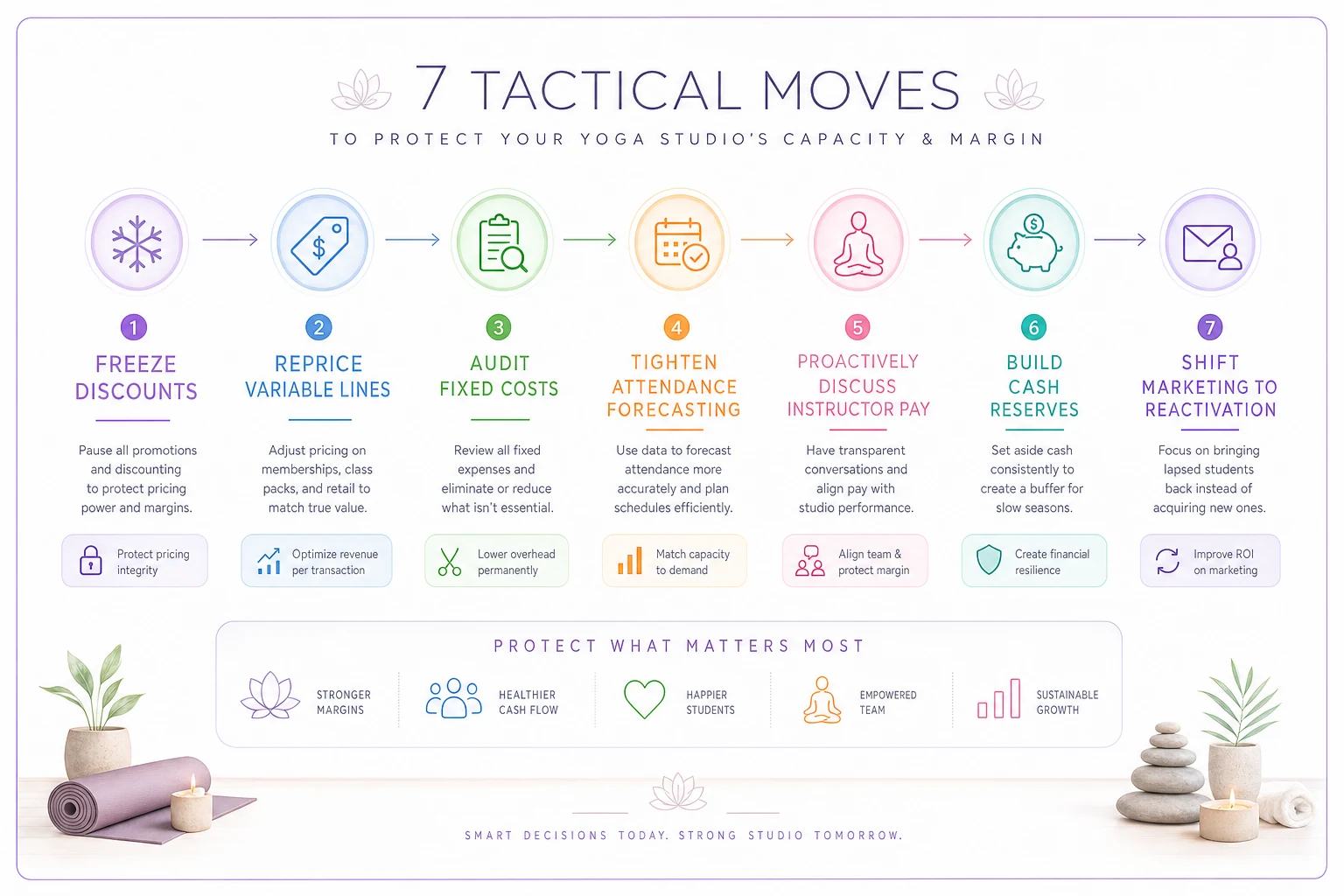
These aren't ranked by how exciting they are. They're ordered by how fast they protect cash without damaging demand.
When each of these makes sense (and when it doesn't)
Not every studio should run all seven at once. Here's the quick decision filter:
-
If your membership base is stable but revenue-per-member is falling → focus on moves 2, 3, and 7. Your problem is variable revenue erosion, not demand collapse.
-
If headcount itself is dropping → prioritize 1, 4, and 6. You're facing genuine demand softening and need to protect cash while you diagnose why.
-
If your teachers are getting recruited or grumbling about pay → move 5 jumps to the top, because losing a signature instructor during a soft patch is far costlier than the pay adjustment.
Who should NOT aggressively cut classes: studios still in a growth phase with a thin schedule. Cutting classes to protect short-term margin can stall momentum that's hard to rebuild. For those studios, moves 3 and 7 matter more than 4.
A quick real scenario
A single-location studio in a mid-size metro, doing roughly $48k/month, noticed something off in late Q3. Active members held steady around 310, but monthly revenue slipped by about $2,800 over two months. Owner's first instinct: run a sale.
Instead they ran the audit. Drop-in and workshop revenue had quietly fallen around 22% while membership held flat — classic inflation re-ranking. They did three things: left core membership prices untouched, re-tiered workshops with a members-only rate, and found about $740/month in fixed-cost creep (duplicate software, an auto-renewed insurance bump, and slow retail inventory tying up cash).
Within about six weeks, workshop attendance recovered close to prior levels because the members-only pricing made membership feel more valuable, and the recovered fixed costs offset most of the remaining gap. No discount campaign. No price increase on the core product. Roughly $2k/month back without alienating a single loyal member.
The deeper problem this exposes
Inflation didn't create the vulnerability here. It just exposed it. The studios that got hit hardest were the ones that only ever managed prices and never managed margin — they knew what they charged but not what each class, each workshop, each retail SKU actually contributed after real costs.
That gap is the real issue. When you only watch top-line revenue and active-member count, you're flying with half your instruments covered. An inflation shock just makes the blind spots painful enough to notice. The fix isn't reactive discounting or panic price hikes — it's building a standing system that watches contribution margin by line, not just revenue, so you can catch erosion while it's still small enough to correct.
If you want the full framework, it's worth reading how to protect margins, not just prices — because the studios that handle this inflation cycle well won't be the ones who reacted fastest. They'll be the ones who already had a way to see margin clearly before the headline hit.
The September numbers are a reminder, not a crisis. Audit the quiet costs, protect the variable high-margin lines, keep your teachers whole, and refill the reserve. Do that, and a soft quarter stays a soft quarter instead of turning into the thing that defines your year.
Ready to elevate your studio operations?
Join 1,500+ yoga studios using Yoglyly to save time, reduce scheduling conflicts, and enhance member experiences.