

Most studios don't have a personalization problem. They have a segmentation problem that looks like one.
You send a "we miss you" email to someone who booked a class yesterday. You pitch an unlimited membership to a student who already has one. You offer a beginner workshop to someone six months into your advanced series. Each of these is a small, embarrassing miss — and each one quietly erodes trust. Students don't complain. They just start ignoring you.
The instinct is to blame the copy or the send time. The real issue is upstream: your segments are too coarse, your data is scattered across systems that don't talk to each other, and nobody has actually defined what "re-engagement" means in behavioral terms. Add in the fact that studios collect genuinely sensitive data — health conditions on waivers, prenatal status, injury notes from instructors — and sloppy personalization stops being just ineffective. It becomes a liability.
This is a blueprint for building a studio personalization system that actually holds up: a segmentation hierarchy that makes sense, privacy-safe playbooks for the three messages that matter most, and the orchestration rules that keep the whole thing from contradicting itself.
Why studio personalization breaks differently than retail
Retail personalization is mostly about purchase history. Studios are messier because your data blends behavioral, financial, and health-adjacent information — and that last category changes the rules entirely.
Think about what sits in a typical studio's systems. Attendance frequency and class types. Membership tier and billing status. But also: the prenatal note on an intake form, the "lower back injury, avoid deep twists" flag an instructor added, the fact that someone signed up specifically for a trauma-informed series. That information is genuinely useful for personalization — and genuinely dangerous to use carelessly.
The mistake that comes up constantly: studios treat all student data as equally usable for marketing. A well-meaning owner segments by "prenatal students" to pitch a prenatal workshop, not realizing they've just used health-category data for marketing without consent. Most students won't notice. The one who does will be furious, and depending on your region, legally in the right.
So the first principle isn't a tactic. It's a line: behavioral and transactional data drives your marketing. Health-category data drives your in-studio experience, and stays there unless a student explicitly opts in. Keep those two lanes separate and most of the privacy risk disappears before you've sent a single email.
The segmentation hierarchy, built in layers
A good segmentation hierarchy is layered, not flat. Flat segmentation — one big list of tags — is how studios end up with contradictory, overlapping groups that nobody trusts. Layers let you combine attributes cleanly.
Eliminate class scheduling chaos.
Yoglyly helps you book, confirm & manage every class seamlessly.
- Centralized class scheduling
- Member notifications
- Instructor and resource management
No credit card required
Here's the structure that holds up as a studio grows: Layer 1 — Lifecycle stage. Where someone is in their journey: prospect, first-timer, activating (classes 2–5), established regular, at-risk, lapsed, winback. Everyone belongs to exactly one. Layer 2 — Value tier. What they're worth operationally: drop-in buyer, package holder, unlimited member, series/cohort enrollee. This drives what you can reasonably upsell. Layer 3 — Behavioral signals. Patterns, not identities: preferred time of day, class-type affinity (vinyasa vs. restorative vs. hot), booking lead time, cancellation rate. Layer 4 — Consent state. What you're actually allowed to do: email opt-in, SMS opt-in, health-data marketing consent (usually off), personalization consent.
| Segmentation layer | Example values | Drives | Privacy sensitivity |
|---|---|---|---|
| Lifecycle stage | first-timer, regular, at-risk, lapsed | message type | low |
| Value tier | drop-in, package, unlimited, series | upsell eligibility | low |
| Behavioral signals | evening classes, restorative affinity, high cancel rate | message relevance | low–medium |
| Consent state | email ✓, SMS ✗, health-marketing ✗ | message channel & permission | high (gatekeeper) |
When in doubt, default health-category data to excluded from marketing segments.
Notice the consent layer is the gatekeeper. It doesn't make messages better — it decides whether a message is allowed to exist. That's the layer most studios skip, and it's the one that keeps you out of trouble.
The three playbooks: welcome, re-engage, upsell
Personalization lives or dies in three moments. You don't need twenty flows. You need these three done well, each driven by segments rather than guesses.
Welcome: earn the relationship before you use the data
The welcome window is where privacy-safe personalization is easiest, because you're working almost entirely with behavioral data the student just generated by showing up.
A privacy-clean welcome flow personalizes on what the student did, not what you inferred. Someone who booked a restorative class gets a welcome that references restorative practice and what to expect. Someone who came to a hot vinyasa class gets hydration tips and a nudge toward the next intensity-appropriate class. Neither message required pulling their health form.
The common failure: studios front-load the welcome with upsells. First-timer books one class, and the next day they're hit with an unlimited membership pitch. Conversion on that is terrible because you've asked for commitment before delivering a second experience. The goal of the welcome flow is a second visit, not a sale. The mechanics of that sequencing are covered in depth in our breakdown of email and SMS sequences that convert new students into repeat attendees — the personalization layer sits on top of that same structure.
Re-engage: define "at-risk" by behavior, not by calendar
Most re-engagement flows are time-based: 30 days no booking, send email. That misfires constantly. Someone who comes twice a week going quiet for 10 days is a bigger red flag than a once-a-month student at day 25.
Better: define at-risk relative to the student's own baseline. If their normal cadence is roughly 6–8 visits a month and they've dropped to one, that's your trigger — regardless of the calendar. Behavioral, privacy-safe, and dramatically more accurate.
The re-engage message should acknowledge the pattern without being creepy about it. "Haven't seen you in your usual Tuesday evening class" works. "We noticed you stopped coming after your injury note was added" is a privacy disaster and will torch the relationship. The line again: use behavioral signals, never health-category inferences.
Upsell: gate by value tier and actual usage
Upsell is where contradictions get embarrassing. Pitching unlimited to someone already on unlimited. Pushing a 10-pack to someone who buys drop-ins but only comes twice a month — where a 10-pack is a worse deal and they know it.
-
Drop-in buyer averaging 4+ visits/month → package is genuinely better for them, so the pitch is honest.
-
Package holder consistently burning through packs → unlimited math works, pitch it.
-
Unlimited member with high attendance → don't upsell price, upsell depth: workshops, series, a teacher training track.
The honesty here isn't just ethics — it's performance. An upsell that's mathematically worse for the student converts badly and breeds distrust. Gating on actual usage means every pitch you send is one the student would recognize as a reasonable offer.
Orchestration and fallback: stopping the flows from fighting each other
Here's the failure mode nobody plans for. You build three solid flows. They run independently. A single student triggers all three in the same week — a welcome sequence, an at-risk nudge, and an upsell — because the systems don't know about each other.
Orchestration is the layer that prevents your own automations from contradicting themselves. It needs a few hard rules:
-
One primary message per student per window. Pick a frequency cap (no more than 2 marketing touches per week, for example) and enforce it across all flows, not per-flow.
-
Priority ordering. When flows collide, lifecycle wins. A re-engagement message for an at-risk student outranks an upsell. You don't pitch a package to someone who's about to churn — you try to save them first.
-
Suppression rules. Billing failure? Suppress all marketing until it's resolved. Recent complaint or refund? Suppress for a cooling-off period. These are the touches that make studios look tone-deaf.
-
Fallback defaults. If a student's segment is ambiguous or data is missing, default to the least aggressive message. Missing consent data defaults to no send. Ambiguous lifecycle stage defaults to a neutral value message, not an upsell.
That fallback principle — when in doubt, do less — is what separates studios that personalize well from studios that spam. The absence of a message is almost never the thing that loses a customer. A wrong message often is.
Why this falls apart without a single source of truth
None of this orchestration works if your booking system, your payment processor, and your CRM each hold a different version of the truth. If billing shows "payment failed" but your CRM still thinks the member is active, your suppression rule never fires — and you cheerfully upsell someone whose card just bounced.
This is the structural dependency most personalization projects ignore. Personalization sits on top of clean, synced data. If the foundation is wrong, better segmentation just helps you make mistakes faster. How to fix the underlying data layer is covered in detail in a studio single source of truth: data-ownership matrix and sync-cadence blueprint — worth getting that in order before you invest heavily in personalization flows.
When the data layer is solid, AI-assisted platforms can handle a lot of the orchestration logic automatically — routing students into the right flow, enforcing frequency caps, firing suppression rules without anyone manually checking a dashboard. That's where operational software with AI automation actually earns its keep. But it only works if the underlying data is trustworthy to begin with.
A simple visual helps make the orchestration rules clear.
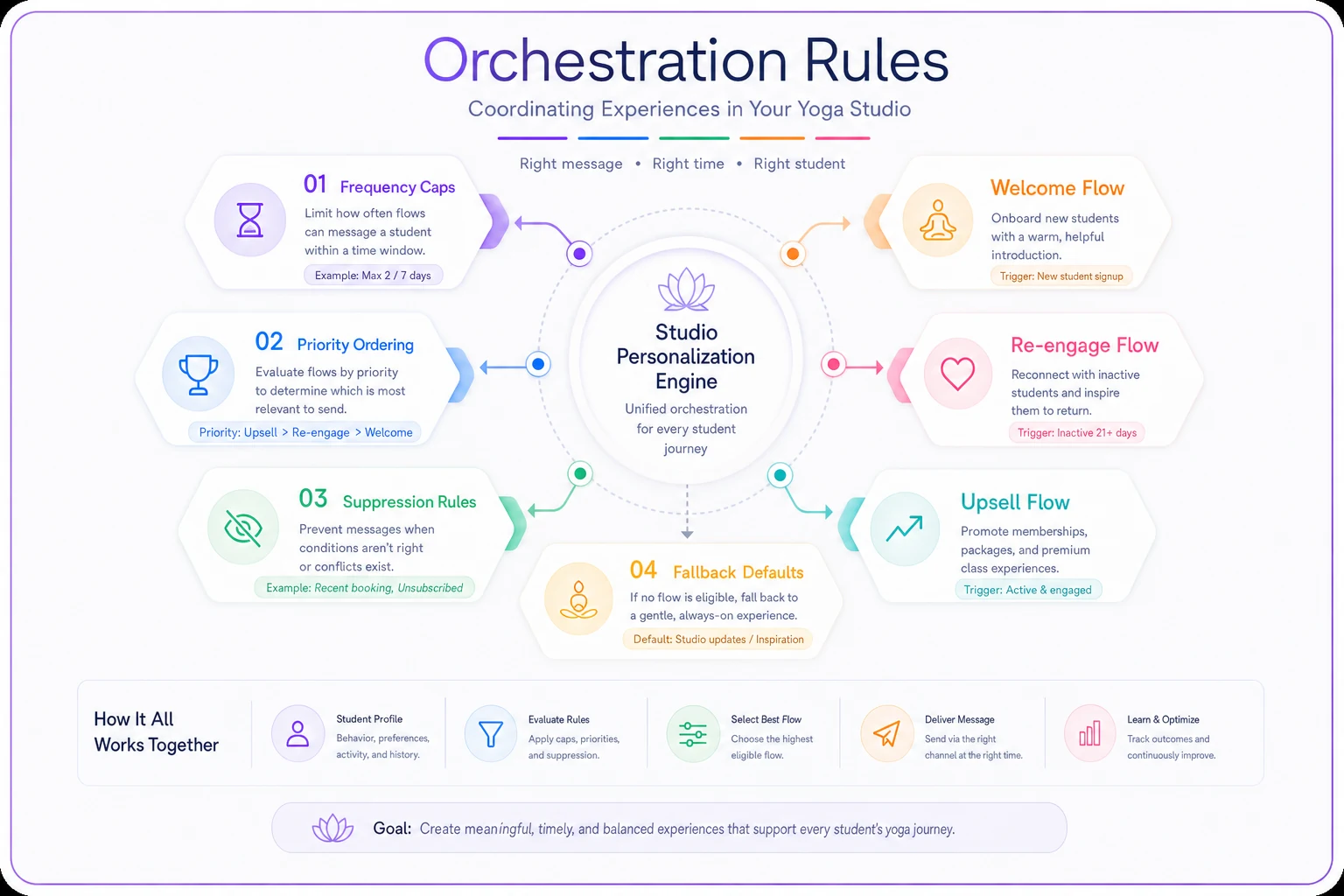
Use this to align frequency caps, priority ordering, suppression, and fallback so flows don't collide.
Measurement hooks that don't require tracking everything
You can measure personalization effectiveness without building a surveillance apparatus. Over-tracking is its own privacy risk — the more granular individual-level data you hoard, the bigger your exposure.
Measure at the segment level, not the individual level. You don't need to know that Student #4471 opened at 7:42pm. You need to know whether the "at-risk restorative regulars" segment came back at a better rate after the new flow than before.
-
Flow-level return rate. Of students who entered the re-engage flow, what share booked within 21 days? Compare against a holdout group that got nothing.
-
Upsell acceptance by tier. Which value-tier transitions actually happen, and at what rate.
-
Suppression accuracy. How often did a suppression rule correctly stop a message that would've been inappropriate. Audit a sample monthly.
-
Complaint/unsubscribe rate per flow. Your early-warning system. A flow with rising unsubscribes is mis-targeted, full stop.
Keep a holdout group — maybe 10% of each segment gets no personalized touch. It feels counterintuitive to deliberately not-market to people, but without it you can't tell whether your personalization is driving returns or whether those students would've come back anyway. Studios that skip the holdout almost always overestimate their flows' impact.
A privacy-safe setup checklist
Before you turn any of this on, walk this list:
-
Health-category data (injuries, prenatal, conditions) is flagged and excluded from all marketing segments by default.
-
Every student record has an explicit consent state for email, SMS, and personalization.
-
Segments are built from behavioral and transactional data only, unless a student opted in otherwise.
-
A global frequency cap exists across all flows — not per-flow.
-
Billing-failure and complaint suppression rules fire automatically.
-
Ambiguous or missing data defaults to the least aggressive action.
-
A holdout group is reserved for measurement.
-
Someone owns a monthly audit of what got sent and why.
If you can't check the first three, stop and fix those before building a single flow. The rest is optimization. Those three are the difference between personalization and a privacy incident.
When this makes sense — and when it doesn't
When it makes sense: You've got enough volume that manual outreach has broken down — roughly 150+ active students is where owners stop being able to hold everyone in their head. You have consistent data entry. And your core systems are synced enough that "active member" means the same thing everywhere.
When it's a bad idea — for now: If your booking, payments, and CRM data still disagree with each other, personalization will amplify the chaos. Fix the foundation first. Same goes if you haven't established consent capture — retrofitting consent onto an existing list is painful, but sending without it is worse.
Who should probably not do this yet: A new studio with 40 students and a handful of regulars. At that scale, personalization is a solved problem — it's called knowing your people's names. Honest, human outreach beats any flow until you physically can't keep up.
A real scenario
A two-location vinyasa studio with around 320 active students was running the same monthly newsletter and a generic "we miss you" email to anyone inactive for 30 days. Unsubscribe rates were creeping up, and the re-engage email was converting almost no one — partly because it kept going to people who'd booked the day before, thanks to a sync lag between their booking app and their email tool.
They rebuilt around the layered hierarchy. Re-engagement got redefined against each student's own baseline cadence rather than a flat 30-day timer. Upsells got gated on actual usage, so drop-in buyers coming 4+ times a month got package offers and nobody on unlimited got pitched a membership they already held. Health-form data got walled off from marketing entirely. A frequency cap plus billing-suppression rule stopped the embarrassing collisions.
Over the following quarter, the re-engage flow's 21-day return rate roughly doubled off a low base — not dramatic in absolute numbers, but a clear, repeatable lift confirmed against a holdout. Upsell acceptance improved once the offers actually made sense for the recipient. The unsubscribe creep flattened out, mostly because students stopped getting messages that obviously didn't apply to them.
Nothing exotic happened. They didn't add more messages — they added judgment to the ones they already sent, and built the rules to enforce that consistently.
The system view
Personalization isn't a campaign. It's a system that sits on top of your data foundation, your consent discipline, and your orchestration rules — and it fails the moment any of those three wobble.
The studios that get this right aren't the ones with the cleverest copy. They're the ones who decided, in advance, what each segment means, what each student is allowed to receive, and what happens when the flows disagree. Build the hierarchy. Wall off the sensitive data. Cap the frequency. Default to doing less when you're unsure. Measure at the segment level with a holdout so you actually know what's working. Do that consistently, and personalization stops being something you're nervous about and becomes a quiet, reliable part of how your studio keeps people coming back — without ever making a student wonder how much you really know about them.
Ready to elevate your studio operations?
Join 1,500+ yoga studios using Yoglyly to save time, reduce scheduling conflicts, and enhance member experiences.