



The Federal Reserve kept rates unchanged at 3.50%–3.75% this week, with mixed signals about what comes next. For yoga studios carrying equipment loans, lines of credit, or planning expansions, that means higher borrowing costs stick around through at least the fall.
What matters operationally is that elevated rates change the math on every cash flow decision you make — not just loan payments. Your scheduling efficiency, instructor pay structure, membership pricing, and even workshop timing all look different when capital costs more and consumer spending tightens.
Studios that protect margins during rate cycles don't just cut costs randomly. They restructure operations to match the new financial reality. Here's what shifts when rates stay higher for longer, and how to actually adjust.
The hidden cash flow squeeze most studios miss
When people think about interest rates affecting their studio, they focus on the obvious stuff. Higher loan payments on equipment financing. More expensive lines of credit. Bigger monthly hits from that expansion loan taken out two years ago.
Those direct costs are real. A studio with $150,000 in various debt might see monthly payments jump $400–600 when rates rise 2–3%. That's roughly $5,000–7,000 annually straight off the bottom line.
But the indirect effects hurt worse. Higher rates mean your members face the same squeeze. Their mortgages cost more. Their credit card balances sting harder. That discretionary income for yoga memberships shrinks.
Studios tend to report membership conversions dropping 15–20% during rate-hiking cycles. Drop-in revenue falls even faster. Workshop attendance becomes spotty. The $89 monthly unlimited that seemed reasonable last year now competes with a grocery bill that's up significantly.
Meanwhile, instructors feel the same pressure. They're asking for higher pay or more guaranteed hours. Rent probably has an escalation clause tied to inflation. Insurance premiums climb. Every cost input trends upward while revenue softens.
This is the operational squeeze — costs rising while revenue capacity shrinks. Studios that don't adjust get crushed between those two forces.
Why standard cost-cutting destroys your studio
The knee-jerk reaction is to slash expenses. Cut instructor hours. Reduce class variety. Eliminate those Friday evening sessions that only draw 8 people.
Eliminate class scheduling chaos.
Yoglyly helps you book, confirm & manage every class seamlessly.
- Centralized class scheduling
- Member notifications
- Instructor and resource management
No credit card required
This backfires almost every time.
When you cut classes, you reduce capacity for revenue. Those 8-person Friday sessions might only generate $120 directly, but three of those students probably attend because Friday works for their schedule. Cut Friday, lose those three entirely. That's $267 monthly (at $89 unlimited) gone to save $50 in instructor costs.
Reducing instructor hours creates instability. Your best teachers find steadier gigs elsewhere. Quality drops. Students notice immediately. The membership bleeding accelerates.
Pausing marketing during tough times ensures they stay tough. New student acquisition stops. Natural churn continues. Your student base shrinks month by month.
The studios that survive rate squeezes don't cut — they optimize. They restructure operations to extract more value from existing resources without gutting the experience that keeps people coming back.
Restructure your class schedule for margin protection
Your schedule probably evolved organically over years. A teacher wanted Tuesday mornings. Members requested Sunday evening yin. You added a noon class because the space sat empty anyway.
That patchwork approach bleeds money when margins tighten.
Start with utilization analysis. Pull attendance for every class over the past 90 days. Calculate revenue per class — factor in membership versus drop-in mix, not just headcount. Compare that to instructor cost including prep and breakdown time.
You'll find some surprising patterns. That popular Monday 6pm vinyasa might generate $380 in revenue but cost $95 in instructor pay — a healthy 4:1 ratio. Saturday's 2pm gentle flow brings $140 revenue against $75 instructor cost — barely 2:1. Same class type, completely different economics.
Don't just cut low-ratio classes though. Look at student overlap. How many Saturday 2pm attendees only come to that one class? If it's their sole touchpoint with your studio, cutting it loses those memberships entirely.
Instead, consolidate strategically. Can you merge Saturday 2pm gentle with Sunday 10am restorative? Test combining them for a month. Track whether students migrate or disappear.
The goal is fewer classes with higher attendance and better ratios. A 15-person class costs the same to run as an 8-person class. Those 7 extra students are pure margin.
Shift instructor compensation without losing talent
Traditional yoga studio pay structures break during margin squeezes. Flat rates per class ($50–75) mean you lose money on poorly attended sessions. Pure revenue share — say 30% of class revenue — makes instructors bear all the downside risk.
A more sustainable model combines base pay with performance incentives structured for the current rate environment.
A framework that tends to work:
Base tier: $35–40 per class (reduced from typical $50–75)
Attendance bonus: $2 per student above 10 students
Retention bonus: $20 monthly if 80% of their regular students maintain attendance
Workshop commission: 40% of workshop revenue they generate
This structure protects your downside while giving instructors a real reason to build loyal followings. The retention bonus particularly matters — it rewards teachers who create sticky students, not just packed classes that empty out after a few weeks.
An instructor teaching 12 classes monthly with average 14-student attendance and solid retention earns roughly:
-
Base
$420–480
-
Attendance bonus
$96 (4 students over threshold × $2 × 12 classes)
-
Retention bonus
$20
-
Total
$536–596
That's competitive with flat-rate pay but saves 20–30% on poorly attended classes. More importantly, it aligns instructor incentives with studio health during tight periods.
Some instructors will push back. The ones who leave typically ran low-attendance classes anyway. The ones who embrace it are usually the builders.
Convert membership revenue from volatile to predictable
Monthly memberships create predictable revenue, but most studios structure them wrong for higher-rate environments. The typical model — unlimited classes for $89–129 monthly — loses money when attendance patterns shift.
During economic uncertainty, members maximize value. That $89 unlimited holder who attended 6 times monthly suddenly shows up 12 times. Your cost per visit doubles while revenue stays flat.
Meanwhile, new sign-ups slow. People hesitate on monthly commitments when finances feel shaky.
Kill the pure unlimited model. It made sense during cheap money eras. Replace it with capped plans:
-
8 classes monthly
$79
-
12 classes monthly
$99
-
16 classes monthly
$119
This protects against usage surges while feeling more approachable for hesitant buyers. Someone unsure about committing might grab an 8-class plan — a customer you'd lose entirely with unlimited-only options.
Add pause options. Let members freeze memberships for $15 monthly instead of canceling. Studios using pause options retain roughly 40% of members who would otherwise cancel entirely.
Create commitment incentives. Offer 10% off for 6-month commitments, 15% for annual. This locks in revenue and provides upfront cash during tight periods.
Bundle strategically. Include one free guest pass monthly. Add a 10% retail discount. Throw in quarterly workshop priority booking. These cost almost nothing but increase perceived value when your pricing needs defending.
Time your cash flows around the Fed calendar
Interest rates staying elevated changes your cash flow timing dynamics. When money costs more to borrow, when you receive revenue matters almost as much as how much you receive.
Most studios operate on calendar-month membership billing. Everyone renews on the 1st. This creates a massive cash influx early in the month, then nothing for 30 days. Fine when credit lines are cheap. Problematic when they're expensive.
A proper financial calendar spreads revenue throughout the month, but rate environments demand even tighter optimization.
Start staggering membership dates. New members join on their actual sign-up date rather than the 1st. This smooths cash flow naturally over time. A studio with 200 members might eventually see revenue coming in daily instead of in monthly chunks.
Workshop and series timing becomes critical too. Instead of running all workshops at month-end when cash is tight, schedule them mid-month. This bridges the gap between membership billing waves.
Payment terms matter more than most people realize. That corporate wellness contract paying net-30? Negotiate to net-15 or offer a 2% discount for immediate payment. When your line of credit costs 8%, getting paid 15 days earlier saves real money.
Stagger membership billing dates to smooth cash flow throughout the month.
Even small timing shifts compound. Moving teacher payments from bi-weekly to monthly — with their agreement — keeps an extra $3,000–4,000 in working capital at any given time. Switching vendor payments to credit cards paid monthly versus checks adds 20–30 days of float.
Protect margins through scheduling consolidation
The biggest margin protection opportunity isn't cutting costs or raising prices — it's consolidating operations to increase efficiency. Most studios run at 40–50% capacity on any given day. Getting that number up doubles margins without adding costs.
Look at your evening schedule. You probably have 5:30pm, 6:45pm, and 8pm classes. Three instructors, three energy cycles, three opportunities for no-shows.
Test consolidating to two slots: 5:45pm and 7:30pm. Slightly awkward times, but they capture both after-work crowds. Two instructors instead of three. Members choose one or the other, which tends to reduce no-shows too.
This isn't about cramming more people into fewer classes. It's about creating better energy with sustainable economics. A 20-person class feels vibrant. Two 10-person classes feel sparse. Same revenue, completely different experience.
Apply this thinking everywhere:
-
Weekend workshop series running Saturday and Sunday — test Saturday-only with longer sessions.
-
Morning classes at 6am, 7
15am, and 9am — try 6:30am and 8:30am instead.
-
Midday classes spread across three slots — collapse into two with slightly adjusted times.
Every consolidated slot saves $50–75 in instructor costs. Do this across 10 weekly slots and that's $2,000–3,000 monthly in margin protection with no revenue loss.
The key is tracking attendance before and after each consolidation. Some combinations work. Some scatter students who had strong preferences. Test for 30 days before making anything permanent.
Build interest rate hedges into your operations
Revenue diversification provides the first hedge. Studios dependent purely on monthly memberships suffer when consumer spending tightens. Corporate wellness contracts, insurance billing, and workshop revenue respond differently to rate changes — they don't all move in the same direction at once.
A reasonable revenue mix to aim for:
| Revenue Source | Target Mix |
|---|---|
| Monthly memberships | 60% |
| Corporate / insurance contracts | 20% |
| Workshops and series | 15% |
| Retail and other | 5% |
Corporate contracts often hold up during uncertainty — companies boost employee benefits to retain talent when the labor market is tight. That's worth pursuing aggressively right now.
Flexible cost structures create another hedge. Instead of fixed rent, negotiate percentage rent with a base. When revenue drops, rent adjusts somewhat. The performance instructor pay model described earlier does the same thing naturally.
Maintain multiple credit facilities rather than relying on a single source. A business line of credit, equipment financing, and credit cards give you options. When one becomes expensive, you can shift to another.
Pre-funding major expenses helps too. That October workshop series? Collect payment in August. December instructor bonuses? Set aside money monthly starting in July. This reduces emergency borrowing needs when rates spike unexpectedly.
Workshop economics that work when capital costs more
Workshops traditionally supplement studio income, but in high-rate environments they become critical cash flow tools. The key is structuring them for immediate return rather than long-term brand building.
Forget prestigious guest teachers requiring guarantees. A $2,000 guarantee for a weekend workshop needs 40 students at $50 just to break even. In uncertain economies, that's a lot of risk to carry.
Run high-margin workshops with existing instructors instead. Your teachers know your students. No travel costs, hotels, or guarantees. Pay them 40–50% of revenue instead of flat fees.
Topics that tend to sell during uncertainty include stress and anxiety management, restorative practice for sleep, gentle yoga for desk workers, and practical meditation (not deep spiritual dives). People spend on things that feel useful and immediate when budgets are tight.
Price for accessible commitment. Instead of $200 weekend intensives, offer $45 Sunday afternoon sessions. Lower barrier, higher conversion, immediate cash.
Pre-sell aggressively. Don't announce a workshop and hope people register. Get 10 committed attendees before scheduling. This guarantees minimum viable revenue and creates social proof for others sitting on the fence.
Track return per marketing dollar carefully. A Facebook ad campaign costing $200 needs to generate $600+ in workshop revenue to be worth running. When money costs more, every marketing dollar needs an immediate return.
The software infrastructure for margin protection
Managing all these shifts manually will eat your margins through administrative burden alone. Tracking utilization across 30+ weekly classes, calculating instructor performance bonuses, managing staggered memberships with different billing dates — it gets overwhelming fast without proper systems.
This is where AI-powered operational software earns its keep. Not anything exotic, just practical automation handling repetitive tasks while you focus on strategy.
Below is a simple workflow showing how data and automation support margin protection.
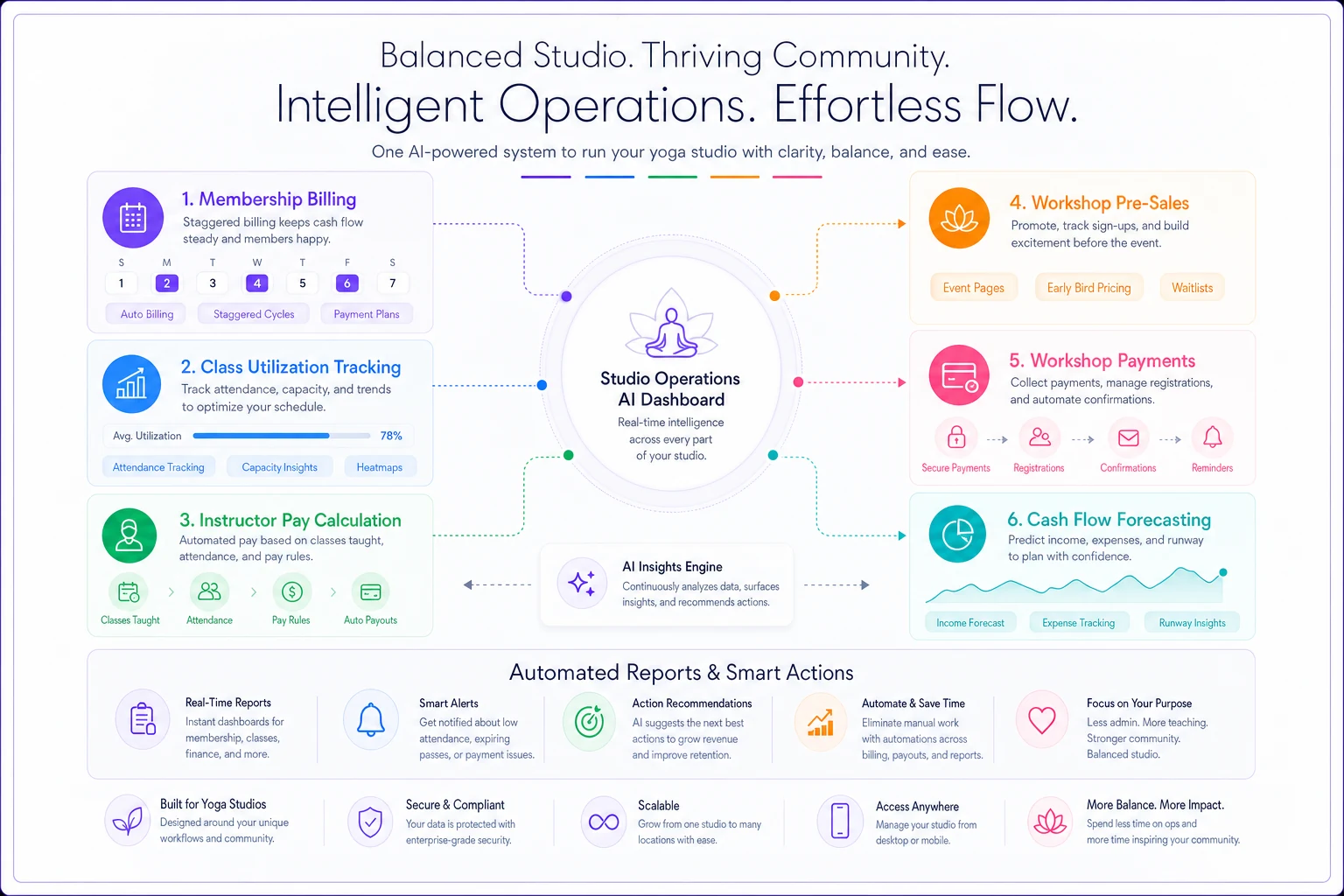
A properly configured platform handles automated utilization reporting showing revenue-per-class trends, instructor pay calculations including performance bonuses, membership billing on staggered dates, workshop pre-registration and payment processing, and cash flow forecasting based on scheduled revenue. These aren't glamorous features, but they're the ones that keep margin-protection strategies from falling apart in execution.
The automation alone can eliminate 10–15 hours of weekly administrative work. That time gets redirected toward member retention, instructor development, and actual strategic thinking.
More importantly, it reduces expensive mistakes. Calculating instructor bonuses incorrectly. Missing membership renewals. Forgetting to collect workshop payments before the event. These errors compound fast when margins are already thin.
The AI components help with pattern recognition — which class combinations maximize attendance, when members typically pause or cancel, what workshop topics generate the best margins. It surfaces insights from your own historical data that you'd realistically miss when you're busy running a studio day to day.
Don't over-engineer it though. You need practical tools that reduce operational friction, not complex systems that create new things to manage.
Scenario: How one studio restructured for rate reality
A 1,800-square-foot studio in a suburban strip mall, four years in operation, carrying $85,000 in equipment financing at variable rates plus a $30,000 line of credit.
When rates started climbing, monthly debt service jumped from $1,100 to $1,475. Not devastating on its own, but membership conversions dropped about 20% at the same time. Monthly revenue fell from around $22,000 to $19,000 while costs moved in the opposite direction.
-
Schedule consolidation
Reduced from 42 weekly classes to 31 by combining low-attendance sessions. Average class size increased from 11 to 16. Instructor costs dropped $2,400 monthly while revenue held steady.
-
Instructor pay restructuring
Shifted to the performance model. Three instructors left; the remaining seven improved class quality and built stronger student relationships. Net savings: around $800 monthly.
-
Membership overhaul
Killed unlimited plans and replaced with capped tiers. Revenue actually ticked up slightly — sporadic members moved to 8-class plans, and new sign-ups increased with the lower entry price point.
-
Workshop frequency doubled
Stopped using guest teachers with guarantees. Monthly workshop revenue grew from $1,200 to $2,100 using existing instructors and practical topics. Pre-selling ensured profitability before committing to any session.
-
Retention improvements
Implemented membership pausing and commitment discounts. Retention improved from 82% to 87%. Annual commitments provided $8,000 upfront cash, eliminating credit line usage entirely.
Results after four months:
| Metric | Before | After |
|---|---|---|
| Monthly revenue | ~$19,000 | ~$21,000 |
| Monthly costs | ~$19,000 | ~$17,500 |
| Net margin | ~$3,000 | ~$3,500 |
| Credit line balance | $30,000 | $0 |
| Cash reserves | None | Building |
Not dramatic changes individually. Just systematic optimization aligned with rate reality, stacked on top of each other.
Moving forward: build flexibility, not predictions
The Fed's mixed signals mean rates could realistically move in either direction. Maybe they cut if the economy weakens. Maybe they hike if inflation resurges. Trying to predict it is mostly a waste of energy.
Build operational flexibility instead. Performance-based pay, capped memberships, consolidated scheduling — these structures work regardless of rate direction. They improve margins when rates are high and position you for growth when rates eventually fall.
The studios that struggle aren't victims of interest rates. They're victims of inflexible operations that can't adapt when conditions shift.
Start with one change. Maybe instructor pay restructuring, maybe membership caps. Test it for a month. Measure results. Adjust and keep moving.
The margin protection you build now becomes a competitive advantage later. When rates eventually fall and competitors rush to expand, you'll have the operational efficiency and cash reserves to grow on your own terms.
Ready to elevate your studio operations?
Join 1,500+ yoga studios using Yoglyly to save time, reduce scheduling conflicts, and enhance member experiences.