

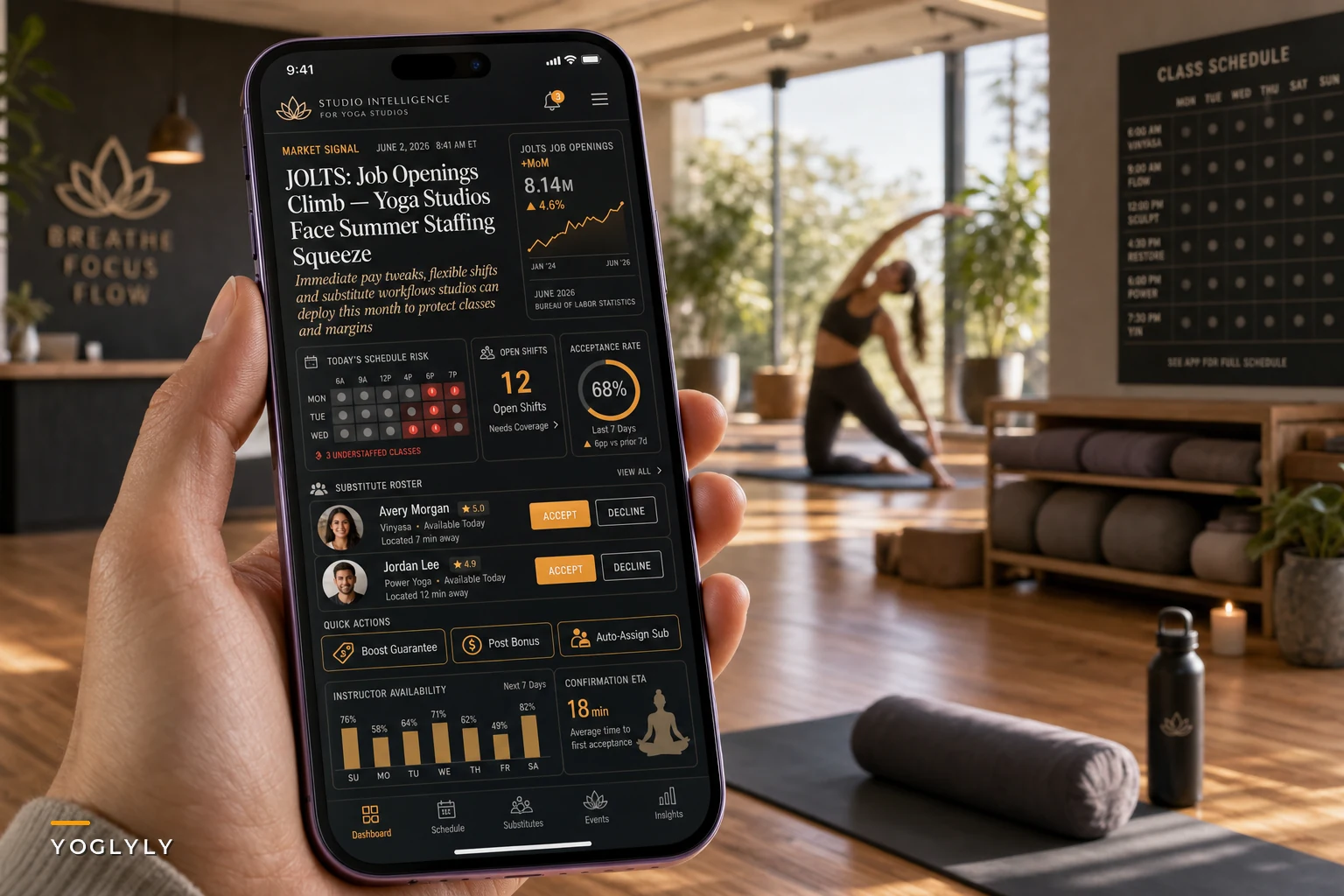

The latest JOLTS data from the Bureau of Labor Statistics landed last week with 7.6 million job openings and hiring still soft. For yoga studios, that number isn't abstract—it means your already thin summer coverage plan is probably closer to breaking than you think.
Three studios in my neighborhood posted the same "seeking substitute teachers" message on Instagram this week. Same guaranteed minimum pay ($75), same desperate tone, zero responses after 72 hours. The labor market isn't just tight; it's forcing studios to completely rethink how they staff classes during the traditionally chaotic summer months.
The real problem isn't finding teachers. It's that most yoga studio staffing strategies were built around a steady pool of available instructors willing to take whatever schedule you offered. That assumption fell apart somewhere around 2022, and studios still operating like it's 2019 are hemorrhaging money on canceled classes and emergency coverage.
Why standard coverage models collapse when every business wants flexible workers
Most studios run some version of the same setup: core teachers get priority scheduling, part-timers fill gaps, and a roster of substitutes handles emergencies. Sounds reasonable until you realize every service business within five miles is fishing from the same talent pool.
Your substitute list probably looks like this right now—eight names, three actually respond to texts, one is always available but students complain about their energy, and the other two only sub for specific teachers they like. Meanwhile, that reliable Saturday morning teacher just picked up shifts at the new boutique fitness place paying $85 per class plus commission on merchandise sales.
Scheduling pressure compounds because summer attendance swings wildly. Memorial Day weekend might see 40% drops while the following Tuesday hits capacity because everyone's back from vacation. Studios end up either overpaying teachers for empty classes or scrambling to add sections when demand spikes.
Raising class prices or cutting teacher pay destroys the community feel that keeps students coming back. Doing nothing means operating at a loss through August while your best teachers drift toward better opportunities.
Breaking down the real cost of last-minute coverage
A studio owner showed me their June numbers last week. They paid $420 in emergency coverage premiums—the extra $25–35 per class needed to get someone to drive over with two hours' notice. Add the admin time spent texting around (roughly 45 minutes per incident, three incidents that month), and they're looking at nearly $500 in hidden costs just from poor coverage planning.
Eliminate class scheduling chaos.
Yoglyly helps you book, confirm & manage every class seamlessly.
- Centralized class scheduling
- Member notifications
- Instructor and resource management
No credit card required
Direct costs:
-
Premium pay differential
$25–35 extra per covered class
-
Lost revenue from canceled classes
$180–350 per cancellation
-
Platform fees for last-minute booking apps
15–20% of teacher payment
Hidden costs:
-
Owner teaching unpaid classes
4–6 hours monthly
-
Student refunds or credits for canceled classes
$200–400 monthly
-
Administrative scramble time
8–12 hours monthly
-
Reputation damage from inconsistent schedules
unmeasurable but real
Studios running fewer than 15 classes weekly feel this most acutely. They can't spread coverage costs across enough revenue-generating sessions, and one sick teacher on a Saturday morning might wipe out the entire weekend's profit.
Three coverage strategies that actually work in tight labor markets
Strategy 1: The teaching collective model
Instead of hiring teachers as contractors for specific slots, create a collective where 4–5 instructors share responsibility for a block of classes. They sort out coverage internally and split a guaranteed monthly amount based on classes taught.
One studio in Denver implemented this for their evening classes. Five teachers share Monday through Thursday 6pm and 7:30pm slots, guaranteeing $3,200 monthly to the group. The teachers coordinate through a shared calendar, coverage became their problem to solve, and class consistency improved. Student complaints dropped. The owner stopped fielding panicked 5pm texts.
The key: pick teachers who already know and respect each other. This falls apart fast if you force incompatible teaching styles into the same collective.
Strategy 2: Graduated pay scales with commitment bonuses
Rather than flat rates, create a structure that rewards reliability over flexibility. Base rate stays at market ($50–60), but teachers who commit to specific slots for three months get an extra $15 per class. Miss a committed class without finding coverage yourself? Lose the bonus for that month.
A studio running 22 weekly classes switched to this model in March. Their coverage scrambles dropped from 8–10 monthly to 2–3. The extra $1,500 monthly in commitment bonuses hurt initially, but they saved roughly $900 in emergency coverage and gained back about 12 hours of admin time.
Strategy 3: Student teacher pipeline programs
The sustainable fix involves growing your own coverage network. Offer discounted or free teacher training to committed students in exchange for teaching commitments—not the watered-down "community class" model where nervous newbies fumble through sequences, but structured mentorship with experienced teachers.
Program structure that works:
-
8-week intensive training (not a full 200-hour certification)
-
Shadow teaching for 4 weeks with regular feedback sessions
-
Guaranteed 2 classes weekly for 6 months at 70% of standard rate
-
Escalating pay as experience builds
-
First refusal rights on permanent slots when they open up
Two students complete the program, and you've essentially created $8,000–10,000 worth of teaching coverage for the cost of training time.
Using flex scheduling without destroying class consistency
Students hate schedule chaos more than most studio owners realize. That 9am Tuesday vinyasa class has regulars who've been coming for three years. Rotate the teacher every other week and watch your retention metrics crater.
The solution isn't rigid scheduling—it's strategic flexibility. Core classes (your money makers with 15+ regular attendees) need rock-solid consistency. Experimental slots can rotate teachers or styles without damaging the studio's reputation.
Map your classes into three categories:
-
Anchors (protect at all costs) - Established time slots with 15+ regulars - Same teacher for minimum 3 months - Premium pay if needed to maintain consistency
-
Flexibles (room to experiment) - Newer time slots still building attendance - Rotating teachers acceptable - Testing ground for new instructors
-
Seasonals (summer/holiday adapted) - Pop-up classes based on teacher availability - Marketed as special or limited series - No expectation of permanence
Label anchor classes clearly in your scheduling software so substitutes and managers know which slots should not rotate.
This framework lets you maintain stability where it matters while staying nimble enough to work with whatever availability you've got.
Why the "anyone can teach" mentality costs more than premium instructors
Every studio owner has made this mistake: hiring enthusiastic but inexperienced teachers because they're available and cheap. Six months later, you're dealing with student complaints, dropping attendance, and ultimately paying more to rebuild the class with someone competent.
Quality gaps compound fast. A weak 6am teacher drives regulars to find another studio, making the slot unprofitable, which forces you to cut it entirely—and lose that time slot to a competitor. Inconsistent beginner classes mean new students don't convert, so marketing costs spike trying to refill the funnel. One injured student from poor instruction can trigger a liability claim that bumps your insurance premiums 20–30%.
The math works out roughly like this: paying a skilled teacher $75 per class beats paying someone mediocre $45 once you factor in retention, word-of-mouth, and avoided problems. The challenge is finding those skilled teachers when everyone's competing for the same talent.
Setting up coverage pools that don't rely on individual availability
The single-point-of-failure problem kills studios every summer. Your Tuesday evening teacher goes on vacation, their usual sub is already booked, and suddenly you're teaching the class yourself or canceling it entirely.
Coverage pools distribute this risk. For studios running 20–30 weekly classes, a three-tier structure tends to work well:
-
Primary pool — 3–4 teachers who can cover any class style, available for at least 2 shifts per month
-
Specialist pool — 2–3 teachers for specific styles like prenatal or hot yoga, used as needed
-
Emergency pool — studio owners plus 1–2 senior teachers, last resort only
Each tier carries different compensation and expectations:
| Tier | Availability Required | Pay Structure | Typical Use |
|---|---|---|---|
| Primary | 2 shifts/month minimum | Regular rate + $10 | 60–70% of coverage needs |
| Specialist | As needed | Regular rate + $20 | 20–25% of coverage needs |
| Emergency | Last resort | Regular rate + $35 or owner teaches free | 5–10% of coverage needs |
The critical detail: primary pool teachers must accept assigned coverage slots, not cherry-pick convenient times. In exchange, they get first consideration for permanent slots when they open up.
Building retention systems that reduce turnover pressure
The best staffing strategies focus on keeping teachers rather than constantly replacing them. Turnover creates compounding problems—students leave when favorite teachers disappear, remaining teachers get burned out covering extra classes, and you're perpetually training new instructors who might leave in six months anyway.
Retention starts with understanding why yoga teachers actually leave. It's rarely just money. The pattern tends to look like this: months one through three, they're excited about teaching and building their class. By month four or five, reality hits—inconsistent attendance, low pay, no clear growth path. By month seven or eight, they're looking elsewhere or picking up additional work. By month ten or twelve, they've given notice or just started quietly reducing availability.
Breaking this cycle means addressing that middle phase before momentum stalls.
Professional development beyond poses:
-
Business skills workshops (social media, student retention)
-
Subsidized continuing education
-
Mentorship from senior teachers
-
Performance feedback that actually helps them improve
Community building among teachers:
-
Monthly teacher practice (paid)
-
Shared planning sessions for themed classes
-
Coverage partnerships where teachers pair up for mutual support
Transparent growth paths:
-
Clear criteria for moving to better time slots
-
Attendance benchmarks that trigger pay increases
-
Opportunity to lead workshops or trainings
One studio cut teacher turnover from roughly 40% annually to around 15% by implementing monthly teacher development sessions. The $300 monthly investment saved them roughly $8,000 yearly in recruitment and training costs.
When to adjust compensation vs when to restructure schedules
Not every staffing problem needs a pay increase. Sometimes the schedule itself is the problem. Studios often default to raising pay when teachers complain, but that's treating symptoms without diagnosing anything.
Schedule problems that look like pay problems include teachers driving 25 minutes for a single class, back-to-back classes with very different intensity levels, prime slots locked to underperforming teachers for historical reasons, and weekend-only teachers getting scattered fragments instead of clustered blocks worth showing up for.
Before touching compensation, audit whether your schedule actually makes operational sense. Can teachers reasonably teach multiple classes per visit? Are you asking someone to teach gentle yoga immediately after power vinyasa?
A useful diagnostic: ask departing teachers whether they'd stay for 20% more pay. If they hesitate or say no, you have a scheduling or culture problem, not a compensation problem. Fix the root cause before throwing money at symptoms.
Smart tech fixes that eliminate schedule chaos
The average studio owner spends 8–12 hours monthly on scheduling tasks—texting for coverage, updating multiple calendars, confirming availability, handling student notifications about changes. That's basically three classes worth of time that could generate revenue instead of solving preventable problems.
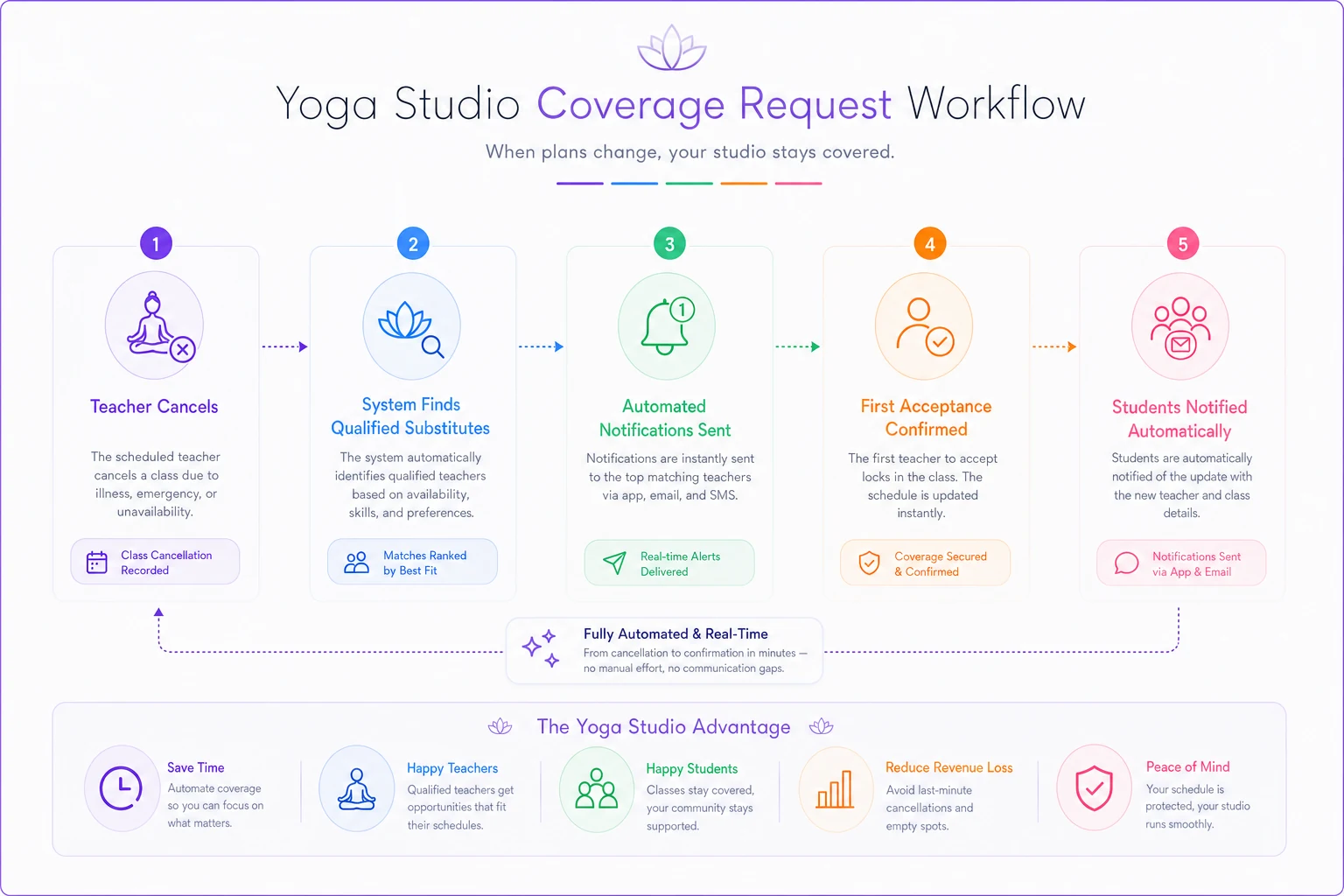
Modern operational platforms handle this differently. Instead of manual text chains when someone calls in sick, automated systems immediately notify qualified substitutes based on availability, teaching style, and proximity. First to accept gets the slot, students get updated automatically, and the owner never touched a phone.
Here's a simplified workflow for automated coverage requests.
The deeper value comes from pattern recognition over time. These platforms track which teachers frequently need coverage, which substitutes actually show up, and when attendance drops due to instructor changes. A system monitoring patterns across dozens of studios might flag that Tuesday evening classes have 30% higher cancellation rates in July and suggest preventive scheduling adjustments before it becomes an emergency.
For compensation management, AI-powered platforms can handle complex pay structures—base rates, attendance bonuses, workshop percentages—without the spreadsheet nightmare that eats up Sunday afternoons. They'll flag when a teacher's per-student rate drops below a sustainable threshold or when a small price adjustment would cover your entire coverage pool cost.
The key is choosing platforms built specifically for yoga studios, not generic scheduling software that treats all appointments the same. Managing teacher certifications, tracking style competencies, handling memberships versus drop-in students—these details matter, and most generic tools get them wrong.
Making summer scheduling work without burning margin or teachers
Summer staffing can't be solved with the same strategies that work in January. Student patterns shift, teacher availability fragments, and competition for qualified instructors intensifies across every service business in your area. Studios pretending otherwise are the ones posting desperate Instagram pleas for emergency coverage every other week.
The sustainable approach treats summer as a different operational season requiring different systems. That might mean running fewer but fuller classes, creating summer series that work with limited teacher availability, or temporarily shifting to the collective model for high-variance time slots.
Stop treating coverage as an emergency and start treating it as an operational function that needs proper systems, budget allocation, and planning. The studios holding up despite the tight labor market aren't lucky—they've adapted their operations to match reality rather than hoping things return to 2019 normal.
Want to explore compensation structures further? Check out our deep dive on fair teacher pay models that protect your margins while keeping quality instructors.
The JOLTS data tells us this labor situation isn't resolving soon. Studios that adapt their staffing strategies now will survive the summer scramble. Those waiting for the perfect teacher to magically appear will spend August teaching every class themselves or watching their community fragment as slots get canceled. When you put it that way, the choice isn't actually that complicated.
Ready to elevate your studio operations?
Join 1,500+ yoga studios using Yoglyly to save time, reduce scheduling conflicts, and enhance member experiences.