


Most studios don't have an engagement problem. They have a coordination problem that looks like an engagement problem.
The symptoms are familiar. A new student comes to their first class, has a great time, and then vanishes. Someone gets an automated "we miss you" email while they're actually sitting in the waiting room for the 9am flow. A loyal member who's been coming twice a week for two years gets the exact same welcome discount you send to strangers. The instructor who knows Priya's shoulder injury has no way to pass that along, so the next teacher walks in blind.
None of these are marketing failures. They're orchestration failures — the studio has good intentions scattered across a booking tool, an email platform, a spreadsheet, and three people's memories, with nothing tying them together. That's what studio engagement orchestration actually is: the connective layer that decides who gets what touch, when, from whom, and how you know it worked.
This post is about building that layer. Not another sequence, not another promo calendar — the operating system underneath all of it.
Why engagement breaks the moment you have more than one instructor
At a solo-teacher studio, orchestration happens by accident. You know everyone. You remember who's on a 10-class pack and who's about to run out. You notice when a regular disappears. Your brain is the operating system.
The problem is that brain doesn't scale, and it doesn't hand off. The second you add a second location, a front desk person, or a roster of five subs, the informal system collapses in ways that are surprisingly predictable:
-
Two people email the same lapsed student, or nobody does
-
The "high-touch" members — your referrers, your workshop regulars — get treated identically to walk-ins because nobody flagged them
-
A student's journey resets every time they interact with a different staff member
-
You have no shared definition of what "engaged" even means, so everyone acts on a different gut read
The failure isn't lack of effort — it's duplicated and contradictory effort. Three well-meaning touches that undercut each other are worse than one good one.
The fix isn't more communication. It's deciding, once, how the whole lifecycle should flow — and then making sure every person and every tool follows the same map.
Start with journey maps that reflect how people actually move
Before you automate anything, you need to draw the actual paths students take. Not the idealized funnel — the real branches.
Eliminate class scheduling chaos.
Yoglyly helps you book, confirm & manage every class seamlessly.
- Centralized class scheduling
- Member notifications
- Instructor and resource management
No credit card required
A useful studio journey map isn't a straight line from "new" to "loyal." It has forks. Someone who comes to an intro offer and books a second class on their own is on a completely different path than someone who used the intro and went quiet. Treating them the same is where most engagement money gets wasted.
Here's a stripped-down version of the stages worth mapping, and the decision point that matters at each one:
| Stage | The real question | What most studios get wrong |
|---|---|---|
| First visit | Did they rebook within 7 days? | They celebrate the visit, not the second booking |
| Early active | Are they hitting 2+ visits/week? | They stop paying attention once someone "seems fine" |
| At-risk | Has cadence dropped vs. their own baseline? | They wait for the pack to expire before noticing |
| Lapsed | Why did they stop — price, schedule, injury, life? | They send one generic win-back and give up |
| Loyal / advocate | Are we asking them to refer or lead? | They over-message this group and burn goodwill |
The most valuable trigger isn't a fixed date — it's a deviation from that person's own pattern. A student who normally comes Monday/Thursday and misses two weeks is a stronger reactivation signal than someone whose pack simply expired on schedule. Absolute rules like "email at day 30" miss this completely.
Here's a quick visual of the journey-mapping workflow.
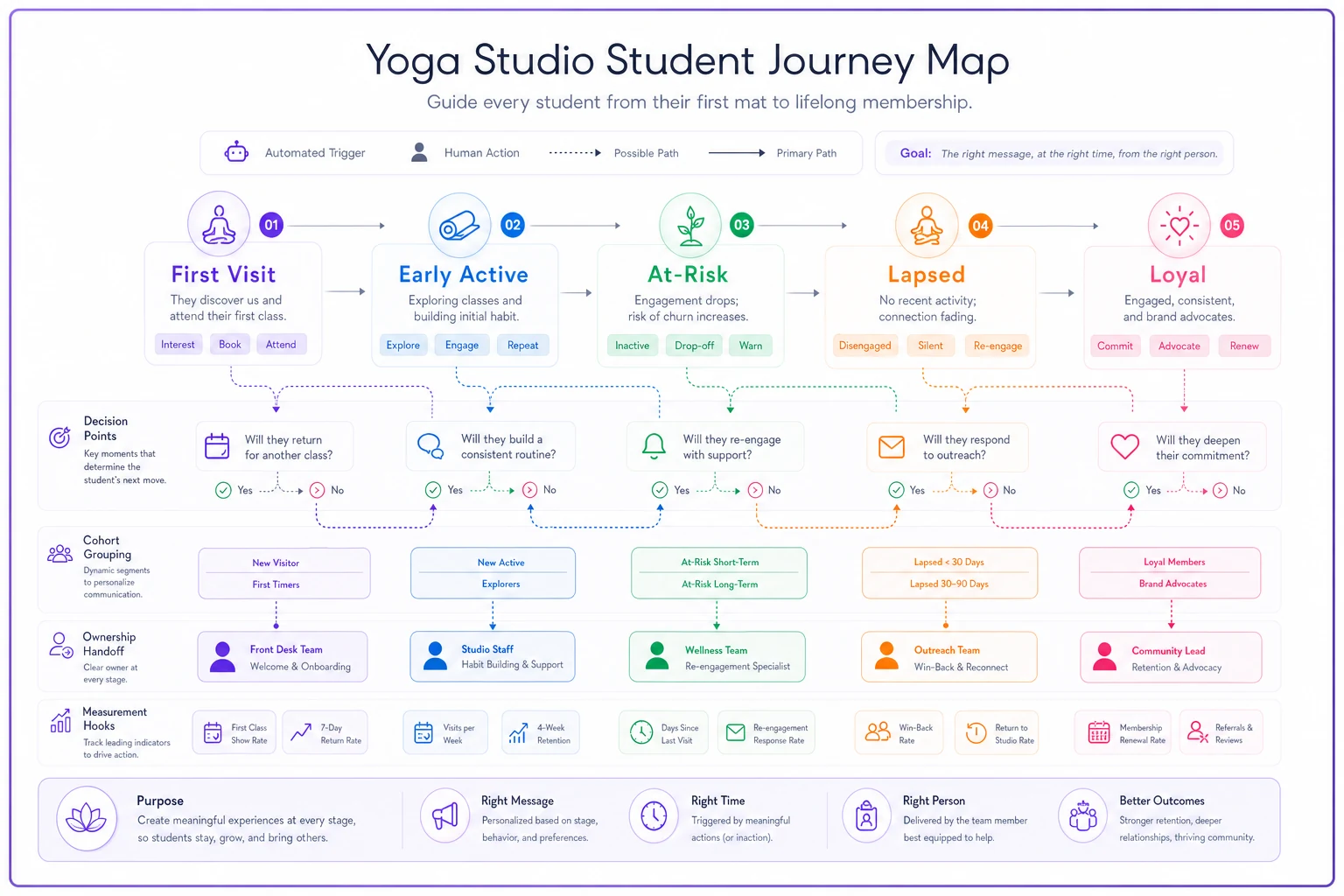
If you haven't defined these stages with real numbers yet, that groundwork matters more than any tool. Our breakdown of what a yoga studio customer lifecycle model should measure is a good place to nail down the definitions before you start orchestrating touches on top of them.
Cohorts, not individuals — and definitely not "everyone"
Once you have journey stages, the next layer is grouping. Studios tend to swing between two bad extremes: blast the whole list, or try to hand-craft messages person by person until they burn out and stop entirely.
Cohort orchestration sits in the middle. You group students by where they are in the journey plus a meaningful attribute, and you run patterns against the group.
-
New-in-14-days who've only attended one class — highest-leverage group in the whole studio, and almost always under-served
-
Consistent 2x/week members approaching pack expiry — retention money, not acquisition money
-
Cadence-droppers attending less than their own 30-day baseline — catch them before they lapse
-
Seasonal fade-outs — people whose attendance historically dips in summer or December, worth a pre-emptive touch
-
Workshop-only attendees who never converted to memberships — a conversion cohort hiding in plain sight
The mistake that shows up constantly: studios build cohorts once and never let them update. A student should move out of "at-risk" automatically the moment they rebook, and any scheduled win-back touch should cancel itself. If your at-risk email still fires after someone's already come back, you look asleep at the wheel — and you've trained that student to ignore you.
Ownership rules: who owns the touch, and who owns the outcome
This is the part almost nobody writes down, and it's where multi-person studios quietly bleed.
Every touch in your system needs two owners:
-
The trigger owner — the person or automation responsible for the touch firing at all
-
The outcome owner — the human accountable for what happens next
These are often different, and that's fine. An automated system can send the "haven't seen you in a while" message. But when a valued member replies "I hurt my back, taking a break," a human needs to own that reply — log the reason, adjust their status, maybe follow up personally in three weeks. If nobody owns the outcome, the automation just becomes noise the student learns to tune out.
A simple ownership model that works for a growing studio:
-
Automation owns
routine, high-volume, time-based nudges — rebooking reminders, pack-expiry heads-ups, first-visit follow-ups
-
Front desk owns
same-day recovery (no-shows, first-timer check-ins, injury notes) and routing replies to the right person
-
Owner/manager owns
the top cohort — advocates, big spenders, at-risk long-term members — where a personal note beats any sequence
-
Instructors own
in-room observations that feed the system (who's struggling, who's ready for a harder class, who mentioned they're moving)
Ask instructors to use a single 'needs follow-up' tag so front desk can act quickly.
The pattern that breaks studios: treating instructors as the outcome owners for retention. They're teaching. They can feed the system with observations, but they can't be tracking who lapsed on the side. Put that responsibility on instructors and it just doesn't happen — not because they're careless, but because it's not their job to hold in their head.
The automation + human-touch pattern (getting the ratio right)
The whole art of studio engagement orchestration is deciding what gets automated and what stays human — and being honest that most studios get this ratio backwards.
They automate the emotional, high-value moments (the reactivation of a two-year member becomes a templated blast) and manually handle the routine stuff (someone hand-types rebooking reminders). Flip it.
Automate the predictable, protect the personal.
A working split looks roughly like this:
-
Fully automated
first-visit thank-you + rebooking nudge, pack-expiry reminders, class-cadence check-ins, review requests after a good streak
-
Automated trigger, human message
at-risk alerts that surface to a person who then decides how to reach out
-
Fully human
advocate outreach, life-event situations, high-value member recovery, anything involving an injury or complaint
The reason this matters isn't just tone — it's capacity. When you automate the 80% that's routine, your team actually has time to be human where it counts. Studios that try to do everything by hand end up doing the personal stuff badly because they're drowning in the routine. Studios that automate everything feel like a spam machine. The blend is the point.
If you're still working out the wording for the automated layer, the sequencing work in our guide on email and SMS sequences that convert new students into repeat attendees pairs directly with the cohort structure here — think of the sequences as the content and this system as the routing.
Measurement hooks: tie every touch back to activation → retention → LTV
Most studios can't tell you whether a single one of their engagement touches actually works. They send emails. Open rates look fine. And nobody has ever connected a specific touch to a student staying an extra four months.
The system only becomes trustworthy when every touch has a measurement hook — a way to see if it moved someone forward in the journey.
-
Activation hook — did the touch get the second and third visit? For a first-timer, forget lifetime value. The only question is whether they came back within their first two weeks. Measure rebook rate per intro cohort.
-
Retention hook — did the touch hold cadence? For active members, track whether a cohort's average weekly visits stay flat or decline over 60–90 days after your touches vs. a group that didn't get them.
-
LTV hook — did the touch extend the relationship? This is the slow one. You're measuring average months-active and total revenue per student, by cohort, over a year-plus.
The connection people miss: activation quality basically determines LTV, but you won't see it in the same quarter. A studio that lifts second-visit rate from around 40% to the low 50s won't feel it for months — then suddenly retention numbers climb because a bigger share of the pipeline actually stuck. If you only measure the last step, you'll never know which early touch caused the improvement.
One practical rule: hold out a small control group. Don't send everyone the at-risk sequence. Leave 10–15% untouched so you can actually see whether the sequence beats doing nothing. It feels counterintuitive to skip students on purpose, but without it you'll keep running touches that do nothing and never find out.
How this plays out in a real studio
A two-location studio, roughly 380 active members between both sites, four core instructors and a rotating cast of subs. Their engagement was entirely reactive — the owner personally noticed when regulars disappeared, but only sometimes, and only at her home location. The second site was basically flying blind.
The specific breakdown: intro-offer students were converting to memberships somewhere around 35%, and a chunk of long-term members were quietly lapsing without anyone catching it until their auto-pay failed. No shared journey map. Two staff members occasionally emailed the same lapsed student with different offers on the same week.
What changed wasn't complicated. They mapped five journey stages, defined four cohorts, and assigned ownership — automation for routine nudges, front desk for same-day recovery, owner for the top 40 or so members and at-risk regulars. First-timers got an automated two-touch rebooking sequence. Instructors got a simple way to flag "this person struggled" so front desk could follow up.
Over the next two quarters, intro conversion moved into the mid-40s. More importantly, lapse-catches started happening before the failed payment instead of after. Not a dramatic turnaround — just fewer people slipping through cracks that shouldn't have existed in the first place. The owner described it as: "I stopped being the system."
That's the real outcome. The goal of orchestration isn't more messages. It's taking the operating system out of one person's head and making it something the whole studio runs on.
When this is worth building — and when it isn't
Build the full system when:
-
You have more than one instructor or location and informal handoffs are already failing
-
You're past roughly 150 active members and can no longer track people by memory
-
You're spending on acquisition but conversion and retention feel leaky
Keep it lightweight when:
-
You're a solo teacher with 40 loyal students — your brain genuinely is the better system right now, and formalizing it just adds overhead
-
You don't yet have clean data on visits and pack status — orchestrating on top of bad data automates the wrong decisions faster
Who should not rush this: any studio that hasn't defined its lifecycle stages or measurement first. Orchestration amplifies whatever's underneath. If your definitions are fuzzy, you'll scale the fuzziness. Get the journey map and the metrics honest before you wire up a single automation.
Bringing it together
A customer engagement operating system isn't a tool you buy or a campaign you launch. It's four decisions made deliberately: how people move (journey maps), how you group them (cohorts), who's responsible (ownership rules), and what stays human vs. automated (the touch pattern) — all held accountable by measurement hooks that connect early activation to long-term value.
Studios that get this right stop reacting to churn and start seeing it coming. They stop treating a two-year member like a stranger. They stop depending on one exhausted owner to remember everything.
The disconnected version — a booking tool here, an email blast there, a mental note somewhere — works fine until it doesn't, and it stops working exactly when you start growing. Building the system before you hit that wall is the difference between scaling smoothly and scrambling. Start with the map. Everything else hangs off it.
Start with the map. Everything else hangs off it.
Start with the map. Everything else hangs off it.
Ready to elevate your studio operations?
Join 1,500+ yoga studios using Yoglyly to save time, reduce scheduling conflicts, and enhance member experiences.