



Most yoga studios run their schedules backwards. They start with teacher availability, add popular class types, then hope revenue follows. This approach fails at studios from 300 to 3,000 square feet, usually the same way—packed Monday evening vinyasa classes subsidizing empty Thursday afternoon restorative sessions while the owner wonders why monthly revenue swings by 20%.
A proper yoga studio scheduling system works differently. It starts with demand profiles, maps class types to revenue targets, then builds capacity rules that balance drop-ins against series students. Not glamorous stuff, but the difference between studios that hit $8-12k monthly and ones stuck at $4-6k with the same square footage.
Why Traditional Scheduling Breaks at Scale
Small studios get away with intuitive scheduling. The owner knows Sarah prefers Tuesday mornings, remembers that gentle yoga fills better at 10am than noon, adjusts on feel. Works fine for 8-10 weekly classes.
Then growth happens. More teachers, more class types, multiple rooms. Suddenly you're juggling 25+ weekly classes and the old system collapses. Peak times overcrowd while off-peak slots run at 30% capacity. Series students can't find spots in popular classes. Drop-ins show up to find classes full. Teachers complain about uneven class sizes affecting their pay.
The breaking point usually hits around 15-20 weekly classes. That's when informal scheduling creates compound problems—inefficient room usage multiplied by poor class mix multiplied by revenue leakage. A studio with two practice rooms running 25 weekly classes might only achieve the revenue of a single-room studio with 15 well-scheduled classes.
Demand Profiles Drive Everything
Before touching your schedule, map actual demand patterns. Not what you think students want—what booking data shows they actually attend.
Eliminate class scheduling chaos.
Yoglyly helps you book, confirm & manage every class seamlessly.
- Centralized class scheduling
- Member notifications
- Instructor and resource management
No credit card required
Pull three months of attendance data and categorize by:
-
Day and time clusters
-
Class intensity preferences
-
Price sensitivity patterns
-
Booking lead time
A typical urban studio sees demand clustering:
Peak windows (75-90% capacity)
-
Weekday 6-8am
-
Weekday 5
30-7:30pm
-
Weekend 9-11am
Shoulder periods (50-70% capacity)
-
Weekday 12-1pm
-
Weekday 4-5pm
-
Weekend early afternoon
Valley times (25-45% capacity)
-
Weekday mid-morning
-
Weekday mid-afternoon
-
Sunday evening
What most studios miss is that demand profiles shift by class type. Power vinyasa peaks hard at 6am and 6pm. Restorative builds steadily through evening hours. Prenatal clusters mid-morning. Beginners prefer weekends.
One studio I analyzed thought they had a "dead zone" from 2-4pm weekdays. Turned out their gentle and chair yoga classes pulled 70% capacity in those slots when positioned correctly. They'd been forcing power yoga into afternoon slots where the demographic simply wasn't there.
Class-Type Mapping to Revenue Targets
Different class formats generate wildly different revenue per square foot. Understanding this changes how you build schedules.
Take a 1,000 square foot studio with 25-student capacity:
| Class Type | Avg Attendance | Drop-in Rate | Member Rate | Revenue/Class |
|---|---|---|---|---|
| Power Vinyasa | 18-22 | $22 | $12 | $260-300 |
| Gentle Flow | 12-15 | $20 | $12 | $180-220 |
| Restorative | 8-12 | $20 | $12 | $140-180 |
| Specialty Workshop | 15-18 | $35 | $28 | $450-520 |
| Private Group | 6-8 | $150 total | - | $150 |
Power vinyasa generates roughly twice the revenue per hour as restorative. That doesn't mean you should run only power classes—market demand caps how many high-intensity slots you can fill, and restorative serves as a retention tool for members who need recovery options.
The key is intentional mix. A balanced weekly schedule might look like:
-
40% high-intensity (power, hot vinyasa)
-
35% moderate (flow, hatha)
-
15% gentle/restorative
-
10% specialty/workshop
This serves different student segments while keeping overall profitability intact. High-intensity classes carry the revenue weight. Moderate classes provide volume. Gentle options improve retention. Specialties create variety and premium pricing opportunities.
Capacity Planning Rules
Raw capacity means nothing without usage rules. A 30-student room at 50% capacity generates less revenue than a 20-student room at 85%—and the smaller room actually feels more energetic, which improves student experience.
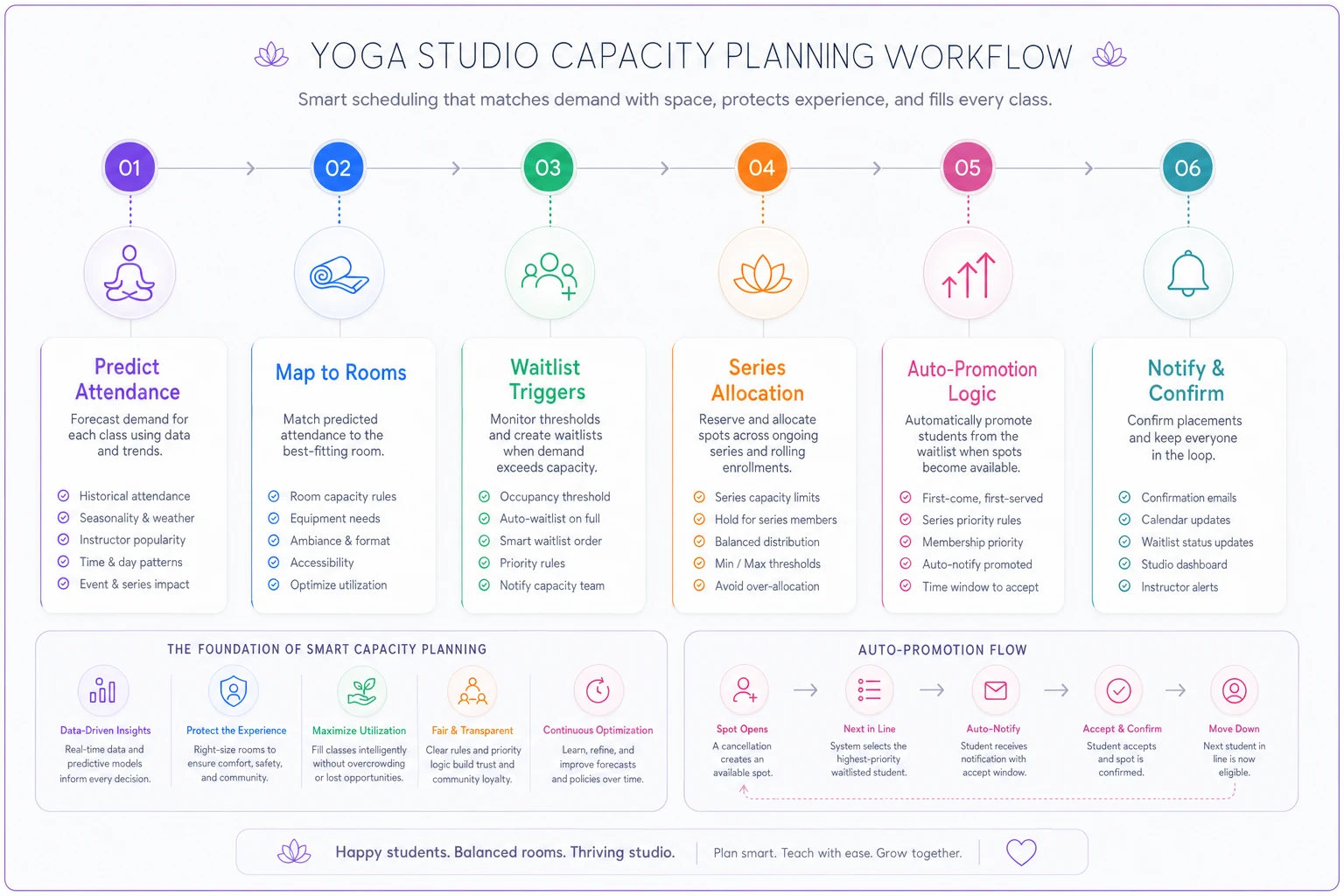
Effective capacity planning uses tiered rules:
Room assignment logic:
-
Predicted attendance 15+ → Large room
-
Predicted attendance 8-14 → Medium room
-
Predicted attendance <8 → Small room or cancel threshold
Waitlist triggers:
-
Open waitlist at 85% booked
-
Cap waitlist at 20% of room capacity
-
Auto-promote from waitlist 2 hours before class
Series allocation:
-
Reserve 30-40% capacity for series students in mixed classes
-
Create series-only sections for popular time slots
-
Release unused series spots 24 hours before class
The series allocation piece trips up growing studios constantly. They either oversell series spots—creating member frustration when classes fill—or undersell them and leave money on the table. The 30-40% rule maintains flexibility while ensuring series students actually get value from what they paid for.
Reserve 30-40% series spots in mixed classes to protect member value while leaving enough availability for drop-ins.
Here's a quick visual of the capacity planning workflow.
The series allocation piece trips up growing studios constantly. They either oversell series spots—creating member frustration when classes fill—or undersell them and leave money on the table. The 30-40% rule maintains flexibility while ensuring series students actually get value from what they paid for.
Balancing Drop-ins vs Series Students
This balance determines studio culture and cash flow stability. Too many drop-ins creates revenue volatility. Too many series locks out new students.
Series students typically generate 60-70% of studio revenue while representing 40-45% of attendance. They're your baseline—predictable revenue that covers fixed costs. Drop-ins provide margin and growth potential.
But the mix needs active management. Watch these ratios:
-
35-45% of weekly spots allocated to series/members
-
15-25% buffer capacity for drop-ins
-
Series students attending 2.3-2.8 classes per week average
-
Drop-in conversion to series at 25-35%
When series attendance drops below 2 classes per week, you've oversold capacity. When drop-ins can't find spots in popular classes two weeks running, you've undersold the drop-in buffer.
One studio running 30 weekly classes discovered they'd allocated 65% of prime-time capacity to unlimited members. Seemed smart until new students couldn't get into popular classes, which killed their conversion funnel entirely. They restructured to 40% member allocation with dynamic release rules—member spots not claimed 48 hours out converted to drop-in availability.
Decision Rules for Schedule Changes
Schedule changes ripple through operations. Moving one class affects teacher schedules, student routines, room availability, cleaning windows. You need clear decision triggers before touching anything.
Green light changes when:
-
Class averages <40% capacity for 4 consecutive weeks
-
Waitlist averages >30% capacity for 3 consecutive weeks
-
Teacher turnover creates natural transition point
-
Seasonal patterns show consistent 3-year trend
Yellow light (test first) when:
-
Capacity hovers at 45-60% for 6+ weeks
-
Student feedback suggests time/type mismatch
-
Competing studio changes create opportunity
-
New demographic emerges in the neighborhood
Red light (don't change) when:
-
You're reacting to one bad week
-
A teacher is pushing for personal preference
-
Less than 6 weeks before a major holiday or season
-
You lack 8 weeks of data to analyze impact
Following these rules prevents reactive scheduling that just confuses students. One studio changed their Tuesday evening lineup three times in two months trying to "optimize." They lost roughly 30% of their Tuesday regulars who gave up tracking the changes.
Sample Class-Mix Templates
Different studio profiles need different scheduling frameworks. Here are three tested templates:
Neighborhood Studio Template (600-800 sq ft, single room)
Weekly structure:
-
18-22 total classes
-
65% moderate intensity
-
25% gentle/beginner
-
10% specialty/workshop
Daily pattern:
-
Morning
One energizing class (6:30 or 7am)
-
Mid-morning
Gentle or all-levels (9:30 or 10am)
-
Evening
Moderate flow (5:30 or 6pm)
-
Late evening
Rotating specialty (7:30pm select days)
Urban Power Studio Template (1,200-1,500 sq ft, two rooms)
Weekly structure:
-
35-40 total classes
-
45% high intensity
-
35% moderate flow
-
15% restorative/yin
-
5% specialty workshop
Daily pattern:
-
Early morning
Simultaneous power + moderate (6am)
-
Lunch
Express power (12pm)
-
Late afternoon
Foundations or gentle (4:30pm)
-
Prime evening
Power in large room, themed flow in small (6pm)
-
Late evening
Restorative or yin (7:45pm)
Wellness Center Template (2,000+ sq ft, 3+ rooms)
Weekly structure:
-
50+ total classes
-
30% yoga various styles
-
25% barre/pilates
-
20% meditation/breathwork
-
15% specialty workshops
-
10% private/semi-private
Zone scheduling:
-
Hot room
Power, hot yoga, heated flow
-
Cool room
Restorative, yin, meditation
-
Movement room
Barre, pilates, dance
-
Private room
One-on-ones, small groups
These templates provide starting mixes that you should adapt to your demand profiles and capacity rules.
Building Your Revenue-Aligned Schedule
Start with a capacity audit. Map every class for the past 12 weeks—attendance, revenue, teacher cost, room used. Calculate actual profit per class hour, not just revenue.
Identify your winners and losers. Winners consistently hit 70%+ capacity with strong margins. Losers run below 45% capacity or generate less than 2x teacher cost in revenue. You need both numbers—a packed class that barely covers teacher cost isn't a winner.
Next, survey demand gaps. Where do waitlists consistently form? Which times do students request that you don't offer? What are nearby studios doing that pulls your students away?
Create test slots for potential additions. Run them for 6-8 weeks minimum before making anything permanent. A single successful class doesn't prove demand—you need sustained attendance patterns to know anything useful.
Then build your rules engine:
Capacity triggers:
-
If 3-week average <40%, consider cancellation
-
If 3-week average >85%, consider adding a parallel class
-
If waitlist averages >5, expand capacity or add a section
Mix maintenance:
-
Minimum 25% gentle/accessible options weekly
-
Maximum 50% high-intensity in any single day
-
At least one beginner-friendly option daily
Revenue protection:
-
No class changes in December or January
-
Protect profitable ugly ducklings (unpopular-looking but actually profitable)
-
Bundle weak classes with strong ones through series packaging
Apply these rules consistently and give changes time to stabilize before judging results.
Common Pitfalls in Schedule Design
The variety trap: Offering too many class styles dilutes your brand and confuses students. Better to excel at 4-5 core offerings than be mediocre at 12.
Teacher-driven scheduling: Letting teachers dictate their preferred times rather than assigning based on demand. Your 500-hour trained instructor might love teaching advanced inversions at 2pm Tuesday, but if 4 students show up, it's a revenue drain.
Symmetrical scheduling: Making every day look identical might seem organized but ignores natural demand variation. Mondays need different energy than Fridays.
Competition mirroring: Copying successful studios' schedules without understanding your own demand profile. Their 5:45am power yoga might pack out, but your demographic might want 6:30am.
Series proliferation: Creating too many specialized series fragments your student base. One studio ran 8 different 4-week series simultaneously and wondered why none of them filled properly.
Technology and Systematic Scheduling
Manual scheduling works until about 15 weekly classes. Beyond that, you need systems that track patterns, predict demand, and flag issues before they cost real revenue.
Modern yoga studio scheduling platforms should handle:
-
Historical attendance pattern analysis
-
Automatic waitlist management
-
Dynamic capacity allocation
-
Teacher utilization balancing
-
Revenue per square foot tracking
The operational difference is significant. Studios using rule-based scheduling software typically see 15-25% improvements in capacity utilization within 90 days—not because the software is magic, but because it enforces consistency where human scheduling gets sloppy over time.
AI-powered platforms can now predict class attendance based on weather, local events, seasonal patterns, and historical data. One studio used this to dynamically adjust their schedule—adding pop-up classes when high attendance was predicted, consolidating when low turnout was expected. Their monthly revenue variance dropped from around 20% to under 8%.
The automation also solves coordination headaches. When a teacher calls out sick, the system can automatically notify qualified substitutes based on certification, availability, and past performance. Students get notified immediately. Waitlisted students get promoted automatically. It's a lot of moving pieces that used to fall on whoever answered the phone first.
Making the Transition
Moving from ad-hoc to systematic scheduling requires careful change management. Start with data collection—at least 8 weeks to establish baselines. Don't announce changes during this period.
Communicate changes through multiple channels starting 3 weeks out. Email series students directly about their specific classes. Post physical schedules at the studio. Update all digital platforms simultaneously.
Phase changes over 2-3 weeks rather than shocking the system. If eliminating a class, offer students a specific alternative. If adding classes, invite your most engaged students to try them first.
Most importantly, stick with changes for at least 8 weeks before evaluating. Students need time to adjust routines. That poorly attended new 4pm Thursday class might build to profitability by week 6.
The Compound Effect
A properly designed yoga studio scheduling system creates compound benefits. Better capacity utilization improves revenue per square foot. Consistent class sizes stabilize teacher income. Predictable availability improves student retention. Higher retention reduces marketing costs.
One studio that implemented this framework saw some interesting ripple effects. Their average class size went from 11 to 16 students. Teacher satisfaction improved because classes felt more energetic. Students stayed longer because they could reliably get into classes. Monthly revenue increased about 35% with the same number of classes on the schedule.
But honestly, the biggest gain was operational calm. No more panic when classes ran empty. No more scrambling to add sections when demand spiked. The schedule became a system that largely ran itself, freeing the owner to focus on community building and studio growth rather than constant schedule firefighting.
The difference between studios that scale and those that stay stuck usually isn't marketing or teacher quality or even location. It's whether they build operational systems that turn complexity into predictability. Your schedule is the foundation of that system—get it right and everything else becomes a lot more manageable.
Ready to elevate your studio operations?
Join 1,500+ yoga studios using Yoglyly to save time, reduce scheduling conflicts, and enhance member experiences.