


Most studios don't have a privacy problem until two things collide: a member asks to be deleted, and you realize their data lives in seven places. Your booking platform, your email tool, your SMS provider, a Google Sheet an instructor made in 2022, your POS, a WhatsApp group, and the spreadsheet your front desk uses to track class passes. Suddenly "please delete my data" turns into a two-hour scavenger hunt—and you're not even sure you got all of it.
That's the real face of studio data privacy consent. It's rarely a lawsuit. It's the slow friction of not knowing who agreed to what, when, and whether you can even text them about tomorrow's canceled 6am class.
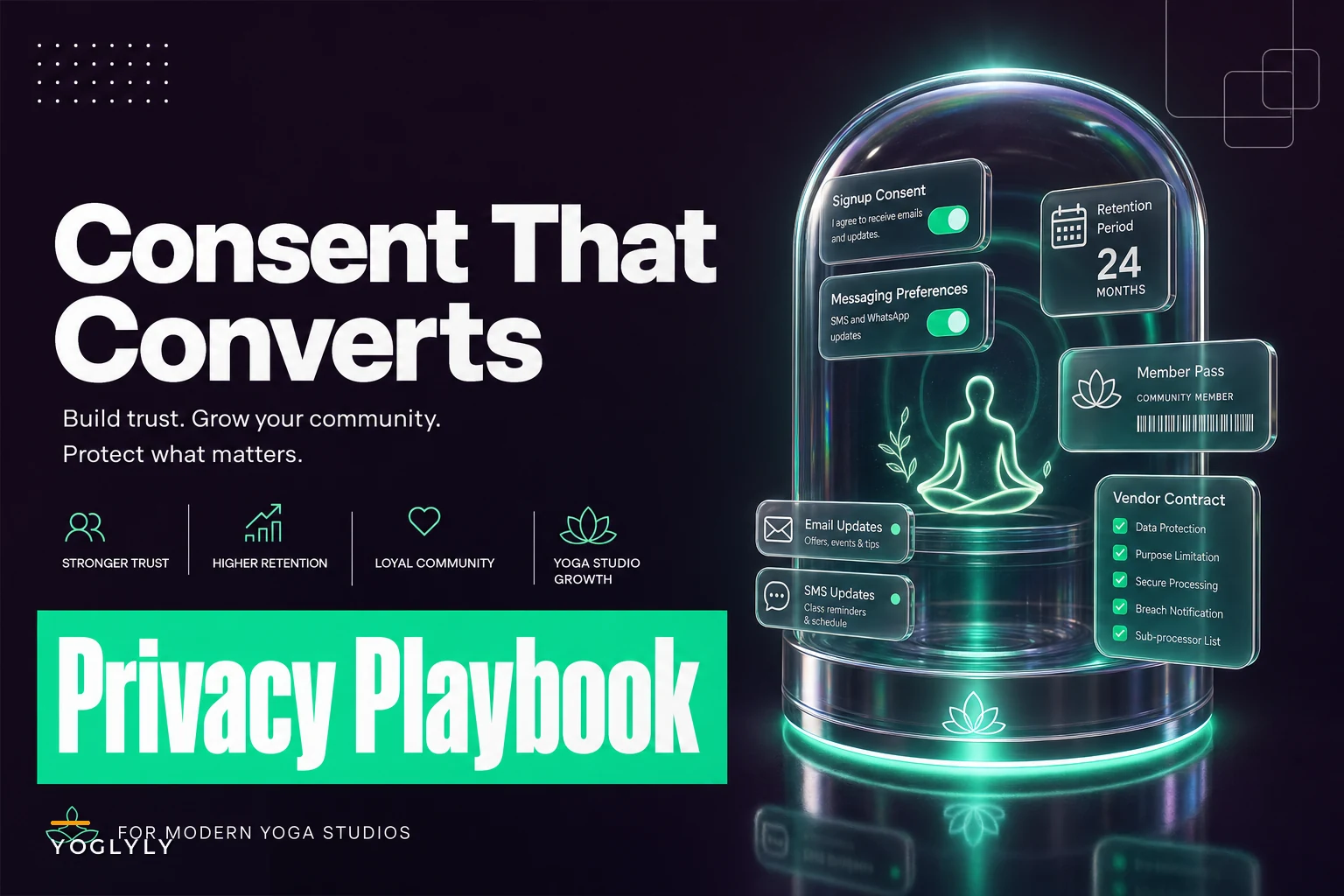
This playbook stays narrow on purpose. We're not covering every regulation on earth. We're covering the exact consent flows a yoga studio actually touches—signup, messaging preferences, retention and erasure schedules, and vendor contracts—with copyable language you can use today.
Why studios get consent wrong (and it's not laziness)
The usual failure isn't that studios ignore privacy. It's that they collect consent in a way that's either useless or hostile.
Useless consent looks like a single checkbox at signup that says "I agree to the terms." You technically got a yes, but you can't prove what they agreed to, you bundled marketing consent with the actual service agreement, and you have no record of which version they saw. When someone later says "I never signed up for texts," you've got nothing to point to.
Hostile consent is the overcorrection. A studio gets nervous, adds four cookie banners, three checkboxes, and a wall of legal text to the intake form. Conversion drops. New students bounce before they book their first class. The front desk starts clicking boxes for people to "save time," which quietly destroys the entire point.
The pattern across studio operations is that consent gets treated as a one-time gate instead of an ongoing state. You don't need a bigger gate. You need a clean record of preferences that your tools actually respect, and that your staff can update in ten seconds.
One thing people consistently miss: transactional messages and marketing messages are different animals. "Your class is canceled" is operational. "Flash sale, 20% off!" is marketing. When you lump them into one consent bucket, a student who opts out of marketing can accidentally lose the cancellation text too—then they show up to a locked studio and leave a one-star review. Separating these two is half the battle.
The four consent flows a studio actually needs
Forget the generic frameworks. These are the only flows that matter for a yoga studio day to day.
Eliminate class scheduling chaos.
Yoglyly helps you book, confirm & manage every class seamlessly.
- Centralized class scheduling
- Member notifications
- Instructor and resource management
No credit card required
1. Signup consent (the intake moment)
This is where most of the damage happens, because it's where you're most tempted to over-ask. Keep the service agreement separate from messaging consent. Someone booking a class is already agreeing to your terms by booking—you don't need a marketing opt-in to complete the transaction.
-
Required, unchecked, part of booking liability waiver + terms of service. This is service consent, not marketing.
-
Optional, unchecked by default "Send me class reminders and schedule changes by text." (transactional-ish, but ask anyway—it's cleaner)
-
Optional, unchecked by default "Send me promotions, workshops, and news by email."
-
Optional, unchecked by default "Send me promotions by text."
A copyable version for your intake form: > Staying in touch (optional) > We'd love to keep you posted. Pick what works for you—you can change these anytime. > ☐ Text me class reminders and last-minute changes > ☐ Email me workshops, promos, and studio news > ☐ Text me occasional promos (we keep these rare) > > You can reply STOP to any text or click unsubscribe in any email. Reminders and schedule changes are separate from promos.
That last line does real work. It tells people that opting out of promos won't cut off their cancellation alerts, which reduces the "unsubscribe from everything out of fear" reflex.
2. Messaging preference center
The intake checkboxes are the start, not the end. Members change their minds. Studios that avoid comms chaos give people a simple way to update preferences without emailing the front desk.
| Message type | Example | Default | Can they opt out? |
|---|---|---|---|
| Operational / transactional | "Your 7pm class is canceled" | On | No (tied to service) |
| Class reminders | "Class starts in 2 hours" | Ask at signup | Yes |
| Marketing email | Workshop launches, promos | Off until opted in | Yes |
| Marketing SMS | Flash sales, event invites | Off until opted in | Yes |
That first row is the important one. Operational messages—cancellations, waitlist spots opening, payment failures—are part of delivering the service they paid for. You generally don't market inside those. Keep them clean and non-promotional, and you can keep sending them.
Where studios trip up: they sneak a promo into a cancellation text. "Sorry, 6am is canceled—but book our 9am workshop for 15% off!" The moment you do that, it stops being purely transactional, and you've muddied your own consent story. Keep operational messages boring. Boring is compliant.
If you want your reminders and promos to actually convert once consent is clean, the sequencing matters as much as the permission—this breakdown of email and SMS sequences that convert new students into repeat attendees pairs well with a tightened preference setup.
3. Retention and erasure schedule
Nobody builds this until it bites them. You need a written answer to: how long do we keep member data, and what happens when someone asks us to delete it?
-
Active members keep data while the membership is active.
-
Lapsed members (no booking in 24 months) archive or anonymize marketing data; keep minimal records only if legally required.
-
Payment records kept per your accountant's or tax requirements—often several years. Don't delete these just because someone asked; financial retention usually overrides.
-
Waiver and injury records kept longer for liability reasons. Know your local limitation periods before you purge.
-
Marketing consent logs keep the record of what someone agreed to for as long as you're messaging them, plus a buffer after they opt out.
The nuance that saves you: "delete my data" doesn't always mean delete everything. If someone asks for erasure but you're legally required to keep their payment or injury record, you honor the request for marketing and contact data, keep only what you're obligated to, and tell them exactly that. A short, honest reply handles this well.
> Hi [Name], we've processed your request. We've deleted your contact details and removed you from all email and text messaging. A few records—payment history and your signed waiver—we're legally required to keep for a set period, after which they're also deleted. Nothing in those is used to contact or market to you. Let us know if you have any questions.
4. Vendor-contract checklist
Your data is only as private as your flakiest vendor. The studio holds the member relationship, but your booking software, email tool, SMS gateway, and payment processor all touch that data. If one of them is sloppy, you inherit the risk.
-
Is there a data processing agreement (DPA)? If a vendor can't produce one, that's a flag.
-
Where is data stored and processed? Know the region—cross-border storage changes your obligations.
-
Do they use member data to train models or resell it? Ask directly, in writing.
-
Can they export your full data on request, in a usable format? You need this for both member erasure requests and for leaving the vendor someday.
-
What's their breach notification window? You want a specific number of hours or days, not "we'll let you know."
-
Can you delete a single member's record on demand through them? Some tools make per-record deletion shockingly hard.
-
What happens to data when you cancel? Get the deletion-on-termination terms in writing.
> Before we move forward, can you confirm in writing: (1) you'll provide a signed DPA, (2) you don't use our member data to train models or share it with third parties, (3) your breach notification window, and (4) that we can export and permanently delete individual member records on request? Thanks.
If a vendor stalls on any of those four points, you've learned something useful before handing them your member list.
A real scenario: the deletion request that took two hours
A mid-sized studio—around 600 active members across two locations—got a polite but firm email: "Please delete all my data." The actual cleanup took the owner and one staff member most of an afternoon.
The member existed in the booking platform, the email tool (synced, but with a stale copy), the SMS provider, the POS, an old "VIP clients" spreadsheet, and a shared inbox thread. They deleted the obvious ones, missed the spreadsheet, and the person got a promo text three weeks later from the SMS tool that never got cleaned. That turned a non-event into an annoyed follow-up and a shaky apology.
After that, they did two things. First, they wrote down every place member data lived—seven systems, which genuinely surprised them. Second, they set a rule: no new tool gets member data unless it can export and delete individual records on request. The next erasure request took about ten minutes, most of which was writing a friendly reply. The work wasn't technical. It was knowing where the data was and having one clean process to follow.
Where tooling quietly helps (without turning into a chore)
Studios that handle this well aren't running a legal department. They've just solved the two things that make consent painful: where preferences live and where member data lives.
When your booking, messaging preferences, and member records sit in one connected system rather than scattered across seven, consent stops being a scavenger hunt. A preference toggle in one place flows everywhere, so opting out of marketing SMS actually suppresses marketing SMS—without someone manually updating three tools. Operational platforms with built-in preference handling and clean data export turn an erasure request from an afternoon into a few clicks.
Here's a simple workflow to aim for.
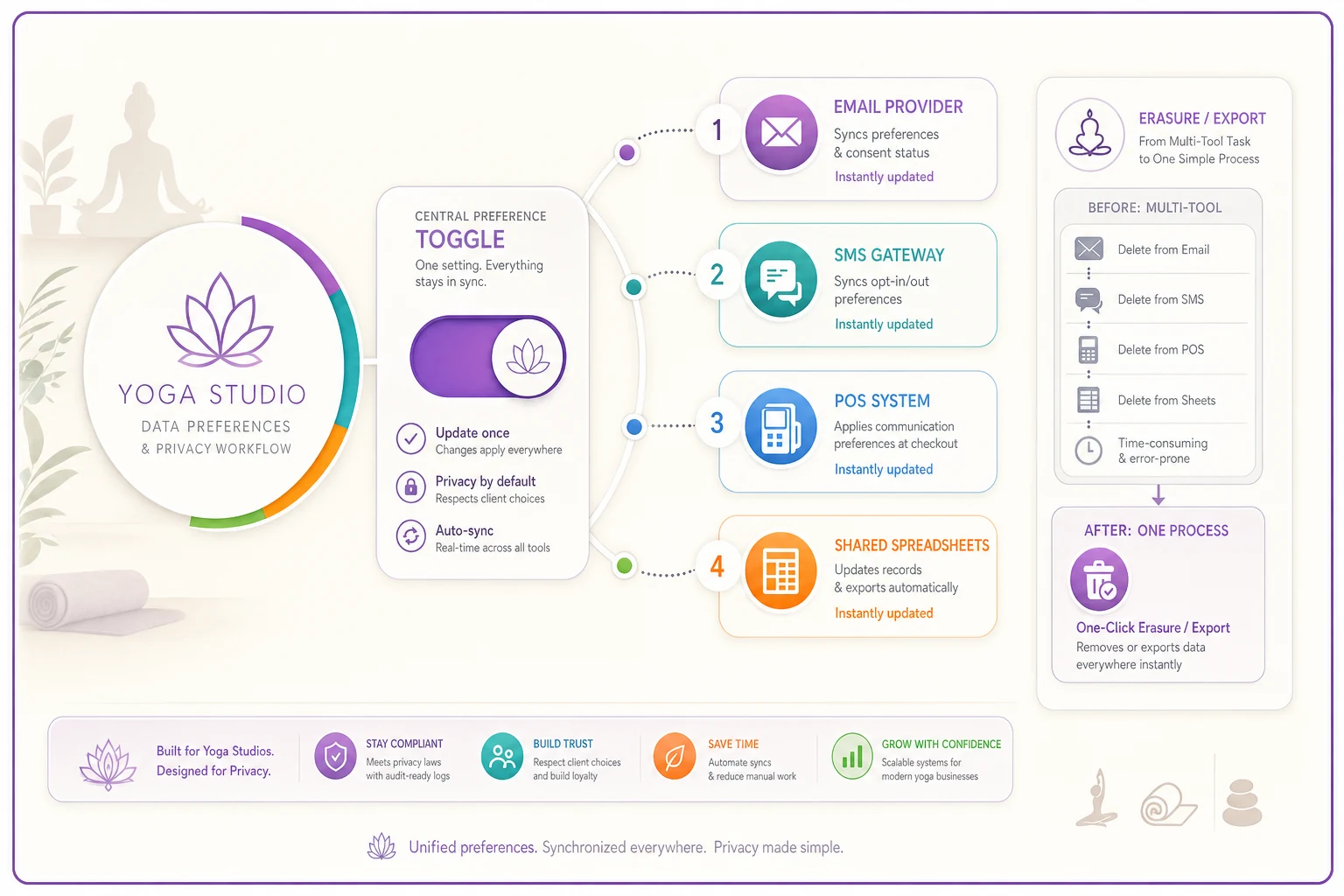
Put the preference toggle in your booking system so opt-outs propagate automatically to connected tools.
Some lightweight automation helps here too. Automatically flagging lapsed members for your retention schedule, or logging exactly which consent version a student saw at signup, removes the manual steps where mistakes—like that stray promo text—actually happen. None of this replaces judgment. It just eliminates the gaps.
When to keep it simple—and when to get serious
When a light setup is fine: a single-location studio with one booking tool, one email provider, and clear unchecked opt-ins. You don't need a privacy officer. You need separated consent, a basic retention note, and a front-desk erasure script.
When to invest more: multi-location studios, anyone running paid ads with custom audiences built from member lists, studios storing injury or health notes, or anyone whose member data lives across more than three or four systems. Once you're syncing data across tools and regions, the cost of a sloppy vendor or an incomplete deletion goes up fast.
That said, there's a real risk of overbuilding. A brand-new studio with 40 members and one email list doesn't need to bury their intake form in checkboxes and legal walls before they've even proven the classes. Get the separated opt-ins right, keep operational and marketing messages distinct, and grow into the rest.
Good studio consent isn't about asking for more permission. It's about asking cleanly, keeping transactional and marketing messages separate, knowing where member data lives, and being able to honor a deletion request without an afternoon of digging.
Do the four flows—signup, preferences, retention and erasure, and vendor checks—once, properly, and privacy stops being a fire drill. Your conversions stay intact because you're not scaring people at the door, and your comms keep running because the right messages still reach the people who said yes.
Ready to elevate your studio operations?
Join 1,500+ yoga studios using Yoglyly to save time, reduce scheduling conflicts, and enhance member experiences.